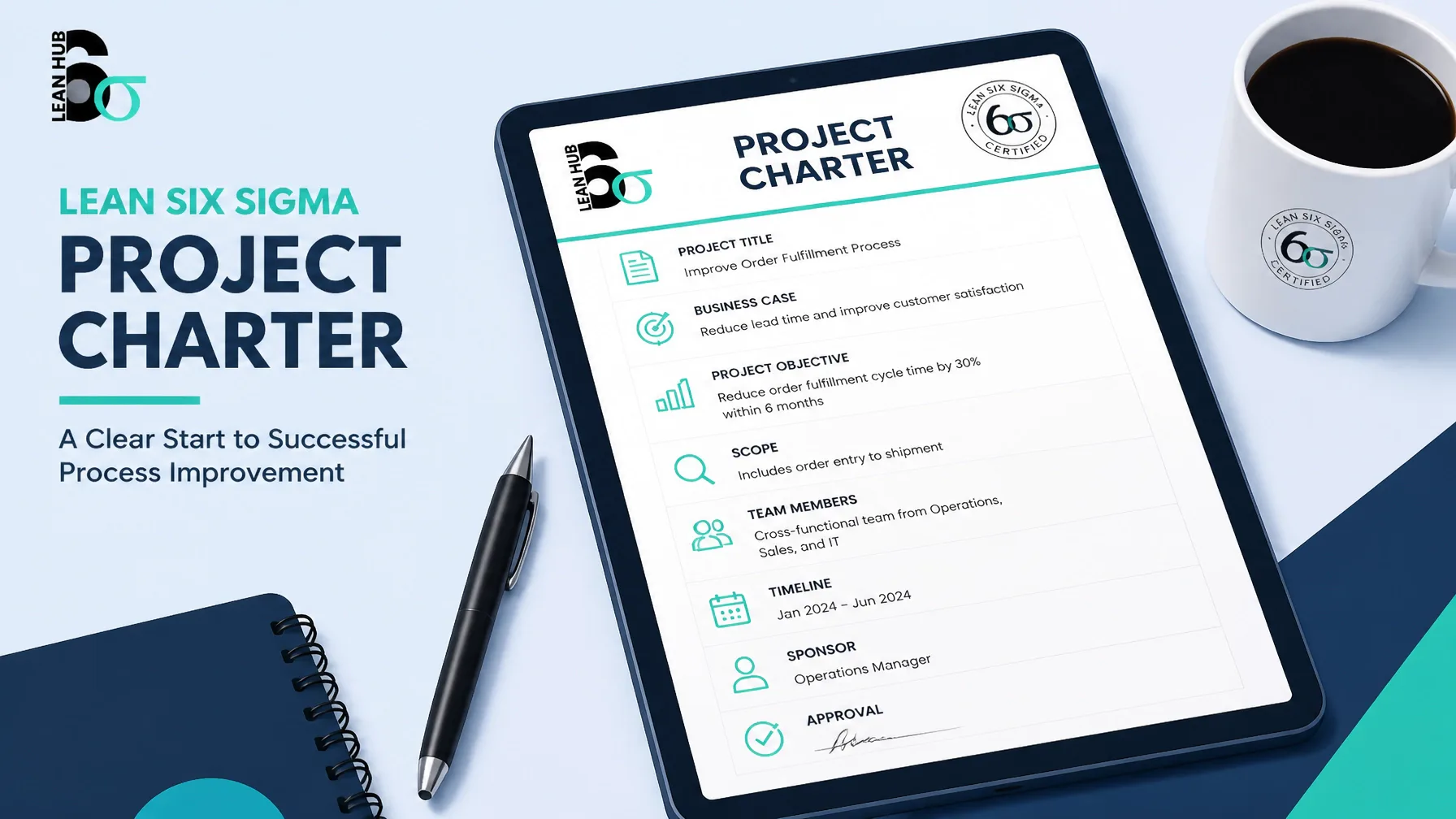
In the realm of process excellence, the Project Charter stands as the primary governance document that bridges the gap between organizational strategy and tactical execution. Among its various components, the problem statement is arguably the most critical. A poorly defined problem leads to misaligned resources, scope creep, and, ultimately, a failure to deliver measurable value.
To fully appreciate the gravity of a well-crafted problem statement, one must recognize it as the foundation of the DMAIC (Define, Measure, Analyze, Improve, Control) methodology. The fundamental purpose of this section is not merely to describe a grievance but to quantify a gap in performance that justifies a significant investment of time and capital.
Deconstructing the Technical Anatomy of a Problem Statement
A high-impact problem statement must be objective, concise, and grounded in empirical evidence. In professional Lean Six Sigma practice, we utilize a specific protocol to ensure that the statement provides all necessary context for stakeholders. To ensure your charter meets the rigorous standards of a Green or Black Belt project, every good problem statement example must address the following four dimensions:
- The Process or Metric (The "What"): Identification of the specific Key Performance Indicator (KPI) or Critical to Quality (CTQ) characteristic that is underperforming.
- The Magnitude of the Gap (The "How Much"): A data-heavy comparison between the current baseline and the desired state or historical performance.
- The Timeframe (The "Since When"): The duration over which the problem has been observed, providing historical context.
- The Business Impact (The "So What"): The measurable outcome in terms of financial loss, customer dissatisfaction, or operational risk.
Strategic professionals avoid including solutions or assigning blame within this statement. The objective is to define the "What," not the "How." For a comprehensive guide on drafting the remaining sections of your document, refer to our Project Charter Template and Guide.

15 Good Problem Statement Examples for Immediate Application
To facilitate your journey toward process mastery, we have curated 15 detailed scenarios across five major industries. These examples utilize the sophisticated logic required for professional-grade project charters.
Manufacturing and Production
In manufacturing, problems often manifest as waste (Muda) or excessive variation.
- Scrap Rate Inefficiency: In the Model X production line, the average scrap rate has escalated from 2.5% to 7.2% over the last four quarters. This variance results in an annual direct material loss of approximately $185,000 and reduces overall throughput by 8%.
- Unplanned Equipment Downtime: Since January 2026, Line 4 has experienced an average of 14 hours of unplanned downtime per week due to hydraulic failures. This has caused a 12% backlog in order fulfillment and an estimated $60,000 in monthly overtime costs to meet shipping deadlines.
- Product Quality Defects: In the high-precision machining cell, the First Pass Yield (FPY) has declined from 98% to 91% over the past six months. This trend necessitates significant rework, costing the department $12,000 per month in additional labor and utility expenses.
Healthcare and Clinical Operations
Precision and timeliness are the primary CTQs in healthcare environments.
- Emergency Department Throughput: At the facility’s Emergency Department, the average patient "door-to-doctor" time has increased from 42 minutes to 95 minutes over the last year. Consequently, patient satisfaction scores have plummeted by 22%, and there has been a 5% increase in patients leaving without being seen (LWBS).
- Medication Error Rates: On the inpatient surgical ward, the rate of minor medication administration errors has risen by 15% in the last quarter. This necessitates an average of 1.2 additional bed days per affected patient, contributing to an estimated $45,000 in preventable costs per month.
- Lab Result Turnaround Time (TAT): Currently, only 68% of critical blood panel results are delivered within the 60-minute target. This delay in the Voice of the Process (VOP) has resulted in a measurable increase in clinical decision wait times, impacting acute patient outcomes.
Finance and Banking
In transactional processes, cycle time and compliance represent the highest areas of risk.
- Loan Approval Cycle Time: Within the Small Business Lending department, the average time to approve or deny a loan application has expanded from 5 business days to 13 business days since the rollout of the new CRM. This delay has resulted in an estimated $3.5M in lost potential loan volume annually.
- Accounts Payable Accuracy: Currently, 18% of processed invoices contain coding errors that require manual intervention. This rework consumes approximately 50 staff hours per week and has incurred $15,000 in late-payment penalties over the last six months.
- Regulatory Compliance Gaps: Internal audits reveal that 28% of mortgage files processed in Q1 2026 lacked mandatory documentation. This exposes the institution to potential regulatory fines of up to $500,000 per occurrence and increases the operational risk profile.
IT and Software Development
IT metrics focus on reliability, responsiveness, and the reduction of technical debt.
- Help Desk Resolution Speed: Since the transition to remote work, the average resolution time for Tier 1 IT tickets has risen from 4 hours to 22 hours. This backlog has resulted in a 30% reduction in employee productivity across the corporate headquarters.
- Software Deployment Failure Rate: Over the last six months, 35% of software releases have required an emergency rollback within 48 hours of deployment. This instability delays the product roadmap by an average of 4 weeks per quarter and consumes significant incident management resources.
- Cloud Infrastructure Uptime: The primary customer-facing database has experienced four major outages totaling 16 hours of downtime in the past 90 days. These incidents have led to approximately $600,000 in lost transaction fees and severe brand erosion.
Logistics and Supply Chain
Efficiency in logistics is often measured through inventory accuracy and route optimization.
- On-Time Delivery (OTD) Performance: Regional distribution center OTD rates have dropped from 97% to 84% over the last two fiscal quarters. This performance gap has triggered penalty clauses in three major service-level agreements (SLAs), totaling $90,000 in rebates.
- Inventory Variance: Annual physical audits show a 14% discrepancy between physical stock and the Warehouse Management System (WMS) records. This lack of data integrity leads to frequent stock-outs and approximately $25,000 in monthly expedited shipping charges to rectify shortages.
- Fleet Fuel Inefficiency: Due to sub-optimal route planning, the delivery fleet is currently averaging 12% more miles per stop than the industry benchmark. This inefficiency adds an estimated $18,000 per month in excess fuel consumption and vehicle wear.

Refinement Protocols: Ensuring Data-Heavy Accuracy
Once an initial draft is completed, it must undergo a rigorous refinement process. To fully appreciate the complexity of this task, one should consult the Lean Six Sigma Concepts and Glossary to ensure that all terminology is used with precision.
- Avoid "Solutioneering": Ensure the statement does not suggest that the solution is "more training" or "a new software system." The goal is to describe the pain, not prescribe the cure.
- Metric Validation: Confirm that the baseline data is accurate by performing a Measurement System Analysis (MSA). If your measurement system is flawed, your problem statement is inherently invalid.
- Narrow the Scope: If the problem is "global company inefficiency," it is too broad for a standard 3-to-6-month project. Focus on a specific location, shift, or product line to maintain a manageable SIPOC.
Elevating Your Organizational Efficiency through Certification
Mastering the art of the project charter is merely the first step in a lifelong journey of professional development. The ability to identify, quantify, and solve complex organizational problems is the hallmark of an elite professional.
At Lean 6 Sigma Hub, we offer a comprehensive suite of accredited training programs designed to transform you into a data-driven leader. Whether you are beginning with the foundational White Belt Online Training or seeking to master advanced statistical strategies through our Black Belt Online Training, our courses provide the practical, real-world simulations necessary for success.
For those ready to lead enterprise-wide transformations and mentor future generations of process analysts, our Master Black Belt Online Training provides the governance frameworks and executive coaching required for the highest level of certification.
Take the decisive step toward career advancement. Pursue your professional certification with Lean 6 Sigma Hub and begin driving measurable excellence within your organization today.