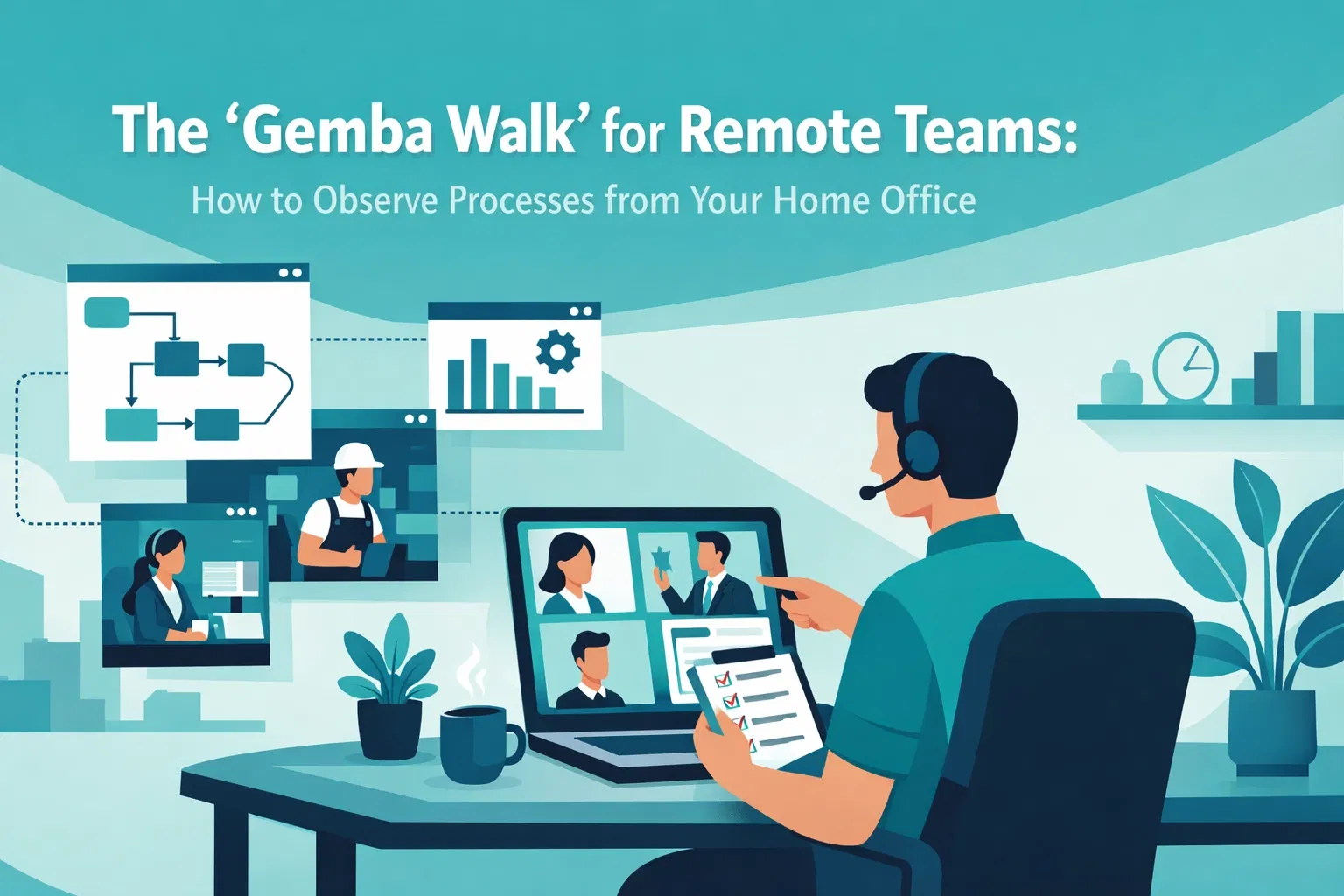
In the world of Lean Six Sigma, the term "Gemba" holds a sacred place. Translated from Japanese, it means "the real place": the location where the actual work happens and where value is created. Traditionally, this meant a plant manager walking the factory floor, observing the hum of machinery, and speaking with operators. But in 2026, the "real place" for millions of professionals is no longer a physical floor; it is a distributed network of home offices, co-working spaces, and digital interfaces.
Does the shift to remote work mean the end of the Gemba Walk? Absolutely not. In fact, in a virtual environment, the need for process improvement and clear observation is higher than ever. Without the ability to "stroll over" to someone's desk, inefficiencies can hide behind Slack messages and closed Zoom tabs.
To maintain a culture of continuous improvement, leaders must master the Virtual Gemba Walk. This guide will explore how to translate this fundamental Lean practice into the digital age, ensuring your remote operations are as lean and efficient as any world-class manufacturing facility.
Redefining the 'Real Place' in a Digital Landscape
The fundamental purpose of a Gemba Walk is to observe a process as it exists in reality, not as it is documented in a manual. In a remote setting, the "Gemba" is the digital workflow. It is the sequence of clicks, the handoff of files, and the communication loops that occur within your software stack.
To fully appreciate the complexity of remote work, you must look beyond the end result. If a team member delivers a report on time, the process is deemed "successful." However, a Virtual Gemba Walk might reveal that the team member spent three hours manually fighting with Excel formatting because of a broken data export. That is waste (Muda), and you won’t see it unless you "go to the Gemba."

Preparing for the Walk: The Setup
Before you jump into a video call, preparation is essential. A poorly planned remote observation can feel like "Big Brother" surveillance, which destroys the psychological safety required for honest process improvement.
- Define the Objective: Are you looking at the onboarding process? The software development lifecycle? Identifying handoff points? Use a SIPOC complexity score calculator to understand which processes are the most critical to observe first.
- Communicate the "Why": Inform the team that the goal is to observe the process, not the person. Emphasize that you are looking for obstacles you can help remove, not looking for reasons to penalize performance.
- Assess the Stakeholders: Use a stakeholder impact assessment calculator to ensure you are engaging the right people during your walk.
The Toolkit for Virtual Observation
In a physical factory, you need a notepad and comfortable shoes. In a virtual environment, your toolkit is digital.
Screen Sharing and Shadowing
This is the closest remote equivalent to standing next to a machine. Have the team member share their screen and perform a standard task. Do not interrupt. Simply watch how they navigate their tools. Note where they hesitate, where they have to switch between multiple windows, or where the system lags. These are the "friction points" that indicate process waste.
One-on-One Video Calls
Sometimes the Gemba Walk is less about watching clicks and more about understanding the "Voice of the Employee." Scheduled interviews allow for a deep dive into specific challenges. You might discover that the "real place" where work stalls is a specific approval bottleneck that isn't documented on any official chart.
Digital Process Mapping
While observing, use collaborative tools to map the process in real-time. Comparing the "as-is" process you are observing to the "should-be" process is a core component of lean six sigma training. Understanding defining handoff points in cross-functional processes is often where the biggest "Aha!" moments occur during a virtual walk.
Executing the Virtual Gemba Walk: A Step-by-Step Protocol
To ensure your walk is productive, follow this structured protocol:
1. Observe Without Interference
The biggest mistake a leader can make is coaching during the observation. If you start correcting the employee’s workflow immediately, they will change their behavior to please you, and you will no longer be seeing the "real" process. Take notes, stay on mute, and let the process unfold naturally.
2. Ask "Why" and "How"
Once the task is complete, engage. Use open-ended questions:
- "How do you know when this task is ready for you to start?"
- "What is the most frustrating part of this specific sequence?"
- "If you could change one tool in this workflow, what would it be?"
3. Focus on Handoffs
In remote teams, the most significant waste usually occurs during handoffs between departments. Using a data collection plan checklist can help you quantify how much time is lost when a project moves from "Marketing" to "Sales" in a virtual environment.
Connecting Gemba to the DMAIC Framework
A Gemba Walk is not a standalone event; it is a critical input for the DMAIC (Define, Measure, Analyze, Improve, Control) methodology.
- Measure: The observations from your walk provide the qualitative data to back up your quantitative metrics.
- Analyze: When you see a process bottleneck live, the root cause analysis becomes much easier.
- Improve: Solutions designed after a Gemba Walk are more likely to be adopted because they are based on the actual reality of the team’s daily life.

If you are currently leading a project, using a project charter ROI calculator can help you estimate the financial impact of the improvements you identify during your virtual walk. Seeing the waste in action makes it much easier to put a dollar value on the fix.
Overcoming the Virtual Barrier: Common Challenges
Remote Gemba Walks aren't without hurdles. One of the most common issues is "Performance Theater," where employees perform the "perfect" version of the process because they know they are being watched. To combat this, conduct walks regularly so they become a normal part of the culture rather than a "special event."
Another challenge is Digital Fatigue. Staring at a screen share for two hours is exhausting for both the observer and the performer. Keep your Virtual Gemba Walks focused and limited to 30–45 minutes per session. It is better to do three short, focused walks than one marathon session that leaves everyone drained.
Why This Matters for Your Career
Mastering the art of remote process observation is a hallmark of a modern leader. As companies continue to embrace hybrid and remote models, the ability to drive efficiency from a home office is a high-value skill. Professionals who can demonstrate these skills often command significantly higher salaries and more senior roles.
Whether you are just starting with a White Belt to understand the basics or aiming for a Black Belt to lead enterprise-wide transformations, understanding the "Real Place" is non-negotiable.
Take the Next Step in Your Lean Journey
The 'Gemba Walk' is just one tool in the extensive Lean Six Sigma shed. To truly transform your team's productivity and your own career trajectory, you need a structured foundation in these methodologies.
At Lean 6 Sigma Hub, we provide CSSC-accredited training that bridges the gap between traditional theory and modern, remote application. From identifying waste in digital workflows to mastering complex statistical analysis, our courses are designed for the 2026 workplace.
Ready to see how Lean Six Sigma can change your perspective on work? Start with our free resources or jump straight into a certification path:
- Test your knowledge: Take the Free Lean Six Sigma Yellow Belt Practice Exam.
- Start for free: Get your feet wet with our Free Lean Six Sigma White Belt Training.
- Calculate Impact: Use our Free Six Sigma Calculators to measure your process efficiency today.
Don't let your remote processes run in the dark. Go to the digital Gemba, see the reality of the work, and start your journey toward operational excellence.
Enroll in a Lean Six Sigma certification course today and start leading your remote team toward a more efficient, waste-free future.