In improvement work, scepticism about artificial intelligence is not a barrier to progress. It is a mark of professional judgement.
Lean Six Sigma practitioners, operational excellence leaders and project sponsors are right to question an AI-generated recommendation that presents a confident conclusion without showing the evidence behind it. A wrong number that looks authoritative can travel further than a blank cell. It can enter a tollgate presentation, influence a prioritisation decision and become part of the project record before anyone checks its foundation.
That is why AI-assisted improvement work needs a higher standard than fluent text. The system should show the evidence, explain the status and leave the decision with the practitioner.
This is the purpose of Ci Flow and its Status Coach: to provide evidence-based project guidance without separating the recommendation from the project record that supports it.
Status Coach Starts With the Live Project Record
Status Coach is not designed to produce a generic summary of an improvement project. It assesses the selected project using the information already recorded in the workspace.
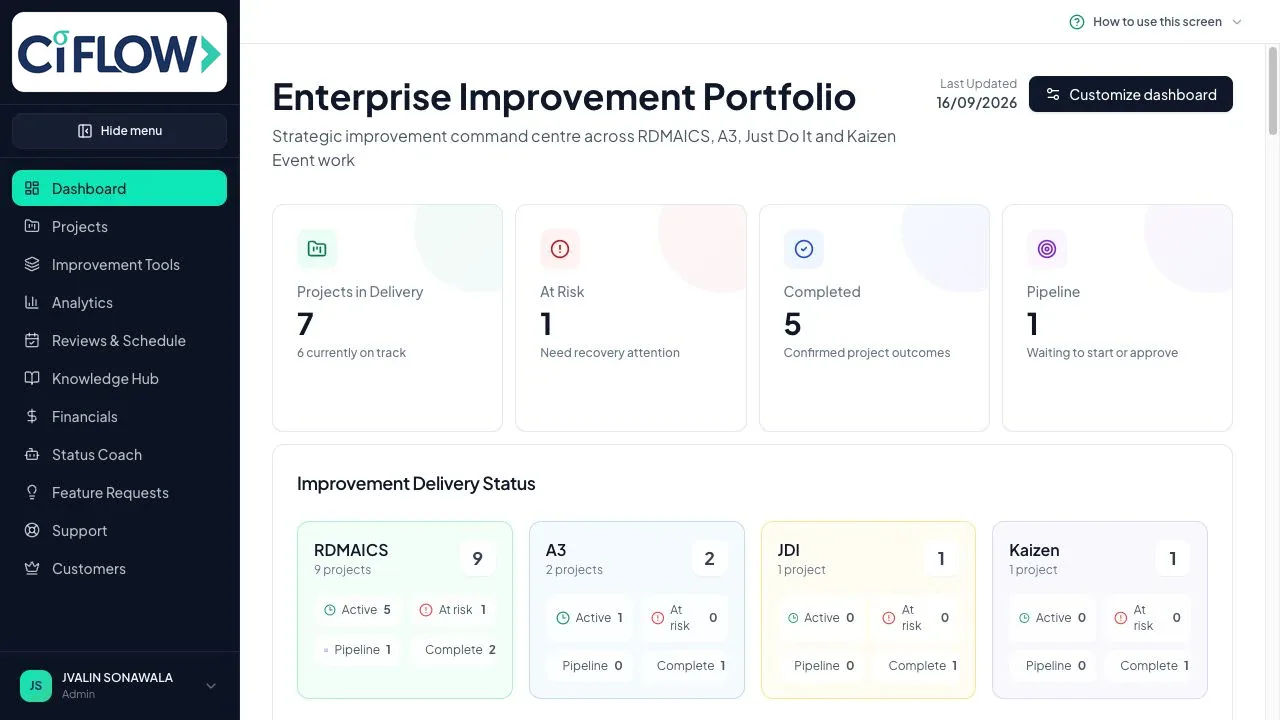
Before giving guidance, it reads the project record, saved tools, phase progress, risks, benefits and completion evidence. This context matters because project status is never defined by one isolated metric. A project may have strong delivery progress but incomplete benefit validation. Another may have a clear primary metric but unresolved blockers. A third may be approaching a tollgate while key evidence remains unfinished.
Status Coach brings these factors together so that guidance remains connected to the actual work.
This approach supports the broader principles taught through Lean Six Sigma online training: define the problem clearly, use reliable evidence, distinguish assumptions from facts and make decisions at the appropriate stage of the methodology.
The Three-Step Evidence-Based Coaching Flow
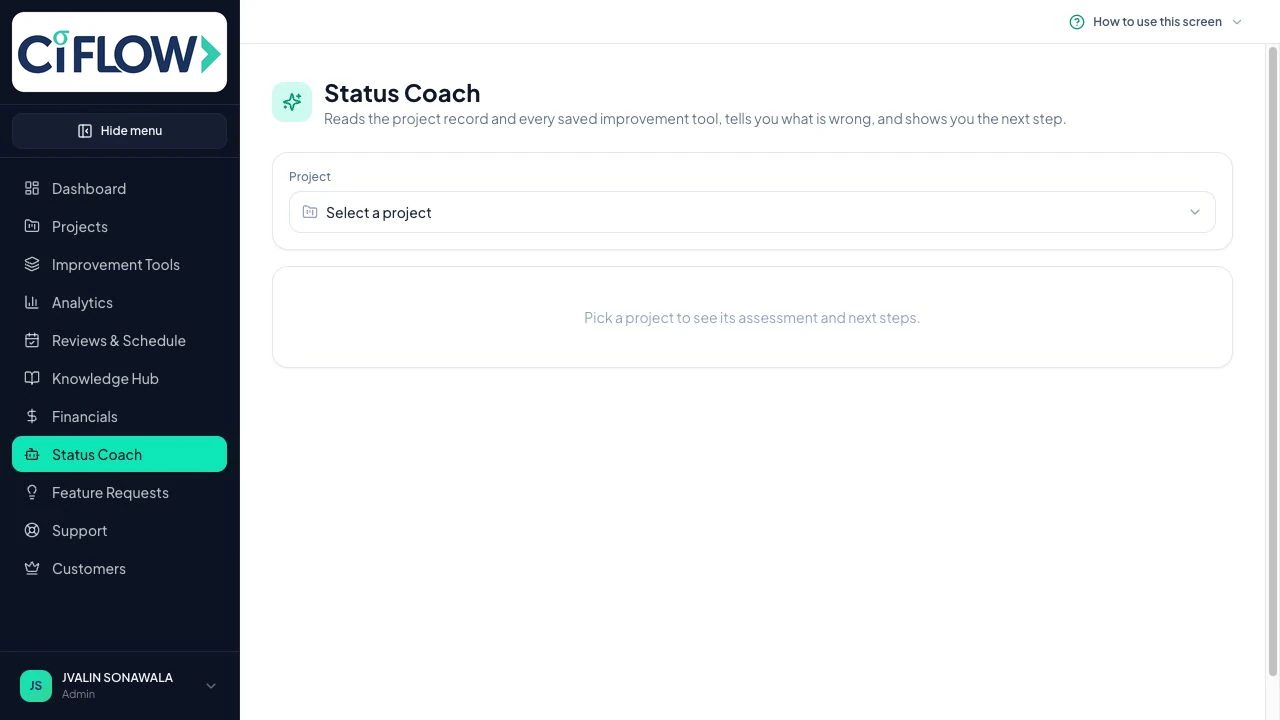
Step 1: Select the Project to Assess
The process begins with a deliberate choice: select the live project that requires assessment.
Status Coach then evaluates that project rather than making a broad statement about an entire portfolio or relying on an unconnected conversation. It considers the project’s methodology, current phase, saved tools, recorded risks, expected benefits and completion evidence.
This selected-project approach provides an important control. The user knows which project is being assessed, and the assessment remains grounded in the information belonging to that project.
Whether the work follows an RDMAICS journey, an A3 problem-solving structure, a Just Do It project or a Kaizen Event, the coach works from the relevant project context.
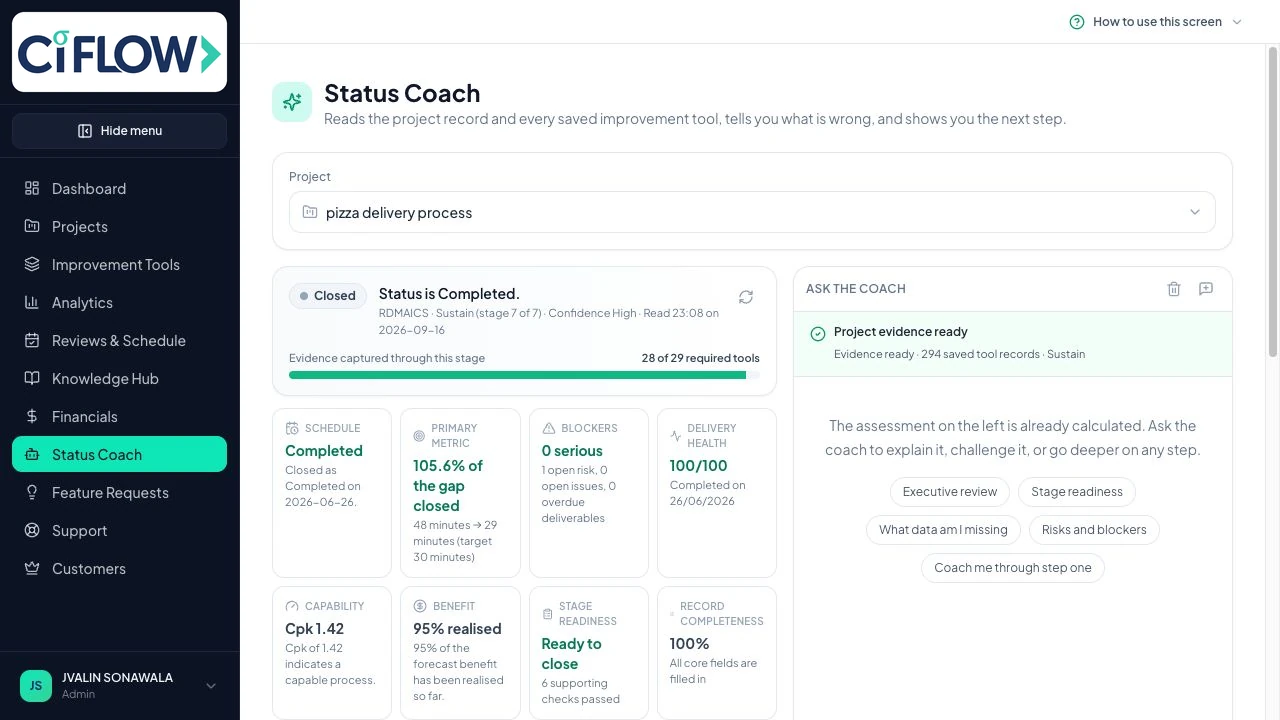
Step 2: See the Evidence Being Assessed
The next step is where Status Coach becomes meaningfully different from a conventional AI summary.
The workspace displays the evidence being assessed in a single view. Users can review:
- Schedule and delivery progress
- Primary project metric
- Current blockers
- Delivery health
- Team or project capability
- Expected and realised benefit
- Stage readiness
- Project record completeness
This evidence panel allows a Belt, project leader or executive reviewer to see what informs the assessment. The user does not need to accept a recommendation simply because it is written clearly. They can inspect the supporting signals first.
For example, suppose a project is shown as 72% complete. That figure alone may appear encouraging. However, the evidence panel might also show that the primary metric has not been updated for 18 days, one critical risk has no owner and the expected benefit has not yet been verified. The appropriate next action may not be to proceed to the next phase. It may be to refresh the measurement record, assign ownership and complete the benefit validation.
The value is not merely that Status Coach identifies these conditions. The value is that the practitioner can see the conditions for themselves.
Step 3: Ask for the Explanation or Next Action
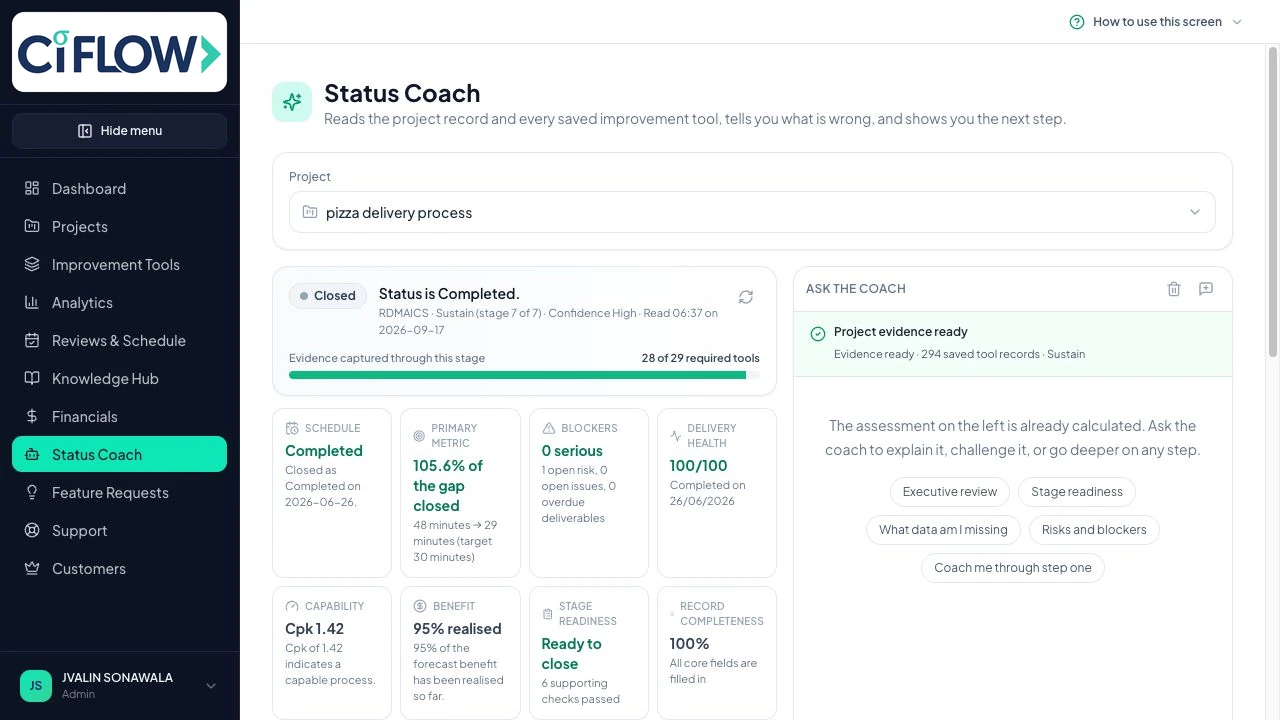
Once the evidence is visible, the user can request guidance suited to the decision at hand.
Focused prompts support several practical use cases:
- Executive review: Prepare a concise view of delivery, risk, benefit and readiness.
- Stage readiness: Identify whether the project has the evidence required to progress.
- Missing data: Highlight incomplete, stale or absent project information.
- Risks and blockers: Summarise constraints, ownership and required actions.
- Step-by-step coaching: Guide the practitioner through the next project activity.
The answer remains tied to the same evidence panel. This creates a useful separation between observation and interpretation. The system displays the recorded condition, then helps the user understand its significance and decide what to do next.
A Green Belt might ask, “What should I address before the Analyse-to-Improve tollgate?” The response can be considered alongside the visible stage-readiness indicators, saved analysis tools, open blockers and completion evidence. A portfolio leader might ask, “Which projects require executive attention this week?” The response can be reviewed against delivery health, risk and benefit information already connected to the portfolio.
Deterministic Calculations Protect Numerical Integrity
The central trust principle is straightforward: AI cannot change a number.
Ci Flow uses a deterministic calculation engine supported by 47 test suites to run the mathematics behind project status and analytical outputs. The AI interprets and explains the results; it does not improvise the arithmetic.
That separation is essential.
AI is valuable when it helps a practitioner:
- Understand what a project signal may mean
- Identify a missing piece of evidence
- Structure an executive update
- Translate project data into a practical next action
- Connect a current condition to the relevant methodology step
However, arithmetic integrity should not depend on a language model generating a calculation from memory or inference. If a project’s completion value, benefit figure or performance metric changes, the user should be able to identify the underlying input and calculation pathway.
In statistical improvement work, this distinction is particularly important. Measures such as averages, defect rates, cycle times, capability indicators and savings estimates need consistent calculation rules. The coach can explain what the number suggests, but the numerical result must come from a controlled calculation process.
Trust by Design Keeps Reasoning With the Project
An AI recommendation is most useful when it remains attached to the project evidence that produced it.
Ci Flow supports this principle through:
- Audit trails for company changes and AI usage
- Role-based and row-level access controls
- Exportable tool inputs
- Exportable AI interpretation
- Structured project records for reviews and reports
- Phase-gate governance and visible decisions
This creates a stronger project history. Instead of retaining only a final narrative, the organisation can preserve the inputs, analysis and interpretation together.
That matters during a tollgate review. It also matters when a project is handed from one practitioner to another, when a benefit is challenged months later or when a leadership team wants to understand why a project was prioritised.
The security model is equally important for organisations handling operational data. Ci Flow states that project information is protected through row-level access at the data layer, AES-256 encryption at rest and TLS 1.2 or higher in transit. The underlying platform provider holds SOC 2 Type II and ISO/IEC 27001 certifications; Ci Flow clearly identifies that these certifications belong to the platform provider rather than presenting them as Ci Flow certifications. You can review the security details here.
That level of precision is part of trustworthy communication: state what is covered, identify who holds the certification and allow customers to inspect the details.
How Belts Should Use an Evidence-Based Coach
Status Coach is most effective when it strengthens professional judgement rather than replacing it. A Belt should apply a disciplined usage pattern:
- Verify the evidence panel first. Confirm that the project, phase, metric, risks and benefits are current.
- Check the quality of the inputs. Ask whether the data is complete, appropriately defined and suitable for the decision.
- Treat recommendations as hypotheses to test. Use the guidance to frame an action, not to bypass analysis.
- Retain human judgement on root causes. The project team remains responsible for validating causes and selecting countermeasures.
- Use the audit trail as a project record. Capture why an action was taken, who owned it and what evidence supported it.
- Reassess after the action. Update the project record and confirm whether the intended condition changed.
This aligns with the discipline of DMAIC. In the Analyse Phase, for example, the coach may help identify missing stratification or suggest a clearer next step. It should not replace hypothesis testing, process knowledge or root-cause validation.
The same principle applies to portfolio governance. A dashboard can surface projects requiring attention, but leaders still need to understand strategic alignment, operational constraints, customer impact and organisational readiness.
Make AI-Assisted Improvement More Defensible
The strongest argument for AI in operational excellence is not that it can produce a polished answer quickly. It is that it can help practitioners work through evidence consistently while preserving the connection between the data, the interpretation and the decision.
Status Coach is designed around that standard. It starts with the selected project, displays the evidence being assessed, explains the status and guides the next action. Its deterministic calculation engine protects numerical integrity, while its audit and export capabilities help keep project reasoning available for reviews and reports.
See the Status Coach evidence panel for yourself. Start a 14-day free trial at ciflow.app, with example projects included and no credit card required.
Kaizen. Kai-Care. Kai-Done. Lean Six Sigma