In continuous improvement, methodology is not a ceremonial choice. It determines how much evidence a team must collect, how decisions are governed, which tools are appropriate and how confidently leaders can evaluate the result.
When every improvement receives the same project template, the operating system loses precision. A small, contained fix becomes surrounded by unnecessary administration, while a complex, data-intensive problem may receive less analysis and governance than it requires. Over time, both situations weaken confidence in the improvement programme.
The stronger principle is right-sized improvement: match the project journey to the problem’s risk, complexity, cross-functional impact and data intensity.
That is the purpose of Ci Flow, an operational excellence platform that brings RDMAICS, A3, Just Do It and Kaizen into one connected workspace. Instead of forcing every opportunity through one structure, Ci Flow gives practitioners four practical routes while giving leaders a portfolio-level command centre.
Right-Sized Governance Builds Improvement Confidence
A useful routing decision begins with five questions:
- How large is the problem?
- Is the cause already understood?
- How much data and statistical analysis are required?
- How many teams, processes or departments are affected?
- What level of sign-off is appropriate?
The answers determine the right balance between speed and structure.
A low-risk local correction may need one owner, a short validation step and a confirmed benefit. A chronic defect problem may require baseline capability analysis, root-cause validation, piloting, control planning and sustainment reviews. A focused team event may require intensive collaboration over several days rather than months of sequential project work.
Ci Flow reflects this distinction directly. The selected methodology changes the stages, governance, recommended tools and evidence requirements, while the project record remains connected to the wider improvement portfolio.
RDMAICS: Seven Connected Phases for Complex Improvement
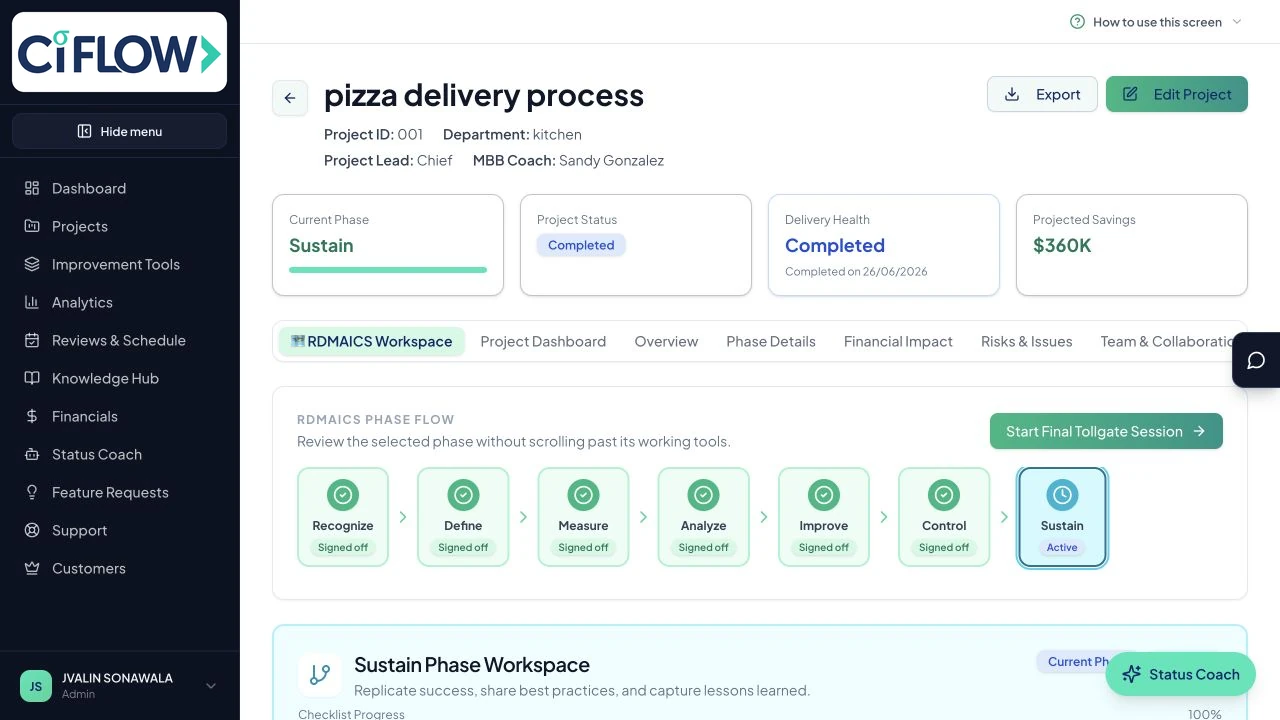
RDMAICS is designed for complex, data-led improvement where the problem requires disciplined investigation and durable control. Its seven phases are:
- Recognize
- Define
- Measure
- Analyse
- Improve
- Control
- Sustain
The value of RDMAICS is not simply the number of phases. It is the way each phase carries the project story forward.
The Recognize phase establishes why the opportunity matters. The team identifies the performance signal, customer impact, business concern or operational gap.
In Define, the problem statement, scope, stakeholders, objective and business case become explicit. This prevents the project from expanding informally as new concerns appear.
Measure establishes the baseline. Depending on the project, this may include defect rates, cycle time, first-pass yield, capability, throughput or cost of poor quality.
During Analyse, practitioners test relationships and investigate root causes using visual and statistical tools. Pareto analysis, process maps, cause-and-effect diagrams, hypothesis tests, regression and capability studies may all contribute to the evidence base.
Improve converts validated causes into countermeasures. Teams can compare options, run pilots and record the impact of each intervention.
Control embeds the new process through standard work, control plans, visual management, ownership and monitoring.
Finally, Sustain verifies that the result remains in place. This phase captures follow-up evidence, lessons learned, replication opportunities and ongoing accountability.
For a project involving a chronic defect rate, multiple departments or uncertain causes, this level of structure protects both the analysis and the result.
A3: A Visual Story for Structured Problem Solving
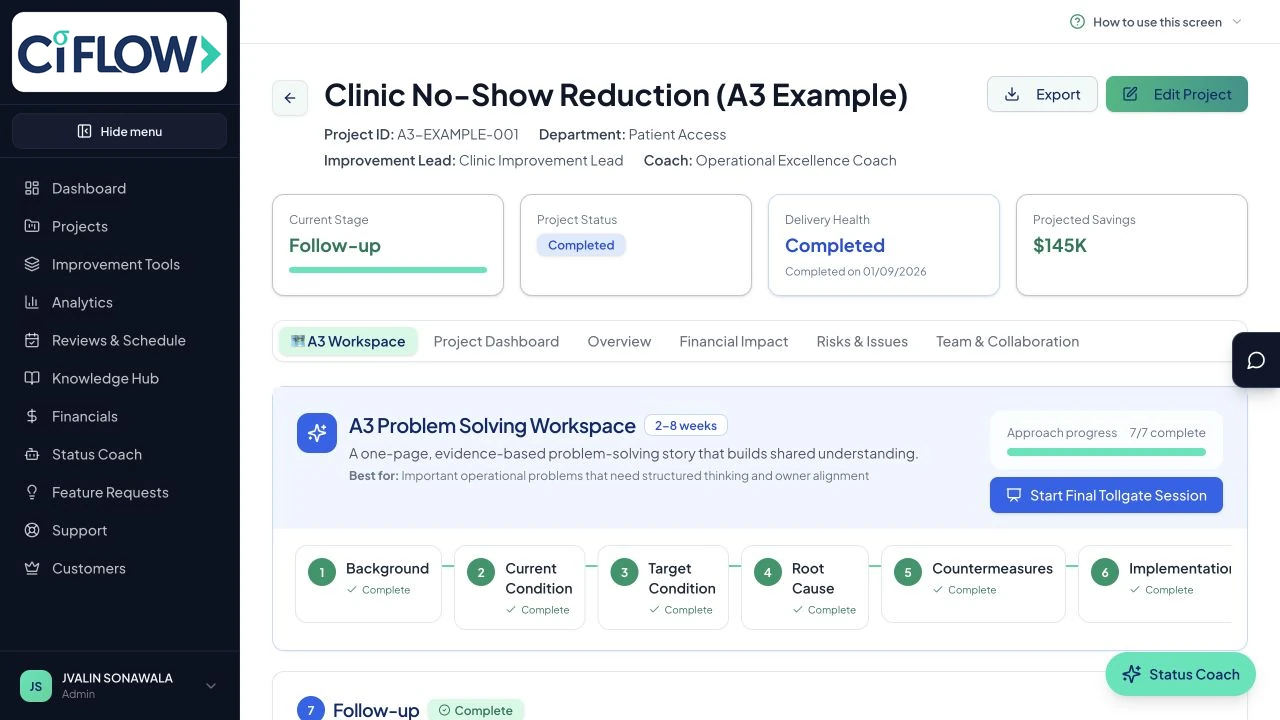
A3 is a visual, evidence-based problem-solving journey for important operational problems that need shared understanding without the full depth of a long statistical project.
Ci Flow’s A3 workspace connects seven stages:
- Background
- Current Condition
- Target Condition
- Root Cause
- Countermeasures
- Implementation
- Follow-up
This structure is especially useful when the problem has several contributing factors and the team must align around a clear story.
For example, a clinic may experience a rising patient no-show rate. The background explains the service and business context. The current condition quantifies the pattern by appointment type, day and patient segment. The target condition defines the desired performance. Root-cause analysis then examines scheduling, reminders, access, transport and communication factors.
Countermeasures are linked to the causes they address. Implementation clarifies owners and timing. Follow-up verifies whether the change improved attendance and whether the new process has become standard work.
A3 is also valuable for coaching because the structure makes the logic visible. Leaders can review the relationship between evidence, cause and action rather than evaluating a conclusion in isolation.
Just Do It: Fast Ownership for Contained Improvements
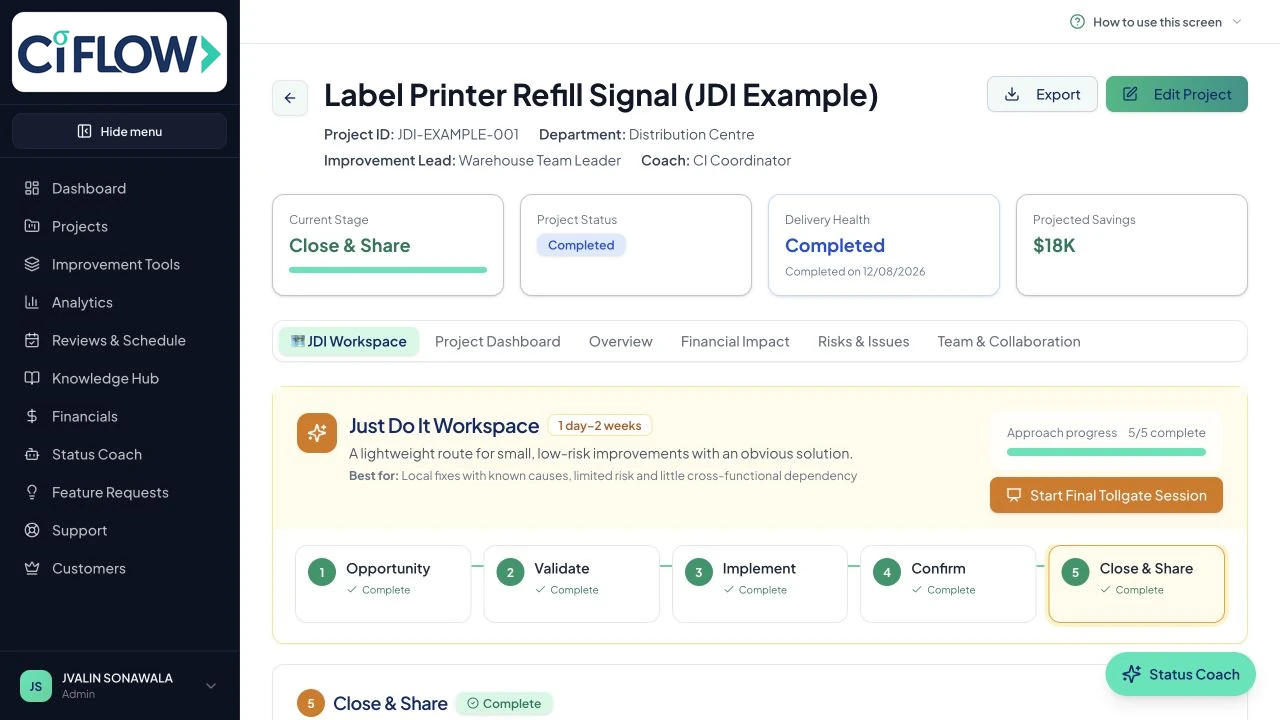
Just Do It, or JDI, is the right route when the cause is reasonably clear, the solution is straightforward and the risk is limited.
Its five stages are:
- Opportunity
- Validate
- Implement
- Confirm
- Close and Share
JDI does not mean “act without thinking.” It means applying an appropriately light structure to a small improvement.
Consider a warehouse label printer that runs out of stock because the refill signal is unclear. If the issue is local, the corrective action is obvious and no major system change is required, the team can validate the situation, assign an owner, implement a refill signal, confirm the outcome and share the learning.
The project still has accountability. It still records the action and verifies the benefit. The difference is that the team does not need to create a heavyweight statistical project for a contained operational correction.
Kaizen: Focused Team Energy with Visible Follow-Through
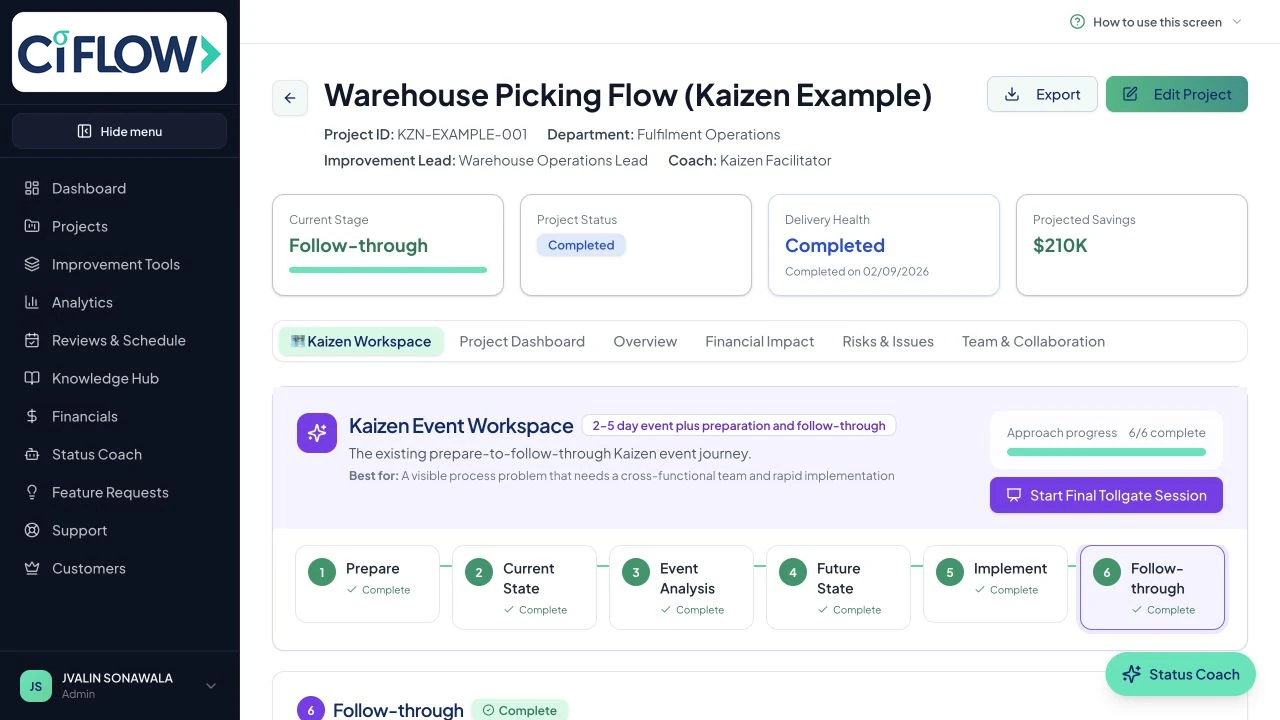
Kaizen is designed for focused, collaborative improvement events. It is useful when a cross-functional team needs to examine a process together, identify opportunities and implement changes within a defined timebox.
Ci Flow supports multiple Kaizen journey options, including:
- A standard Kaizen event
- A Monday-to-Friday journey
- A DMAIC-based Kaizen structure
The stages can be configured around the event. A typical workspace may include:
- Prepare
- Current State
- Event Analysis
- Future State
- Implement
- Follow-through
A Kaizen event creates momentum, but the follow-through stage is what converts event activity into operational performance. Actions need owners, due dates, verification criteria and a clear connection to the future-state process.
For a changeover reduction event, the team might observe the current setup, separate internal and external work, redesign the sequence, test the future state and confirm the reduction in changeover time after the event.
Comparing the Four Ci Flow Journeys
| Journey | Best suited to | Typical duration | Governance depth | Sign-off type | Useful tools and metrics | Value protected |
|---|---|---|---|---|---|---|
| RDMAICS | Complex, cross-functional, data-led problems | Several weeks to 3–6 months | High; seven governed phases | Phase tollgates and formal approval | Capability, Pareto, hypothesis tests, control plans, defect rate, sigma, cost | Prevents unvalidated causes and weak sustainment |
| A3 | Structured operational problems requiring alignment | 2–8 weeks | Moderate and story-focused | Stage-specific tollgates | Process maps, 5 Whys, cause-and-effect, action plans, target-versus-actual results | Prevents disconnected analysis and countermeasures |
| JDI | Small, low-risk improvements with an obvious solution | 1 day–2 weeks | Light but accountable | Validation and closeout confirmation | Check sheets, before-and-after measures, action ownership, benefit confirmation | Prevents administrative delay and unowned quick wins |
| Kaizen | Focused team events and rapid process redesign | 2–5 day event plus preparation and follow-through | Event-based and collaborative | Event review and follow-through confirmation | Value stream maps, spaghetti diagrams, time observations, future-state maps, cycle time | Prevents event energy from being separated from implementation |
Four Scenarios, Four Appropriate Routes
1. Labelling error fixed in an afternoon: JDI
A distribution team identifies that one label printer lacks a visible refill signal. The issue has occurred six times in four weeks. The cause is confirmed, the solution is simple and the risk is low.
The team routes the opportunity to JDI:
- Validate the issue and baseline frequency
- Install a visible refill signal
- Assign the warehouse team leader as owner
- Confirm zero repeat interruptions over the next 10 operating days
- Close and share the improvement
A full RDMAICS project would not improve the decision. JDI provides the necessary ownership and verification with appropriate speed.
2. Changeover reduction over one week: Kaizen
A packaging line requires 74 minutes to change from Product A to Product B. The target is 45 minutes. Operators, maintenance, quality and planning all influence the result.
The team selects a Monday-to-Friday Kaizen:
- Prepare the event and define the target
- Observe the current state
- Analyse internal and external setup tasks
- Design the future state
- Test the revised sequence
- Assign follow-through actions and verify performance
The event format concentrates expertise around the process while preserving a documented path from observation to implementation.
3. Chronic defect rate requiring statistical analysis: RDMAICS
A manufacturing process has a defect rate of 6.8%, compared with a target of 2.0%. The variation appears across shifts, raw material batches and equipment settings. The cause is not yet established.
This is an RDMAICS project because the team must:
- Establish a reliable baseline
- Confirm measurement-system adequacy
- Stratify the data
- Test likely causes
- Pilot improvements
- Establish statistical and operational controls
- Verify sustained performance
The project may involve control charts, capability analysis, hypothesis testing and designed experiments. A governed, evidence-rich journey protects the credibility of the final conclusion.
4. Multi-cause operational problem needing a structured story: A3
A clinic’s no-show rate has risen from 8% to 14% over six months. The issue involves scheduling practices, reminder timing, patient access and communication.
An A3 workspace gives the team a concise structure for aligning on the background, current condition, target, root causes, countermeasures, implementation and follow-up. The problem is substantial, but it may not require months of advanced statistical analysis.
One Command Centre, Practitioner-Led Fit
Methodology selection should not separate local teams from organisational governance. It should connect them.
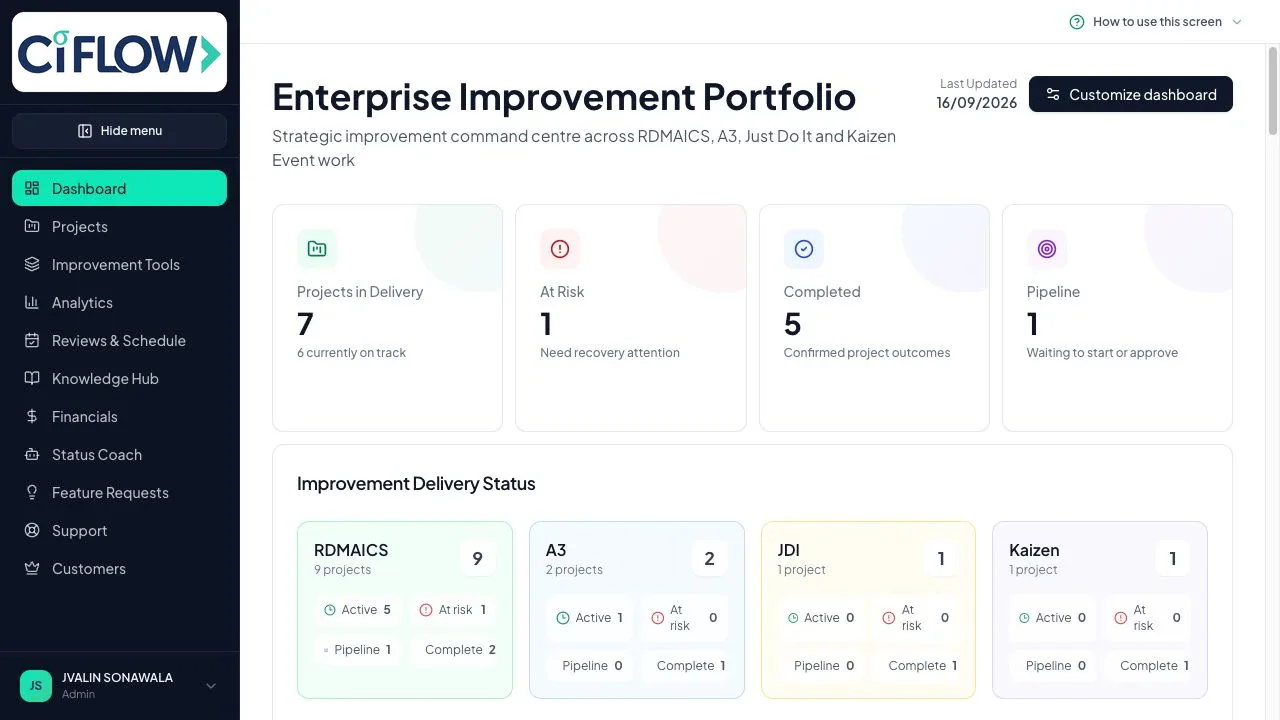
Ci Flow provides a portfolio command centre where leaders can view projects across RDMAICS, A3, JDI and Kaizen. Teams retain the appropriate project workspace, while leaders can see delivery status, risk, benefits, methodology coverage and completed outcomes in one view.
The platform also connects tools and evidence to the project record. Process maps, value stream maps, spaghetti diagrams, analysis outputs, actions and tollgate materials can remain connected rather than distributed across separate files.
That matters for trust. A project’s status should be supported by its evidence, and its evidence should remain protected through appropriate access controls and audit trails. Ci Flow states that company data is separated through row-level access, while security controls include encryption at rest and in transit. Its security page provides further detail.
For practitioners building deeper capability, Lean 6 Sigma Hub’s online Lean Six Sigma training and end-to-end hypothetical project provide additional support for applying structured improvement methods in practice.
Choose the Journey That Fits the Work
The strongest improvement programmes do not measure maturity by how much administration every project carries. They measure maturity by whether each problem receives the right level of thinking, evidence, governance and follow-through.
Use JDI for contained improvements. Use Kaizen for focused team events. Use A3 for structured operational problems that require alignment. Use RDMAICS when complexity, uncertainty and data intensity demand a full improvement cycle.
Explore all four Ci Flow methodology workspaces free for 14 days. Example projects are included, no credit card is required, and you can see how the right journey turns improvement work into a connected, evidence-led operating system.
Kaizen. Kai-Care. Kai-Done. Lean Six Sigma