Continuous improvement creates value only when ideas become verified results. Yet in many organisations, the work required to deliver those results is scattered across disconnected files and systems.
The project charter may sit in Word. Measurement data may be stored in Excel. Statistical analysis may be completed in Minitab. Tollgate materials may be assembled in PowerPoint, while the latest status exists in someone’s notes, inbox or memory.
That separation creates a costly distance between evidence and decision-making.
Before a review, practitioners often rebuild the project story from several sources. Benefits become difficult to prove. Projects stall at phase gates because required evidence is incomplete. Leaders make portfolio decisions using information that is already out of date.
Ci Flow addresses this challenge by bringing the improvement portfolio, project methods, analytical tools, evidence, collaboration and governance into one connected workspace. You can explore the platform directly at Ci Flow.
The command centre model for continuous improvement
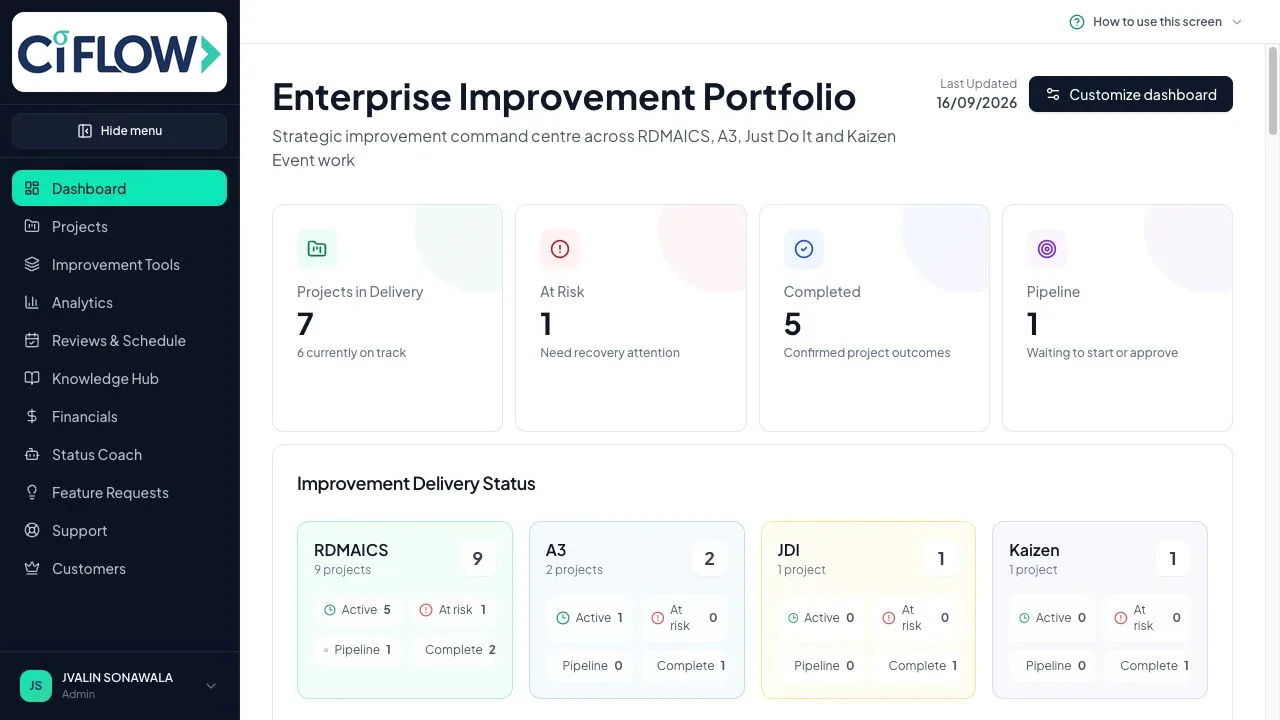
A command centre is more than a dashboard. It is a connected operating environment where the project record, tools, evidence and governance remain linked throughout the improvement lifecycle.
Ci Flow provides two connected perspectives:
- A portfolio view for improvement leaders, showing delivery, risks, benefits, methodology coverage and project health.
- A detailed project workspace for practitioners, where teams define problems, analyse data, document decisions, complete tools and prepare for reviews.
The value comes from the connection between these levels. A leader can review portfolio health without requesting a new spreadsheet, while a Black Belt can complete the detailed work without creating a separate status report for every meeting.
For example, imagine a portfolio of 12 projects:
| Portfolio measure | Traditional reporting cycle | Connected command-centre view |
|---|---|---|
| Projects requiring manual status consolidation | 12 | 0 |
| Separate sources checked per project | 4–6 | 1 workspace |
| Projects with visible phase readiness | Inconsistent | Live by project |
| Benefit evidence available for review | Partially assembled | Linked to project record |
| Leadership status refresh | Weekly or monthly | Available on demand |
The improvement is not simply administrative. When information is connected, leaders can direct attention to the projects requiring support, while teams spend more time solving process problems and less time reconstructing information.
Start your 14-day free trial with Ci Flow and explore how a connected improvement workspace can support project delivery, governance and evidence-based decision-making.
From fragmented reporting to connected delivery
Consider a typical tollgate review. A practitioner may need to:
- Locate the current project charter.
- Check whether the latest data is in Excel or a statistical analysis file.
- Rebuild charts in PowerPoint.
- Confirm which actions have been completed.
- Recalculate the benefit estimate.
- Explain why a decision was made several weeks earlier.
- Answer questions about risks, blockers and phase readiness.
Each step introduces the possibility of inconsistent numbers, missing context or duplicated work.
In Ci Flow, saved tools and project evidence remain part of the same project record. A tollgate presentation can draw from completed project work, including tables, charts, process maps and explanations. The result is an editable stakeholder story that reflects the evidence already captured.
| Improvement activity | Disconnected approach | Ci Flow approach |
|---|---|---|
| Project status | Re-entered into a spreadsheet | Connected to the live project record |
| Analysis | Stored separately from decisions | Saved with the project evidence |
| Tollgate preparation | Manually rebuilt in slides | Generated from saved tools and content |
| Actions | Discussed in meetings and email | Assigned and visible to the team |
| Decisions | Difficult to trace later | Documented within shared project context |
| Portfolio reporting | Consolidated manually | Available through portfolio reporting |
This also supports stronger project discipline. When a decision is connected to the relevant data, analysis or tool, the reasoning remains available to the next reviewer, project owner or improvement leader.
Four project journeys for four types of improvement work
One methodology cannot fit every improvement opportunity. A complex, data-led problem requires structured governance and statistical analysis. A contained low-risk issue may require a focused action and benefit check rather than a full project architecture.
Ci Flow supports four project journeys so teams can apply the appropriate level of structure. If you want to see how these journeys operate inside a connected workspace, review Ci Flow.
RDMAICS: governed improvement for complex problems
RDMAICS provides seven connected phases for complex, data-led improvement. It carries the project from recognition and definition through measurement, analysis, improvement, control and sustainment.
This journey is appropriate when teams need to:
- Establish a clear business and customer case.
- Validate the measurement approach.
- Investigate root causes with data.
- Compare improvement options.
- Confirm process performance after implementation.
- Sustain the result through documented controls.
For example, a healthcare operations team investigating a 14% appointment rescheduling rate may need baseline analysis, stratification by clinic and appointment type, root-cause validation, pilot testing and control monitoring. A governed RDMAICS journey provides the structure to manage that complexity.
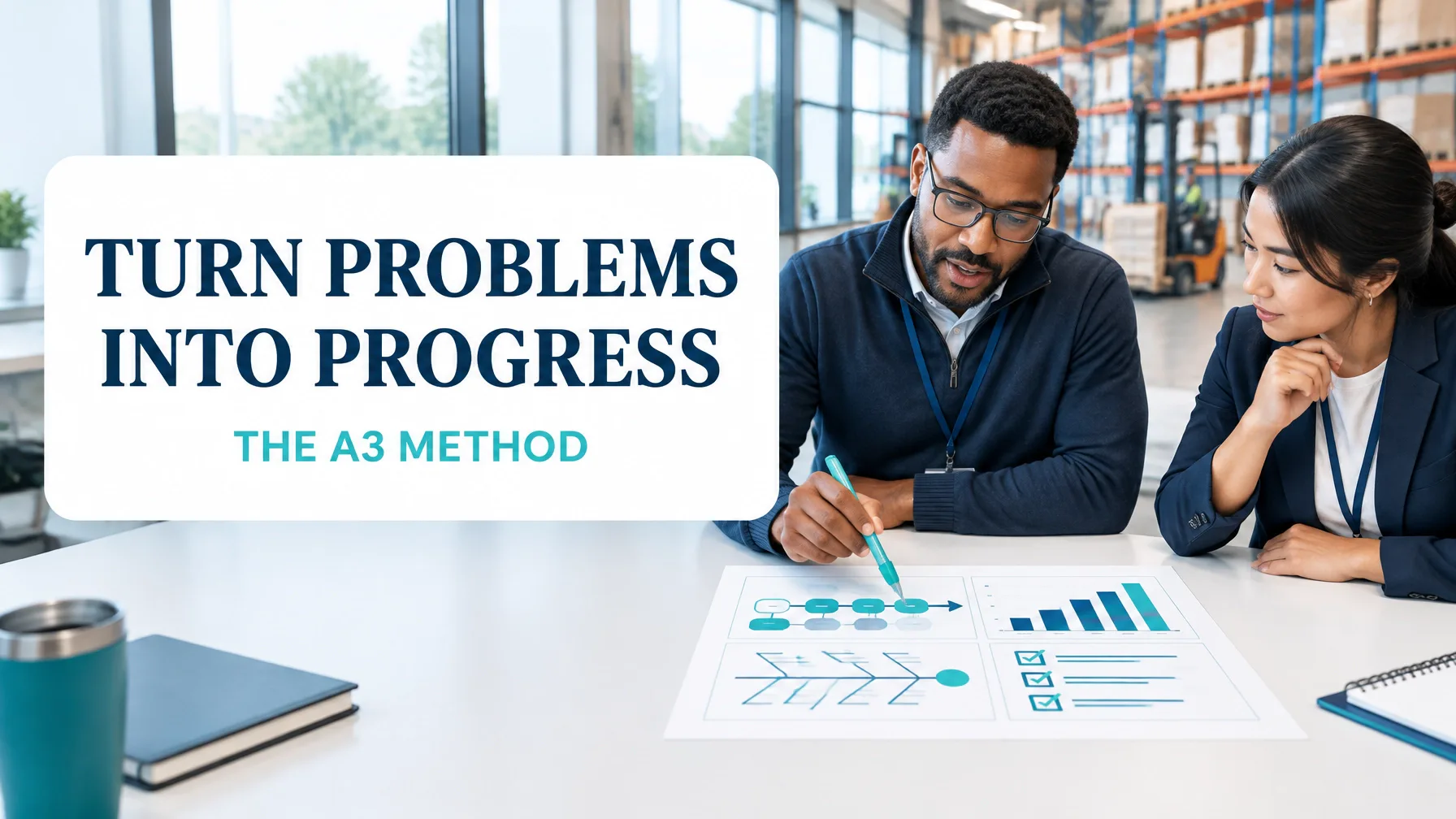
A3: visual, structured problem solving
A3 is designed around a concise, connected problem-solving record. Ci Flow provides seven structured stages covering the background, current condition, target, root cause, countermeasures, implementation and follow-up.
An A3 may suit a logistics team addressing a recurring picking error in one warehouse zone. The team can document the current condition, identify the likely causes, test countermeasures and follow up on performance without creating an oversized project structure.
Just Do It: fast action with verified benefit
Just Do It is a lighter five-stage journey for contained, low-risk improvements. Its purpose is not to remove discipline, but to apply proportionate discipline.
A team might use JDI to revise a standard work instruction, reposition frequently used materials or remove an unnecessary approval from a low-risk internal request. Ci Flow still provides ownership, action tracking, benefit verification and closeout.
The outcome is a practical balance: small improvements move quickly, while the organisation retains a record of what changed and whether it worked.
Kaizen: focused team events with follow-through
Kaizen projects support focused team-based improvement events. Ci Flow allows teams to select a standard event, a Monday-to-Friday journey or a DMAIC-based Kaizen approach, then configure the stages and tools around the event.
This is valuable when the organisation wants to connect workshop activity with measurable follow-through. The event does not end when the team leaves the room; actions, owners, evidence and post-event results remain visible.
Connected layers for evidence-based improvement
Ci Flow combines multiple capabilities inside the same workspace rather than treating them as separate applications.
290+ improvement and analysis tools
The platform includes more than 290 tools across the supported project journeys. Depending on the problem, teams can work with process maps, value stream maps, analytical tools, charts, cause analysis, measurement records and improvement documentation.
The practical advantage is traceability. The tool is not merely a template downloaded from a library; it becomes part of the project evidence.
Process and flow visualisation
The BPMN 2.0 modeller supports swimlanes, gateways, connectors, validation and structured export. Teams can create editable current-state and future-state process models rather than relying on static diagrams.

The value stream mapping tool connects process steps with lead time, process time, inventory and information flow. A team might record 480 minutes of total lead time against 42 minutes of value-added processing, immediately identifying an opportunity to investigate waiting and handoffs.

The spaghetti diagram helps teams examine physical movement by placing work areas, drawing actual routes and recording measured distances. This can support a focused investigation into excess motion, layout and material handling.
AI interpretation with visible evidence
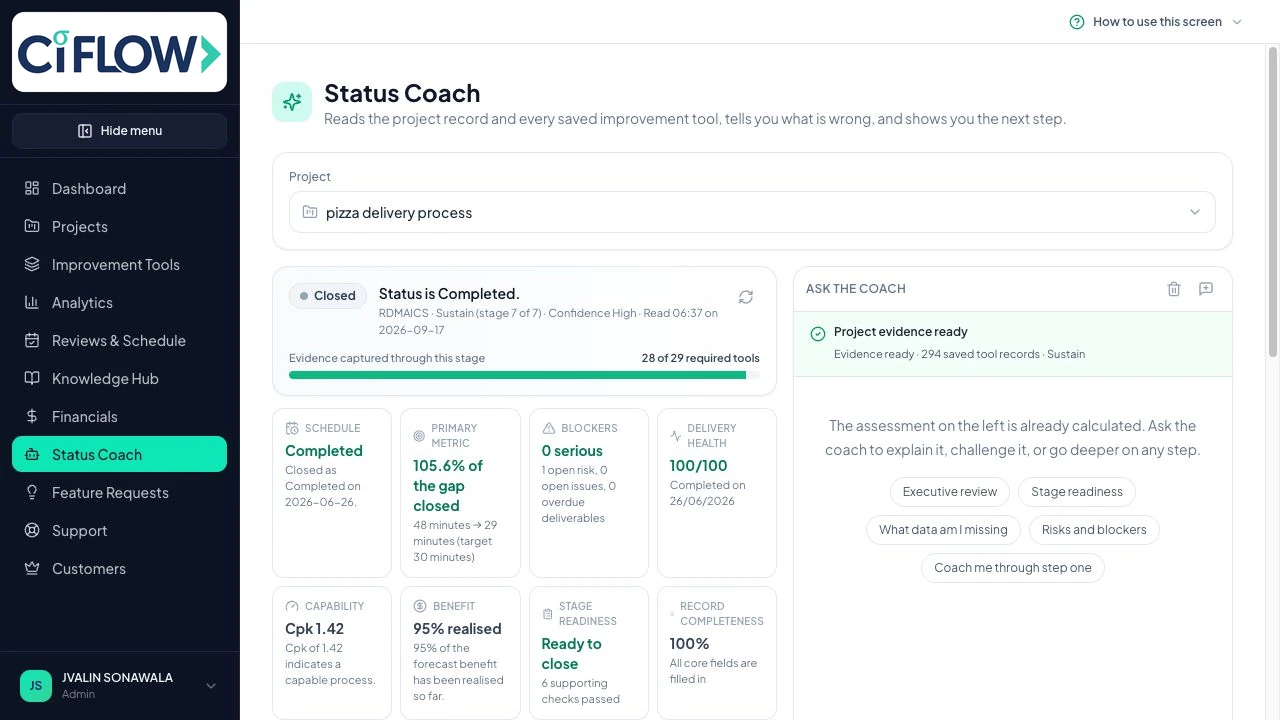
AI is most useful when it helps people interpret information without obscuring the basis for the recommendation. Ci Flow’s Status Coach reads the selected project record, saved tools, phase progress, risks, benefits and completion evidence.
Users can ask focused questions about:
- Executive review readiness.
- Missing data.
- Risks and blockers.
- Phase readiness.
- Recommended next actions.
The evidence panel remains visible alongside the guidance. This makes the assessment easier to review and challenge constructively.
Ci Flow also uses a deterministic engine designed so AI cannot change a number, supported by 47 test suites. Project teams can use AI for interpretation while retaining control over the underlying figures and evidence.
Collaboration and portfolio governance
Project chat, visible decisions and assigned actions keep collaboration inside the project context. For organisations, role-based access and row-level permissions help separate company information and control access at the data layer.
Leaders can monitor:
- Project delivery.
- Methodology selection.
- Risks and blockers.
- Benefits and return on investment.
- Sigma performance.
- Tollgate readiness.
- Portfolio health.
For security, Ci Flow states that its enterprise cloud platform provider is covered by SOC 2 Type II and ISO/IEC 27001, with AES-256 encryption at rest and TLS 1.2 or higher in transit. The platform also describes audit trails for company changes and AI usage. The certifications are held by the infrastructure provider rather than Ci Flow in its own name. A distinction that should be clear in any responsible software evaluation. Read the security details.
Who benefits from a continuous improvement command centre?
Black Belts and improvement practitioners
Practitioners can work through the appropriate methodology, apply analytical tools, retain the evidence and prepare stakeholder-ready outputs without maintaining several disconnected project systems.
If you are building advanced capability, Ci Flow can complement structured Lean Six Sigma Black Belt training by providing an environment in which project methods and tools can be applied.
Improvement leaders
Leaders gain a live portfolio perspective across project health, risks, methodology, benefits and governance. Instead of relying on manually consolidated updates, they can focus conversations on decisions, constraints and support.
Project teams
Teams gain shared context. Actions, decisions, evidence and next steps remain visible to the people responsible for delivering the change.
Build a more connected improvement system
Ci Flow is designed for organisations that want continuous improvement to operate as a managed system rather than a collection of individual files.
With one workspace for project methods, tools, analysis, collaboration, governance and reporting, teams can right-size the way they work while preserving evidence and accountability.
Start your 14-day free trial with Ci Flow. No credit card is required, and example RDMAICS, A3, JDI and Kaizen projects are included so you can explore the platform before creating your own portfolio.
Kaizen. Kai-Care. Kai-Done. Lean Six Sigma