Executives sponsoring an operational excellence programme need a clear answer to three questions:
- Are our improvement projects delivering?
- What is at risk?
- Where are the benefits being realised?
When the answers sit across spreadsheets, status emails, presentation decks and separate methodology templates, governance becomes a reporting exercise rather than a decision-making discipline. Leaders spend valuable time requesting updates, reconciling figures and asking project teams to recreate evidence that already exists elsewhere.
A stronger model is to manage improvement as a connected portfolio. The project record, analytical evidence, risks, decisions, benefits and tollgate status should contribute to one leadership view.
That is the purpose of Ci Flow: an operational excellence SaaS platform that connects improvement projects, Lean Six Sigma tools, governance, collaboration and portfolio reporting in one workspace.
The leadership requirement: a complete view of improvement performance
Portfolio visibility requires more than a list of project names and traffic-light indicators. An improvement leader needs to understand the relationship between activity, evidence and business outcomes.
A useful portfolio view should bring together:
- Delivery status: Which projects are progressing through their methodology?
- Risk and blockers: Where is intervention, escalation or additional support required?
- Benefit realisation: Which projects are delivering verified savings or performance improvements?
- Methodology coverage: Are teams using RDMAICS, A3, Just Do It or Kaizen appropriately?
- Stage readiness: Which projects are prepared for their next phase or tollgate?
- Sigma performance: How are process capability and defect outcomes changing?
- Return on investment: Is the improvement portfolio producing value relative to its investment?
The critical principle is that these measures should be refreshed from the live project record, not reconstructed during a quarterly reporting cycle.
For example, a project may appear healthy because it is marked “on track” in a spreadsheet. However, the underlying record may show that the primary metric has not been updated for six weeks, two actions are overdue and the next phase contains incomplete evidence. A connected portfolio view makes that distinction visible.
This is closely aligned with the broader principles of Lean Six Sigma online training, where decisions are expected to follow evidence, structured analysis and measurable outcomes.
Ci Flow portfolio governance: from project activity to executive insight
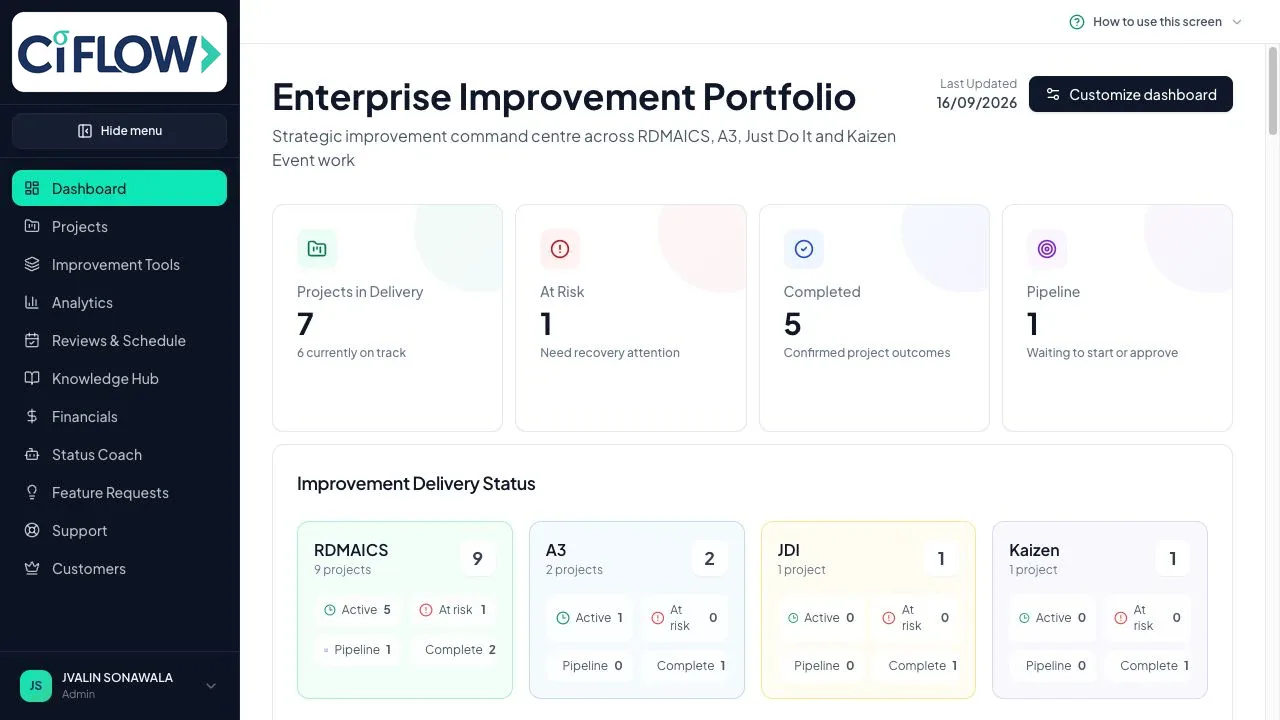
Ci Flow provides a portfolio dashboard that brings project delivery, risk and methodology coverage into one executive view. RDMAICS, A3, Just Do It and Kaizen projects can be represented in the same portfolio, allowing leaders to oversee different types of improvement work without forcing every initiative into one project structure.
That flexibility matters because improvement work is not uniform.
- A complex, data-led issue may require the seven governed phases of RDMAICS.
- A structured operational problem may be well suited to an A3 journey.
- A contained, low-risk fix may be better managed through Just Do It.
- A focused team event may require a Kaizen journey with visible daily actions and follow-through.
Ci Flow allows improvement leaders to see this range of work together while preserving the appropriate methodology inside each project. Customisable portfolio views also help organisations focus leadership attention on the indicators most relevant to their operating model.
Portfolio health scoring supports timely decisions
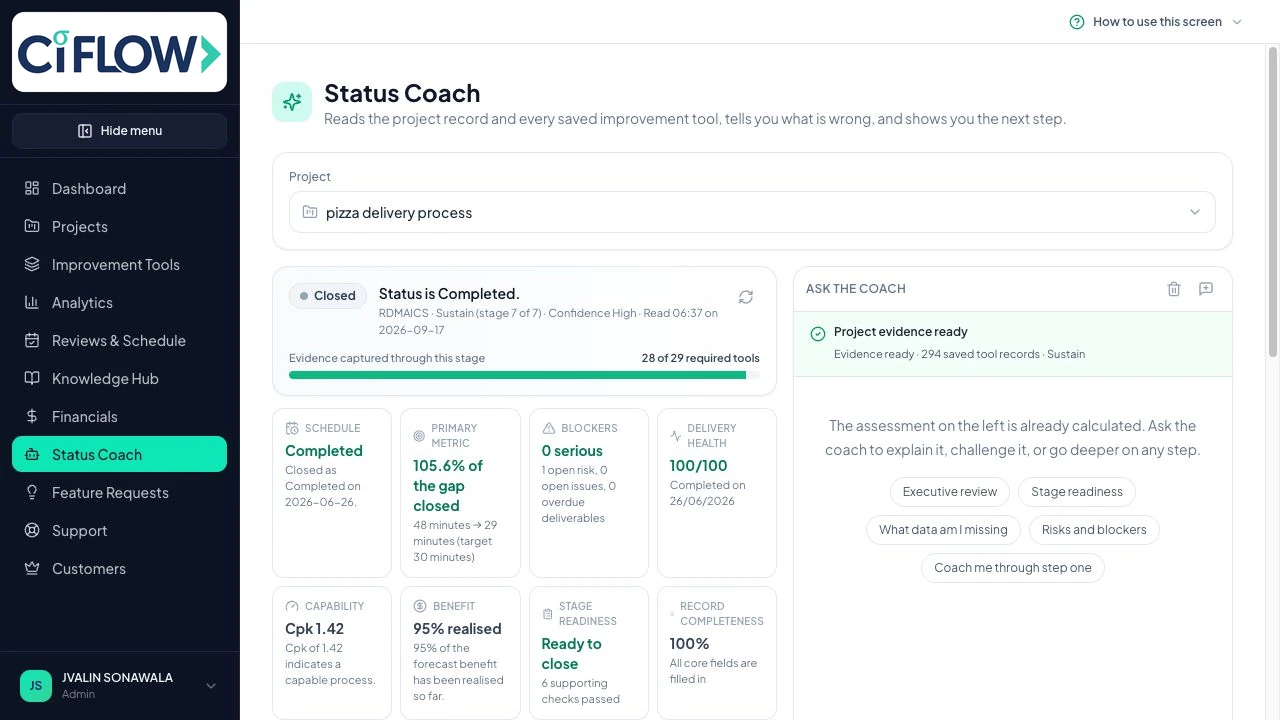
Portfolio health scoring helps distinguish projects that are advancing from projects that require attention. Rather than relying solely on a project owner’s narrative, leaders can assess signals such as:
- Schedule and phase progress
- Primary performance metrics
- Current blockers
- Risk exposure
- Benefit status
- Team capability
- Stage readiness
- Record completeness
This creates a practical basis for governance conversations. A review can move beyond “How is the project going?” to more precise questions:
- What evidence supports the current health rating?
- Which decision is required from leadership?
- What is preventing the next phase from starting?
- Is the expected benefit still credible?
- Does the project need additional analytical or operational support?
That is the difference between visibility and oversight. Visibility shows what is happening; effective governance uses that information to make better decisions.
Governance with structure and practitioner flexibility
Strong governance requires consistent standards, but it should not remove the flexibility practitioners need to solve real operational problems.
Ci Flow supports this balance through:
- Role-based access for appropriate visibility and responsibility
- Phase-gate reviews that create formal checkpoints
- Portfolio health scoring for leadership oversight
- Methodology-specific project journeys
- Consistent improvement standards across the organisation
- Customisable tools and working fields for local terminology
Formal checkpoints are valuable because they clarify whether a project has the evidence, ownership and readiness required to proceed. They also create a common language for executives, Master Black Belts, Black Belts, Green Belts and operational stakeholders.
However, governance works best when the checkpoint is connected to the working record. If reviewers must search through separate folders for charts, process maps and action logs, the checkpoint becomes slower and less reliable. When the evidence is already linked to the project stage, the review can focus on decisions and outcomes.
For organisations using the Company plan, the admin portfolio view provides company-level oversight across up to 100 projects and 50 team members. This gives improvement leaders a practical structure for building a consistent operational excellence system across multiple functions or business units.
Collaboration that keeps decisions traceable
Improvement decisions rarely depend on one data point. They emerge from conversations involving project teams, process owners, sponsors, subject matter experts and finance or quality stakeholders.
Ci Flow keeps this context inside the project workspace through:
- Project chat
- Visible decisions
- Assigned actions
- Shared project context
- Evidence connected to the relevant stage
This matters because the reason behind a decision should remain visible next to the evidence that prompted it.
Consider a project team deciding to test a new standard work sequence. The decision may depend on cycle-time observations, a process map, an operator discussion and a risk assessment. If the conclusion is recorded only in an email, the team may later spend time reconstructing the rationale. If the decision, owner, due date and supporting evidence are recorded in the project workspace, the next review has a clear starting point.
Traceable collaboration also supports continuity when project members change. The improvement story remains attached to the project rather than dependent on individual memory.
The tollgate advantage: worked evidence stays aligned
A tollgate review should demonstrate progress through evidence, not simply present a polished narrative.
Ci Flow’s tollgate presentation capability helps maintain that connection because only saved tools enter the storyboard. Tables, charts, process maps and explanations remain aligned between:
- The working project record
- Presentation mode
- Exported PowerPoint materials
- The relevant methodology phase
This creates a more reliable review process. A Black Belt can present the saved analysis that supports the project’s conclusion, while reviewers can understand how the evidence relates to the phase objective.
For example, a project may include:
- A current-state process map
- A Pareto chart showing the principal defect categories
- A validated root-cause analysis
- A future-state process design
- A benefit calculation
- A control or sustainment plan
When these outputs are drawn from the same project record, the tollgate story is easier to verify. Reviewers spend less time reconciling slide content with source files and more time evaluating whether the proposed decision is justified.
That can shorten review cycles and strengthen the case for continued investment. Leaders see not only that a project claims progress, but also the worked evidence supporting the claim.

Customisation for enterprise fit
Operational excellence systems are most effective when they reflect the organisation’s existing language and management routines.
Ci Flow supports enterprise fit by allowing teams to:
- Rename headings
- Add or remove columns
- Adapt existing tools
- Match company terminology
- Configure working fields around the current operating system
This reduces the distance between the platform and day-to-day work. Teams can retain familiar terminology while gaining a connected system for project delivery and governance.
The platform also provides security controls designed for organisational use, including row-level access enforced at the data layer, audit trails for company changes and AI usage, and separation of company project information. Ci Flow states that its platform infrastructure uses AES-256 encryption at rest and TLS 1.2 or higher in transit. Its hosting provider is covered by SOC 2 Type II and ISO/IEC 27001 certifications, with the important clarification that these certifications are held by the platform provider rather than Ci Flow itself. Read the security details.
Who benefits from a connected portfolio view?
Improvement leaders
Improvement leaders gain visibility across delivery, risk, benefit realisation, methodology progress and tollgate readiness without chasing separate files.
Black Belts and practitioners
Black Belts can manage the project, use analytical tools and keep decisions connected to the evidence that supports them. This complements the advanced project leadership and mentoring focus of Lean Six Sigma Black Belt training.
Project teams
Project teams gain one shared workspace for actions, decisions, tools, discussions and the next stage of work.
Executives and sponsors
Executives receive a clearer view of where improvement investment is producing value, where risks require attention and which projects are ready for the next decision.
Build your operational excellence portfolio
A mature improvement system should make it easier to connect strategy, project execution, governance and measurable benefit.
Ci Flow provides that connection through a portfolio dashboard, methodology-specific journeys, health scoring, phase-gate reviews, traceable collaboration, evidence-based tollgate presentations, customisable tools and company-level oversight.
Build your operational excellence portfolio free for 14 days at ciflow.app. No credit card is required. Start here: https://ciflow.app.
Kaizen. Kai-Care. Kai-Done. Lean Six Sigma