In operational excellence, data is rarely just data.
An improvement project workspace may contain cost information, defect rates, process weaknesses, supplier performance, staffing constraints, customer details and evidence of control failures. In healthcare, financial services, defence and public-sector environments, that information may also be subject to contractual, privacy or regulatory obligations.
Even outside regulated industries, process evidence can reveal where an organisation is vulnerable, how much it spends, which suppliers are underperforming and where customers experience delays. If disclosed, that information may create commercial risk.
Improvement platforms therefore carry a serious data obligation. Security should not be an afterthought added after the tool has already been selected. It should be part of the decision from the beginning, alongside methodology fit, analytical capability and portfolio governance.
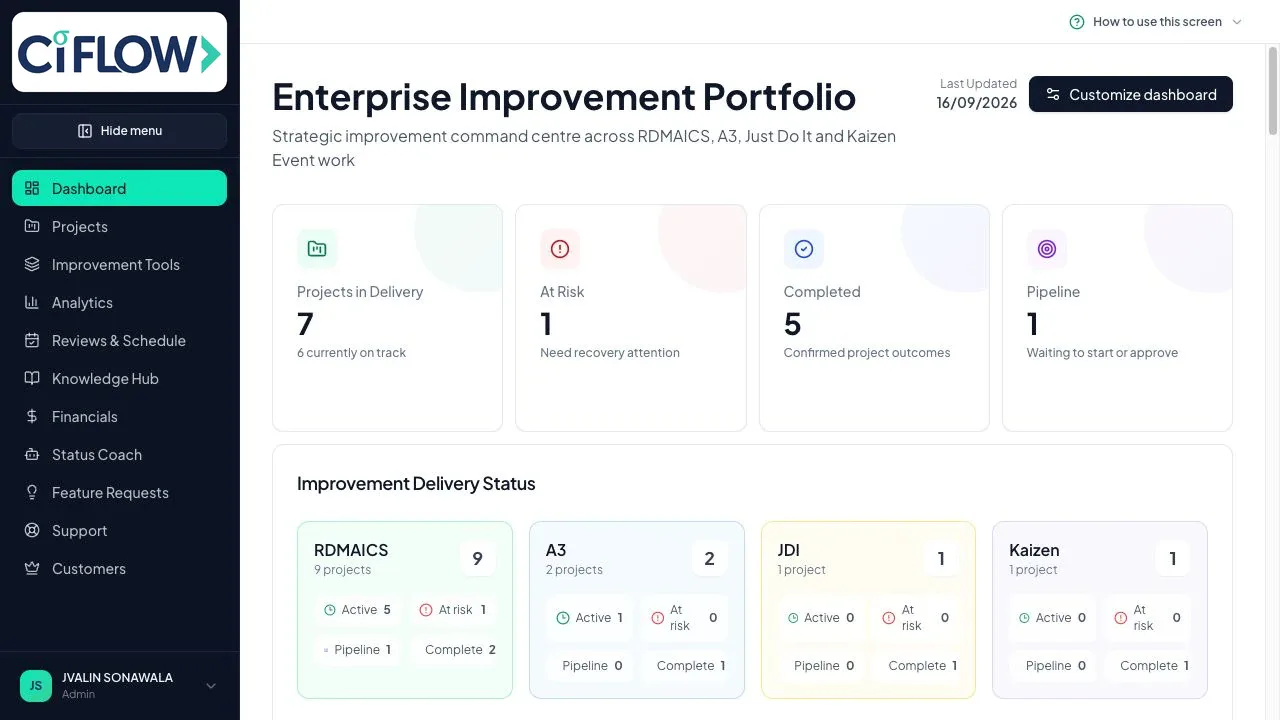
Ci Flow is designed as a connected operational excellence command centre: a place where teams can manage projects, tools, evidence, collaboration and governance in one workspace. Its security approach focuses on four practical protections: who can access project evidence, what actions are recorded, how calculations are protected and how customer data is treated. You can explore the platform directly at ciflow.app.
Protection One: Row-Level Access Enforced at the Data Layer
A permission setting in a visible interface is useful, but it is not the complete security model. The stronger question is whether access rules remain active at the data layer, even if a request bypasses the expected screen. This is a critical consideration when assessing any enterprise improvement workspace, including Ci Flow.
Ci Flow applies access controls per project:
- A project is readable by its creator or named members.
- Editing is restricted to the creator or people on the editor list.
- Deletion is restricted to the creator.
- Read access and write access are managed separately.
- Adding a stakeholder as a viewer does not give that person permission to alter project evidence.
- Company administrators do not automatically gain access to every individual project.
This distinction matters during governance reviews. A sponsor may need visibility of a project’s tollgate progress, risks and benefits without having the ability to change the underlying numbers. A specialist may need access to one project without seeing unrelated work. A practitioner may require editing rights while other stakeholders retain read-only access.
The result is a more precise least-privilege model: people receive the access required for their role rather than broad visibility by default.
That is particularly important when a portfolio contains projects involving different clients, business units, suppliers or regulated processes.
Protection Two: Audit Trails Make the Project Record Reconstructable
A project record becomes more valuable when its history can be understood.
Ci Flow logs company-level changes against the person who made them. It also records AI usage, including the user, the action and the amount consumed. This creates a traceable record of important activity around the platform and its assistance features.
For improvement leaders, an audit trail supports practical questions such as:
- Who changed a company-level setting?
- Who initiated an AI interpretation?
- What action was performed?
- When did the action take place?
- Which project or workspace was involved?
- Can the current project record be explained from the evidence saved within it?
This supports stronger project governance without turning every improvement initiative into an administrative exercise. Phase-gate reviews, project decisions, assigned actions and saved tools can remain connected to the project journey rather than scattered across email threads, spreadsheets and presentation files.
It also helps teams distinguish between the original evidence, the interpretation of that evidence and the decision that followed.
For practitioners building a DMAIC, A3, Just Do It or Kaizen project, that distinction is valuable. The record should show not only what the team concluded, but also the evidence available at the time.
Protection Three: AI Cannot Change a Number
AI can help teams interpret information, identify patterns and determine the next useful question. It should not be treated as the source of truth for statistical calculations.
Ci Flow separates calculation from explanation.
Its deterministic engine produces the statistics and is validated against NumPy and SciPy. The AI receives the completed calculation as a source of truth it is not permitted to alter. Its role is to explain the result, provide interpretation and guide the user towards an appropriate next action.
The platform runs 47 automated test suites on every release to protect this separation. When the same worksheet is run repeatedly, the figures remain identical to nine decimal places.
This distinction is important when a project includes:
- Defect rates and yield calculations
- Process capability measures
- Hypothesis tests
- Variation analysis
- Financial benefits
- Lead-time or cycle-time evidence
- Risk and readiness indicators
A model may explain what a result means. It should not silently change the result to make the explanation appear more convincing.
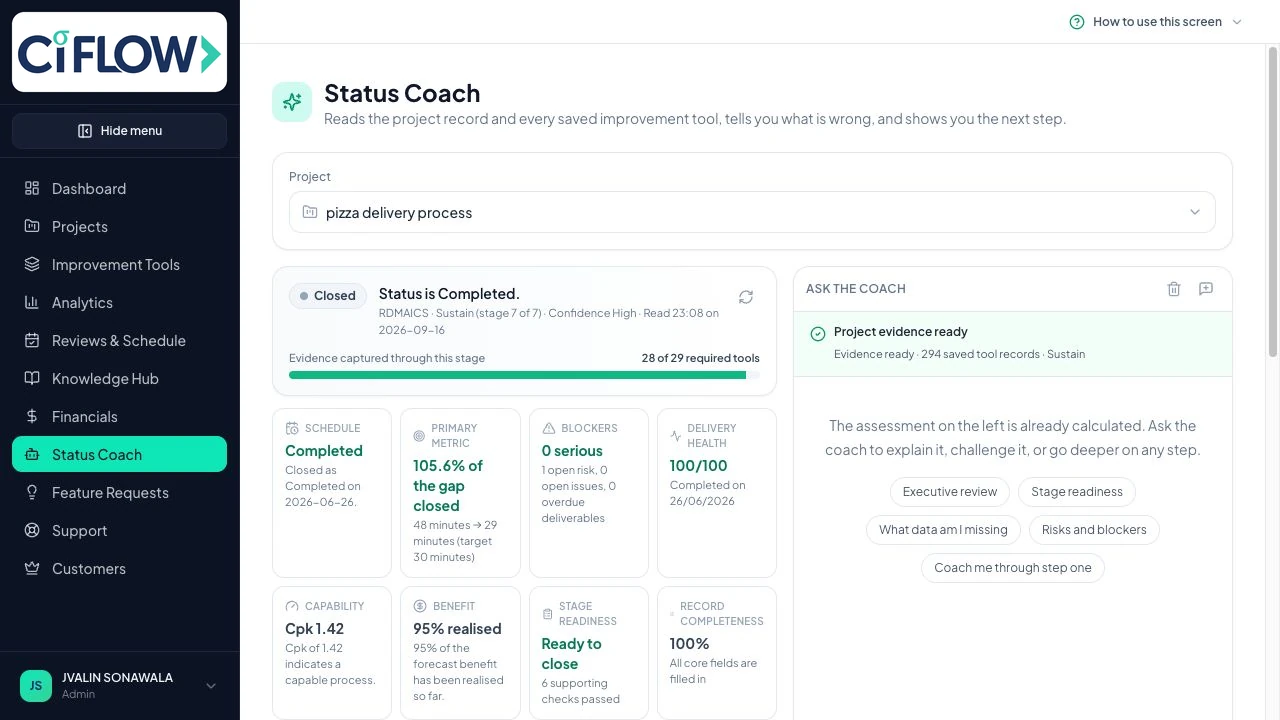
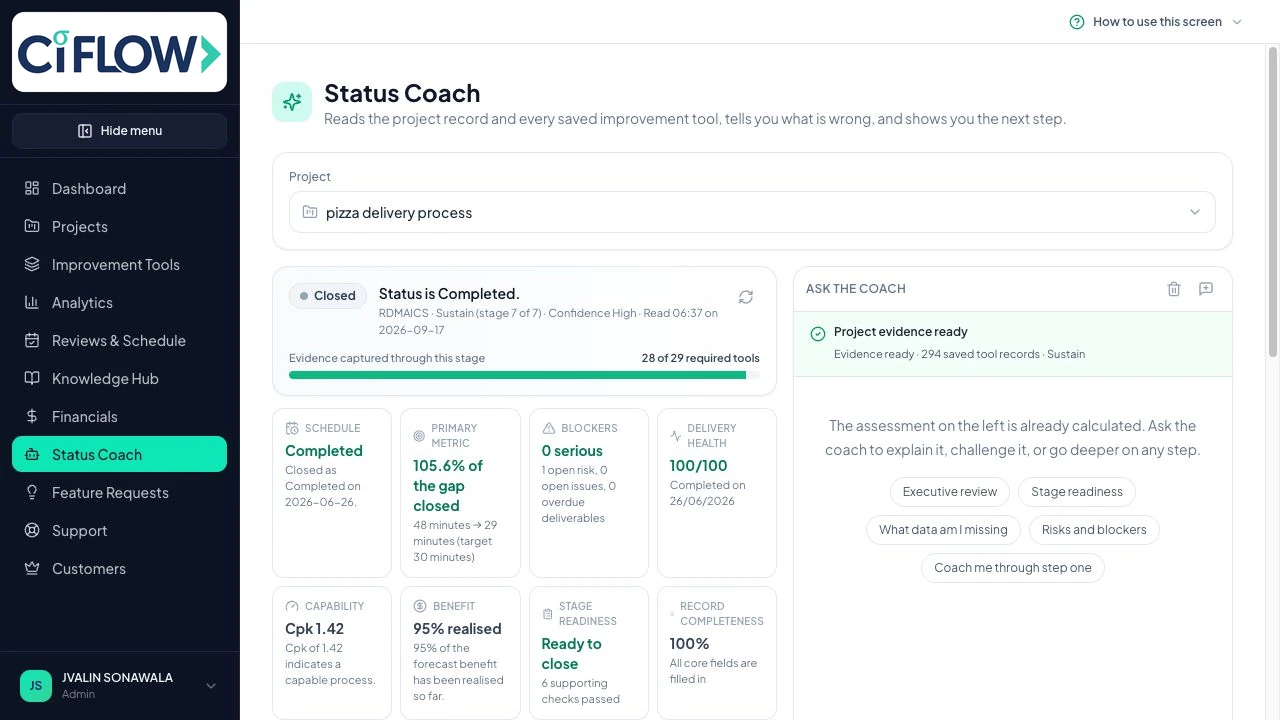
Ci Flow’s Status Coach follows the same evidence-focused principle. It reads the selected project record, saved tools, phase progress, risks, benefits and completion evidence. The assessment is presented alongside the evidence panel, allowing the user to see what the guidance is based on.
That makes AI more useful in a professional setting because the recommendation remains connected to the project record rather than appearing as an untraceable answer.
Protection Four: Your Data Stays Yours
Improvement evidence belongs to the organisation that creates it.
Ci Flow does not sell customer data and does not use customer project content to train public models. Project evidence, worksheets, process maps and tollgate records remain associated with the customer’s organisation and its workspace.
This matters because an improvement platform may hold commercially sensitive information across multiple layers:
- The initial problem statement
- Current-state process evidence
- Supplier and customer performance
- Financial benefits
- Root-cause analysis
- Proposed countermeasures
- Control plans and sustainment data
- Executive review material
A clear data-use position gives procurement teams and project owners a basis for evaluating whether a platform is suitable for internal improvement work.
The principle is straightforward: customer data should support the customer’s analysis, governance and decision-making, not become an undisclosed training resource for public systems.
The Infrastructure Behind Ci Flow
Ci Flow runs on an enterprise cloud application platform with security controls operated by that platform provider.
The inherited infrastructure includes:
- An independent SOC 2 Type II audit
- An ISO/IEC 27001-certified information security management system
- AES-256 encryption at rest
- TLS 1.2 or higher encryption in transit
- Managed infrastructure for application secrets and API credentials
- Ongoing security monitoring and testing
- Data Processing Agreement support through the platform provider
- PCI DSS-certified payment processors for subscription payments
These controls provide the infrastructure foundation. Ci Flow then adds product-level protections such as project-specific access, separate read and write permissions, AI usage logging and deterministic calculation controls.
For organisations with formal procurement processes, a Data Processing Agreement can be requested, and security questionnaires can be submitted for an accurate response to specific requirements. Teams evaluating secure deployment options can also review the broader Ci Flow platform alongside the security documentation.
A Clear Boundary on Certifications
Ci Flow makes an important distinction that every SaaS buyer should examine carefully.
The SOC 2 Type II audit and ISO/IEC 27001 certification belong to the enterprise cloud platform provider. Ci Flow holds no security certification in its own name. Ci Flow inherits relevant controls from the platform on which it operates, but it does not present the provider’s certifications as its own.
That boundary is worth stating plainly.
A badge can create confidence, but only when the reader understands who holds it, what system it covers and which controls are included. Clear disclosure is more useful than displaying a certification mark that cannot be independently verified in relation to the product being purchased.
For procurement, security and compliance teams, this gives you a better starting point. You can ask focused questions about the product’s own controls, the infrastructure it inherits and the evidence available for your organisation’s risk assessment.
A Practical Security Checklist for Improvement Platforms
Before placing process data into any improvement platform, ask the provider:
| Question | What to establish |
|---|---|
| Where does the data physically sit? | The hosting environment, available regions and whether data residency requirements can be met |
| Who can see a project by default? | Whether access is private, company-wide or controlled by named members |
| Who can edit project evidence? | Whether read and write permissions are separated |
| Does customer data train AI models? | Whether project content is used for public-model training or sold to third parties |
| What does the audit trail capture? | Users, actions, timestamps, AI usage and company-level changes |
| Can AI change calculations? | Whether statistics come from a deterministic engine or model-generated arithmetic |
| What happens at contract end? | Export formats, data extraction options and account closure procedures |
| Who holds the certifications? | Whether certifications belong to the SaaS provider or its infrastructure provider |
| Is a DPA available? | Whether the organisation can obtain appropriate data-processing documentation |
This checklist applies across healthcare, financial services, defence, public-sector environments and any commercial organisation where process weaknesses or performance data would be damaging if disclosed.
Bring Security Into the Improvement System
Security and operational excellence should reinforce each other.
A platform that combines project governance, analytical tools, collaboration, evidence and portfolio reporting can reduce the number of disconnected locations where sensitive information is stored. When access, calculations and project history are handled deliberately, improvement teams gain both speed and confidence.
Ci Flow is built for practitioners, improvement leaders and organisations that need a connected command centre for measurable change. You can explore how its operational excellence platform supports RDMAICS, A3, Just Do It and Kaizen projects, review the full security detail, or visit ciflow.app to see how the system brings governance, evidence and analysis into one secure environment.
Review the full security detail and start your 14-day free trial at ciflow.app today, no credit card required.
Kaizen. Kai-Care. Kai-Done. Lean Six Sigma