In Lean Six Sigma, Approval is more than a signature at the bottom of a project document. It is a governance mechanism that determines whether an improvement project has enough evidence, alignment, resources, and control to move forward.
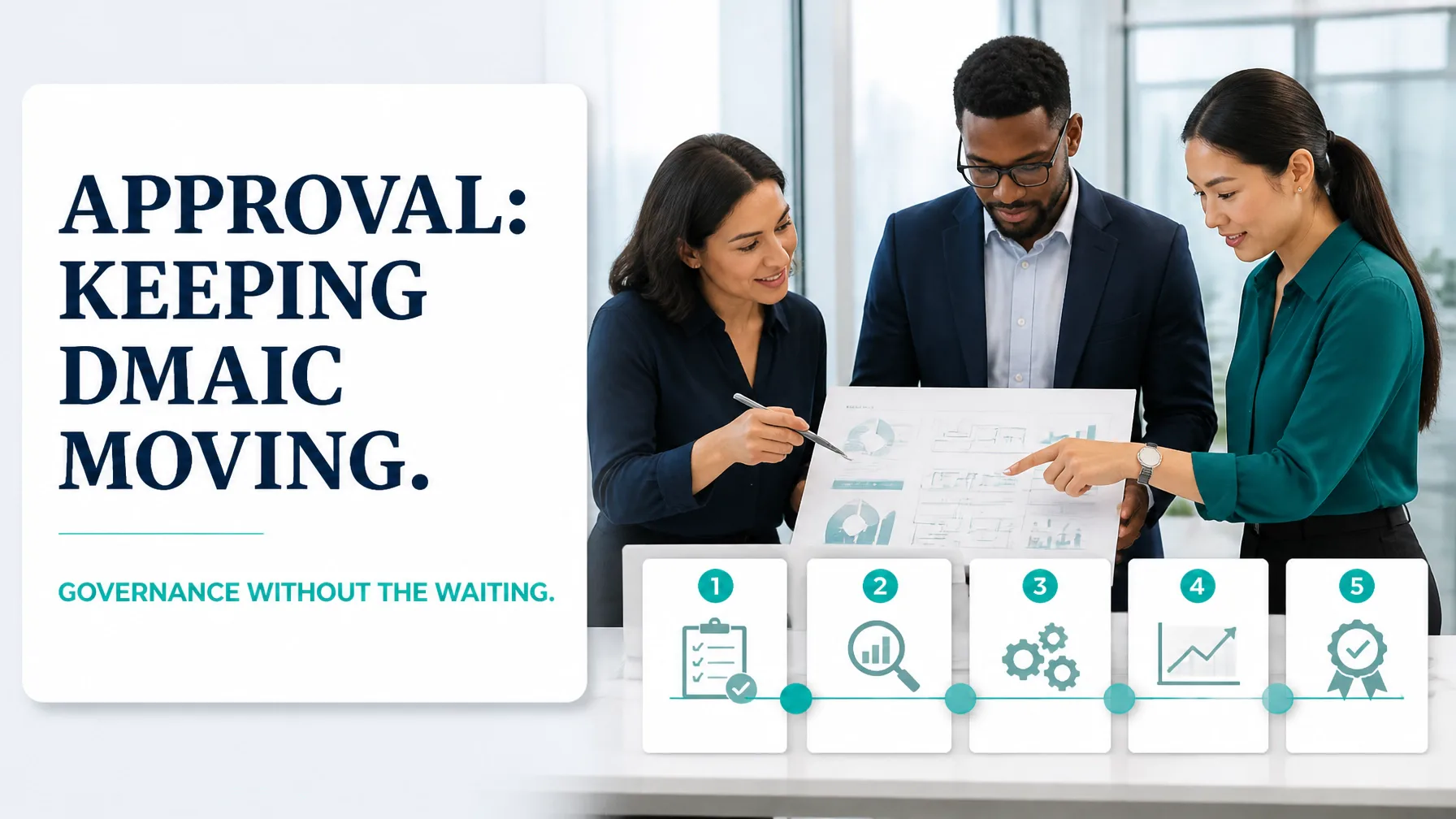
Within the DMAIC methodology: Define, Measure, Analyse, Improve, and Control: formal approvals often appear as tollgates, sign-offs, or stage gates. These checkpoints protect the organisation from investing time and money in poorly defined projects. They also create an opportunity for sponsors, process owners, finance partners, and improvement specialists to confirm that the project remains worthwhile.
However, governance has a flow problem of its own. When every decision depends on one busy executive, when approval criteria are unclear, or when minor projects receive the same review process as enterprise initiatives, Approval becomes a queue. Work waits. Teams lose momentum. Benefits are delayed.
The objective is not to remove governance. The objective is to design approval gates that protect value while allowing good work to flow.
What Does Approval Mean in Lean Six Sigma?
Approval is the formal authorisation to begin, continue, modify, or close a Lean Six Sigma project. It confirms that the required evidence has been reviewed by the appropriate decision-maker.
A typical approval may occur at the following points:
- Project selection: Is this opportunity aligned with strategic priorities?
- Define tollgate: Is the problem, scope, goal, team, and Business Case sufficiently clear?
- Measure tollgate: Is the baseline credible, and can the measurement system be trusted?
- Analyse tollgate: Have the likely root causes been validated with data?
- Improve tollgate: Has the proposed solution been tested and assessed for risk?
- Control tollgate: Are the gains sustainable, documented, and owned by the process?
A gate should produce a clear decision:
- Approved: The project proceeds.
- Conditionally approved: The project proceeds while completing specifically defined actions.
- Returned for rework: Evidence or scope must be corrected before progression.
- Paused or stopped: The project no longer justifies the required investment.
This structure supports accountability. It also prevents a project team from moving into Improve based on assumptions rather than evidence.
For a detailed example of Define-stage governance, see How to Run a Successful Define Phase Tollgate Review.
Why Approval Matters in DMAIC Governance
The fundamental purpose of a tollgate is to create a disciplined decision point. Without it, a project may continue because effort has already been invested, even when the Business Case has weakened or the problem is no longer strategically important.
Effective approval supports four outcomes:
1. Strategic alignment
The project should address a measurable customer, operational, compliance, or financial priority. A sponsor can confirm that the work is relevant to the organisation’s current direction.
2. Evidence-based progression
Each DMAIC phase has a specific purpose. Approval confirms that the team has completed the necessary work before moving to the next type of analysis.
For example, a team should not begin testing solutions in Improve if it has not established a reliable baseline in Measure or validated root causes in Analyse.
3. Resource protection
A formal gate verifies that the project has the people, time, data, technology, and funding required to succeed. This is especially important when a project requires support from several departments.
4. Benefits accountability
Approval links the project to measurable outcomes. The sponsor and process owner can agree on the baseline, target, benefit calculation, and ownership arrangements before implementation begins.
A sound approval process therefore protects both the organisation and the project team. It makes expectations visible.
When Approval Becomes a Bottleneck
A Bottleneck is a constrained step that limits the overall flow or capacity of a process. Approval can become a bottleneck when more work arrives at a decision point than the decision-maker can process.

Common warning signs include:
- Projects waiting several weeks for a sponsor’s signature
- Review meetings repeatedly postponed because key attendees are unavailable
- Multiple committees reviewing the same Business Case
- Teams unsure about the evidence required to pass a gate
- Conditional approvals with no owner or due date for follow-up actions
- Minor projects waiting for the same executive panel as high-risk initiatives
- Approval meetings focused on presentation quality rather than decision quality
This is also a Waiting waste. People may be ready to proceed, but the project is idle because information or authorisation has not arrived. The team may have completed the Define phase, prepared its charter, and built the financial case, yet still spend ten business days waiting for a calendar slot.
The delay is not always visible in the project plan. A project may appear to require 20 working days for Measure, but if it waits 15 days for approval before Measure begins, its elapsed time is substantially longer.
Worked Example: How an Approval Process Delayed a Project
Consider a customer-service improvement project designed to reduce billing enquiry resolution time.
The project’s initial data showed:
- Baseline average resolution time: 5.8 business days
- Annual enquiry volume: 48,000 cases
- Estimated annual benefit: $312,000
- Project implementation cost: $74,000
- Target resolution time: 3.5 business days
- Expected payback period: 3.4 months
The team completed the Define phase in 15 working days. Its Business Case was reviewed by:
- The department manager
- The finance business partner
- The IT service owner
- The steering committee
The approval design required all four sign-offs in sequence. Each reviewer had a scheduled review window every second Friday.
The actual waiting time was:
| Approval step | Review time | Waiting time |
|---|---|---|
| Department manager | 1 day | 4 days |
| Finance partner | 1 day | 6 days |
| IT service owner | 2 days | 5 days |
| Steering committee | 1 day | 10 days |
| Total | 5 days | 25 days |
The project therefore spent 25 working days waiting and only 5 working days under active review. The total Define-to-Measure transition took 30 working days instead of the expected 7.
At an estimated benefit rate of $312,000 per year, the project represented approximately:
- $26,000 in potential benefit per month
- $1,200 in potential benefit per working day, using 260 working days per year
- $30,000 of delayed benefit opportunity across the 25-day approval queue
The project was not failing technically. The governance design was constraining its flow.
Redesigning Approval Gates for Flow
The organisation redesigned the process using a risk-based approval model.
Before redesign
- Four sequential approvals
- Ad hoc document circulation
- No standard response time
- Every project sent to the steering committee
- Repeated review of the same financial assumptions
After redesign
- A standard one-page charter and Business Case template
- One concurrent review by the department manager, finance partner, and IT owner
- A five-business-day service-level expectation
- Steering committee review only for projects above $250,000 investment, high regulatory risk, or cross-enterprise impact
- A documented approve / conditional / rework / stop decision
- Delegated authority for low-risk projects
The revised approval flow produced these results:
| Measure | Before | After |
|---|---|---|
| Sequential approval steps | 4 | 1 concurrent review |
| Waiting time | 25 days | 4 days |
| Active review time | 5 days | 3 days |
| Total transition time | 30 days | 7 days |
| Reduction in elapsed time | : | 76.7% |
The project retained governance but removed unnecessary queues. Based on the same estimated daily benefit, reducing the delay by 21 working days recovered approximately $25,200 in earlier benefit opportunity.
The lesson is important: faster Approval does not mean weaker Approval. It means separating essential decisions from avoidable waiting.
Five Practices for Better Approval Governance

1. Define the evidence before the project reaches the gate
Publish a checklist for each DMAIC tollgate. For Define, this may include:
- Problem statement
- Goal statement
- Scope and exclusions
- Stakeholder analysis
- Baseline assumptions
- Business Case
- Risks and constraints
- Team roles and decision rights
Clear criteria reduce rework because the team knows what “ready” means.
2. Match approval intensity to project risk
Not every improvement requires executive committee review. Use tiers such as:
- Low risk: Process owner and Green Belt approval
- Moderate risk: Sponsor, finance, and relevant functional owner
- High risk: Executive or steering committee approval
This prevents low-risk work from queuing behind major capital or regulatory projects.
3. Review documents concurrently
Sequential review creates unnecessary Waiting. Where possible, give all relevant reviewers access to the same pre-read and ask them to respond within a defined window.
A shared review does not remove accountability. It removes the delay caused by passing one document from inbox to inbox.
4. Use conditional approval intelligently
A conditional approval should identify:
- The exact action required
- The accountable owner
- The due date
- The evidence needed to close the condition
- Whether the project may proceed while the action is completed
“Provide more detail” is not a useful condition. “Add 30 days of baseline data and confirm the operational definition by Friday” is actionable.
5. Track approval performance as a process metric
Approval should be measured like any other process. Useful metrics include:
- Average approval lead time
- Percentage of gates completed within the target time
- Number of review cycles per gate
- Percentage of decisions made at the first review
- Projects waiting by approval stage
- Benefits delayed by approval queues
Use this data to identify the actual constraint. A process map or Lean Six Sigma Project Storyboard Toolkit can help teams visualise phase deliverables, tollgates, and sign-offs in a consistent format.
Building a Business Case That Moves Through the Gate
A strong Business Case makes Approval easier because it translates process performance into organisational value.
Include:
- Current performance and financial impact
- Customer or compliance consequences
- Improvement target
- Expected recurring and one-time benefits
- Implementation and operating costs
- Risks and assumptions
- Payback period or return estimate
- Benefit owner and validation method
The Business Case Financial Calculator can help structure the financial discussion using measures such as NPV, ROI, payback period, and risk-adjusted value.
Approvers should not be asked to approve paperwork. They should be asked to approve a clearly defined opportunity with a credible path to value.
The Leadership Principle: Govern the Work Without Starving the Flow
Approval is essential to Lean Six Sigma governance. It creates discipline, confirms alignment, protects resources, and establishes accountability throughout DMAIC.
Yet every approval step consumes capacity. If the process requires too many signatures, unclear criteria, or unavailable decision-makers, the gate becomes a Bottleneck. The resulting Waiting delays customer value, financial benefits, and organisational learning.
The strongest governance systems use clear criteria, risk-based authority, concurrent review, defined response times, and measurable performance. They preserve control while allowing capable teams to move.
Build the skills to design effective DMAIC governance, manage tollgates, and deliver measurable improvement through accredited six sigma training. Explore Lean 6 Sigma Hub’s self-paced Lean Six Sigma online training and pursue the certification level that matches your professional goals.
Kaizen. Kai-Care. Kai-Done. ( Lean Six Sigma)