
In the realm of operational excellence, the 5S methodology is frequently misunderstood as a simple housekeeping exercise. Many organizations initiate a "5S event," clear out the clutter, paint some lines on the floor, and declare victory. However, the fundamental purpose of 5S is not to create a clean environment; it is to establish a behavioral foundation for high performance.
When the initial excitement of a cleanup fades, the true challenge begins: the transition from a physical state to a psychological discipline. To move beyond the basics of Sort, Set in Order, and Shine, leaders must embed a culture of continuous discipline where excellence is the default, not a reaction to an upcoming audit.
Reframing 5S: From Housekeeping to a Behavioral Contract
To fully appreciate the power of 5S, one must view it through the lens of a behavioral contract. In high-performance environments, every label, shadow board, and floor marking is a visual standard that dictates how work is performed. When these standards are ignored, it is not merely a "mess": it is a process deviation.
For professionals leading these transformations, such as those pursuing a Lean Six Sigma Black Belt, the focus shifts from the tools themselves to the discipline required to maintain them. The first three stages: Sort, Set in Order, and Shine: are the preparation. The final two: Standardize and Sustain: are where the organizational culture is either forged or fractured.

The Fifth S: Sustain as Leadership Governance
The Japanese term for Sustain is Shitsuke, which translates more accurately to "discipline" or "training." In the Lean 6 Sigma Hub Glossary, sustaining is defined as the act of institutionalizing improvements so they become the new norm.
Sustainability cannot be delegated to the front line alone; it is a governance framework driven by leadership. This is where the role of the Master Black Belt becomes critical. A Master Black Belt does not just fix processes; they build the governance systems that ensure those processes stay fixed. This involves:
- Layered Audits: Moving away from "policing" and toward coaching. Leaders at every level must participate in frequent, short checks to verify that standards are being met and to remove obstacles for the team.
- Leader Standard Work: Defining specific, recurring tasks for managers to ensure they are visible at the Gemba (the real place where work happens).
- Visual Governance: Ensuring that every abnormality: whether it is a missing tool or a lagging metric: is instantly visible to anyone walking through the area.
Daily Management Systems: The Pulse of High Performance
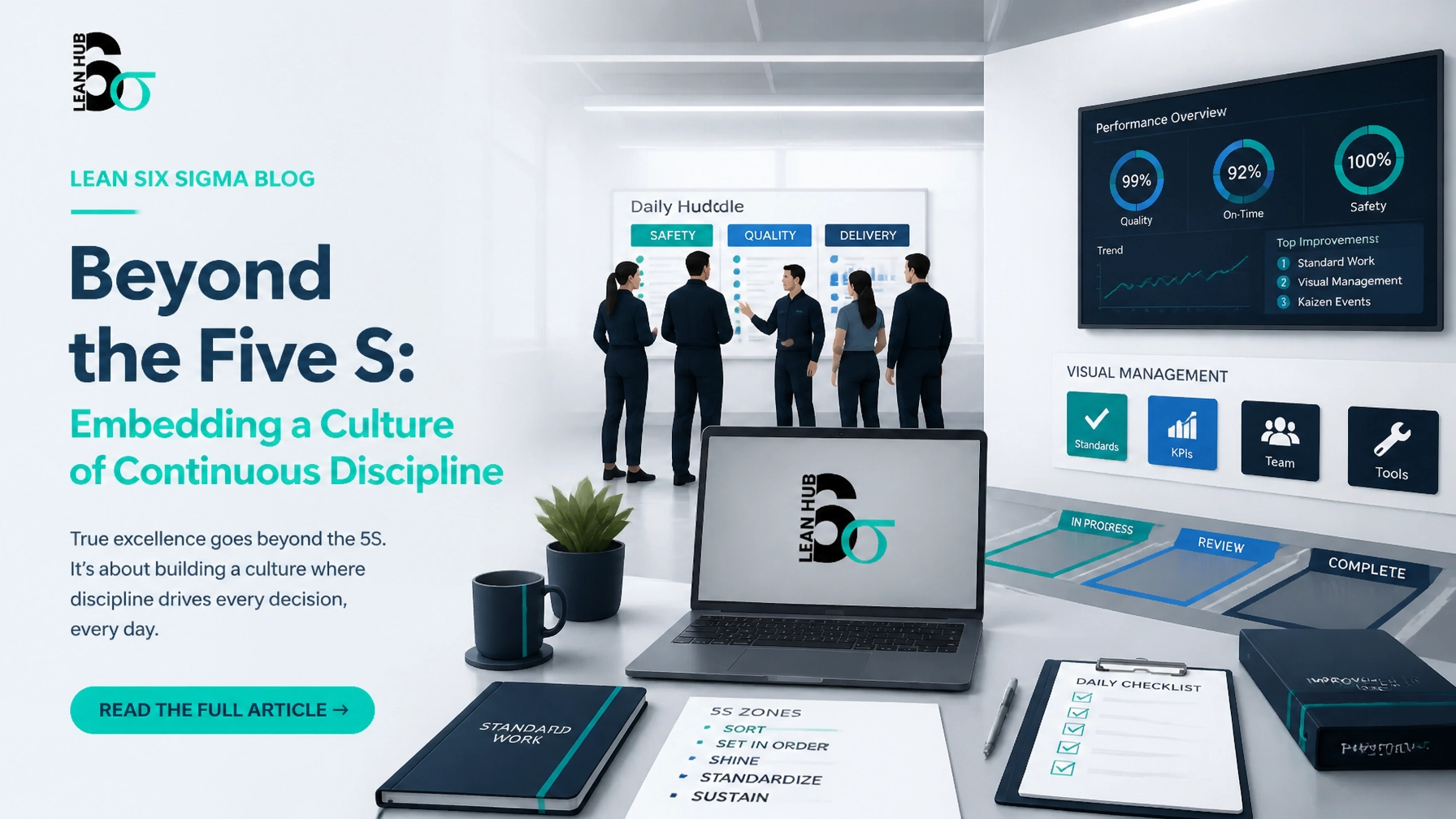
A culture of continuous discipline requires a rhythmic pulse. This is achieved through a Daily Management System (DMS). A robust DMS integrates 5S with performance metrics to ensure that the "state of the union" is understood by every employee, every single day.

The cornerstone of this system is the Daily Huddle. During these 10-minute stand-up meetings, teams review their performance against targets in safety, quality, delivery, and cost. By standing in a 5S-maintained area and reviewing visual controls, the team reinforces the link between their environment and their results.
Key components of a disciplined DMS include:
- Red/Green Visuals: Using simple indicators to show if a process is within its defined limits.
- Kaizen Boards: A visible place to log small problems discovered during the 5S audit and track their resolution.
- Escalation Triggers: Clear rules on when a minor deviation requires a more formal Root Cause Analysis.
5S in the Digital and Transactional World
While 5S was born on the factory floor, its application in logistics, finance, and IT is perhaps even more critical. In a transactional environment, "clutter" is invisible. It exists in bloated email inboxes, redundant file structures, and convoluted approval loops.
Applying continuous discipline in these realms involves:
- Digital Sorting: Eliminating redundant, obsolete, or trivial (ROT) data to improve retrieval times.
- Standardizing Workflows: Ensuring that every Process Analyst follows the same protocols for data handling and project documentation. To understand the balance required here, see our guide on The Relationship Between Standardisation and Flexibility.
- Visualizing Information Flow: Using digital Kanban boards to make the status of invisible work "visible" to the entire team.
The ROI of Discipline: Data-Driven Outcomes
Organizational efficiency is not a vague concept; it is measurable. When 5S is treated as a discipline, the impact on key metrics is profound. In a study involving global logistics operations, firms that moved from "Cleanup 5S" to "Continuous Discipline" saw:
- 30% Reduction in Lead Time: By eliminating the "search waste" (Motion) associated with missing information or tools.
- 15% Improvement in OEE (Overall Equipment Effectiveness): Through better equipment care and earlier detection of abnormalities.
- Significant Safety Gains: A direct correlation exists between 5S scores and a reduction in lost-time incidents.

Implementing the Governance Framework: A 3nd Step Protocol
To transition your organization beyond the initial 5S setup, follow this high-standard protocol:
- Define the Behavioral Standards: Document exactly what "good" looks like with photos and clear Standard Work instructions. Ambiguity is the enemy of discipline.
- Establish the Audit Rhythm: Implement layered audits that involve everyone from the operator to the CEO. Use these as teaching moments, not disciplinary actions.
- Link Discipline to Strategy: Utilize Hoshin Kanri (Policy Deployment) to ensure that the discipline maintained at the department level directly supports the organization’s high-level strategic goals.
Conclusion: Pursue Professional Mastery
Embedding a culture of continuous discipline is the hallmark of a world-class organization. It requires a shift from "doing Lean" to "being Lean." This level of cultural transformation demands highly skilled leaders who understand the deep mechanics of human behavior, data analysis, and process governance.
If you are ready to lead your organization beyond the basics and into the realm of enterprise-wide excellence, you must arm yourself with accredited, practical knowledge. Take the next step in your professional development and enroll in the Lean Six Sigma Black Belt Certification or the Master Black Belt Program today to master the architecture of high-performance cultures.