Most process documentation fails for the same reason: it reduces a living process to a static list of boxes. The list may show what happens, but it rarely shows who owns each step, where decisions change the route, how work moves between departments, or how long the customer waits.
BPMN 2.0 exists precisely to capture those elements. Yet the notation has a reputation for being more difficult than the process it describes. For many practitioners, the challenge is not understanding the purpose of a gateway or swimlane. It is finding a practical way to model a real process without first completing a notation course.
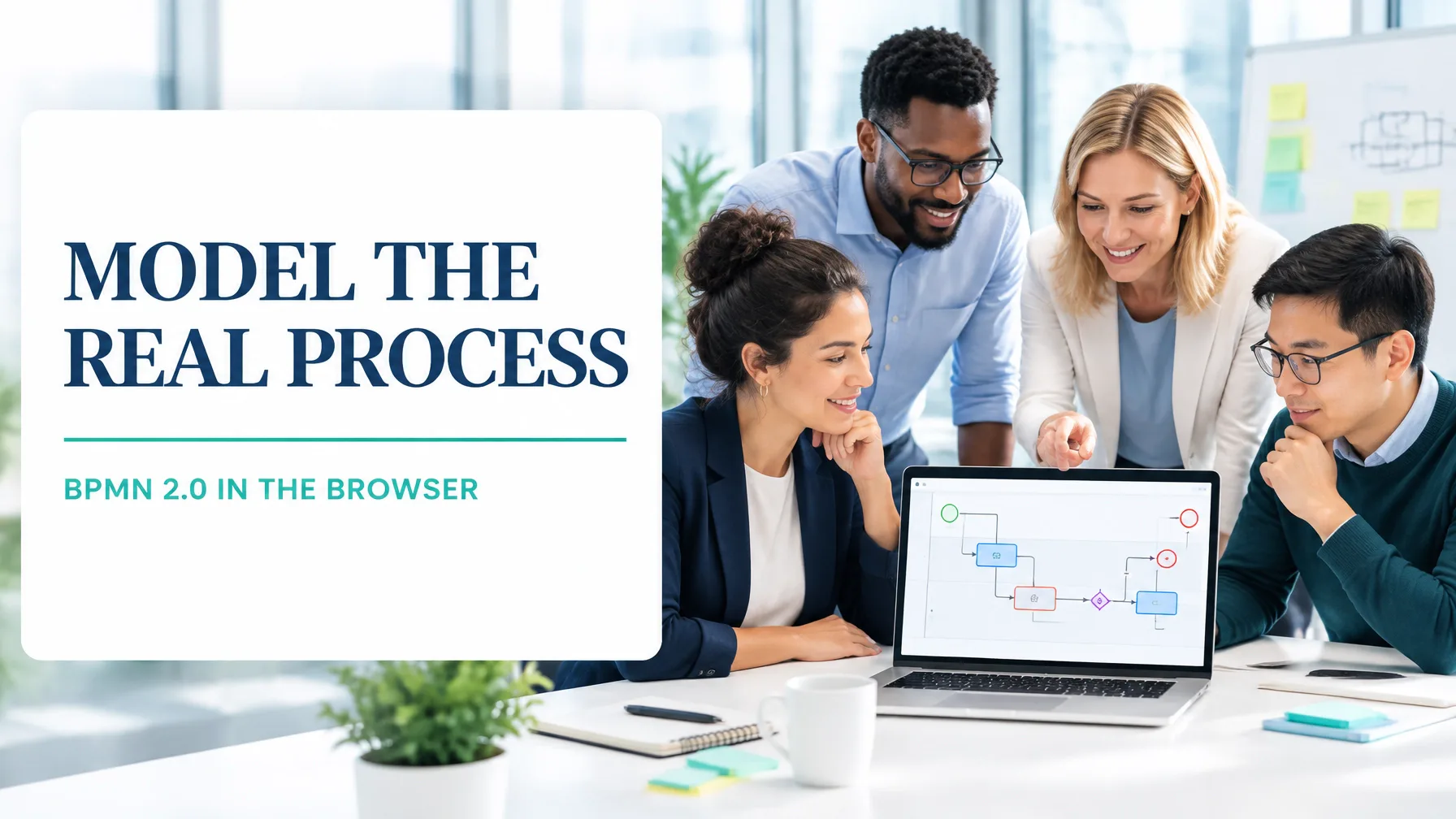
The BPMN 2.0 process modeller inside Ci Flow provides that practical route. It helps process analysts and improvement teams build an editable process map, validate its logic, record timing and export structured evidence. All within the same operational excellence workspace.
What the BPMN 2.0 Modeller Does
A useful process model must be more than a diagram that looks complete in a workshop. It should be editable, reviewable and sufficiently structured to support analysis, governance and improvement.
Inside Ci Flow, practitioners can:
- Build as-is and future-state process maps.
- Use BPMN 2.0 events, activities, gateways, connectors and swimlanes.
- Assign activities to the appropriate department, role or system.
- Edit connectors when the process logic changes.
- Record task durations and waiting durations.
- Validate the model before stakeholder review.
- Export structured process information for documentation, audits and business cases.
The result is a process model that can continue developing as evidence improves. It is not a one-time workshop artefact. It becomes part of the project record.
For teams working across DMAIC, RDMAICS, A3 or Kaizen projects, this provides a stronger connection between process understanding and improvement governance. A process map can support the Define and Measure work, inform the Analyse phase, and provide a reference point during future-state validation.

Why Swimlanes and Gateways Earn Their Place
Consider a purchase approval process involving three departments:
- Operations submits a purchase request.
- Finance checks completeness and budget.
- Compliance performs a risk review before final approval.
A conventional procedure might describe this in several paragraphs. A BPMN model makes the responsibility and logic visible immediately.
Worked Example: The Approval Process
The process begins when Operations submits a request. Finance checks whether the request includes the required supplier, cost centre, quotation and business justification.
The first gateway asks:
Is the request complete?
If the answer is no, the request returns to Operations for correction. Once corrected, it loops back to Finance for another completeness check. This is the rework loop: visible, measurable and assigned to an owner.
If the request is complete, Finance performs a budget review. The process then moves to Compliance, where the second gateway asks:
Does the request meet the risk criteria?
If yes, the request proceeds to approval and release. If not, Compliance escalates the request for an exception decision rather than allowing the process to move forward automatically.
The swimlane layout exposes the handoffs:
| Process activity | Owner | BPMN significance |
|---|---|---|
| Submit purchase request | Operations | Start activity |
| Check completeness | Finance | Cross-lane handoff |
| Is the request complete? | Finance | Exclusive gateway |
| Correct missing information | Operations | Rework activity |
| Review budget | Finance | Control activity |
| Assess risk | Compliance | Specialist review |
| Does the request meet risk criteria? | Compliance | Exclusive gateway |
| Approve and release | Finance | Completion activity |
Without swimlanes, the handoff from Operations to Finance and then to Compliance may be hidden in prose. Without gateways, the rework and escalation routes may be described vaguely as “return if required.”
BPMN makes the process logic explicit. Inside Ci Flow’s process modeller, those elements remain editable, so the team can refine the model when interviews, observations or data reveal a more accurate operating pattern.
Timing as First-Class Process Data
A process map that records only sequence answers the question, “What happens next?” A process map that records duration and waiting answers the more valuable question, “Why does the customer experience take this long?”
Suppose the current-state approval process contains the following timing:
| Step | Touch time | Waiting time |
|---|---|---|
| Operations submits request | 15 minutes | – |
| Finance checks completeness | 20 minutes | 1 business day |
| Operations corrects incomplete request | 15 minutes | 1.5 business days when rework occurs |
| Finance reviews budget | 30 minutes | – |
| Compliance assesses risk | 45 minutes | 2 business days |
| Finance approves and releases | 10 minutes | 0.5 business day |
The direct work content is approximately 120 minutes, yet the normal lead time is approximately 3.5 business days plus processing time. If 25% of requests enter the rework loop, the expected lead time increases further.
That distinction is central to Lean analysis. The process may contain only two hours of actual work while the customer experiences nearly four business days of elapsed time.
Recording these values directly on the model turns the diagram into a diagnostic. It helps the team distinguish:
- Value-adding work from administrative activity.
- Processing time from queue time.
- Rework time from first-time-through work.
- Structural delay from occasional variation.
This is also where BPMN complements tools such as process cycle efficiency analysis. The model explains where time exists; the analysis helps quantify the proportion of lead time spent on value-adding activity.

Validation and Structured Export
A process model should be reviewed for meaning, not just appearance. A visually attractive map can still contain disconnected activities, incomplete paths or gateways with unclear outcomes.
Validation helps identify structural issues before a stakeholder, auditor or project tollgate exposes them. Typical checks include:
- Is there a clear process start?
- Does every activity connect to the wider flow?
- Does each gateway have defined outgoing paths?
- Are decision outcomes labelled clearly?
- Does the process reach a valid end state?
- Is every activity assigned to an appropriate lane?
- Are rework paths connected to the step that genuinely receives the work?
This matters because a disconnected flow is not merely a drawing error. It may represent an undocumented business rule, an unclear ownership boundary or a missing control.
Structured export extends the value of validation. The model can leave the platform and remain useful in:
- Standard operating procedure documentation.
- Audit evidence packs.
- Project tollgate presentations.
- Business cases for process redesign.
- Training materials for new team members.
- Future-state implementation plans.
The model remains a reusable source of process evidence rather than a diagram trapped inside a single workshop file.
From As-Is to Future-State
The strongest improvement teams do not create a current-state map and then abandon it. They use the current state as the baseline for a future-state design.
In the approval example, the future state might introduce:
- A guided request form that prevents missing information.
- Automated completeness checks before Finance receives the request.
- A risk questionnaire that routes only relevant cases to Compliance.
- A service-level timer for requests waiting in a departmental queue.
- A visible exception path for requests outside delegated authority.
The future-state model can then be compared with the current state in the same workspace:
| Measure | Current state | Future state |
|---|---|---|
| Rework rate | 25% | 8% |
| Average waiting time | 3.5 business days | 1 business day |
| Direct processing time | 120 minutes | 90 minutes |
| Expected lead time | Approximately 4 business days | Approximately 1.1 business days |
The improvement is now provable. At the next tollgate, the team can review not only the proposed design but also the specific changes in ownership, decision logic, waiting time and rework exposure.
Five Questions to Answer Before Opening the Modeller
Preparation improves modelling speed and quality. Before building the first element, answer these questions:
-
What is the trigger?
Identify the event that starts the process. This could be a submitted request, a customer order, a defect notification or a scheduled review. -
What is the completed outcome?
Define what “done” means. Approval issued, service delivered, record closed and payment released are different outcomes. -
Which lanes represent genuinely different owners?
Use lanes for departments, roles or systems that have distinct accountability. Avoid creating a lane for every individual involved. -
Which decisions change the path?
A gateway belongs where the answer determines what happens next. Label both the question and the outgoing outcomes. -
Where does work wait?
Record queue points, handoff delays, batch schedules and approval intervals. Waiting is often the largest component of lead time.
These questions keep the model focused on the operating reality instead of encouraging unnecessary notation complexity.
Who This Is For
The BPMN 2.0 modeller is particularly useful for:
- Process analysts documenting ownership, handoffs and decision logic.
- Business analysts translating operational requirements into a shared process view.
- Lean Six Sigma practitioners establishing a baseline for Measure and Analyse work.
- Improvement practitioners documenting a process for the first time.
- Project teams comparing as-is and future-state designs.
- Quality and compliance teams preparing process evidence that can withstand an audit.
- Operational leaders who need process visibility without relying on disconnected files.
You do not need to become a BPMN specialist before creating a useful model. Start with the trigger, outcome, owners, decisions and waiting points. Then use the modeller to refine the structure and validate the flow.
Model Your First Process in Ci Flow
A process map becomes valuable when it captures the decisions, ownership and timing that shape real performance. BPMN 2.0 provides the language; a practical browser-based workspace makes that language accessible to the people closest to the work.
Model your first process free for 14 days at Ci Flow, no credit card required, with example projects included.
Kaizen. Kai-Care. Kai-Done. Lean Six Sigma