Let’s be honest: humans are the weakest link in any process. We’re distracted, we’re tired, we’re hungry, and occasionally, we’re just plain clumsy. You can provide the best training in the world, write a 50-page manual, and hold a dozen "awareness sessions," and someone will still find a way to plug a square peg into a round hole.
If you’re relying on "being more careful" as your primary quality control strategy, you’ve already lost.
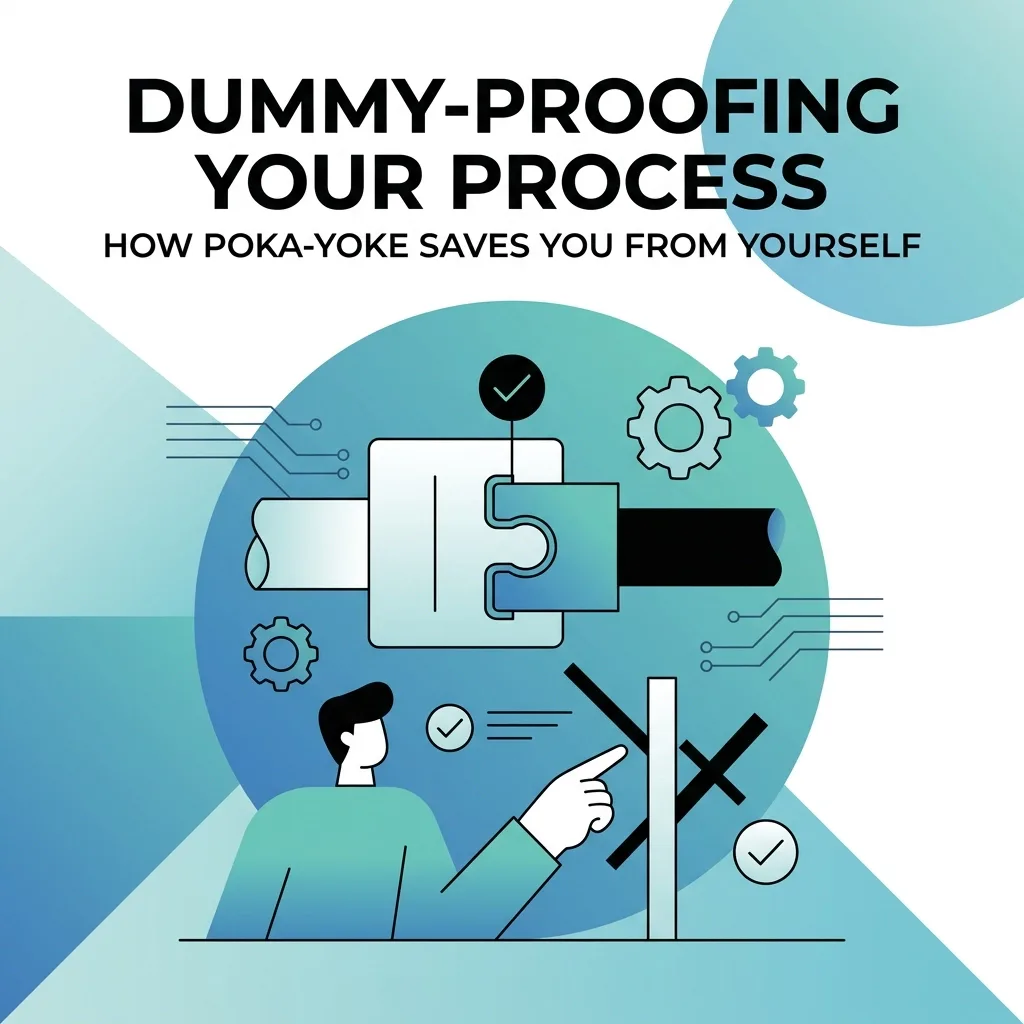
In the world of Lean Six Sigma, we don’t blame the person; we blame the process. This is where Poka-Yoke comes in. It is the art and science of "mistake-proofing" your workflow so that doing the wrong thing becomes difficult: or, ideally, physically impossible.
What is Poka-Yoke? (And Why "Dummy-Proofing"?)
The term Poka-Yoke (pronounced POH-kah YOH-kay) was coined by Shigeo Shingo in the 1960s as part of the Toyota Production System. Interestingly, it was originally called Baka-Yoke, which translates literally to "idiot-proofing." Shingo changed the name because workers found it offensive. He realized that the goal wasn't to call people idiots, but to acknowledge that even the most intelligent, skilled worker is prone to inadvertent errors.
At its core, Poka-Yoke is about quality at the source. It’s a mechanism that either prevents an error from happening or makes the error so blindingly obvious that it is caught and corrected before it moves downstream. If you want to dive deeper into the terminology, check out our Lean Six Sigma Concepts and Glossary.
Why You Can’t "Train" Away Human Error
Traditional management loves to respond to mistakes with "more training." But here’s the high-attitude truth: Training is a weak control.
Why? Because human error isn’t usually a lack of knowledge; it’s a lapse in execution.
- You know you need to attach the file to the email, but you hit "send" anyway.
- You know the car shouldn't start in Drive, but you might forget and try it if you’re in a rush.
- You know the patient’s allergies, but in a chaotic ER, you might reach for the wrong vial.
Poka-Yoke doesn't care about your intentions. It builds the "standard work" into the physical or digital environment. It saves you from yourself by removing the choice to fail.
The Two Faces of Poka-Yoke: Prevention vs. Detection
When we implement mistake-proofing, we generally aim for one of two outcomes:
1. Prevention (The Gold Standard)
This is the "Control" method. It makes it physically or logically impossible for the error to occur.
- Example: You cannot put your car into "Reverse" while you are driving 70 mph on the highway. The transmission system physically blocks the action to prevent a catastrophic failure.
- Example: A 3-prong electrical plug. You cannot plug it in upside down. The geometry of the device dictates the correct usage.
2. Detection (The Warning System)
This is the "Warning" or "Shutdown" method. The error might happen, but the process stops immediately, or a loud alarm sounds so the defect doesn't move forward.
- Example: Your car beeps incessantly if you don't buckle your seatbelt. It doesn't stop the car from moving (usually), but it makes it impossible to ignore the mistake.
- Example: Spellcheck in your browser. It doesn't stop you from typing "mispelled," but it highlights it in red immediately.
 A visual representation of common everyday Poka-Yoke examples like USB-C cables and elevator sensors.]
Poka-Yoke in the DMAIC Framework
In a Lean Six Sigma project, Poka-Yoke is most frequently utilized during the Improve Phase. Once you have identified root causes through process mapping, you need solutions that stick.
Mistake-proofing is a favorite tool for Setup Time Reduction because it eliminates the "adjustment" phase where operators have to fiddle with settings to get them "just right." If the machine only fits one way, there is no adjustment needed.

Once the Poka-Yoke is implemented, it becomes a permanent part of your process documentation, ensuring that the improvement is sustained long after the project team has moved on.
6 Ways Poka-Yoke Makes You Look Like a Genius
If you're looking to justify a Poka-Yoke investment to your boss (or Jvalin), here are the heavy-hitting benefits:
1. It Slashes Defect Rates
When you move from "inspection" (finding mistakes after they happen) to "prevention" (stopping them from happening), your Sigma level skyrockets. You aren't just fixing bugs; you're deleting the possibility of bugs.
2. It Eliminates Waste
Rework is the ultimate "non-value-added" activity. Every minute spent fixing a mistake is a minute you could have spent making money. Poka-Yoke keeps your "First Pass Yield" high and your scrap pile low.
3. it Simplifies Training
Imagine a process so well-designed that a new hire can be productive on day one without a 200-page SOP. If the system guides the user (via color-coding, shapes, or digital prompts), the "learning curve" becomes a flat line.
4. It Improves Safety
In high-risk environments, Poka-Yoke isn't just about quality; it's about life and death. Interlocks that prevent machines from running while a guard is open are classic Poka-Yoke devices.
5. It Boosts Morale
Nobody goes to work wanting to screw up. Errors lead to frustration, finger-pointing, and stress. By "dummy-proofing" the process, you remove the anxiety of making a mistake, allowing your team to focus on higher-level problem-solving.
6. It’s a "Set and Forget" Solution
Unlike a tollgate review, which requires manual oversight, a physical Poka-Yoke works 24/7 without supervision.
How to Implement Mistake-Proofing in 5 Steps
Don't overcomplicate this. Poka-Yoke is most effective when it is simple and cheap.
- Identify the Defect: Look at your data. Where are the recurring "oops" moments? Use your SIPOC to see where inputs go sideways.
- Trace it to the Source: Where exactly is the mistake made? Is it a data entry error? A misaligned part? A forgotten signature?
- Choose Your Strategy: Can you eliminate the step? Replace it with an automated one? Facilitate it with better tools? Or detect it immediately?
- Design the Device: Whether it’s a drop-down menu in Excel that limits choices or a physical jig on a workbench, keep it robust.
- Test and Standardize: Ensure the Poka-Yoke itself doesn't create a new bottleneck. Once it works, update your standard work.
Real-World Examples to Steal
- Digital: A website form that won’t let you click "Submit" until the phone number field has 10 digits.
- Office: An email "Undo Send" button that gives you a 10-second window to realize you forgot the attachment.
- Logistics: Barcode scanners that beep a "low tone" if the wrong item is picked and a "high tone" if it's correct.
- Manufacturing: Guide pins that ensure a part can only be placed on a machine in the correct orientation.
The Bottom Line: Respect the Human, Fix the System
Poka-Yoke is the ultimate sign of respect for your workforce. It acknowledges that people are valuable for their creativity and problem-solving skills, not for their ability to act like robots who never lose focus.
By dummy-proofing your processes, you free your people to do the work that actually matters. You move from a culture of "Who messed up?" to "How can we make it impossible to mess up?"
If you’re ready to stop firefighting and start engineering excellence, it’s time to get serious about your Lean Six Sigma journey. Whether you're looking for Quick Wins or Long-Term Solutions, mastering tools like Poka-Yoke is the fastest way to prove your value as a leader.
Ready to become a master of process improvement? Take the next step in your career and earn your certification today.
Enrol in our Black Belt Training and Certification Program