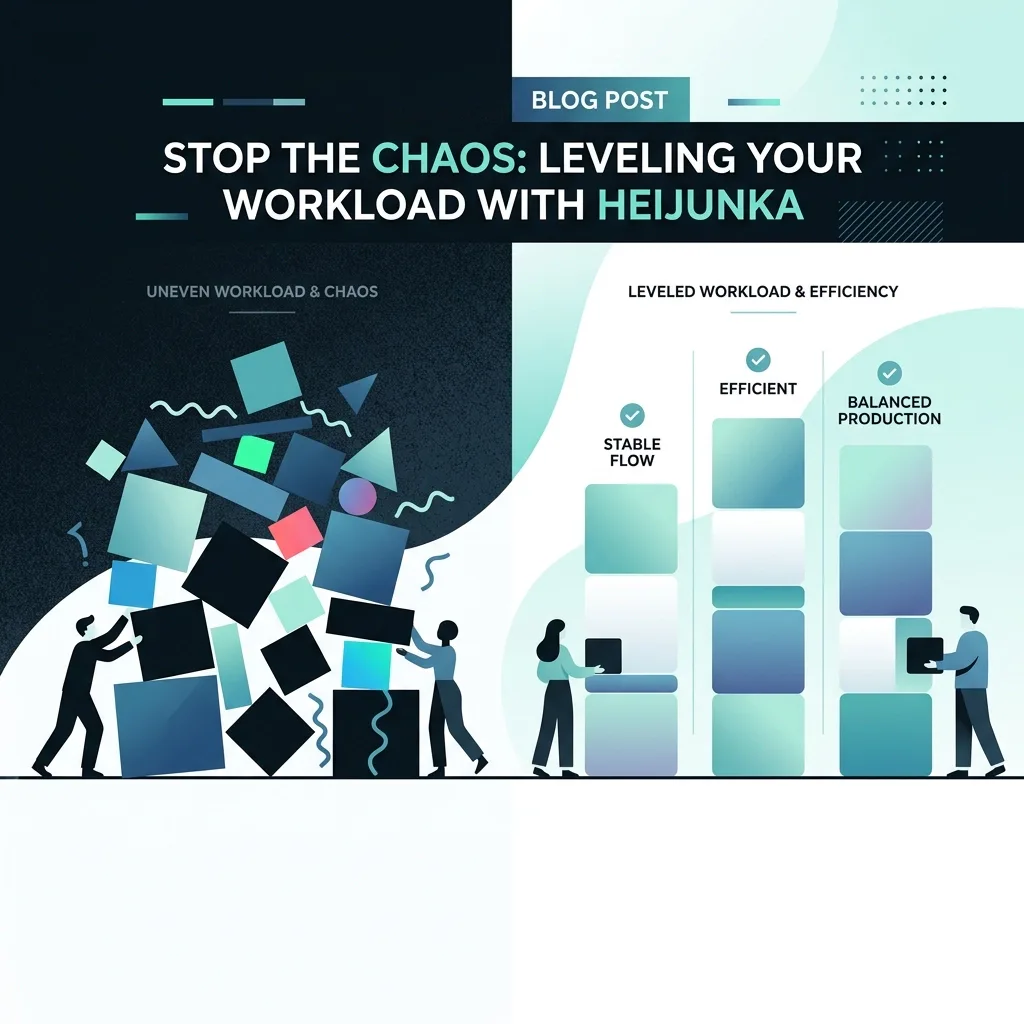
If your Monday mornings feel like a scene from a disaster movie and your Thursday afternoons feel like a ghost town, you aren’t "riding the waves of demand." You’re drowning in them. In the world of Lean Six Sigma, we call this Mura, the waste of unevenness. It’s the silent killer of productivity, the father of burnout, and the primary reason why your quality scores look like a heart rate monitor.
Most managers try to fight this chaos by working harder, screaming louder, or throwing more overtime at the problem. They embrace the "batch-and-queue" madness, thinking that if they just push the pile through, things will stabilize. Spoiler alert: they won't. To truly stop the chaos, you need to master Heijunka.
Heijunka is the Japanese art of workload leveling. It’s about taking those lumpy, unpredictable spikes in demand and turning them into a steady, predictable drumbeat. It’s the difference between a flash flood and a controlled irrigation system. Let’s dive into how you can stop reacting to the storm and start controlling the flow.
The Madness of Batch-and-Queue
Before we talk about the solution, let's look at the enemy. Batch-and-queue is the "traditional" way of working. You wait for a huge pile of orders to arrive, you process them all at once (the batch), and then you send them to the next station where they sit in another pile (the queue).
The problem? Batching creates massive lead times. If you are "Product C" at the bottom of a batch of 500 "Product A’s," you’re going to be waiting a long time before anyone even touches you. This creates a "bullwhip effect" where small ripples in customer demand become massive tidal waves of work for the shop floor or the office.
Heijunka kills the batch. It moves us toward a world where we produce what the customer wants, when they want it, in a way that doesn't break our equipment or our people. To get a better grasp on these foundational terms, you can always check out our Lean Six Sigma Concepts and Glossary.
Leveling by Volume: The "How Much"
The first pillar of Heijunka is Volume Leveling. This is about smoothing out the amount of work you do every day.
Imagine your weekly demand looks like this:
- Monday: 400 units
- Tuesday: 100 units
- Wednesday: 250 units
- Thursday: 50 units
- Total: 800 units
In a traditional environment, Monday is a nightmare. Everyone is stressed, errors are made, and machines are pushed to their limits. By Thursday, half the team is cleaning their desks because there’s nothing to do.
Under Heijunka, you calculate the average demand. Over 4 days, 800 units means an average of 200 units per day. Instead of chasing the daily spikes, you plan to build 200 units every single day.
- On Monday, you build 200 and fulfill the rest of the demand from a small "finished-goods buffer."
- On Thursday, you still build 200, replenishing that buffer.
The result? Your staffing is stable. Your machines aren't being redlined. Your stress levels plummet. You’ve moved from firefighting to a steady pace, the Takt Time, which is the heartbeat of your process.

Visualizing the shift from "Spiky Demand" to "Leveled Volume"
Leveling by Mix: The "What Type"
Volume is only half the battle. If you make 200 units a day, but you spend all of Monday making Type A, Tuesday making Type B, and Wednesday making Type C, you’re still batching. This is where Mix Leveling comes in.
Instead of running big batches like AAAAA BBBB CC, Heijunka encourages you to interleave the work: A B A A C A B A.
Why bother? Because it makes you flexible. If a customer suddenly needs a "Type C" unit on Monday afternoon, and you’ve already switched to a leveled mix, you can give it to them. If you’re in a batch-and-queue mindset, that customer is waiting until Wednesday.
However, there is a catch. To level the mix, you have to be able to switch between tasks quickly. If it takes you four hours to change a machine setup, you can’t run small batches. This is why understanding setup time reduction (SMED) is non-negotiable for anyone serious about Heijunka.

The Visual Engine: The Heijunka Box
You can’t manage Heijunka in your head, and you certainly shouldn't try to manage it with a complex, hidden spreadsheet that only one person understands. You need a Heijunka Box.
A Heijunka Box is a physical (or digital) scheduling board that visualizes the leveled schedule.
- The Rows: Represent the different product types or services (Product A, B, C).
- The Columns: Represent time buckets (e.g., every 30 minutes, or every hour).
- The Slots: These hold Kanban cards.
Each card represents a job. The team simply "pulls" the next card from the current time slot. If it’s 10:00 AM, and the slot has two "Type A" cards and one "Type B" card, that is exactly what the team works on. It removes the guesswork and the constant "What should I do next?" questions that plague unorganized shops.

Example of a Heijunka Box with time slots and product rows.
Implementing Heijunka: A 5-Step Battle Plan
Ready to stop the chaos? Don't try to flip the switch on your entire factory overnight. Follow this roadmap:
1. Stabilize the Basics
Heijunka will fail if your process is a mess. If your machines break down every two hours or your staff doesn't follow standard work, a leveled schedule will just highlight how broken you are. Ensure you have documented your process changes properly before you try to level them.
2. Choose Your Pacemaker
Pick one line or one department to act as your "pilot." Look for the "pacemaker" process, the point in your value stream that dictates the pace for everything else. This is usually the closest point to the customer.
3. Calculate Average Demand and Takt Time
Look at the last 3 months of data. What is the real average? Don't plan for the "worst-case scenario" peak demand, or you'll have too much waste. Plan for the average, and use a small buffer to handle the outliers.
4. Categorize by Volume (ABC Analysis)
- A Items: High volume. These should be in your Heijunka box every single day.
- B Items: Medium volume. Maybe they appear in the box every other day.
- C Items: Low volume. These are scheduled in specific "windows" once a week.
5. Install Visual Controls
Whether it’s a physical board or a digital FIFO (First-In, First-Out) lane, make the schedule visible to everyone. If the board is full, you don't add more work. This creates a hard limit on Work in Progress (WIP).
Heijunka in the Office (Yes, it Works There Too)
Don't think this is just for people in hard hats. If you work in an office, your "inventory" is just invisible. It’s the unread emails, the pending approvals, and the half-finished reports sitting in your "In" box.
A customer service team can use Heijunka to level their workload. Instead of everyone rushing to answer the "easy" tickets first (batching), they can use a leveled mix to ensure complex cases are handled throughout the day. This prevents the "Friday afternoon nightmare" where all the difficult work has been pushed to the end of the week.
Applying these concepts to service industries is often one of those quick wins vs. long-term solutions that can provide immediate relief to a stressed-out team while building the foundation for lasting success.
Common Pitfalls: Why Leveling Fails
Heijunka is powerful, but it’s not magic. Most failures come down to three things:
- Ignoring Changeovers: If you try to mix your products but your changeover times are huge, your productivity will crater. You must reduce setup times first.
- No Buffer: If you have zero finished-goods buffer and zero "backlog" of orders, you are at the mercy of demand. Heijunka requires a "shock absorber."
- Set and Forget: Demand changes. Your leveled rate needs to be reviewed and adjusted (usually monthly or quarterly) to stay in sync with the market.
Stop Reacting. Start Leading.
The chaos of lumpy demand is an choice. You can choose to keep firefighting, or you can choose to implement a system that levels the playing field. Heijunka isn't just a scheduling tool; it's a philosophy that respects your people by giving them a predictable, manageable pace of work.
If you’re ready to move beyond the basics and start leading high-level transformations like this, it’s time to level up your own skills. Mastery of concepts like Heijunka is exactly what separates a process participant from a true Six Sigma leader.
Stop settling for "busy" and start aiming for "balanced." Enroll in our Black Belt Certification today and learn how to lead your organization out of the chaos and into a state of high-efficiency flow.