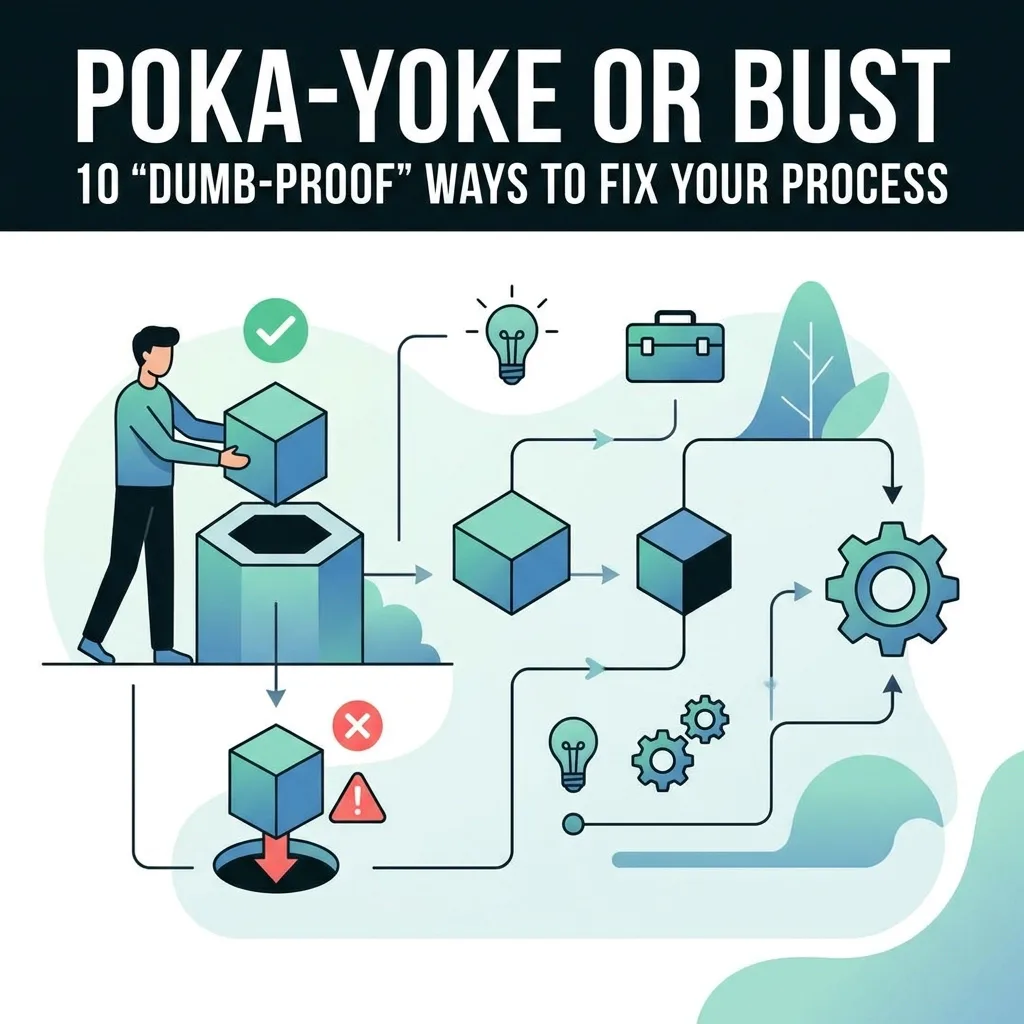
In the realm of operational excellence, the margin for error is increasingly narrow. High-volume manufacturing, complex service delivery, and digital workflows all share a common vulnerability: the human element. Even the most highly trained professionals are susceptible to fatigue, distraction, and cognitive overload. To mitigate these risks, industry leaders turn to a fundamental Lean Six Sigma concept known as Poka-Yoke.
The fundamental purpose of Poka-Yoke, or mistake-proofing, is to design processes so that errors are either physically impossible to commit or immediately detectable upon occurrence. Originating from the Toyota Production System and championed by industrial engineer Shigeo Shingo, this methodology moves away from the archaic reliance on inspection and moves toward proactive prevention. To fully appreciate the impact of mistake-proofing, one must understand that "quality by inspection" is a reactive, costly strategy that fails to address the root cause of defects.
The Technical Framework of Mistake-Proofing
According to the Lean Six Sigma concepts and glossary, mistake-proofing involves a structural shift in how work is performed. There are two primary approaches to implementing Poka-Yoke:
- The Control Method: This is the most robust form of mistake-proofing. It physically prevents an error from happening. For example, a machine that will not start unless a safety guard is in place.
- The Warning Method: This approach alerts the operator that an error has occurred or is about to occur through sensory signals: visual, auditory, or tactile. While it does not physically stop the process, it demands immediate attention to prevent the defect from moving downstream.
When these methods are integrated into a process, the Process Sigma Level increases significantly because the probability of defects (DPMO) drops toward zero. Organizations often explore these solutions during the "Improve" phase of a DMAIC project, particularly when balancing quick wins vs. long-term solutions.
10 Practical "Dumb-Proof" Examples of Poka-Yoke
To ground these theoretical concepts in reality, let us examine ten high-impact examples of mistake-proofing that can be applied across various industries.
1. Geometric and Physical Constraints
The most common example of a "control" Poka-Yoke is the design of physical connectors. Consider the USB-C cable or a three-prong electrical plug. These items are designed so they can only be inserted in a specific orientation (or, in the case of USB-C, any orientation that maintains circuit integrity). In a manufacturing setting, this might involve using guide pins of different sizes to ensure a part can only be loaded into a jig in the correct position.
2. Digital Input Validation and Drop-Down Menus
In administrative and digital processes, human error often manifests as data entry mistakes. By replacing open text fields with standardized drop-down menus or mandatory data formats (such as Date/Month/Year), you eliminate the possibility of "typos" that can crash a database or skew a Shapiro-Wilk normality test.
3. Safety Interlocks and Sensors
Industrial machinery often utilizes light curtains or interlock switches. If an operator’s hand breaks a light beam or a door is opened during operation, the machine instantly loses power. This is a fail-safe mechanism that prioritizes human safety and prevents product damage due to mid-cycle interference.

4. Visual Color-Coding and Shadow Boards
The "5S" methodology frequently employs Poka-Yoke through visual management. A shadow board: where each tool has a designated, labeled, and color-coded silhouette: makes it immediately detectable if a tool is missing or if the wrong tool is being reached for. This reduces "search waste" and prevents the use of incorrect equipment.
5. Fixed-Value Counting (The Kitting Method)
If a technician is required to use exactly four bolts to secure a component, providing them with a "kit" containing only four bolts is a Poka-Yoke. If a bolt remains in the kit after the task is finished, an error is immediately detected. This is far more effective than asking the technician to count four bolts from a bin of five hundred.
6. Sequence-Step Verification
In complex assembly, software can be programmed to ensure that Step B cannot be initiated until Step A is confirmed as complete. This is often used in Robotic Process Automation (RPA) to ensure that data is not pushed to a live environment until all validation checks have returned a "pass" status.
7. Weight-Based Limit Switches
In packaging industries, automated scales are used to verify the contents of a box. If the weight falls outside a specific tolerance, the conveyor belt diverts the box to a reject bin. This prevents the shipment of incomplete orders without requiring a manual check of every package.
8. Automated "Spell-Check" and Logic Flags
Beyond simple orthography, modern ERP systems use logic flags. If a procurement officer attempts to order 10,000 units of a part that usually only requires 100, the system triggers a "high-value" warning or requires a secondary authorization. This prevents catastrophic financial errors due to a single misplaced decimal point.
9. Unique Tooling and Non-Interchangeable Parts
In medical environments, different gas lines (Oxygen vs. Nitrogen) utilize unique, non-interchangeable fittings. This ensures that it is physically impossible to connect an oxygen mask to a nitrogen line. This level of mistake-proofing is critical in high-stakes environments where an error results in more than just a financial loss.
10. The "Dead-Man" Switch
Common in trains and heavy lawn equipment, the dead-man switch requires continuous engagement from the operator. If the operator becomes incapacitated or lets go, the equipment stops. This ensures the process only continues under active, intentional control.
Integrating Poka-Yoke into the DMAIC Cycle
Mistake-proofing is not a standalone activity; it is most effective when integrated into a broader continuous improvement framework. During the Measure Phase, teams often use process mapping to identify "error-prone" steps where the current sigma level is unacceptably low.
Once these failure points are identified, the team moves into the Improve Phase, where Poka-Yoke solutions are designed and piloted. The success of these interventions is then quantified by calculating process sigma levels before and after the change.

Sustaining the Improvements
A common pitfall in Lean Six Sigma projects is the "reversion to mean," where processes slowly degrade back to their original, error-prone state. To prevent this, it is vital to document your process changes properly. Documentation ensures that the Poka-Yoke mechanism is understood, maintained, and not "bypassed" by employees seeking a perceived shortcut.
Furthermore, capturing these successes in a lessons learned document allows the organization to replicate similar mistake-proofing techniques in other departments, creating a culture of systemic quality.
Conclusion: Engineering Out the Error
Poka-Yoke is the ultimate expression of respect for the worker. By engineering out the possibility of error, you remove the stress of "perfection" from the individual and place the responsibility for quality where it belongs: within the design of the system itself. Whether you are using a SIPOC complexity score calculator to identify messiness or deploying high-tech sensors on a production line, the goal remains the same: zero defects.
The transition from a "fix-it" culture to a "prevent-it" culture requires more than just tools; it requires a deep understanding of Lean Six Sigma methodologies. If you are ready to lead your organization toward world-class quality and eliminate the high cost of human error, the next step is formalizing your expertise.
Take control of your professional trajectory and master the art of process design. Enroll in our globally recognized Lean Six Sigma Green Belt Certification today and start building processes that cannot fail.