
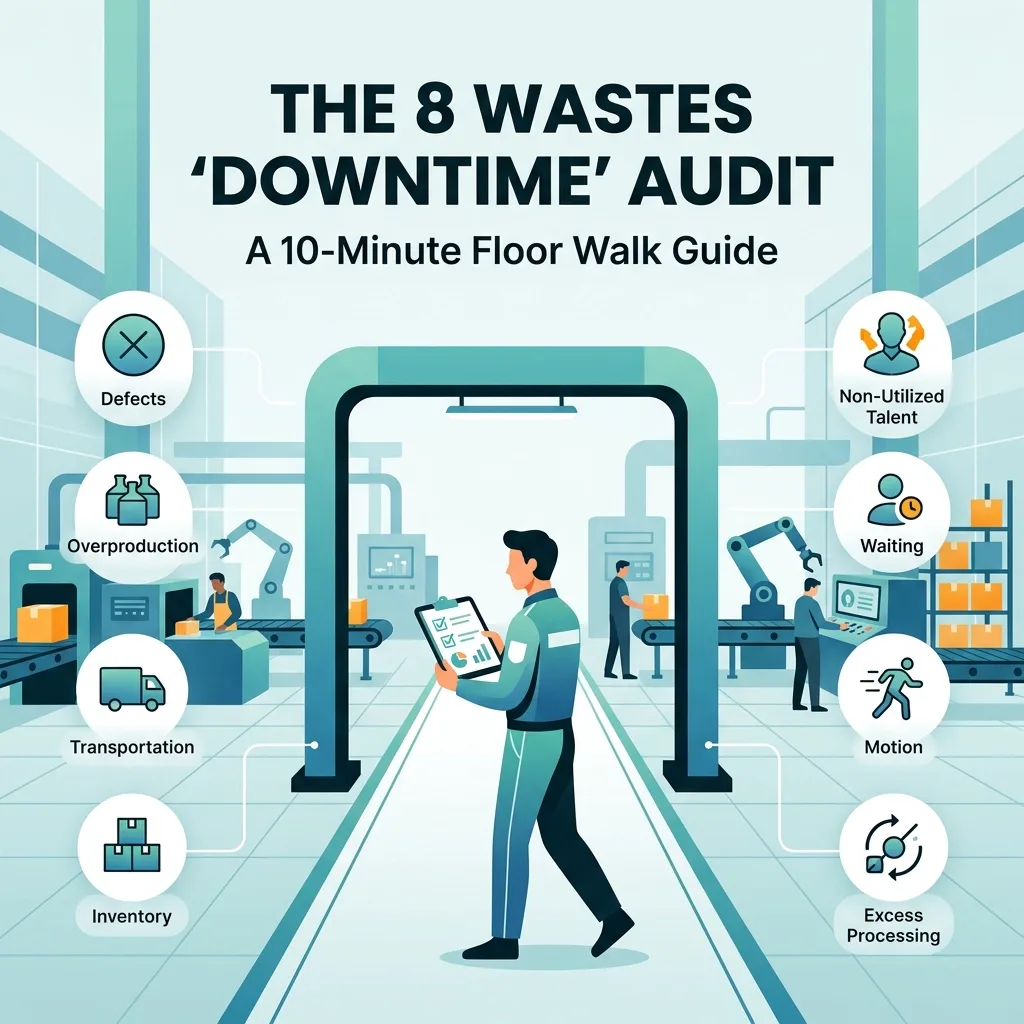
In the realm of operational excellence, profit isn't always lost in grand, catastrophic failures. More often, it leaks out through the floorboards in the form of subtle, repetitive, and often ignored inefficiencies. In Lean methodology, we call these the "Eight Wastes." If you are leading a team or managing a facility, your primary objective isn't just to "work harder": it is to eliminate the friction that prevents your team from delivering value to the customer.
To fully appreciate the scale of this issue, one must look past the busy-ness of a floor and start seeing the movement through the lens of DOWNTIME. This acronym: Defects, Overproduction, Waiting, Non-utilized talent, Transportation, Inventory, Motion, and Extra-processing: serves as the definitive diagnostic tool for any Lean practitioner.
The fundamental purpose of a "Waste Walk" (or Gemba Walk) is not to supervise, but to observe. You cannot fix what you do not see. This guide provides a structured, 10-minute protocol to help you identify these "money leakers" and move your organization toward a more efficient future.
The Anatomy of Waste: Understanding the DOWNTIME Framework
Before you step onto the floor, you must have a crystalline understanding of what constitutes waste. According to the Lean Six Sigma concepts and glossary, waste is defined as any activity that consumes resources but adds no value to the customer.
1. Defects
Defects are the most obvious form of waste. These are products or services that do not meet specifications, requiring rework or disposal.
- The Cost: You pay for the material twice, the labor twice, and the overhead twice.
- What to look for: Red tag bins, piles of "to-be-fixed" items, or workers spending time on "corrections" rather than "creations."
2. Overproduction
Taiichi Ohno, the father of the Toyota Production System, considered this the "root of all evil." Overproduction is making more than is needed, faster than is needed, or before it is needed.
- The Cost: It hides other wastes and ties up capital in stagnant goods.
- What to look for: Large batches of finished goods sitting at the end of a line with no immediate shipping destination.
3. Waiting
Whenever work stops, money is burning. Waiting occurs when goods are not moving or being processed.
- The Cost: Idle labor and lost throughput.
- What to look for: Operators standing around a machine, staff waiting for approvals, or "bottlenecks" where one process is overwhelmed while the next is starving for work.
4. Non-Utilized Talent
This is the "human waste." It occurs when we fail to leverage the brains, creativity, and experience of our workforce.
- The Cost: Low morale, high turnover, and missed opportunities for quick wins.
- What to look for: Highly skilled employees performing menial data entry or operators who have ideas for improvement but no forum to share them.
5. Transportation
Moving products or materials from one location to another adds zero value to the end product.
- The Cost: Increased risk of damage, energy costs, and wasted time.
- What to look for: Forklifts traveling long distances, multiple hand-offs between departments, or complex routing paths.
6. Inventory
Whether it is raw materials, work-in-progress (WIP), or finished goods, excess inventory is simply "cash with a shelf life."
- The Cost: Storage costs, insurance, and the risk of obsolescence.
- What to look for: Overstuffed stockrooms, cluttered hallways, or desks covered in "pending" files.
7. Motion
Unlike transportation (which focuses on the product), motion focuses on the person. If an operator has to reach, bend, or walk to get a tool, that is wasted motion.
- The Cost: Physical fatigue, increased risk of injury, and lost seconds that add up to hours.
- What to look for: Employees searching for tools, walking across the room for a printer, or repetitive awkward movements.
8. Extra-Processing
This is "gold-plating." It is doing more work than the customer requested or using high-precision tools for low-precision tasks.
- The Cost: Using expensive resources unnecessarily.
- What to look for: Multiple signatures for a low-cost item, over-cleaning a part that will be painted anyway, or producing reports that nobody reads.

The 10-Minute Audit Guide: Your Step-by-Step Protocol
A waste walk shouldn't be a day-long event. If you know what you are looking for, 10 minutes is all you need to find enough improvement opportunities to last a month. Follow this strict protocol:
Minute 0-2: The "Horizon Scan"
Stand at the entrance of the work area. Do not move. Just look.
- Look for flow: Is work moving in a straight line or a zig-zag?
- Look for piles: Where is the inventory stacking up?
- Look for stillness: Are people or machines waiting?
Minute 3-6: The DOWNTIME Tally
Walk through the process in reverse. Starting at the finished product and walking back to the raw material helps you see the "why" behind the bottlenecks. Carry a simple clipboard and tally every time you see one of the 8 wastes.
- Identify Handoffs: Pay close attention to the boundaries between workstations. This is often where process mapping reveals the most significant gaps.
Minute 7-9: The "Why" Interview
Stop at one workstation where you identified waste. Ask the operator one question: "What is the most frustrating part of your job today?"
- Usually, the answer points directly to a waste. If they say "I have to wait for the supervisor to sign off," you’ve found Waiting. If they say "The parts don't fit right," you’ve found Defects.
Minute 10: The Debrief
Step away from the floor. Look at your tally. Pick the one waste that, if removed, would make the biggest impact on the team's daily life. This is your target for a Kaizen event or a SIPOC complexity review.
Turning Observations into Action
Data without action is just trivia. Once you have identified waste, you must categorize it and prioritize the fix. Some issues will be "just-do-its," while others will require a more formal DMAIC approach.
To ensure these improvements stick, documentation is critical. As you implement changes, refer to our guide on how to document your process changes properly to ensure the gains are sustainable.

Case Study: The "Wait-Time" Crisis
In a recent audit of a manufacturing firm, a manager used the DOWNTIME audit and discovered that operators were spending 12% of their shift Waiting for quality inspections. By implementing a basic Poka-Yoke (Mistake Proofing) system and a clear Tollgate Review process, they were able to reduce the wait time to 2%, increasing throughput by nearly 10% without hiring a single new employee.
Why Certification is Your Best Defense Against Waste
Spotting waste is a skill; eliminating it is a science. While a 10-minute walk provides immediate insights, long-term organizational transformation requires a deeper toolkit. Whether you are aiming to solve specific problems with a Yellow Belt, lead departmental shifts with a Green Belt, or drive enterprise-wide change with a Black Belt, Lean Six Sigma training provides the structural integrity your career needs.
The difference between a "busy" manager and an "effective" leader is the ability to see the invisible. Don't let your profits continue to leak through the floorboards.
Boost your career and your company’s bottom line by enrolling in our accredited training today.
- Yellow Belt: Solve Real Problems Fast
- Green Belt: Drive $50K-$100K in Savings
- Black Belt: Master Advanced Problem Solving
Take the first step toward mastery. Your 10-minute audit starts tomorrow morning. Will you be ready to fix what you find?