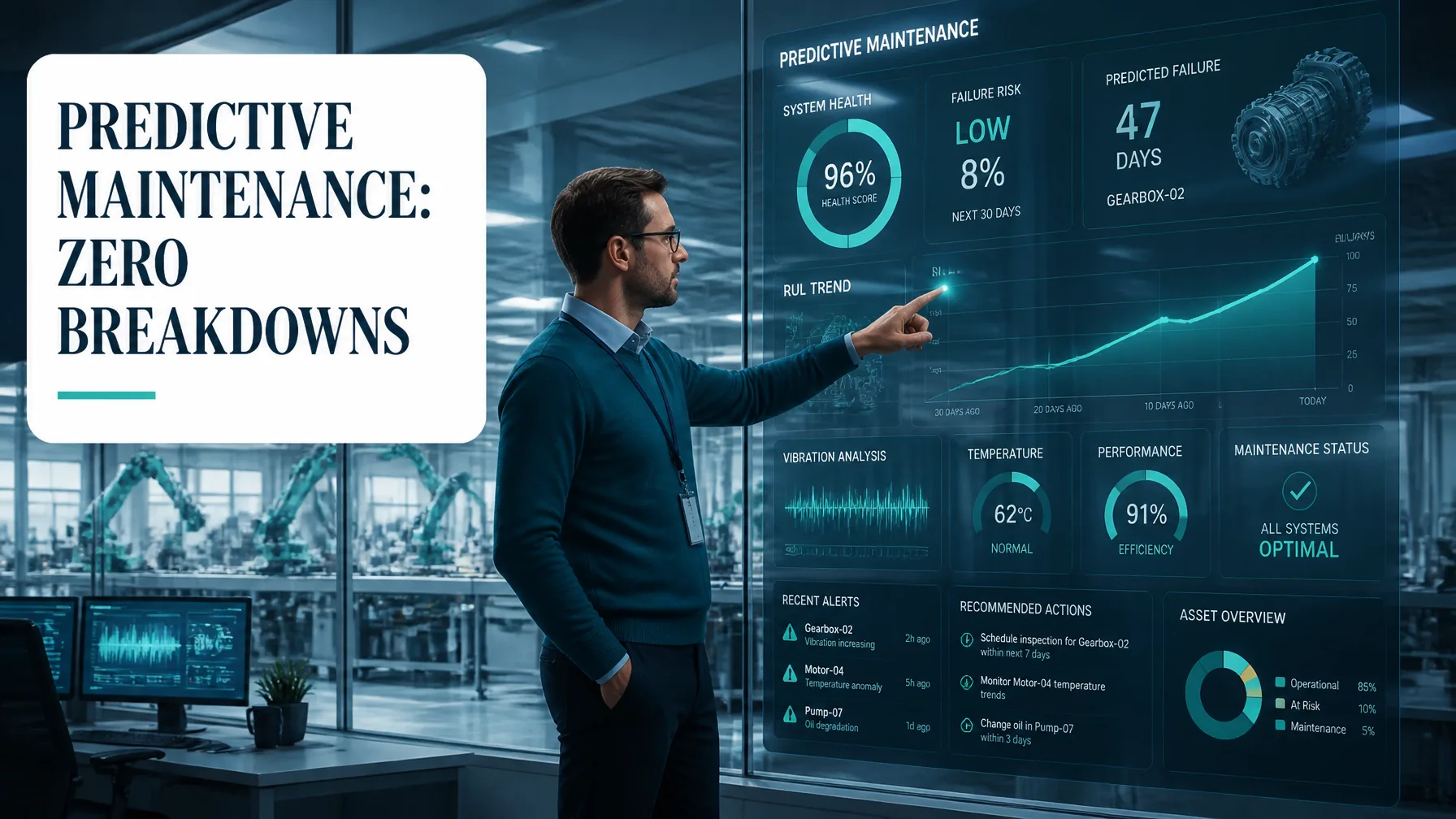
In the realm of modern manufacturing and service operations, there is a seductive lie that many leaders tell themselves: "As long as we fix it fast, we’re doing fine." This mindset is the ultimate trap. It’s the difference between a high-performing enterprise and one that is slowly bleeding profit through the thousand cuts of unplanned downtime.
Total Productive Maintenance (TPM) isn't just a maintenance schedule; it’s a fundamental philosophy shift from reactive firefighting to a culture of Zero Defects. If you are reacting to equipment failure, you aren’t managing a process: you are being managed by it. To truly succeed, you must move into the world of predictive maintenance, where data speaks before the machine screams.
The Foundation: Value and the Voice of the Customer
To fully appreciate the necessity of TPM, we must first look at Value. In Lean terms, value is defined by the customer's willingness to pay. Any activity that doesn’t contribute to what the customer wants is, by definition, Waste (Muda). When a machine breaks down, you aren't just losing production time; you are failing the Voice of the Customer (VOC). They don’t care that your hydraulic seal blew; they care that their order is late.
Similarly, we must balance this with the Voice of the Business (VOB), which demands high efficiency and low costs, and the Voice of the Process (VOP). The VOP is the data-driven heartbeat of your operation. It tells you whether your performance meets customer expectations or if you are drifting into the danger zone of Variation.
The Reactive Trap: A Symphony of Waste
When you operate in a reactive mode, you are essentially inviting the eight DOWNTIME wastes into your facility. The most visible of these is Waiting. While a technician hunts for a spare part, your operators are idle, your Work in Process (WIP) is piling up, and your Throughput (the units produced per period) plummets.
This accumulation of WIP is a silent killer. Excess partially completed items create waiting, storage issues, and overproduction waste, further obscuring the real Bottleneck in your system. According to the Theory of Constraints (TOC), every process has a limiting factor. If your maintenance strategy isn't focused on systematically improving the bottleneck, your overall throughput will never lift.

The Predictive Shift: Y = f(x)
The fundamental purpose of moving to a predictive TPM model is to control the equation Y = f(x). In this context, 'Y' is your process outcome (like uptime or Yield), and 'x' represents the critical inputs (like vibration levels, temperature, or lubrication frequency). By controlling the critical inputs, you influence the outcome before failure occurs.
This requires a sophisticated understanding of your Value Stream. By conducting thorough Value Stream Mapping, you can create current and future state maps that identify where waste lives and where predictive leverage points exist. To get there, you need a solid Business Case to secure leadership Approval, proving that the investment in sensors and training will lead to a clear Break-Even Analysis point where the cost of prevention is far lower than the cost of failure.
Technical Mastery: Monitoring the Heartbeat
Predicting failure isn't a guessing game; it's a statistical discipline. We use tools like the X-bar Chart to monitor process averages alongside an R chart. This allows us to detect shifts and trends in equipment performance before they cross the line into "broken."
When we analyze the data gathered during the Analyse Phase (DMAIC), we look at several factors:
- Variation: We distinguish between common cause (routine fluctuations) and special cause (specific issues) to guide our corrective actions.
- ANOVA (Analysis of Variance): We use this to compare the means of three or more groups to see if there are significant differences in how different machines or shifts are performing.
- Bartlett’s Test: Before running an ANOVA, we use this to assess whether the variances of several groups are equal, ensuring our statistical conclusions are sound.
- Box Plot: This five-number summary helps us visualize the spread, skewness, and outliers in our maintenance data.
- Z-Score: By calculating standard deviations from the mean, we can compare performance across different distributions and machine types.
We must also be wary of Bias. A systematic deviation from the true value in our sensors or reporting can destroy the reliability of our predictive models. This is why Attribute Data (qualitative data like "Pass" or "Fail") must be handled as carefully as continuous data.

Autonomation and the Human Element
A key pillar of TPM is Autonomation (Jidoka): intelligent automation that detects and responds to issues in real-time. This is often paired with Andon systems, visual signaling that alerts the entire team to production problems the moment they occur.
However, technology is nothing without the people. This is where the Lean Six Sigma hierarchy becomes critical:
- White Belt: These team members have foundational awareness and understand how their daily actions impact the broader DMAIC framework.
- Yellow Belt: These are the "boots on the ground" who support larger improvement projects and master essential tools to manage small, local projects.
- Black Belt: These advanced practitioners lead complex TPM implementations, driving organizational change and mentoring Green Belts.
Even your methodology should be modern. Many top-tier firms now use an Agile approach, which involves flexible, iterative sprints that complement traditional Lean Six Sigma projects. This allows maintenance teams to pivot quickly as new data emerges.
Setting the Rhythm with Takt Time
In a truly optimized TPM environment, the production rhythm is set by Takt Time. By dividing your available time by customer demand, you set the heartbeat of the plant. If maintenance causes you to miss your Takt Time, you are failing the customer.
To prevent this, we use a Time Observation Sheet to record actual step times during maintenance tasks. This allows us to separate value-added work from non-value-added work, ensuring that even our "planned" downtime is as lean as possible. We track our success using Yield metrics: specifically First Pass Yield and Rolled Throughput Yield: to ensure we are creating defect-free output from the moment the machines start back up.

Conclusion: Don't Wait for the Crash
The transition from reactive to predictive maintenance is not a luxury; it is a survival requirement in a competitive global market. If you are still relying on an Average (Mean) performance that includes frequent "emergency" repairs, your baseline is a lie. You are simply waiting to fail.
To truly master these concepts and move your organization toward a state of Zero Defects, you need more than just a blog post: you need world-class training. Whether you're starting with a White Belt to understand the basics or aiming for the leadership heights of a Master Black Belt, the journey to process excellence starts with certification.
Stop reacting. Start predicting. Master the tools of the future today.
Enrol in our CSSC-Accredited Lean Six Sigma Training now and take control of your career.