In the realm of process improvement, data is the only currency that matters. If you aren't measuring your performance, you aren't managing it; you're simply guessing. For many professionals in manufacturing, logistics, or healthcare, the question of quality often boils down to a simple binary: Did it work, or did it fail?
When your data is categorical: meaning you are counting "defects" rather than measuring specific dimensions: the P Chart is your most powerful weapon. It is the definitive tool for listening to the Voice of the Process, allowing you to distinguish between the natural "noise" of your daily operations and the "signals" that indicate something has gone seriously wrong.
The Technical Foundation: What is a P Chart?
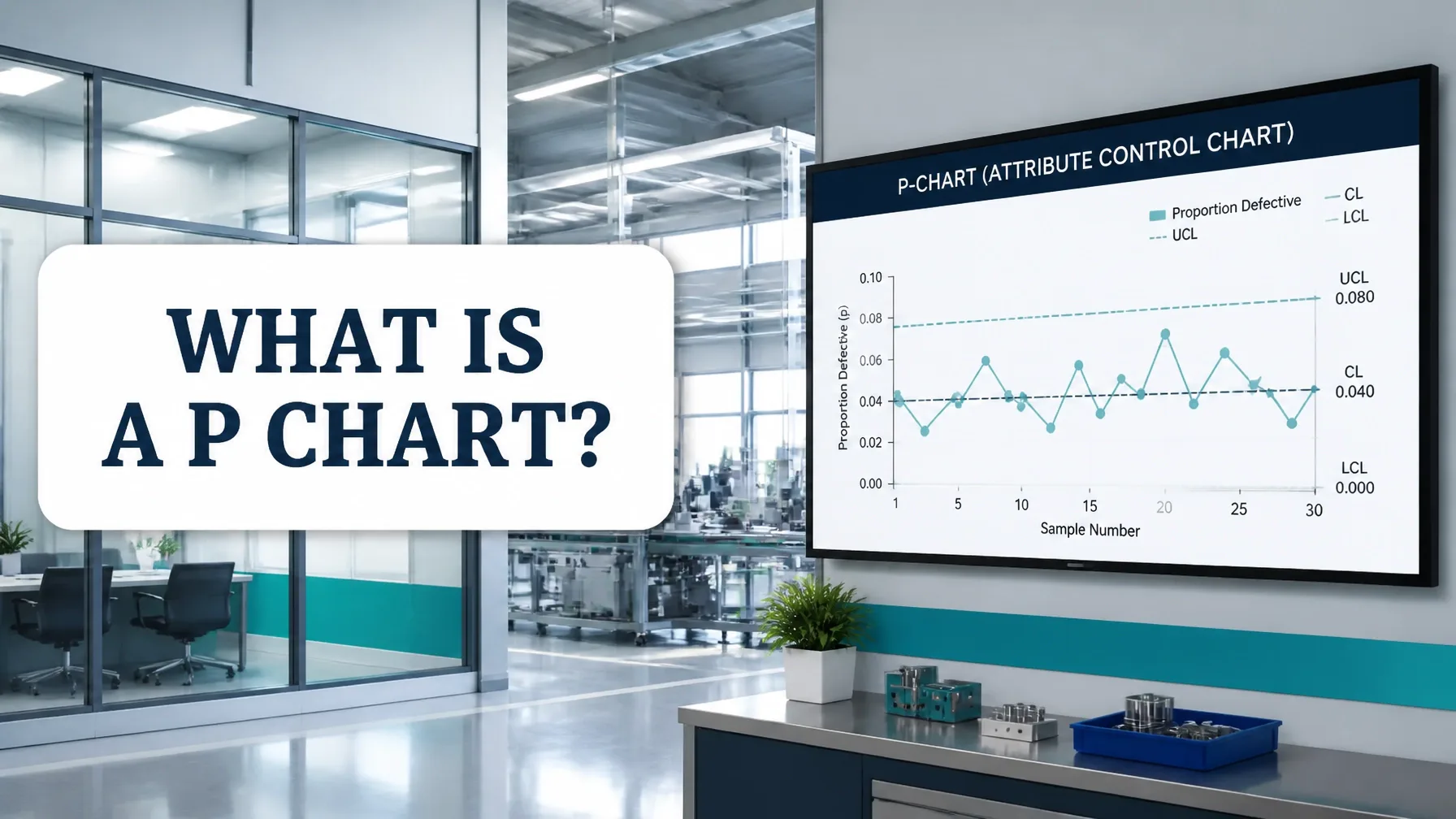
At its core, a P Chart (Proportion Chart) is an attribute control chart used to track the proportion of defective items in a set of data over time. Unlike an X-bar chart, which tracks continuous variables like weight or length, the P Chart is built specifically for Attribute Data.
Understanding Attribute Data
Attribute data is qualitative. It classifies an item based on the presence or absence of a specific characteristic. In a professional setting, this usually looks like:
- Pass vs. Fail
- Conforming vs. Non-conforming
- Late vs. On-time
- Complete vs. Incomplete
To fully appreciate the utility of the P Chart, one must understand that it deals with the binomial distribution. It calculates the percentage (or proportion) of defectives within a subgroup, even if the size of those subgroups varies from day to day.

The Core Concept: Mastering Variation
The fundamental purpose of a P Chart is to help a Lean Six Sigma Black Belt or a project team visualize Variation. In the Lean Six Sigma philosophy, variation is the enemy of efficiency. However, not all variation is created equal.
Common Cause Variation
This is the inherent "background noise" of any system. It represents the natural, random fluctuations that occur even when a process is operating exactly as designed. If your proportion of defects fluctuates slightly between 1% and 1.5% without any specific pattern, you are likely looking at Common Cause Variation. Improving this requires a fundamental redesign of the process itself: something often spearheaded by a Master Black Belt to drive enterprise-wide capability.
Special Cause Variation
This is where the P Chart earns its keep. Special Cause Variation refers to non-random, assignable causes that disrupt the process. These are unexpected "spikes" or "shifts" in the data. On a P Chart, a special cause is identified when a data point falls outside the calculated Upper Control Limit (UCL) or Lower Control Limit (LCL).
When a special cause appears, it is a direct signal that an external factor: such as a machine malfunction, a batch of poor raw materials, or an untrained operator: has influenced the outcome. In the equation Y = f(x), the P Chart helps you identify when a critical input ($x$) has changed, thereby altering the output ($Y$).

Real-World Applications: The P Chart in Action
To ground these theoretical concepts in reality, let's look at three detailed examples of how different industries utilize P Charts to maintain high standards of quality and Yield.
1. Electronics Manufacturing: PCB Soldering
In a high-volume electronics facility, a team might inspect 500 printed circuit boards (PCBs) every four hours. They aren't measuring the thickness of the solder; they are simply checking if the board is functional (Pass) or defective (Fail).
- The Data: Number of defective boards per 500 units.
- Voice of the Process: The P Chart shows a stable defect rate of 2%. Suddenly, on Tuesday afternoon, the defect rate jumps to 8%, crossing the Upper Control Limit.
- Action: The Yellow Belt on the floor notices the signal and alerts the team. They discover that a specific soldering machine has a clogged nozzle: a classic Special Cause.
2. Food & Beverage: Bottling Line Efficiency
A bottling plant monitors the proportion of "leakers": bottles that fail a pressure test after capping.
- The Data: The proportion of leaking bottles checked every shift.
- The Metric: They track First Pass Yield (the percentage of units that move through the process without needing rework).
- Insight: By using a P Chart, the management team identifies that while the average leak rate is 0.5%, it consistently spikes during the third shift. This investigation leads them to find a Bottleneck in the training protocol for night-shift maintenance staff.
3. Service Industry: Loan Application Processing
Lean Six Sigma isn't just for factories. A bank might use a P Chart to track the proportion of loan applications that are returned due to missing information.
- The Data: Percentage of incomplete applications per week.
- Strategy: By analyzing the Value Stream, the team identifies that "missing info" is a form of Waste (Muda): specifically Waiting and Defects. The P Chart identifies whether a recent software update actually reduced the error rate or if the variation remains within "Common Cause" limits.
Why You Need This in Your Toolkit
Whether you are a White Belt just starting your journey or a seasoned practitioner leading a Black Belt project, understanding the P Chart is non-negotiable. It allows you to:
- Stop Overreacting: Don't waste time investigating "common cause" noise.
- Act Fast on Signals: Identify "special cause" problems the moment they occur.
- Validate Improvements: If you implement a Kaizen initiative, your P Chart will prove whether the defect proportion has actually shifted downward or if the "improvement" was just a lucky streak.
By focusing on process metrics, you ensure that the Voice of the Business is satisfied by delivering consistent, defect-free value to your customers.

Take the Next Step in Your Career
Mastering the P Chart is only one piece of the puzzle. To truly drive organizational change and command a top-tier salary in the process improvement space, you need a structured, accredited education.
At Lean 6 Sigma Hub, we provide 100% self-paced, CSSC-accredited online courses that take you from foundational principles to advanced statistical mastery. Whether you are aiming for a Green Belt to lead departmental projects or a Master Black Belt to build global governance frameworks, our training is designed for professionals who demand practical, real-world results.
Stop guessing. Start measuring. Elevate your career by becoming a certified Lean Six Sigma professional today.
Explore Our Certification Courses Now