
In the current landscape of industrial evolution, often characterized as Industry 4.0, the emergence of Artificial Intelligence (AI) has triggered a paradigm shift in how organizations perceive efficiency and process excellence. For decades, the Lean Six Sigma (LSS) methodology has served as the gold standard for reducing waste and minimizing process variation. However, with the advent of large language models, machine learning, and agentic AI, a common question arises: Does the traditional Black Belt leader remain relevant in an era of automated intelligence?
The fundamental purpose of this exploration is to demonstrate that while AI will undeniably transform the technical execution of projects, it simultaneously elevates the necessity for high-level human leadership. To fully appreciate this transition, one must understand that AI is not a replacement for the seasoned practitioner but rather the most potent tool ever added to the professional’s arsenal. For those pursuing lean six sigma black belt online training, this evolution represents an unprecedented opportunity to shift from being a data analyst to becoming a strategic process architect.
The AI Revolution in Process Excellence
In the realm of process improvement, AI excels at the heavy lifting of data processing. Where a traditional practitioner might spend weeks collecting manual samples and performing regression analysis, AI-driven systems can monitor entire value streams in real-time. By integrating AI into the DMAIC framework, organizations can move from episodic "project-based" improvements to a state of "always-on" process optimization.
Technical Capabilities of AI in LSS:
- Predictive Analytics: Moving beyond descriptive statistics to forecast future failures before they occur.
- Pattern Recognition: Identifying complex non-linear correlations in "big data" that are invisible to standard statistical tools.
- Automated Root Cause Identification: Scouring thousands of variables to surface the most likely contributors to process drift.
- Natural Language Processing (NLP): Analyzing thousands of customer reviews to extract the Voice of the Customer (VOC) with near-instantaneous speed.
Why AI Cannot Replace the Black Belt
Despite the computational superiority of AI, the core of Lean Six Sigma remains a human endeavor. AI lacks the contextual awareness, ethical judgment, and emotional intelligence required to lead organizational change. A Black Belt’s value is increasingly found in the spaces where data meets human behavior.
1. Strategic Alignment and Critical to Quality (CTQ)
AI can identify that a process is "broken," but it cannot decide if that process is worth fixing. The Define Phase requires a human leader to interpret the organization's strategic goals and translate them into Critical to Quality (CTQ) characteristics. A Black Belt ensures that every project aligns with the broader business objectives, a task that requires nuanced negotiation with executive stakeholders.
2. The Nuance of Root Cause Analysis
While AI can point to a statistical correlation, it often misses the "soft" root causes. Many process issues stem from misaligned incentives, cultural resistance, or informal "workarounds" that aren't captured in a database. A professional trained via lean six sigma black belt online training is equipped to perform a Gemba Walk, engage with frontline staff, and uncover the human friction that data alone cannot see.
3. Change Management and Influence
Process improvement is 20% technical and 80% cultural. AI cannot mentor a struggling Green Belt, nor can it facilitate a heated workshop where departments are fighting over resources. The ability to influence, coach, and build a culture of continuous improvement is an exclusively human capability.
Practical Playbook: Leading with AI and Lean Six Sigma
To succeed in this new era, leaders must adopt a "Human-in-the-Loop" strategy. Below is a protocol for integrating AI into your LSS leadership style:
Step 1: Automate the 'Measure' and 'Analyze' Phases
Leverage AI tools to handle the high-volume data collection and initial statistical screening. This allows the Black Belt to focus on the Analyze Phase's most critical output: Insight. Instead of spending 40 hours building control charts, you spend 40 minutes interpreting what the anomalies mean for your customer experience.
Step 2: Utilize AI for Solution Generation in the 'Improve' Phase
During the Improve Phase, use AI to simulate thousands of "what-if" scenarios. This allows you to test the impact of process changes in a virtual environment before committing resources to a physical pilot study.
Step 3: Implement AI-Enabled Control Plans
Shift from static, manual Control Plans to dynamic AI alerts. An AI agent can monitor your process 24/7 and trigger an escalation procedure the moment a trend indicates a potential out-of-control condition.

The Imperative of Governance
As AI becomes more integrated into operations, the role of Governance becomes the Black Belt's primary responsibility. Without human oversight, AI can "over-optimize" a specific department while creating massive bottlenecks elsewhere in the value stream, a phenomenon known as local optimization at the expense of global efficiency.
The Governance Framework for AI-Led Projects Includes:
- Ethical Oversight: Ensuring AI models do not introduce bias into decision-making.
- Validation Protocols: Rigorously testing AI-generated solutions to ensure they meet safety and quality standards.
- Strategic Prioritization: Using tools like the Project Selection Scoring Calculator to ensure AI is focused on the highest-value opportunities.
- Resource Allocation: Managing the human-AI interface to ensure employees feel empowered rather than replaced.
Why Black Belt Certification is More Relevant Than Ever
In an automated world, the demand for "generic" analysts will plummet, but the demand for Expert Process Governors will skyrocket. Pursuing an accredited lean six sigma black belt online training program provides you with the foundational rigor needed to manage these complex systems.
When you earn your certification through Lean 6 Sigma Hub, you are not just learning formulas; you are learning how to lead. Our CSSC-accredited curriculum focuses on practical application, simulation-based learning, and the high-level leadership skills required to navigate the intersection of process and technology.
The Career Advantage of the Modern Black Belt:
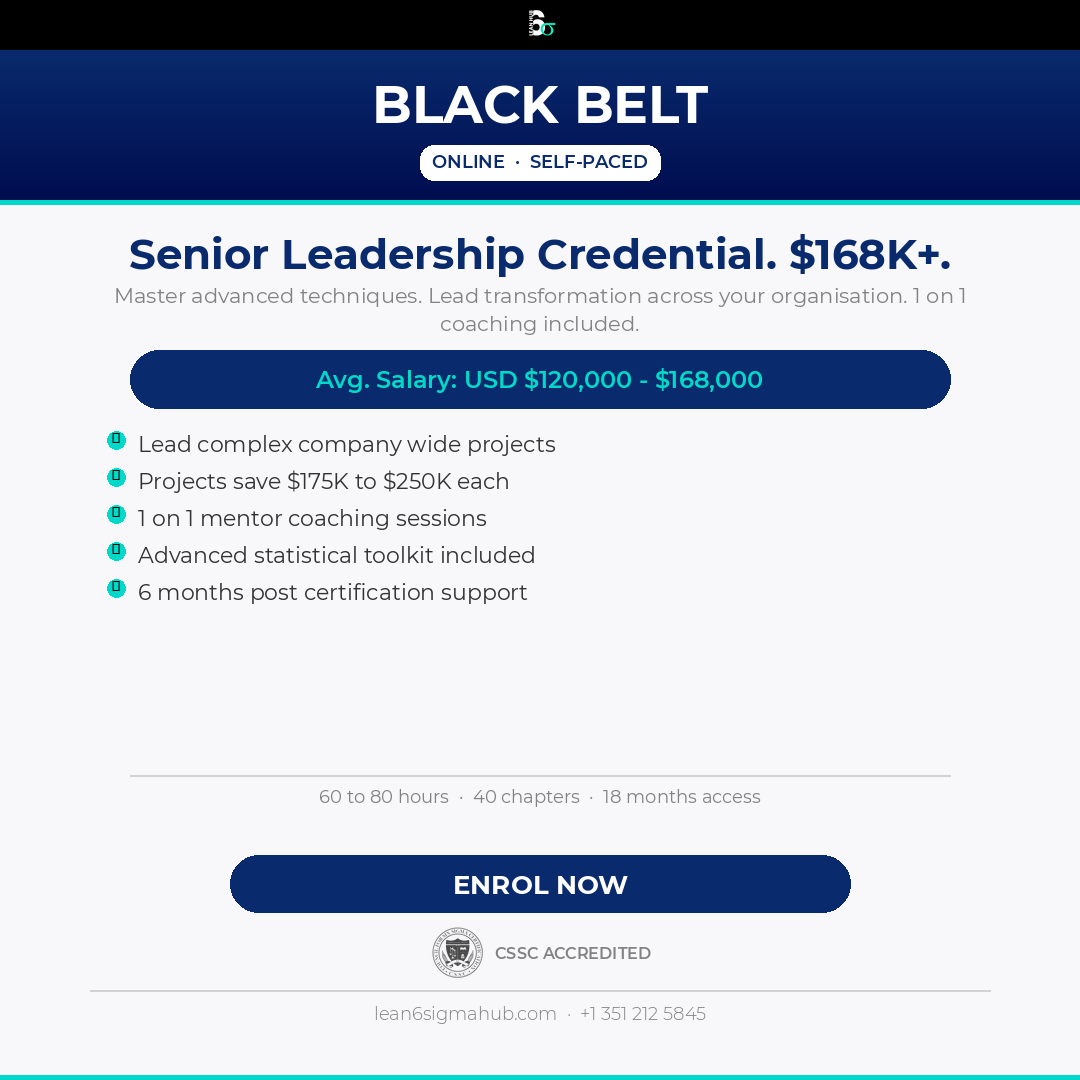
- Command Higher Salaries: Professionals with the ability to lead complex, AI-integrated projects consistently earn between $120,000 and $168,000.
- Lead Enterprise Transformation: Transition from project leader to a strategic advisor who shapes company-wide governance.
- Future-Proof Your Skills: By mastering the Project Charter and stakeholder management, you remain indispensable even as technology evolves.
Conclusion
The rise of AI does not signal the end of the Lean Six Sigma professional; it signals a promotion. By delegating the rote calculations to machines, Black Belts are finally free to focus on what matters most: strategy, culture, and high-impact decision-making. The future belongs to the leaders who can bridge the gap between algorithmic speed and human wisdom.
To fully appreciate the complexities of modern process leadership and to secure your place at the forefront of this industrial shift, you must invest in your professional development.
Frequently Asked Questions (FAQ)
1. Will AI replace the need for Six Sigma belts?
No. While AI automates data analysis, it cannot provide the strategic alignment, change management, or ethical governance that a human Black Belt provides.
2. How does AI help in the Analyze phase?
AI can perform complex pattern recognition and predictive modeling across massive datasets far faster than manual methods, identifying root causes that might otherwise remain hidden.
3. Is Lean Six Sigma Black Belt Online Training still worth it with AI?
Absolutely. Certification proves you have the rigorous, structured thinking required to govern AI systems and ensure they align with business objectives and customer needs.
4. Can AI lead a Gemba Walk?
No. A Gemba Walk involves observing human behavior, informal processes, and cultural nuances that are not captured in digital data.
5. What is the role of a Black Belt in an AI-driven organization?
The Black Belt acts as the "Process Architect" and "Governor," ensuring that AI tools are used correctly, projects are strategically aligned, and the human element of change is managed effectively.