A machine rarely fails without warning. Before a breakdown, there may be a small leak, unusual vibration, loose fastener, dirty sensor, rising temperature, or repeated minor stoppage. The opportunity is to detect those signals early: before they become lost production, urgent maintenance work, or customer-impacting defects.
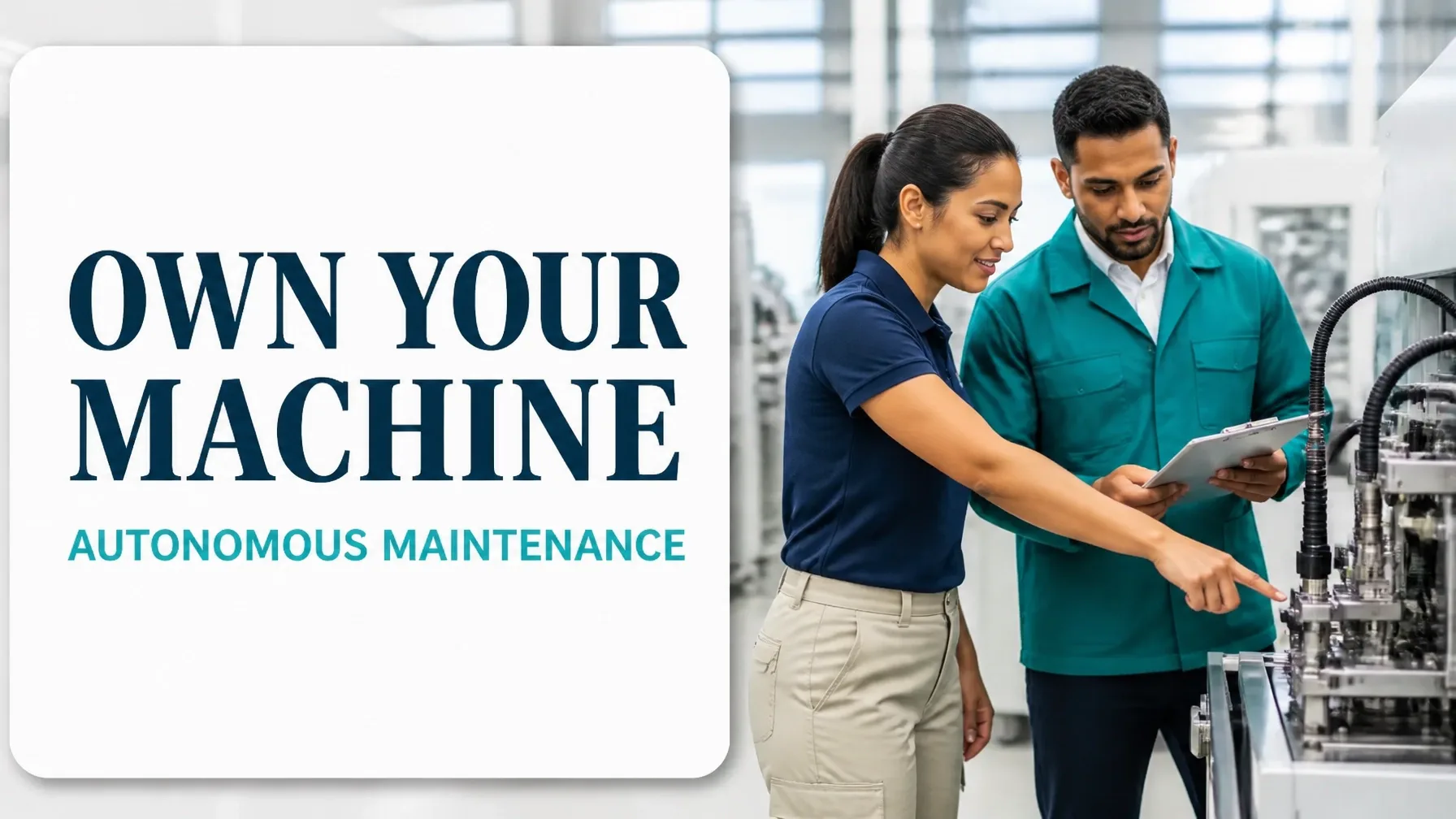
This is the fundamental purpose of Autonomous Maintenance, the first pillar of Total Productive Maintenance (TPM). It gives operators responsibility for the routine care and early inspection of the equipment they use every day.
That does not mean asking operators to become maintenance technicians. It means giving them the training, standards, authority, and visual controls needed to keep equipment in basic condition, identify abnormalities, and escalate issues quickly.
When integrated with Lean Six Sigma methods, Autonomous Maintenance can improve equipment reliability, strengthen standard work, and create a more dependable foundation for OEE: Overall Equipment Effectiveness.
What Is Autonomous Maintenance?
Autonomous Maintenance, also known as Jishu Hozen, is a structured approach in which operators perform defined routine activities such as:
- Cleaning accessible equipment surfaces and components
- Inspecting for abnormal conditions
- Lubricating designated points
- Tightening accessible fasteners
- Checking sensors, guards, belts, gauges, and fluid levels
- Reporting abnormalities through a clear escalation process
- Completing minor adjustments within approved limits
The operator is often the first person to notice that a machine is behaving differently. Autonomous Maintenance turns that proximity into a controlled improvement capability.
The boundary is important:
Operators maintain basic conditions and identify abnormalities. Maintenance specialists handle technical repairs, complex diagnosis, and work requiring specialist authorisation.
This division improves responsiveness without compromising safety or technical standards.
Why Cleaning Is Really Inspection
In a mature TPM system, cleaning is not treated as a cosmetic activity. It is a method for exposing abnormal conditions.
A layer of oil, dust, product residue, or metal swarf can conceal:
- A leaking seal
- A cracked hose
- A loose fitting
- A damaged cable
- A blocked sensor
- A worn belt
- A misaligned guide
- A missing fastener
When operators clean the machine according to a defined standard, they see its condition more clearly. The machine becomes easier to inspect because the normal state is visible.

A useful cleaning-and-inspection standard should specify:
- What to clean or inspect
- Where the point is located
- How the task should be performed
- When it should be completed
- What normal looks like
- What action to take when abnormality is found
For example:
| Checkpoint | Frequency | Normal condition | Abnormal response |
|---|---|---|---|
| Photoelectric sensor | Every shift | Lens clean; green indicator active | Clean lens and tag if signal remains unstable |
| Drive belt | Daily | No fraying; correct tension mark visible | Stop if unsafe; notify maintenance |
| Lubrication point B1 | Weekly | Correct lubricant level | Apply approved lubricant or escalate |
| Guard fasteners | Weekly | Secure and intact | Tag loose or missing hardware |
The standard should be visual wherever possible. A photograph showing “normal” and “abnormal” is often more useful than several paragraphs of instructions.
The Seven Steps That Build Operator Ownership
Autonomous Maintenance becomes sustainable when introduced progressively. A practical seven-step sequence is:
1. Perform initial cleaning
Restore the equipment to a clean baseline. Record abnormalities rather than simply cleaning around them. Use tags for leaks, loose components, damaged guards, contamination sources, and other conditions requiring follow-up.
2. Eliminate contamination sources
Find out why dirt, oil, dust, chips, or product residue is accumulating. Fix the source where possible. Also improve access to inspection and cleaning points.
The goal is not to make operators clean faster through effort alone. The goal is to make the equipment easier to keep clean.
3. Establish cleaning and lubrication standards
Define the task, frequency, method, tools, lubricant, and acceptance criteria. Keep the standard concise enough to use during the shift.
4. Train operators in general inspection
Teach operators what to look, listen, feel, and smell for: within safe operating limits. Training may cover abnormal noise, vibration, temperature, pressure, alignment, leakage, and sensor condition.
5. Introduce autonomous inspection
Operators perform routine checks as part of standard work. The inspection should be scheduled into the operating rhythm rather than treated as optional work completed only when production is quiet.
6. Standardise visual controls
Use labels, colour coding, marked inspection points, fixed tool locations, abnormality tags, and simple status indicators. This is where 5S and visual management reinforce TPM.
7. Develop continuous improvement
Once the routine is stable, operators can use loss data to lead small Kaizen improvements. They may redesign a contamination point, improve access, clarify a standard, or reduce the time required for inspection.
The sequence matters. Asking teams to manage advanced improvement activity before basic conditions are stable usually produces inconsistent results.
Make Standards Visible Without Creating Paperwork
A common concern is that TPM creates another collection of forms. It does not have to.
A practical Autonomous Maintenance board can fit beside the equipment and contain only the information the team needs:
- Machine name and responsible team
- Cleaning, inspection, lubrication, and tightening tasks
- Shift or frequency requirements
- Simple completion markers
- Abnormality tags
- Open and closed actions
- Current OEE and top loss categories
- Escalation contacts and response expectations
The board should answer three questions immediately:
- What should happen?
- Has it happened?
- What requires action?
If a checklist takes fifteen minutes to interpret, it is not visual standard work. Use photographs, symbols, short phrases, and clear status markers.
The supporting record can be digital where appropriate, but the point of visual management is that the condition of the machine and the status of the work are visible at the place where the work occurs.
How Autonomous Maintenance Improves OEE
OEE is calculated as:
OEE = Availability × Performance × Quality
Autonomous Maintenance contributes to all three components.
Availability
Early detection reduces the frequency and duration of breakdowns. A leaking fitting or loose connection can be corrected before it causes an extended stoppage.
Performance
Clean sensors, correct lubrication, stable alignment, and reliable component condition reduce minor stops and speed losses. These losses are often individually small but significant in aggregate.
Quality
Equipment in basic condition is more likely to hold process settings consistently. This reduces defects and rework caused by contamination, drift, misalignment, or unstable operating conditions.

Connecting Autonomous Maintenance to the Six Big Losses
TPM traditionally groups equipment losses into six categories:
- Breakdowns
- Setup and adjustment losses
- Idling and minor stoppages
- Reduced speed
- Defects
- Rework
Autonomous Maintenance has its strongest direct influence on breakdowns, minor stoppages, reduced speed, defects, and rework.
For example:
- Cleaning sensors can reduce minor stops.
- Lubrication can prevent deterioration-related breakdowns.
- Inspection of guides and belts can reduce reduced-speed conditions.
- Contamination control can prevent quality defects.
- Early abnormality detection can prevent repeated rework.
Setup and adjustment losses may require additional methods such as SMED, standardised changeover work, or a dedicated Lean Six Sigma project. Autonomous Maintenance still supports those efforts by keeping the equipment stable before and after the changeover.
Case Study: A Bottling Line’s OEE Improvement
A published case study of a bottle-filling monoblock machine reported a substantial improvement following TPM implementation with a strong Autonomous Maintenance focus. The study can be reviewed in the IEOM Society proceedings.
The baseline period showed:
- Average OEE of 42%
- Total downtime of 5,927 minutes
- Idling and minor stoppages representing approximately 49% of losses
The improvement programme included operator-led cleaning, inspection, lubrication, basic tightening, abnormality tagging, and standardised daily and weekly routines.
After implementation, the reported results were:
- Average OEE increased to 84.03%
- Comparable downtime reduced to 240 minutes
- The dominant loss category shifted toward setup and adjustment losses, representing approximately 62% of remaining losses
The result is instructive. Once minor stoppages and deterioration-related issues were reduced, the improvement team could see the next constraint more clearly: changeover and adjustment performance.
This is an important Lean principle. Improvement does not eliminate the need for further improvement. It changes the loss profile and reveals the next opportunity.
The figures are specific to the reported case and should not be treated as a universal forecast. Your own baseline should be established using reliable downtime, speed, quality, and production data.
A Practical Implementation Plan
To introduce Autonomous Maintenance without overwhelming the team:
- Select one pilot machine or line.
- Establish the current baseline, including OEE, breakdown minutes, minor stops, defects, and rework.
- Conduct an initial cleaning and abnormality tagging exercise.
- Prioritise safety-critical and reliability-critical abnormalities.
- Create a one-page cleaning and inspection standard.
- Train operators at the machine, using actual conditions and photographs.
- Install a simple visual board.
- Review completion and abnormalities at the daily team meeting.
- Track the Six Big Losses weekly.
- Expand only after the pilot routine is stable.
Avoid measuring checklist completion as the only success indicator. A completed form does not necessarily mean a healthier process. Track outcomes such as:
- Breakdown frequency
- Unplanned downtime minutes
- Minor stoppage count
- Mean time between failures
- Mean time to repair
- OEE and its three components
- Defect and rework rates
- Abnormalities detected before failure
- Time required to complete the routine
How Lean Six Sigma Training Supports TPM
TPM establishes the daily equipment-care system. Lean Six Sigma provides the analytical discipline to understand variation, prioritise losses, verify causes, and sustain results.
A Lean Six Sigma Yellow Belt can support data collection, visual management, and small improvement activities. A Green Belt can analyse recurring downtime patterns, conduct Pareto analysis, and lead focused improvement projects. A Black Belt can coordinate complex, cross-functional work involving reliability, process capability, changeover performance, and financial impact.
For professionals building these capabilities, Lean Six Sigma online training offers a flexible pathway from foundational awareness to advanced project leadership. The Green Belt course is particularly relevant for practitioners who need to connect operational data with structured improvement.
You can also use the Lean Six Sigma Practitioner’s Guide to connect TPM activity with DMAIC, standard work, control plans, visual management, and sustainment.
The Real Meaning of “Own the Machine”
Operator ownership is not about assigning blame when equipment performance falls short. It is about giving the people closest to the process the capability to protect basic conditions and raise issues while they are still manageable.
When standards are clear, training is practical, escalation is reliable, and leaders review the loss data, Autonomous Maintenance becomes part of the operating system. Cleaning becomes inspection. Inspection becomes early detection. Early detection becomes improved reliability. Improved reliability creates a stronger platform for Lean Six Sigma improvement.
Build the capability to lead TPM and equipment improvement: pursue Lean Six Sigma training and professional certification today.
Kaizen. Kai-Care. Kai-Done. ( Lean Six Sigma)