

The RDMAICS Framework
The Practitioner’s Guideto Lean Six Sigma
Building improvement from the ground up with the RDMAICS framework
Lean added from established practice
Sustain anchored in ISO 9001
First edition · 2026
Copyright
The Practitioner’s Guide to Lean Six Sigma
Building improvement from the ground up with RDMAICS
First edition, 2026
Copyright © 2026 Jvalin Sonawala
All rights reserved. No part of this publication may be reproduced, stored in a retrieval system, or transmitted in any form or by any means, electronic, mechanical, photocopying, recording, or otherwise, without the prior written permission of the author.
The author has asserted the moral right to be identified as the author of this work.
ISO 13053, ISO 9001, and related standards are referenced for guidance and education. This book is an independent work and is not endorsed by or affiliated with the International Organization for Standardization. Readers should consult the current published standards for authoritative requirements.
Crestline, and the people described in the worked case, are illustrative. Any resemblance to a real organisation or person is coincidental.
ISBN: [to be assigned]
Cover and interior design: [ ]
[Publisher or imprint] · [City]
For every practitioner who was handed a problem, a deadline,
and no map, and built one anyway.
Advance praise
Praise for The Practitioner’s Guide to Lean Six Sigma
“This reads like a mentor sitting beside you, walking a real project from the first day to the last. The tools finally sit where the work actually happens.”
— A Master Black Belt, financial services
“It begins on the Monday you arrive with no brief, no charter, and no data, and it stays beside you through every phase after that.”
— A continuous improvement lead, healthcare
“The Recognise and Sustain phases are exactly where our projects used to struggle. Seeing them run in full changed how my team works.”
— An operations director, business services
“Tying Six Sigma to ISO 13053 and Sustain to ISO 9001 gives the method a spine. I could hand this to an auditor and to a new belt and both would trust it.”
— A quality manager, manufacturing
“One company, followed from the first walk to the final sign-off. By the end you have not just learned the tools, you have watched judgement being made.”
— A Black Belt, public sector
“It respects the reader. It assumes you know the tools and teaches you the far harder thing, which is when to reach for each one and when to leave it on the shelf.”
— A head of transformation, logistics
Introduction
What this book gives you
This is a practical guide for the practitioner who already holds the tools and now has to lead. It follows one company, Crestline, from the first Monday to the last sign-off, and shows every phase of improvement run in the setting practitioners most often face: a busy, profitable, proud organisation with no improvement function, thin data, and a headcount assumption waiting to be tested.
A framework that fits reality. RDMAICS wraps the familiar DMAIC core in the two phases that decide whether improvement survives. Recognise does the work of finding and framing the right problem before Define. Sustain does the work of holding the gain after Control.
One project, followed all the way. You do not jump between disconnected examples. You watch a single problem move through every phase, so the method reads as a story you can follow and repeat.
Standards you can stand on. Six Sigma is run to ISO 13053. Lean is added from established practice and clearly marked as such. Sustain is anchored in ISO 9001. Every step rests on something solid and auditable.
Every tool, chosen by judgement. Each applicable tool is taught in the order you reach for it, with the template drawn in place and filled with the live case. Scenarios show you how the choice changes with the project in front of you.
A method that meets you where you are. The four grounds and the maturity ladder let you read your own setting honestly and match the work to it, rather than forcing one recipe onto every firm.
The organisational game, handled. Reporting lines, executive sponsorship, the defensive process owner, and the pressure to add headcount are treated as real, solvable parts of the work, not obstacles left to chance.
The judgement to know when not to run it. The gatekeeper and the routing chapter teach you to send a problem to the right method, so your effort lands where it will actually pay.
If you have the belt and now need the judgement to lead, this book was written for you.
Preface
How to use this book
Welcome. You are about to follow a single improvement project from beginning to end, in a company that looks a great deal like the ones most practitioners actually work in. Crestline is busy, profitable, and proud. It has no improvement function, no quality team, and no project history. That is the point. The method in this book is built to work there.
The book is sequenced deliberately. The early chapters set the ground you walk into, the way improvement should sit in an organisation, and the roles that make it work. The case then lands, and only after you have felt the two real gaps for yourself does the framework get its name. This means the method arrives as an answer to problems you already understand, rather than as a diagram to memorise.
From there, each phase gets its own chapter and the same clear shape: what the phase must achieve, how to choose your tools, the toolkit itself drawn and filled with the case, the scenarios that show judgement, the common hiccups, and the tollgate that closes the phase. You can read straight through, or, if you are mid-project right now, turn to the phase you are standing in and use it today.
You do not need to run every tool on every project. The book teaches you to read the project and reach for what fits. The diagnostics, registers, and templates are yours to reuse. Mark them up, adapt them, and make them your own.
Above all, this is a book about judgement. The tools are here in full, taught with care, but the real work is knowing which one to pick, when to hold the line, and how to make a gain that lasts. That is the skill this book was written to build.
Chapter flow
How the chapters connect
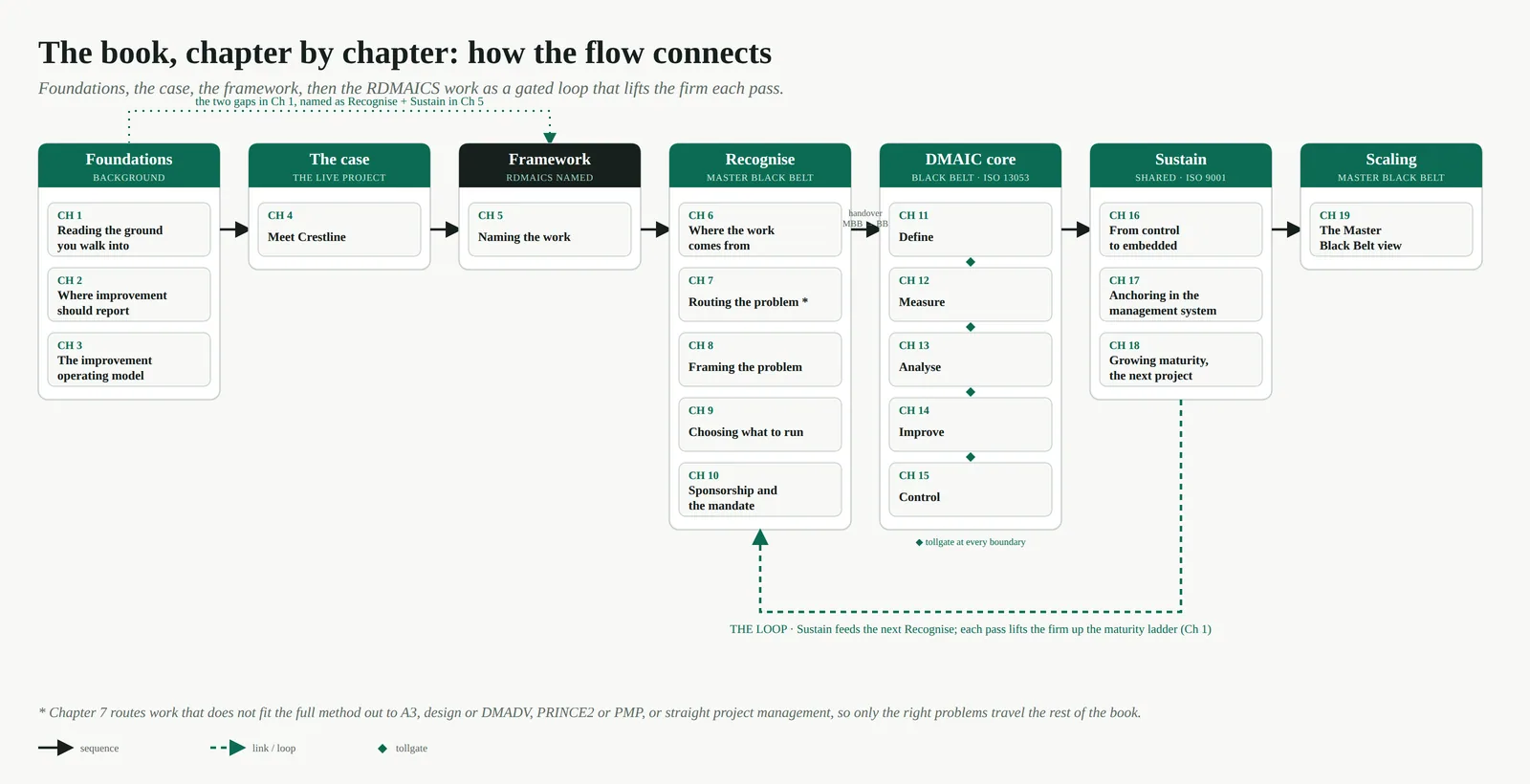
A flow of all nineteen chapters, grouped by RDMAICS phase, showing the sequence, the tollgate chain, the belt handover, the routing branch, and the closing loop.
The connections in detail
The book is not a list of chapters. It is one path with five connective patterns holding it together. Read these first, then the chapter map below shows each handoff.
The gap loop. The two gaps you feel in Chapter 1, the unframed problem at the front and the decaying gain at the back, are the two phases named in Chapter 5. The book plants the need, then names the answer.
The belt handover. The Master Black Belt owns Recognise, Chapters 6 to 10, and hands a backed project to the Black Belt for the DMAIC core, Chapters 11 to 15. Sustain, Chapters 16 to 18, is shared. The Master Black Belt view returns in Chapter 19.
The tollgate chain. Every phase from Define to Control ends at a tollgate that is the entry to the next, so the DMAIC core reads as a chain of gated handoffs, never a jump.
The closing loop. Control drifts, Sustain holds and embeds the gain, and Sustain feeds the next Recognise. The process is a loop, not a line, and each pass lifts the firm one step up the maturity ladder from Chapter 1.
The routing branch. Chapter 7 sends work that does not fit the full method out to A3, design, or project management, so only the right problems travel the rest of the book.
Chapter map
| Chapter | What it establishes | What it hands to the next |
|---|---|---|
| FOUNDATIONS | ||
| Ch 1 Reading the ground you walk into | Reads the terrain: four grounds, the maturity ladder, and two gaps you can feel but cannot yet name. | The two unnamed gaps, carried to Ch 5, and a read of your own maturity, carried to Ch 2 and Ch 3. |
| Ch 2 Where improvement should report | Places the function in the organisation and shows where its authority comes from. | A reporting line and the sponsorship idea, opened up inside the function in Ch 3. |
| Ch 3 The improvement operating model | Looks inside the function: executive owner, Master Black Belt, Black Belt, and the conditions a project needs to start. | The roles and a readiness test, tied back to the Ch 1 diagnostic, used for the rest of the book. |
| THE CASE | ||
| Ch 4 Meet Crestline | Hands you a live project: a complaint process across three teams, no owner, and a headcount assumption. | A concrete case in which you now feel both gaps for real, which sets up the need for a method. |
| FRAMEWORK | ||
| Ch 5 Naming the work | Reveals RDMAICS as the answer to the two gaps: Recognise before Define, Sustain after Control, seven phases, each with a tollgate. | The named framework and the lead for each phase, launching Recognise. |
| RECOGNISE · MASTER BLACK BELT LED | ||
| Ch 6 Where the work comes from | Finds and receives problems through the four voices and the listening walk. | A set of raw problem candidates, passed to routing. |
| Ch 7 Routing the problem | Decides what kind of work each problem is. | Fit problems, recurring with unknown cause, continue to framing; non-fit work is routed out to A3, design, or project management. |
| Ch 8 Framing the problem | Writes a cause-neutral, measurable problem statement and kills the assumed cause. | A clean problem statement, ready to be screened. |
| Ch 9 Choosing what to run | Screens worthiness, builds the improvement register, and sequences the first project. | The chosen first project, complaints, ready for sponsorship. |
| Ch 10 Sponsorship and the mandate | Secures the sponsor, maps stakeholders, and writes the one-page recognition note. | The Recognise tollgate and the handover from Master Black Belt to Black Belt: the recognition note becomes the charter seed. |
| DMAIC CORE · BLACK BELT LED · ISO 13053 | ||
| Ch 11 Define | Turns the recognition note into a signed charter, a scope, and the CTQs. | The Define tollgate and the bridge into Measure. |
| Ch 12 Measure | Builds a defensible baseline from nothing and checks the data can be trusted. | The Measure tollgate and the bridge into Analyse. |
| Ch 13 Analyse | Proves the real cause and shows the headcount assumption is wrong. | The Analyse tollgate and the bridge into Improve. |
| Ch 14 Improve | Generates, pilots, and proves the solution, and leads the change. | The Improve tollgate and the bridge into Control. |
| Ch 15 Control | Holds the gain with controls that fit a low-maturity setting. | The drift that appears weeks later, which becomes the bridge into Sustain. |
| SUSTAIN · SHARED · ISO 9001 | ||
| Ch 16 From control to embedded | Shows why a signed handover is not a held gain, and transfers ownership into standard work. | A gain that no longer depends on you, passed to the management system. |
| Ch 17 Anchoring in the management system | Wires the process into ISO 9001: ownership, documents, audit, and review. | Corrective action and continual improvement that feed the next Recognise. |
| Ch 18 Growing maturity and the next project | Tells the result story, refreshes the control, and builds the portfolio. | The closing loop, from Sustain back to Recognise, and a step up the maturity ladder. |
| SCALING | ||
| Ch 19 The Master Black Belt view | Builds the pipeline, keeps governance light, and scales across teams. | The argument, again, for the right reporting line from Ch 2, and a firm that improves on its own. |
Reading the entry point. The diagram shows Chapter 1 as the start, with no arrow leading into it. Its first outward link is the dashed one to Chapter 5, where the two gaps are named. That is why Chapter 1 can feel like a cold open: the reader meets the terrain before the argument that explains why the terrain matters.
Contents in brief
The seven parts at a glance
Part 1 · Foundations
1 Reading the ground you walk into
2 Where improvement should report
3 The improvement operating model
Part 2 · The case begins
4 Meet Crestline
Part 3 · The framework revealed
5 Naming the work
Part 4 · Recognise
6 Where the work comes from
7 Routing the problem
8 Framing the problem
9 Choosing what to run
10 Sponsorship and the mandate
Part 5 · DMAIC, run to ISO 13053 with Lean
11 Define
12 Measure
13 Analyse
14 Improve
15 Control
Part 6 · Sustain, anchored in ISO 9001
16 From control to embedded
17 Anchoring in the management system
18 Growing maturity and the next project
Part 7 · Scaling
19 The Master Black Belt view
A full section-wise table of contents follows in the front matter of the complete manuscript.
Table of contents
Section by section, with links
- PART 1Foundations
- 1Reading the ground you walk into29 min
- 1.1What this work is, and what it needs
- 1.1.1The work, and where the gains come from
- 1.1.2What a finished piece of work leaves behind
- 1.1.3Why the same method takes a different shape in every firm
- 1.2The ground you walk into
- 1.2.1The blank page
- 1.2.2The firefight
- 1.2.3The false start
- 1.2.4The quiet achiever
- 1.3Four supports to read
- 1.3.1The project pipeline
- 1.3.2Data you can trust
- 1.3.3A sponsor who backs it
- 1.3.4A system that holds
- 1.4The culture you are joining
- 1.4.1Pride in effort over method
- 1.4.2Suspicion of frameworks and outsiders
- 1.4.3Why the culture is a starting condition, not an enemy
- 1.5The maturity ladder, and where you sit
- 1.5.1The five maturity levels, from Initial to Optimised
- 1.5.2Where the four grounds sit
- 1.5.3What the ladder tells you about the road ahead
- 1.6The two gaps to feel
- 1.6.1The problem nobody framed
- 1.6.2The gain nobody holds
- 1.6.3Naming these as problems, not yet as phases
- 1.7A diagnostic for your own setting
- 1.7.1The reading questions
- 1.7.2Reading your answers honestly
- 1.7.3What changes across the grounds
- 2Where improvement should report24 min
- 2.1Why reporting structure matters
- 2.2Why improvement must begin from the top
- 2.3Improvement under Operations
- 2.4Improvement under the PMO
- 2.5Improvement under Finance
- 2.6Improvement under Change or Transformation
- 2.7Improvement under Quality
- 2.8What makes an effective organisational home
- 2.9The preferred organisational model
- 2.10Borrowing authority through executive sponsorship
- 2.11Working successfully from an imperfect home
- 2.12Building toward the ideal future state
- 2.13Diagnosing your organisation
- 2.14Key lessons
- 3The improvement operating model33 min
- 3.1Inside the reporting line
- 3.1.1Chapter 2 placed it, now look inside
- 3.1.2The operating model matters as much as placement
- 3.1.3The shape in one view, an executive owner above, a Master Black Belt running the function, a Black Belt running projects
- 3.2What a full function must cover
- 3.2.1The firm-level work, finding and backing and holding
- 3.2.2The project-level work, running one piece end to end
- 3.2.3The two parts an immature firm always leaves uncovered, the front and the back
- 3.3The executive owner above the function
- 3.3.1The executive owner, named by altitude not by title
- 3.3.2Why the senior owner must understand the method, not just fund it
- 3.3.3What an informed executive owner gives you, air cover, reach, patience for the cycle
- 3.3.4An invented failure case, ownership routed up through executives who did not know the method
- 3.3.5The bar for the executive owner, and the gap when it is not met
- 3.4The Master Black Belt runs the function
- 3.4.1The Master Black Belt runs the function
- 3.4.2Why running the function sits with the senior most belt, the firm-level work needs that depth
- 3.4.3The Black Belt runs the projects beneath the lead
- 3.4.4Green Belts and capable people without a belt, team members, never the lead
- 3.4.5How the function sits beneath the executive owner
- 3.5Belt depth is capability, not position
- 3.5.1The belt ladder as a scale of method depth
- 3.5.2Why most firms treat the belt as a skill, not a job title
- 3.5.3Why the lead needs both depth and standing, capability from the belt, authority borrowed from above
- 3.6When the firm has no Master Black Belt yet
- 3.6.1The common reality, the bar is set and the firm cannot meet it
- 3.6.2Holding the bar, a Black Belt acting up with a coach above
- 3.6.3Buying or borrowing the depth until you build it
- 3.6.4Why you do not lower the bar, a non-belt lead is a gap, not a solution
- 3.7Sizing the function to the firm
- 3.7.1The lone belt
- 3.7.2The small team
- 3.7.3The coached setup
- 3.7.4Sizing read against the maturity ladder and the Chapter 2 home
- 3.8The sponsor and the process owner
- 3.8.1What a sponsor must provide, authority and independence
- 3.8.2Choosing the sponsor by the spread of the problem
- 3.8.3The conflict when the head owns the process
- 3.8.4Governing the conflict when you cannot raise the sponsor
- 3.8.5The manager who owns the process
- 3.9Shared literacy across the firm
- 3.9.1When the firm adopts the method, the terms become the common language
- 3.9.2A minimum belt across the workforce, White or Yellow, so the function is understood
- 3.9.3Literacy for the many, capability for the few
- 3.10What the function needs to operate
- 3.10.1An informed executive owner or a sponsor who stands in for one
- 3.10.2Access to the people and the work
- 3.10.3A decision rhythm
- 3.10.4Ready or not ready, tied to the Chapter 1 diagnostic
- PART 2The case begins
- 4Meet Crestline17 min
- 4.1The company
- 4.1.1A business services firm of around four hundred people
- 4.1.2Profitable, busy, and proud
- 4.1.3No improvement function, no quality team, no project history
- 4.2The pressure from the top
- 4.2.1Rising client churn
- 4.2.2The board’s attention
- 4.2.3The headcount assumption
- 4.3The problem in the work
- 4.3.1The complaint flow across three teams
- 4.3.2No owner end to end
- 4.3.3Resolution from two days to three weeks
- 4.4The cast
- 4.4.1The director and sponsor
- 4.4.2The defensive process owner
- 4.4.3The capable but untrained team member
- 4.4.4The senior leader pushing for headcount
- 4.5The Monday morning arrival
- 4.5.1No brief, no charter, no data
- 4.5.2The first walk through the process
- 4.5.3What you know by Friday
- PART 3The framework revealed
- 5Naming the work13 min
- 5.1The gaps, now named
- 5.1.1The unframed problem at the front
- 5.1.2The decaying gain at the back
- 5.1.3Why both sit outside the DMAIC cycle
- 5.2What the standard cycle assumes
- 5.2.1A problem ready at Define
- 5.2.2A system that holds after Control
- 5.2.3Why neither holds at Crestline
- 5.3The two added phases
- 5.3.1Recognise, the work before Define
- 5.3.2Sustain, the work after Control
- 5.3.3Why these carry the most weight here
- 5.4The shape of the framework
- 5.4.1The seven phases in order
- 5.4.2Who leads each phase
- 5.4.3The tollgate at every boundary
- 5.5The standards behind the method
- 5.5.1ISO 13053 sets the Six Sigma method and the tool set
- 5.5.2Lean is added from established practice, not from ISO 13053
- 5.5.3ISO 9001 anchors Sustain
- 5.5.4Why the book names which parts are standard-backed
- 5.6How the book runs the framework
- 5.6.1Crestline as the worked case
- 5.6.2Tools chosen by project type, not by a fixed order
- 5.6.3Where to turn next
- PART 4Recognise
- 6Where the work comes from21 min
- 6.1The Master Black Belt as scanner and problem gatekeeper
- 6.1.1Why finding and receiving work is a senior job
- 6.1.2The mindset of active search
- 6.1.3The gatekeeper who receives the problems that arrive
- 6.2The four voices
- 6.2.1Voice of the customer
- 6.2.2Voice of the business
- 6.2.3Voice of the process
- 6.2.4Voice of the employee
- 6.3The listening walk
- 6.3.1Walking the process end to end
- 6.3.2Listening at the handoffs
- 6.3.3Recording what you hear without judging it
- 6.4Gathering candidates
- 6.4.1Capturing problems in plain words
- 6.4.2Resisting the urge to choose early
- 6.4.3The Crestline candidates after a week
- 6.5The toolkit, in the order you reach for it
- 6.5.1The gemba and listening walk
- 6.5.2The problem scan log
- 6.5.3The handoff map
- 6.5.4The eight wastes as a scanning lens
- 6.5.5Voice of the customer capture for complaints and lost clients
- 7Routing the problem23 min
- 7.1The gatekeeper’s first question
- 7.1.1What kind of work is this, asked before is it worth doing
- 7.1.2Why routing comes before framing or screening
- 7.1.3The cost of forcing every problem into the method
- 7.2Reading the problem
- 7.2.1Is there an existing process to improve
- 7.2.2Is the cause already known
- 7.2.3Is the problem recurring, with real variation
- 7.2.4Is this design, delivery, or improvement
- 7.3The routes and when to use each
- 7.3.1A3 for small, local, fast fixes
- 7.3.2DMADV or design when there is no existing process
- 7.3.3PRINCE2 or PMP for delivery and implementation
- 7.3.4Straight project management when the cause is known
- 7.3.5The full method for recurring process problems with unknown cause
- 7.4Routing in practice
- 7.4.1The routing decision tree
- 7.4.2The routing comparison table
- 7.4.3The triage checklist
- 7.4.4Worked routing of the Crestline candidates
- 7.5The intake and the record
- 7.5.1A front door for problems
- 7.5.2The routing register
- 7.5.3The intake and routing flow
- 7.5.4The cast, and who owns each step
- 7.5.5Reading the funnel
- 7.5.6The cadence that runs it
- 7.6Routing honestly
- 7.6.1Why the gatekeeper must not become a gate that kills good work
- 7.6.2Sending a problem on without offloading it
- 7.6.3What continues into the rest of the book
- 8Framing the problem16 min
- 8.1Symptom, problem, and cause
- 8.1.1What people feel
- 8.1.2The gap in the process
- 8.1.3The cause you will prove later
- 8.2The assumed cause trap
- 8.2.1How leaders attach a cause to a symptom
- 8.2.2Why accepting it poisons the project
- 8.2.3The Crestline headcount assumption
- 8.3Writing a cause-neutral statement
- 8.3.1Making it measurable
- 8.3.2Pointing at the process, not the fix
- 8.3.3A worked statement for Crestline
- 8.4Holding the problem open
- 8.4.1Peeling the cause off, every time
- 8.4.2Separating Recognise from Analyse
- 8.4.3Why a pre-baked solution kills a project
- 8.5The toolkit, in the order you reach for it
- 8.5.1The symptom-to-problem worksheet
- 8.5.2The problem statement template
- 8.5.3The is and is not analysis
- 8.5.4Five-why, used only to separate symptom from problem
- 9Choosing what to run16 min
- 9.1The worthiness screen
- 9.1.1Impact
- 9.1.2Feasibility
- 9.1.3Control
- 9.1.4Data availability
- 9.2Weighting for an immature firm
- 9.2.1Why control matters more here
- 9.2.2Why data availability matters more here
- 9.2.3Reading the four criteria together
- 9.3Building the improvement register
- 9.3.1A shared tool, not a private sheet
- 9.3.2What to record against each candidate
- 9.3.3The register as the start of portfolio work
- 9.4Sequencing the first project
- 9.4.1Visible enough to matter
- 9.4.2Contained enough to win
- 9.4.3How the first win funds the next
- 9.5Placing the Crestline candidates
- 9.5.1Plotting impact against feasibility
- 9.5.2The control and data check
- 9.5.3Why complaints is the first project
- 9.6The toolkit, in the order you reach for it
- 9.6.1The worthiness screen, scored
- 9.6.2The improvement register
- 9.6.3The impact against feasibility grid
- 9.6.4The project selection checklist
- 10Sponsorship and the mandate21 min
- 10.1Executive sponsorship in a corporate world
- 10.1.1What a sponsor is for
- 10.1.2Why the sponsor stands in for missing authority
- 10.1.3Choosing the right level of sponsor
- 10.1.4Who can sponsor, and who cannot
- 10.2Where sponsorship comes from
- 10.2.1You identify the level, you do not name the sponsor
- 10.2.2Why a belt cannot grant authority
- 10.2.3The route to a sponsor when there is no function
- 10.2.4When no one with authority will own it
- 10.3Sponsorship across the grounds and up the ladder
- 10.3.1What sponsorship looks like on each ground
- 10.3.2What changes as the firm matures
- 10.3.3Reading your own ground before you ask
- 10.4Speaking the sponsor's language
- 10.4.1Cost and customers, not tools and phases
- 10.4.2The time to a first result
- 10.4.3Framing the ask for the Crestline director
- 10.5Stakeholder mapping
- 10.5.1The three departments and their interests
- 10.5.2Influence and resistance
- 10.5.3Planning for the defensive process owner
- 10.6The mandate
- 10.6.1What you must secure
- 10.6.2Keeping the ask small
- 10.6.3Spotting empty sponsorship
- 10.7The one-page recognition note
- 10.7.1The seven fields
- 10.7.2Why one page
- 10.7.3From note to charter seed
- 10.8Closing Recognise
- 10.8.1The Recognise tollgate
- 10.8.2The handover from Master Black Belt to Black Belt
- 10.8.3What the Black Belt receives
- 10.9The toolkit, in the order you reach for it
- 10.9.1The stakeholder map and influence grid
- 10.9.2The one-page recognition note, filled
- 10.9.3The sponsor briefing one-pager
- 10.9.4The project RACI at handover
- PART 5DMAIC, run to ISO 13053 with Lean
- 11Define51 min
- 11.1What Define does
- 11.1.1The purpose of the phase and what it must produce
- 11.1.2Setting the objective before you have a baseline
- 11.1.3The ISO 13053 Define objectives and the mandatory minimum
- 11.2Choosing the tools for your project
- 11.2.1The rule
- 11.2.2The three readings that settle most of the choice
- 11.2.3The worked selection for Crestline
- 11.3The toolkit, walked through the three ISO Define steps
- 11.3.1Voice of the customer LEAN · established practice
- 11.3.2CTQ characteristics MANDATORY · ISO 13053 Factsheet 04
- 11.3.3Affinity diagram SUGGESTED · ISO 13053 Factsheet 02
- 11.3.4Kano model SUGGESTED · ISO 13053 Factsheet 03
- 11.3.5House of quality RECOMMENDED · ISO 13053 Factsheet 05
- 11.3.6Benchmarking RECOMMENDED · ISO 13053 Factsheet 06
- 11.3.7Six Sigma indicators MANDATORY · ISO 13053 Factsheet 20
- 11.3.8Financial justification MANDATORY · ISO 13053 Factsheet 01
- 11.3.9SIPOC RECOMMENDED · ISO 13053 Factsheet 09
- 11.3.10Process map and process data RECOMMENDED · ISO 13053 Factsheet 10
- 11.3.11Project risk analysis MANDATORY · ISO 13053 Factsheet 07
- 11.3.12RACI matrix RECOMMENDED · ISO 13053 Factsheet 28
- 11.3.13Gantt chart RECOMMENDED · ISO 13053 Factsheet 08
- 11.3.14Project charter MANDATORY · ISO 13053 Factsheet 07
- 11.4The Define tollgate
- 11.4.1The mandatory tools confirmed done
- 11.4.2The ISO 13053 project review with the sponsor
- 11.4.3The bridge into Measure
- 12Measure2 hr 19 min
- 12.1What Measure is for
- 12.2Choosing the tools for your project
- 12.2.1The rule
- 12.2.2The three readings that settle most of the choice
- 12.2.3The worked selection for Crestline
- 12.3.1CTQ characteristics carried forward
- 12.3.2Detailed process flow chart
- 12.3.3Timed value stream map
- 12.3.4Takt, cycle and lead time
- 12.3.5Spaghetti diagram of movement
- 12.3.6Time observation at the handoffs
- 12.3.7Data collection plan
- 12.3.8Operational definitions
- 12.3.9Sample size determination
- 12.3.10Measurement system analysis
- 12.3.11Probability distribution tests, continuous data
- 12.3.12Probability tests for attribute data
- 12.3.13Descriptive statistics, histogram and box plot
- 12.3.14Pareto
- 12.3.15Trend and run charts
- 12.3.16Statistical process control, baseline
- 12.3.17Six Sigma indicators, DPMO and sigma score
- 12.3.18Capability or performance analysis
- 12.3.19Project review, the Measure tollgate
- 12.4Fitting Measure to the project in front of you
- 12.4.1The data-rich baseline and the data-poor baseline
- 12.4.2A formal gauge study, and an attribute agreement check when the system is people
- 12.4.3The Lean-led measure and the Six Sigma-led measure
- 12.4.4Measuring without disrupting a defensive team
- 12.4.5The wrong-tool trap, chasing a full MSA the process cannot support
- 12.5Hiccups and how to clear them
- 12.5.1There is no data
- 12.5.2People record inconsistently
- 12.5.3A formal MSA is impossible
- 12.5.4The act of measuring flatters the baseline
- 12.6The Measure tollgate
- 12.6.1The mandatory tools confirmed done
- 12.6.2The ISO 13053 gate review with the sponsor
- 12.6.3The bridge into Analyse
- 13Analyse7 hr 2 min
- 13.1What Analyse does
- 13.1.1The purpose of the phase and what it must produce
- 13.1.2What changes when the cause is contested and the data is thin
- 13.1.3The ISO 13053 Analyse objectives and the mandatory minimum
- 13.2Choosing the tools for your project
- 13.2.1The rule
- 13.2.2The three readings that settle most of the choice
- 13.2.3The worked selection for Crestline
- 13.2.4The same kit on different ground
- 13.3The toolkit, walked through the ISO Analyse steps
- 13.3.1Process mapping for analysis
- 13.3.2Waste analysis, the eight wastes quantified
- 13.3.3Value stream analysis, current against ideal
- 13.3.4Bottleneck and flow analysis
- 13.3.5Cause and effect, the Ishikawa diagram
- 13.3.6Brainstorming
- 13.3.7Five-why
- 13.3.8Process FMEA
- 13.3.9Scatter and Pareto plots
- 13.3.10Hypothesis testing
- 13.3.11Regression and correlation
- 13.3.12Analysis of variance
- 13.3.13Design of experiments
- 13.3.14Reliability and the Weibull analysis
- 13.3.15Capability analysis
- 13.3.16Project review, the phase gate
- 13.4Choosing tools by project type
- 13.4.1When a statistical test is justified and when it is not
- 13.4.2Process analysis versus data analysis
- 13.4.3Variation problem versus flow and waste problem
- 13.4.4Letting the data weight decide the tool
- 13.5Scenarios
- 13.5.1Hypothesis testing on clean data, and process analysis on thin data
- 13.5.2A simple five-why, and a full fishbone with verification
- 13.5.3The Lean-led analyse, waste first, and the Six Sigma-led, test first
- 13.5.4Running an FMEA where the owner reads every failure mode as blame
- 13.5.5The wrong-tool trap, a designed experiment where a process map answered it
- 13.6Hiccups and how to clear them
- 13.6.1The sponsor wants to skip to Improve
- 13.6.2The data is too thin for a clean test
- 13.6.3The owner reads the FMEA as blame
- 13.7The Analyse tollgate
- 13.7.1The mandatory tools confirmed done
- 13.7.2The ISO 13053 gate review with the sponsor
- 13.7.3The checklist
- 14Improve4 hr
- 14.1What Improve does
- 14.1.1The purpose of the phase and what it must produce
- 14.1.2What changes when the team prefers the old way
- 14.1.3The ISO 13053 Improve objectives and the mandatory minimum
- 14.2Choosing the tools for your project
- 14.2.1The rule
- 14.2.2The three readings that settle most of the choice
- 14.2.3The worked selection for Crestline
- 14.3The toolkit, in the order you reach for it
- 14.3.1Brainstorming and creativity tools SUGGESTED
- 14.3.2Flow and pull redesign LEAN
- 14.3.3Standard work for the new handoff LEAN shown in this section
- 14.3.4Single-piece flow where it applies LEAN
- 14.3.5Levelling the workload, heijunka LEAN
- 14.3.6Mistake proofing, poka-yoke RECOMMENDED
- 14.3.7Solution selection matrix RECOMMENDED shown in this section
- 14.3.8Prioritisation matrix RECOMMENDED
- 14.3.9Design of experiments RECOMMENDED
- 14.3.10Analysis of variance RECOMMENDED
- 14.3.11The Kaizen event LEAN
- 14.3.12The pilot and reliability run RECOMMENDED
- 14.3.13The updated FMEA RECOMMENDED
- 14.3.14The capability study RECOMMENDED
- 14.3.15The RACI for the rollout SUGGESTED
- 14.3.16The house of quality RECOMMENDED
- 14.3.17The Gantt chart for the rollout SUGGESTED
- 14.3.18The project review RECOMMENDED
- 14.4Choosing tools by project type
- 14.4.1When a designed experiment is warranted, and when it is not
- 14.4.2Redesigning flow against tuning a parameter
- 14.4.3Solution selection when the choice is unclear
- 14.4.4Matching the change to what the team can adopt
- 14.5Scenarios
- 14.5.1A pilot with rich data, and a pilot judged on a thin signal
- 14.5.2A single obvious fix, and a structured selection across options
- 14.5.3The Lean-led improve, and the Six Sigma-led improve
- 14.5.4Leading the change against a defensive owner and an untrained team
- 14.5.5The wrong-tool trap
- 14.6Hiccups and how to clear them
- 14.6.1The team loves the first idea
- 14.6.2The pilot succeeds only because you were watching
- 14.6.3Leadership wants full rollout on day one
- 14.7The Improve tollgate
- 14.7.1The mandatory tools confirmed done
- 14.7.2The gate review with the sponsor
- 14.7.3The checklist and the bridge into Control
- 15Control2 hr 10 min
- 15.1Control as a job in an immature firm 3
- 15.2Control walked on Crestline 7
- 15.3The toolkit, in the order you reach for it 12
- 15.4Choosing tools by project type 79
- 15.5Scenarios 82
- 15.6Hiccups and how to clear them 86
- 15.7The Control tollgate 89
- 15.1Control as a job in an immature firm
- 15.1.1What the phase must achieve
- 15.1.2What changes when there is no quality function to keep the gain
- 15.1.3The compliance minimum the standard requires
- 15.2Control walked on Crestline
- 15.2.1A control plan the team will actually use
- 15.2.2A visual signal over a chart nobody reads
- 15.2.3A response plan for when the metric moves
- 15.3The toolkit, in the order you reach for it
- 15.3.1Control plan
- 15.3.2Standard work and leader standard work
- 15.3.3Mistake proofing
- 15.3.4Visual management and the team board
- 15.3.55S
- 15.3.6Total productive maintenance where relevant
- 15.3.7Statistical process control and control charts
- 15.3.8Ongoing capability
- 15.3.9Further MSA
- 15.3.10Descriptive statistics
- 15.3.11Financial justification, actual against expected
- 15.3.12Project review and project closure
- 15.4Choosing tools by project type
- 15.4.1The three questions, in order
- 15.4.2What the team can read and act on
- 15.4.3Control on a manual process versus a system
- 15.4.4Matching the control to local capability
- 15.5Scenarios
- 15.5.1A chart that works, and a board that works better
- 15.5.2A simple check, and a full SPC scheme where the data supports it
- 15.5.3The Lean-led control, and the Six Sigma-led control
- 15.5.4Handing a control to a team that has never held one
- 15.5.5The wrong-tool trap, a control chart nobody on the floor can read
- 15.6Hiccups and how to clear them
- 15.6.1You hand over a chart nobody can read
- 15.6.2The new way lives in your head and one spreadsheet
- 15.6.3It drifts six weeks later
- 15.7The Control tollgate
- 15.7.1The mandatory tools confirmed done
- 15.7.2The gate review and sign-off
- PART 6Sustain, anchored in ISO 9001
- 16From control to embedded1 hr 41 min
- 16.1Why a signed handover is not a held gain
- 16.1.1What Control hands over, and where it stops
- 16.1.2The four decay paths
- 16.1.3Why the decay runs faster where there is no quality function
- 16.1.4What Sustain has to build
- 16.2Sustain walked on Crestline
- 16.2.1Six weeks after the signature
- 16.2.2What the walk back in finds
- 16.2.3A control that failed and a control nobody worked are not the same fault
- 16.2.4What Crestline needed, in the order it needed it
- 16.3The toolkit, in the order you reach for it
- 16.3.1Ownership transfer agreement · TEMPLATE
- 16.3.2Process owner RACI · PRACTICE
- 16.3.3Sustainment plan · TEMPLATE
- 16.3.4Standard work in the operating rhythm · LEAN
- 16.3.5Leader standard work and the layered check · LEAN
- 16.3.6Skills and competency matrix · LEAN
- 16.3.7Training plan and one point lessons · LEAN
- 16.3.8Handover pack and knowledge file · TEMPLATE
- 16.3.9Decay risk register · PRACTICE
- 16.3.10Staged withdrawal and the dependency test · PRACTICE
- 16.3.11The thirty, sixty and ninety day check schedule · PRACTICE
- 16.4Choosing the tools for your project
- 16.4.1The rule
- 16.4.2The three readings that settle most of the choice
- 16.4.3The four types and their kit
- 16.4.4What to drop when there is no leader routine
- 16.4.5The load budget
- 16.5Scenarios
- 16.5.1The capable owner and the nominal owner
- 16.5.2The staff move at week eight
- 16.5.3Lean led and systems led sustainment
- 16.5.4Ownership split across a handoff
- 16.5.5The wrong tool trap
- 16.6Hiccups and how to clear them
- 16.6.1The owner signed to end the meeting
- 16.6.2The new way lives in one person habit
- 16.6.3Leadership stopped asking
- 16.6.4The process changed and the control did not
- 16.6.5You are still being called
- 16.7The bridge into the management system
- 16.7.1What people hold, and what the system has to hold
- 16.7.2Which decay paths are still open
- 16.7.3What Chapter 17 anchors
- 17Anchoring in the management system41 min
- 17.1Why ISO 9001 makes a fix permanent
- 17.1.1The standard as a sustainment frame
- 17.1.2Working with an existing or emerging management system
- 17.1.3What changes when a process is controlled
- 17.2The process and its owner
- 17.2.1Process approach, clause 4.4
- 17.2.2Roles and responsibilities, clause 5.3
- 17.2.3Closing the no-owner gap that caused the problem
- 17.3Documenting the new way
- 17.3.1Documented information, clause 7.5
- 17.3.2Control of provision, clause 8.5.1
- 17.3.3The procedure people actually follow
- 17.4Checking and governing the gain
- 17.4.1Internal audit, clause 9.2
- 17.4.2Management review, clause 9.3
- 17.4.3Keeping leadership attention on the result
- 17.5Correcting and improving
- 17.5.1Corrective action, clause 10.2
- 17.5.2Continual improvement, clause 10.3
- 17.5.3Feeding the next Recognise
- 17.6The crosswalk in practice
- 17.6.1Mapping each phase to its clauses
- 17.6.2Using the crosswalk on a live project
- 17.6.3Reference to the appendix
- 18Growing maturity and the next project39 min
- 18.1Telling the result story
- 18.1.1Reporting the gain to the board
- 18.1.2Translating the result into business terms
- 18.1.3Using the story to fund the next project
- 18.2The audit and refresh cycle
- 18.2.1Setting the rhythm
- 18.2.2Catching drift early
- 18.2.3Refreshing the control as the process changes
- 18.3Building the portfolio
- 18.3.1The Master Black Belt returning to the improvement register
- 18.3.2Selecting the next project
- 18.3.3Raising maturity one project at a time
- 18.4Closing the loop
- 18.4.1From Sustain back to Recognise
- 18.4.2The Sustain tollgate
- 18.4.3Moving up the maturity ladder
- PART 7Scaling
- 19The Master Black Belt view33 min
- 19.1Where the first project leaves you
- 19.1.1RDMAICS in one view, phase by phase
- 19.1.2What Crestline looked like end to end
- 19.1.3What exists now, and what is still missing
- 19.2Building the pipeline
- 19.2.1Keeping the improvement register alive
- 19.2.2Balancing the portfolio
- 19.2.3Sequencing for momentum
- 19.3Light governance
- 19.3.1Standardising without smothering
- 19.3.2Accreditation and recognition
- 19.3.3Avoiding bureaucracy
- 19.4Scaling across teams
- 19.4.1Spreading beyond the first team
- 19.4.2Repeating the model
- 19.4.3Arguing again for the right reporting line