

PART 4 · RECOGNISE
Chapter 10
Sponsorship and the mandate
AIM Win an executive sponsor and convert a problem into a backed project.
You have a problem worth solving. It is framed, and it is chosen. It is still not a project. A problem becomes a project only when authority agrees to back it, and you cannot supply that authority yourself. Securing it is the last act of Recognise.
You did the finding in Chapter 6, the routing in Chapter 7, the framing in Chapter 8, and the choosing in Chapter 9. The complaint problem at Crestline came through all four. It is now a clear, cause-neutral statement with a rough size against it. What it does not yet have is a sponsor and a mandate. This chapter secures both, and it is careful about one thing above all. The sponsor does not come from you. It comes from authority, and the difference decides whether the project stands or sinks.
10.1 Executive sponsorship in a corporate world
In the firm you walked into, you hold no authority over the teams whose work you need to change. You are new, you sit outside their reporting line, and you cannot direct them. A sponsor is how the work gets authority you do not own.
10.1.1 What a sponsor is for
A sponsor is not a cheerleader and not a figurehead. A sponsor gives the work three things you cannot give it yourself. Authority, access, and alignment. Figure 10.1 sets them out.
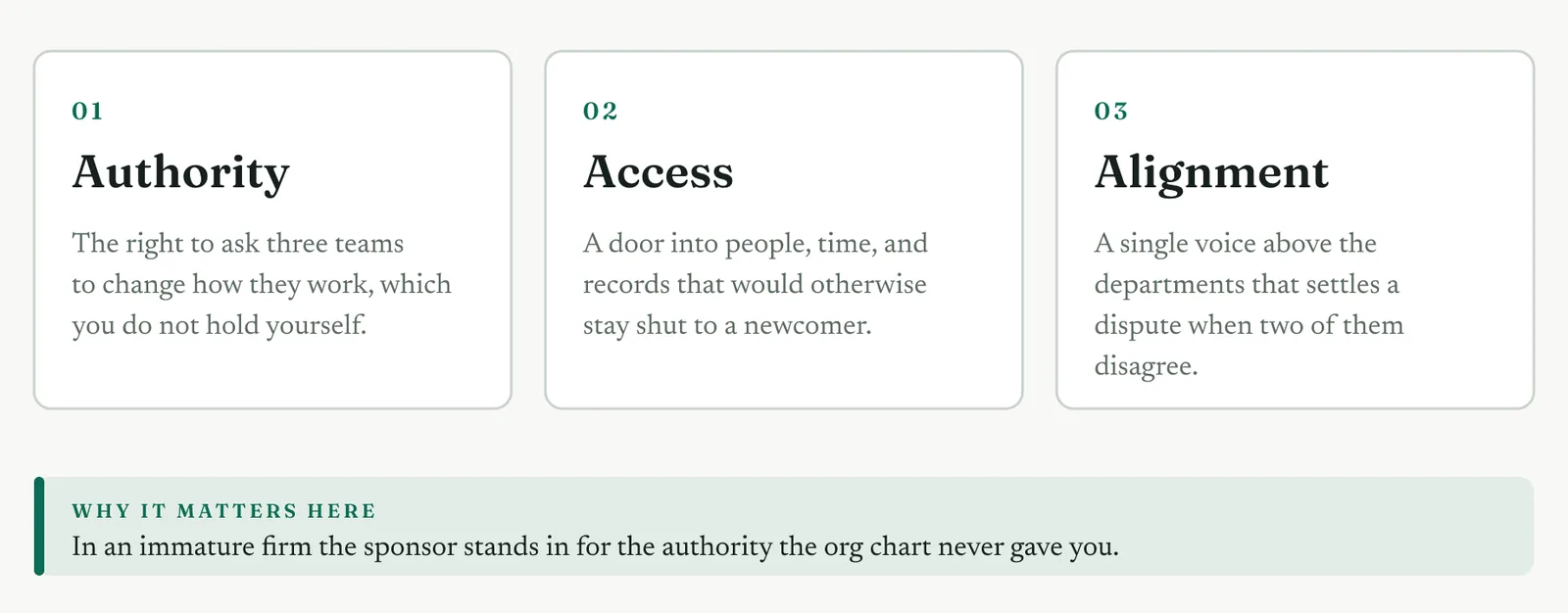
Authority is the right to ask three teams to change how they work. Access is a door into the people, the time, and the records that would otherwise stay shut to a newcomer. Alignment is a single voice above the departments that settles a dispute when two of them disagree. In a firm that has run improvement before, the reporting line carries some of this on its own. In the firm you walked into, it carries none of it. The sponsor stands in for the authority the org chart never gave you.
10.1.2 Why the sponsor stands in for missing authority
In a mature organisation an improvement function reports somewhere with reach, and that reach travels with the belt into a project. At Crestline there is no function and no reach. You are the whole improvement capability, and you have no line authority over client services, case handling, or billing. The sponsor lends you theirs.
This is borrowed authority, and it is worth naming as borrowed. It lasts only as long as the sponsor backs you. The moment the backing goes quiet, your authority goes with it. That is why so much of this chapter is about protecting the sponsor relationship rather than just winning it once.
10.1.3 Choosing the right level of sponsor
The common early mistake is to take the first willing sponsor rather than the right one. Willing is easy to find. Right depends on the spread of the problem. Match the level of the sponsor to the widest team the problem crosses. Figure 10.2 shows the match.
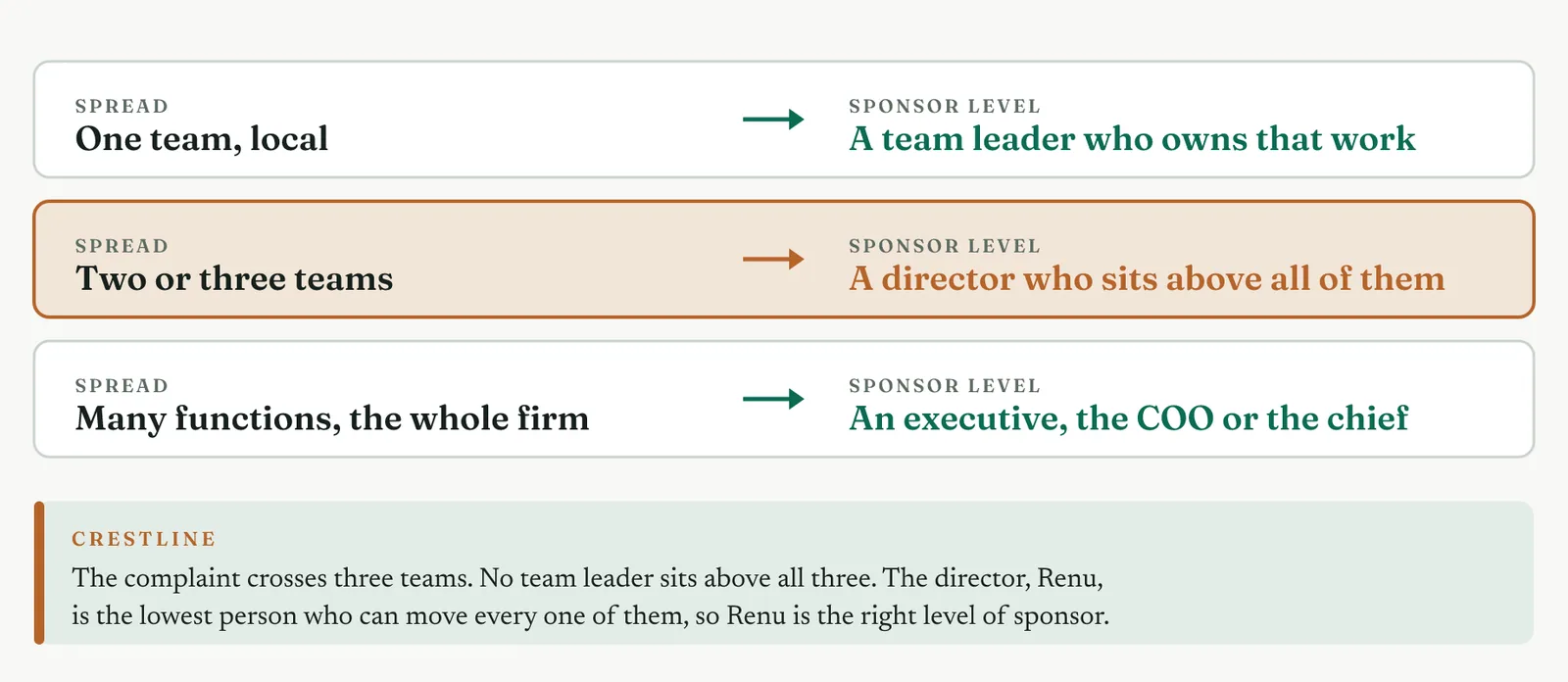
Pick a sponsor who sits above every team the problem touches. Pick lower, and you hit a wall the first time the work crosses into a team your sponsor does not control. At Crestline the complaint crosses three teams, and no team leader sits above all three. Renu, the director, is the lowest person who can move every one of them. A team leader might have said yes faster, and would have been unable to deliver. Renu is willing and able. Identifying that level is your job. Granting it is not, and that is the subject of the next two sections.
10.1.4 Who can sponsor, and who cannot
Naming the right level still leaves a question. Not everyone at that level can sponsor. A real sponsor passes three tests, set out in Figure 10.3.
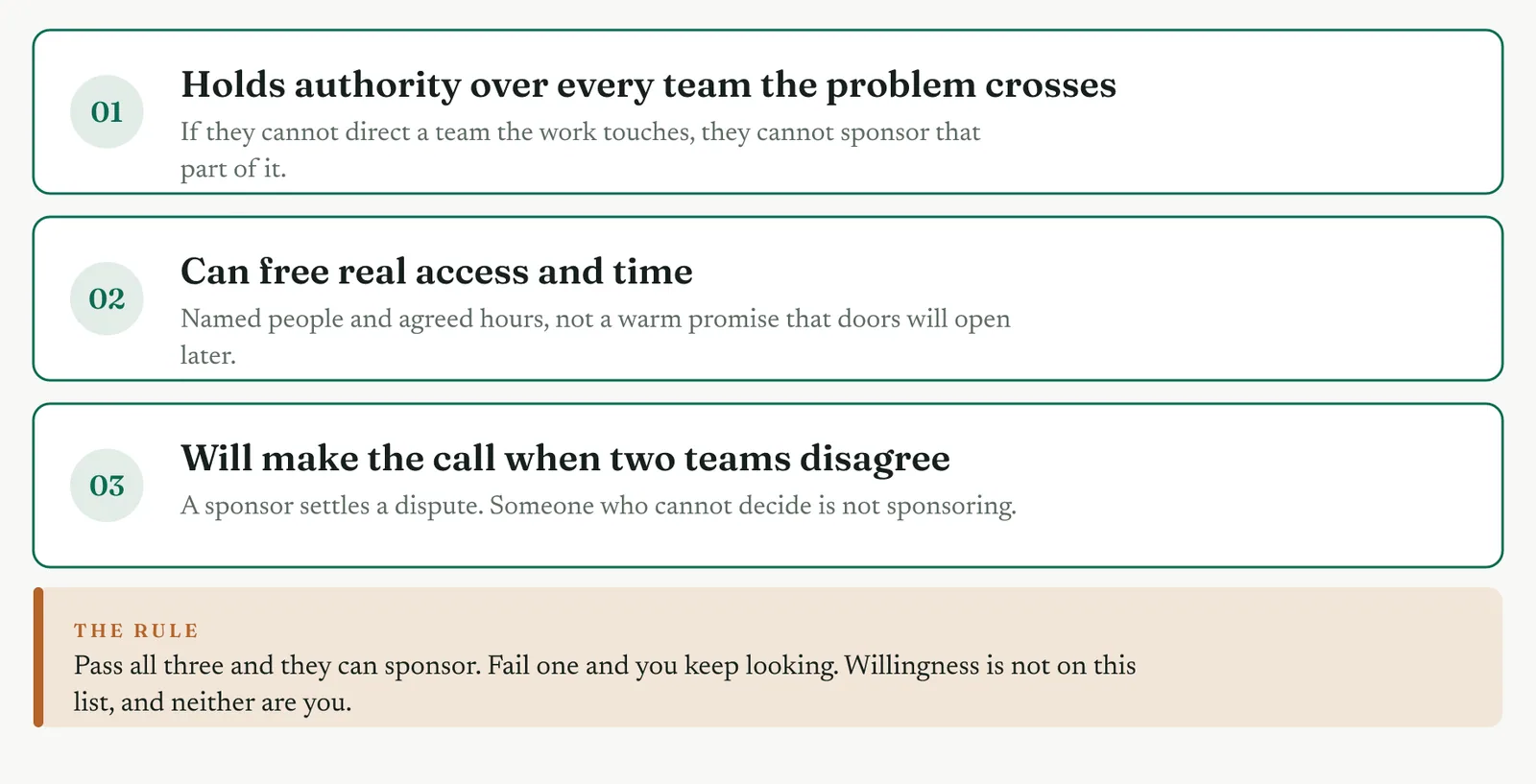
First, they must hold authority over every team the problem crosses. If they cannot direct a team the work touches, they cannot sponsor that part of it, however senior they sound. Second, they must be able to free real access and time, named people and agreed hours, not a promise that doors will open. Third, they must be willing to make a call when two teams disagree, because settling that dispute is the one thing only a sponsor can do.
Three people fail this test often. A peer of the affected managers, who has influence but no authority over them. A willing, enthusiastic manager whose reach stops at the edge of their own team. And you. You hold no line authority over the teams, so you cannot be your own sponsor, and neither can a Master Black Belt who runs the function. Willingness is not authority, and it is not on the list.
10.2 Where sponsorship comes from
You cannot be your own sponsor, and a willing peer cannot back the work either. So the authority a project needs has to come from somewhere you do not control. It comes from above, and it comes down, never up.
10.2.1 You identify the level, you do not name the sponsor
Your job is to read the spread of the problem and name the level it needs. That is analysis, and it is real work. Naming the level is not naming the sponsor. You bring the framed problem and its level up to the person who owns improvement, and authority decides who carries it. You cannot name or appoint the sponsor yourself, because a sponsor is real only through the authority they hold over the teams, and you have no authority to hand out. Figure 10.4 shows where it actually comes from.
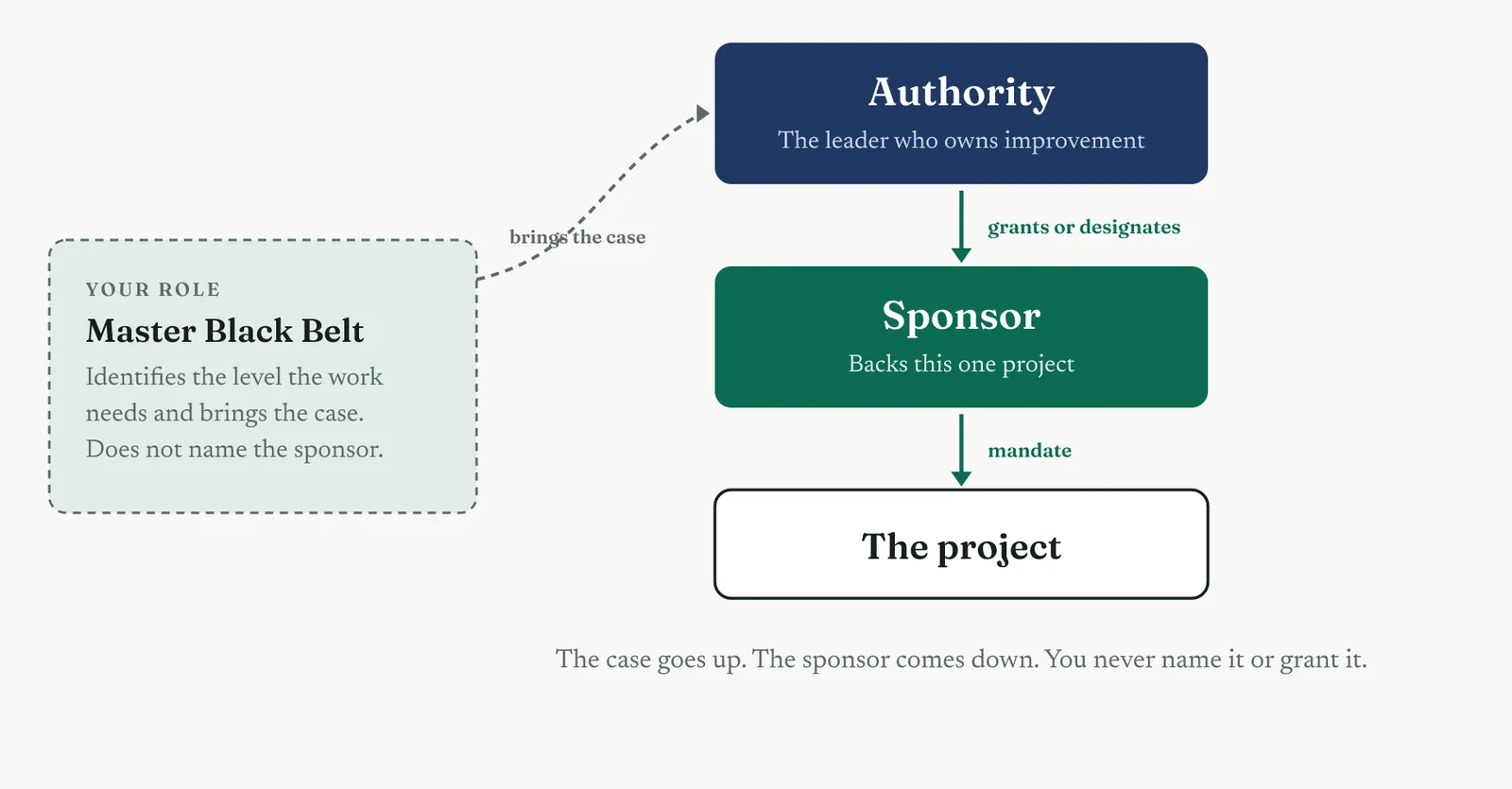
Authority sits at the top. It names and grants a sponsor, or designates one with the reach. The sponsor gives the project a mandate. Your part runs the other way, upward, and it is narrow. You take the framed problem to the person who owns improvement and you say, this crosses three teams, so it needs a backer who sits above all three. Who that backer is, is theirs to decide. The decision to put authority behind the work is theirs to make, not yours.
10.2.2 Why a belt cannot grant authority
This is the same structural truth you met twice already. In Chapter 2 you could not move your own reporting line, because that decision sits with HR and the senior chain, not with you. In Chapter 3 the executive owner was identified by altitude, not chosen by the belt. Sponsorship follows the same rule. Authority descends. A sponsor you manufacture yourself is empty by construction, because the thing that makes a sponsor real, authority over the teams, is the one thing you were never able to hand them.
This matters in practice, not just in principle. The belt who talks a friendly peer into being a sponsor feels backed, right up to the first time two departments clash and the peer cannot settle it. At that moment the borrowed authority turns out to have been borrowed from someone who never held it. Spare yourself that discovery. Take the case to authority and let authority grant the backing.
10.2.3 The route to a sponsor when there is no function
In a mature firm a steering group assigns the sponsor on a set cadence, and the route is short. In the firm you walked into there is no steering group and no function, so the route runs through one person, the leader who owns improvement, the executive owner from Chapter 3. You take them the recognition note and the level the problem needs. Then one rule decides who appoints. A sponsor can be placed over teams only by someone whose own authority already covers those teams. If the improvement owner has that reach, they sponsor it themselves or name someone below them who does. If their reach falls short of a team the problem crosses, they cannot appoint a backer over it. It goes up to the lowest executive whose authority spans every affected team, as far as the chief executive if the spread demands it. Either way the appointment sits with authority, and your job was to bring a clear case, not to install a backer of your own.
At Crestline the route is short, because Renu both owns the improvement work and holds authority over all three teams. You take the case to Renu, and Renu appoints herself, because the authority and the problem sit in the same person. You did not make Renu a sponsor. You brought authority a problem worth backing at the level it needed, and authority backed it.
10.2.4 When no one with authority will own it
Sometimes you take the case up and no one with the right reach will put their authority behind it. That is not a failure of your persuasion, and it is not a reason to settle for a willing peer who cannot deliver. It is information. The work stays a candidate in the improvement register until authority is ready to own it. A project forced forward without a real sponsor is the gain nobody holds from Chapter 1, decided in advance. Better to leave it in the register than to build on sand.
| TIP Take the case for a sponsor up to authority, and let authority grant it. |
10.3 Sponsorship across the grounds and up the ladder
The rule that authority must grant sponsorship holds on every ground. What changes from ground to ground is who you approach, and how. Bring the reading from Chapter 1 with you before you ask anyone for anything.
10.3.1 What sponsorship looks like on each ground
Figure 10.5 sets the four grounds against the sponsorship you will find on each.
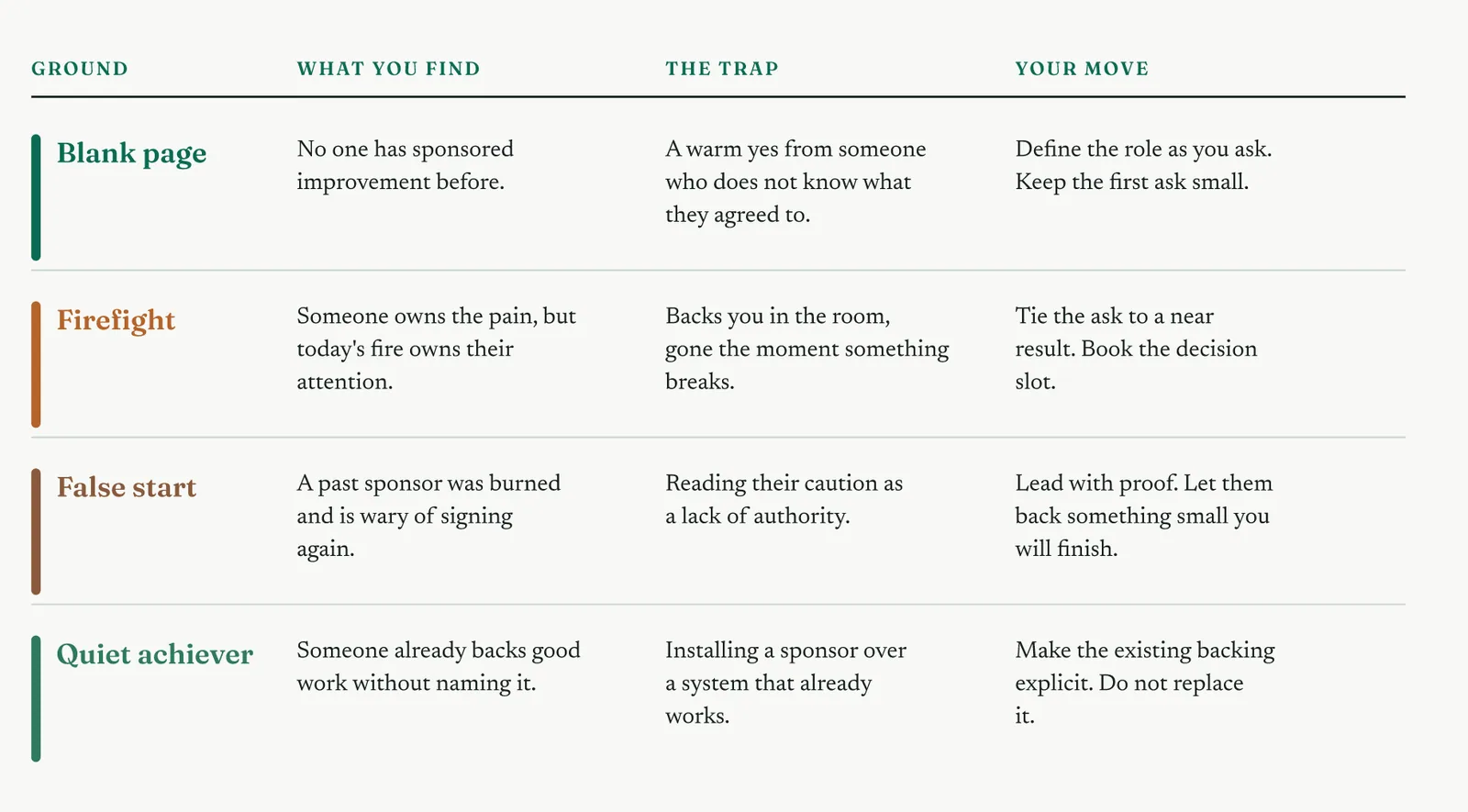
On a blank page no one has sponsored improvement before, so part of your task is to teach the role while you ask someone to fill it. The danger is a warm yes from a person who has no idea what they agreed to. In a firefight someone owns the pain, but their attention belongs to today's fire, and the backing you win in the room can vanish the moment something breaks. On a false start a past sponsor was burned by a programme that failed, and is wary of attaching their name again. Read that caution as memory, not as a lack of authority. As a quiet achiever you will often find someone who already backs good work without ever calling it sponsorship, and the work is to make that backing explicit rather than to install a new sponsor over the top.
10.3.2 What changes as the firm matures
Figure 10.6 follows sponsorship up the maturity ladder from Chapter 1.
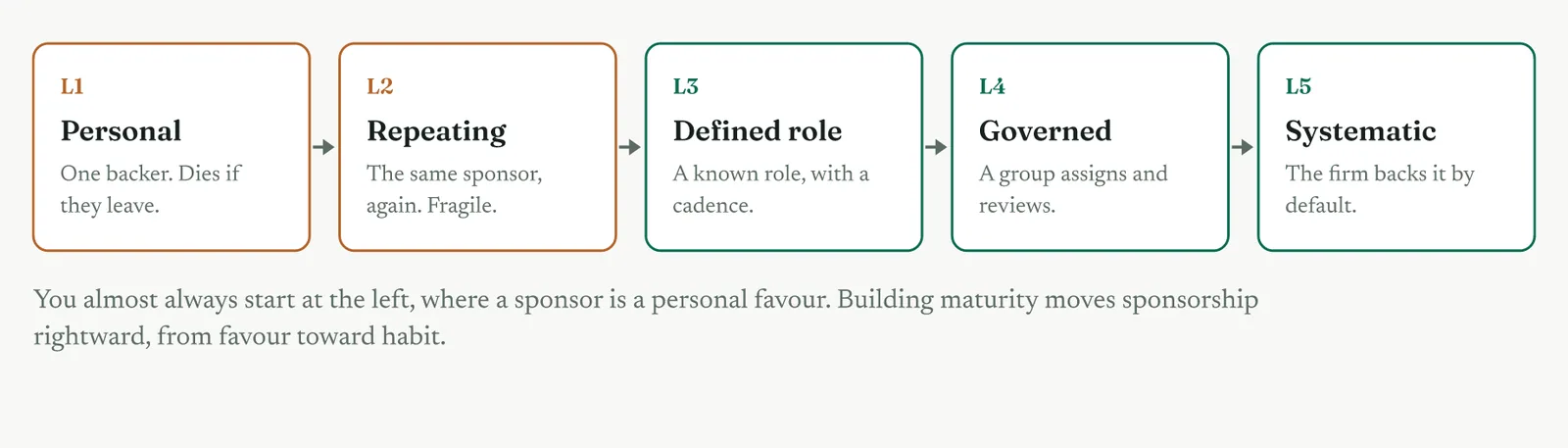
At Level 1, where almost every firm in this book sits, sponsorship is personal. It lives in one executive's backing and dies if they leave. At Level 2 a few sponsors repeat, often the same capable person, and the backing is still fragile. At Level 3 sponsorship becomes a defined role with a known cadence, and a sponsor knows what a tollgate is before you explain it. At Level 4 it is governed, with a group that assigns sponsors and reviews the portfolio on a rhythm. At Level 5 it is systematic, and the firm backs improvement by default. You almost always begin at the left, where a sponsor is a personal favour. Moving sponsorship rightward, from favour toward habit, is part of the maturity you are here to build.
10.3.3 Reading your own ground before you ask
Before you approach anyone, place your firm with the diagnostic from Chapter 1. The ground does not change the rule that authority grants sponsorship. It changes how you carry the case to authority. On a blank page you define the role as you ask. In a firefight you tie the ask to a fire you can put out, and you book the decision slot so it survives the next one. On a false start you lead with proof and keep the ask small, so backing you costs no reputation. As a quiet achiever you formalise the backing that already exists. Same rule, four different approaches.
| TIP Read your ground before you choose who to ask, and how. |
10.4 Speaking the sponsor's language
You found the right sponsor and authority granted the backing. Now you have to keep it, and that is a translation job. Belts routinely lose a sponsor by speaking in the language of the method instead of the language of the business.
10.4.1 Cost and customers, not tools and phases
A sponsor does not care about your method, and they should not have to. They care about cost, customers, and time. Speak in those three, and the method stays your private business. Figure 10.7 shows the translation.
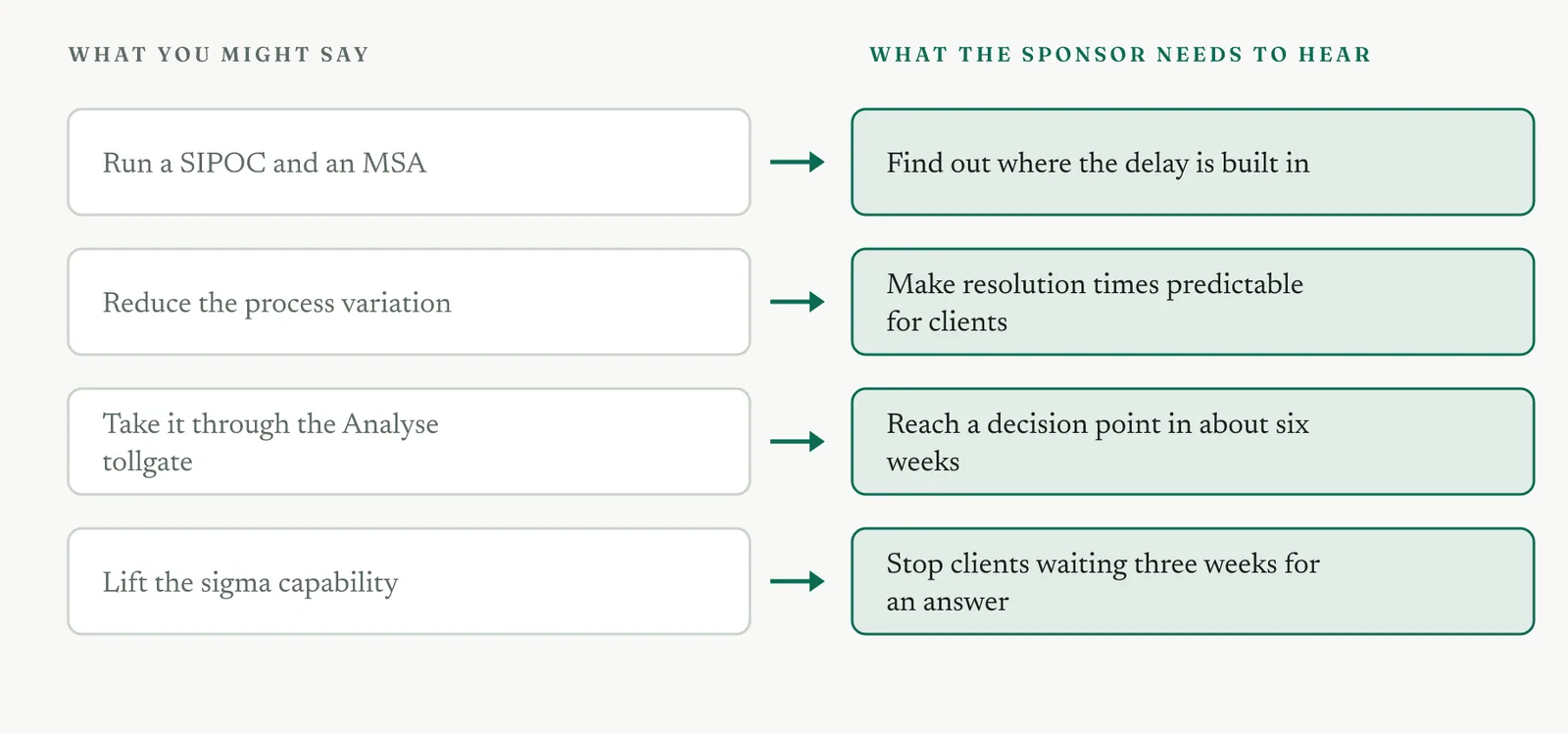
The sponsor does not need to hear SIPOC or MSA. They need to hear that you will find where the delay is built in. They do not need the word capability. They need to hear that clients will stop waiting three weeks for an answer. Every time you reach for a tool name, stop, and say the outcome instead. The machinery is yours to carry. The result is what you put on the table.
10.4.2 The time to a first result
Sponsors fund momentum, not promises. The strongest thing you can offer is a near date for a real decision. Do not promise a finished fix by a far date. Promise a framed problem and a measured baseline by a near one, with a decision point at the end of it. Small, near, and certain beats large, far, and vague. A sponsor who sees a result in six weeks will give you the next six. A sponsor promised a transformation in six months will lose interest by week three.
10.4.3 Framing the ask for the Crestline director
You sit down with Renu. You do not open with the framework, and you do not draw a single diagram. You open with the client. Clients wait up to three weeks for a complaint answer, you say, and the board has already flagged the churn that comes with it. Then the cost, in renewals at risk. Then the ask, kept small. Named access to the three teams, about six hours of their time, and a fortnightly slot where Renu can approve, stop, or steer. Then what Renu gets in return. A framed problem, a measured baseline, and a first decision point in about six weeks. And one thing said plainly. This is not a request for more staff. You will test that theory, not assume it.
| TIP Open every sponsor conversation with the client, not the method. |
10.5 Stakeholder mapping
A sponsor is one person. A project lives or dies on a wider set of people, and some of them do not want it. Map them before you start, so the resistance is something you planned for rather than something that ambushes you.
10.5.1 The three departments and their interests
The Crestline complaint crosses three teams, and each holds a different piece of the problem and a different view of it. Client services takes the complaint first, and feels the client anger directly. Case handling works the complaint, and feels the volume. Billing often holds the answer the client is waiting for, and feels blamed for delays it sees as someone else's fault. None of the three owns the whole flow. That missing ownership is the root of the problem, and it is also the root of the politics you are about to walk into.
10.5.2 Influence and resistance
Ask two questions of every person the project touches. How much influence do they have over whether it succeeds. And do they support it or resist it. Those two questions place each person on a simple grid, and the grid tells you how to handle them. Figure 10.8 shows the four plays.
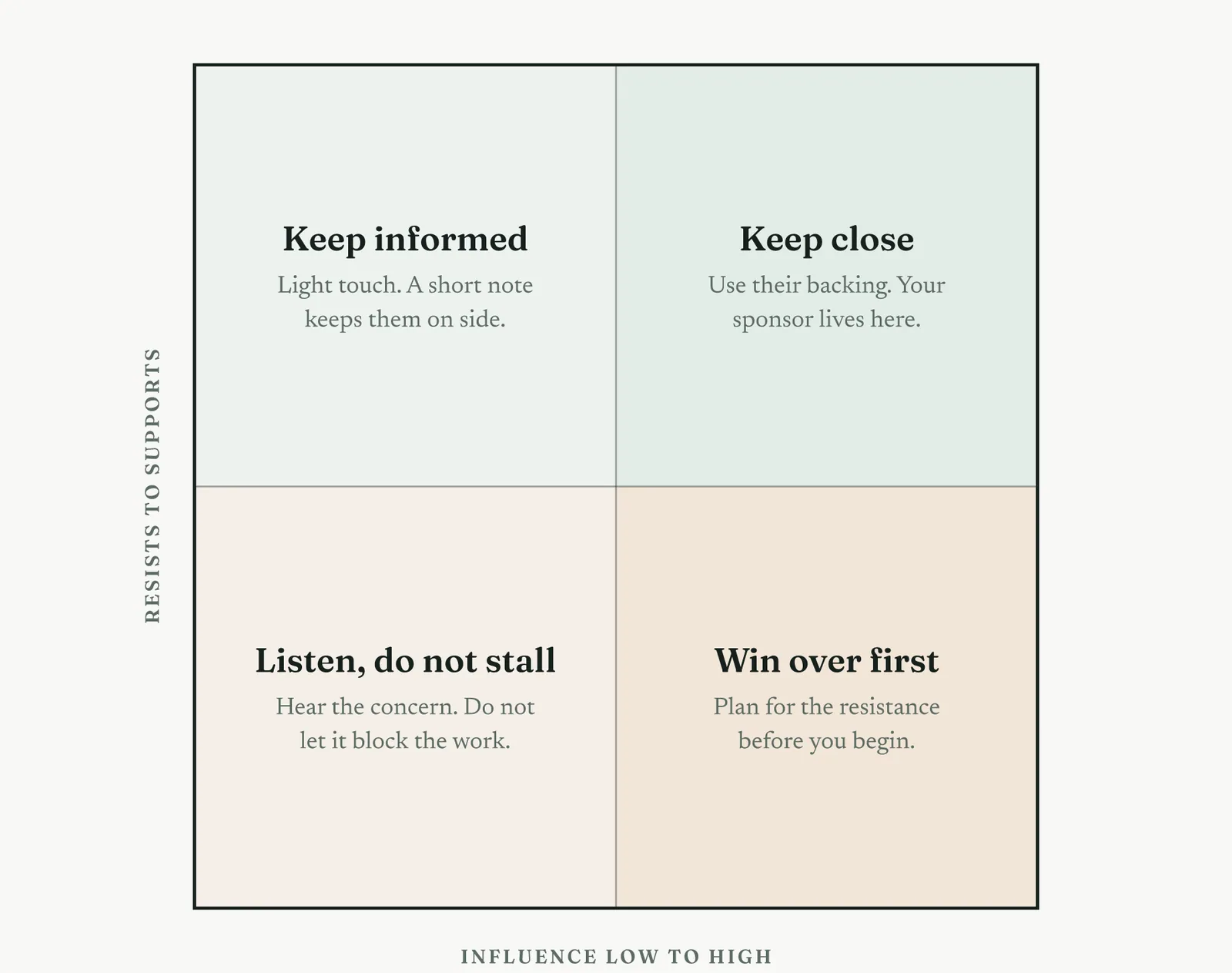
Someone with high influence who supports you is your sponsor, and you keep them close and use their backing. Someone with high influence who resists is the one to win over first, before the work begins. Someone with low influence who supports you needs only to be kept informed. Someone with low influence who resists is heard, and then not allowed to stall the work. The grid is not a way to rank people. It is a way to spend your attention where it changes the outcome.
10.5.3 Planning for the defensive process owner
Geoff owns part of the complaint flow, and he reads any look at the process as a verdict on him. He has enough influence to slow you and enough wariness to try. He is the high-influence, resistant case, and he needs handling before the first workshop, not after. Bring him in early. Frame the work as fixing a process that has no owner, never as fixing Geoff. Give him a real role in the solution, so that when the change lands it is partly his. A defensive owner brought in early becomes a defender of the gain. The same owner surprised in a workshop becomes the reason the gain never holds.
| TIP Bring the defensive owner in before the first workshop, not after. |
10.6 The mandate
Backing you cannot point to is not backing. A sponsor who agrees in principle and frees nothing in practice has given you a feeling, not a mandate. The mandate is the backing made concrete, and it is the thing you actually leave the room with.
10.6.1 What you must secure
Three things turn a willing sponsor into a working mandate. Access, time, and a decision slot. Figure 10.9 sets them out, against the empty sponsorship they replace.
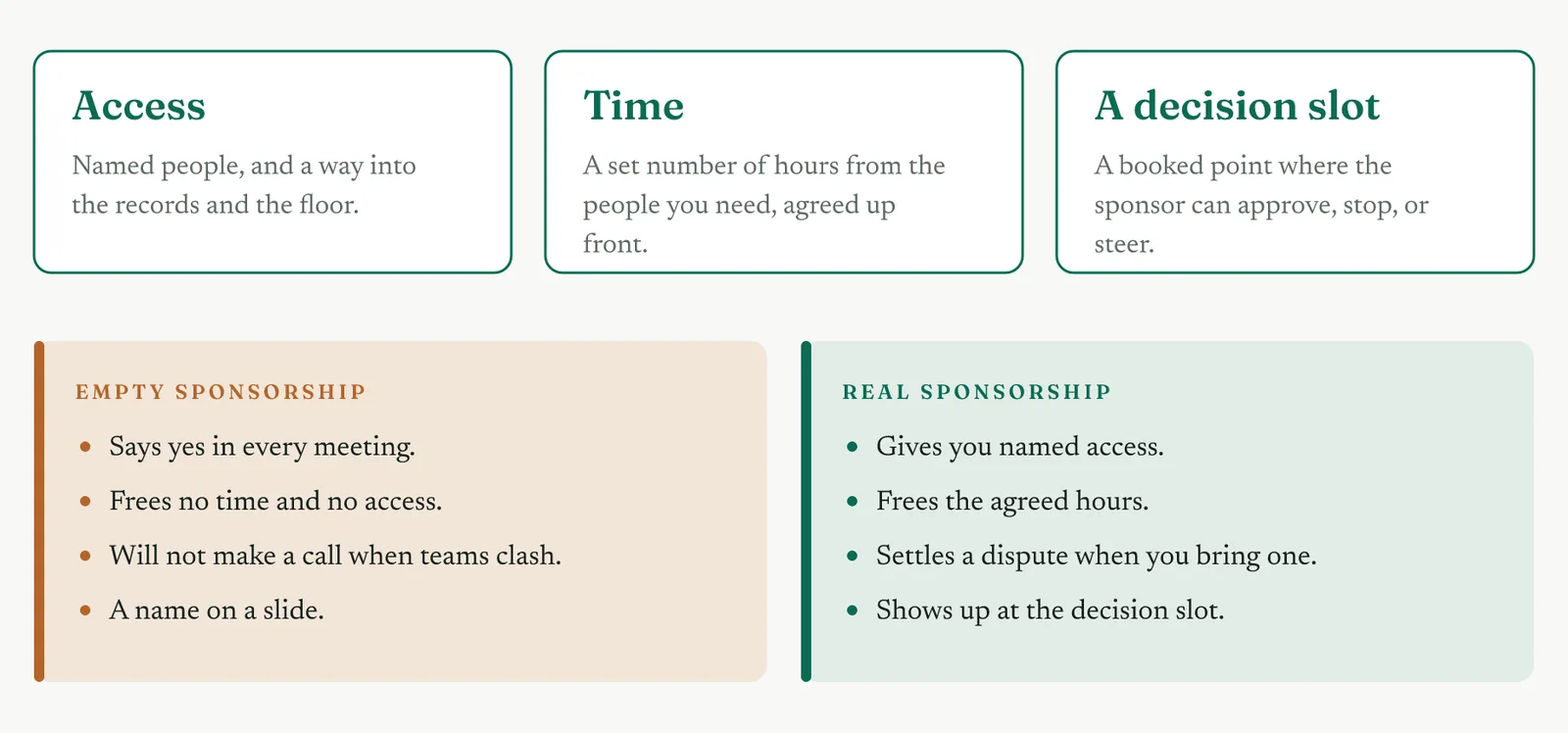
Access means named people and a way into the records and the floor, not a vague promise that doors will open. Time means an agreed number of hours from the people you need, set up front, not borrowed against goodwill later. A decision slot means a booked point in the calendar where the sponsor can approve, stop, or steer, so the project never stalls waiting for a verdict that nobody scheduled. Secure those three and you have a mandate. Leave with anything less and you have a conversation.
10.6.2 Keeping the ask small
Ask for little. A large ask invites a slow no, because it forces the sponsor to weigh a big commitment before you have proven anything. A small ask invites a fast yes. Secure a small mandate, deliver against it in full, then come back and ask again from a position of proof. The first ask buys the second. This is the same discipline you read in Chapter 1, where one finished project earns the standing to ask for more. It applies to the mandate exactly as it applies to the work.
10.6.3 Spotting empty sponsorship
Empty sponsorship says yes in every meeting and frees nothing between them. You find it by testing it, early. In the first week, ask for one small, specific thing. A name. An hour. A single record. If it appears, you have a sponsor. If it does not, you have a name on a slide, and the time to discover that is now, while the cost of discovering it is small. Empty sponsorship is most common on the two grounds where the sponsor is least sure of the role. The blank page, where they do not know what they signed, and the false start, where they hedge to protect themselves. On both, the small early test is what tells you whether the backing is real.
| TIP Test the mandate in the first week with one small, specific ask. |
10.7 The one-page recognition note
Everything Recognise produced now lands on a single page. The recognition note is that page. It is the artefact that carries the framed problem, the rough size, the sponsor, and the ask across the boundary into Define.
10.7.1 The seven fields
The note has seven fields, and no more. Figure 10.10 shows the blank form.
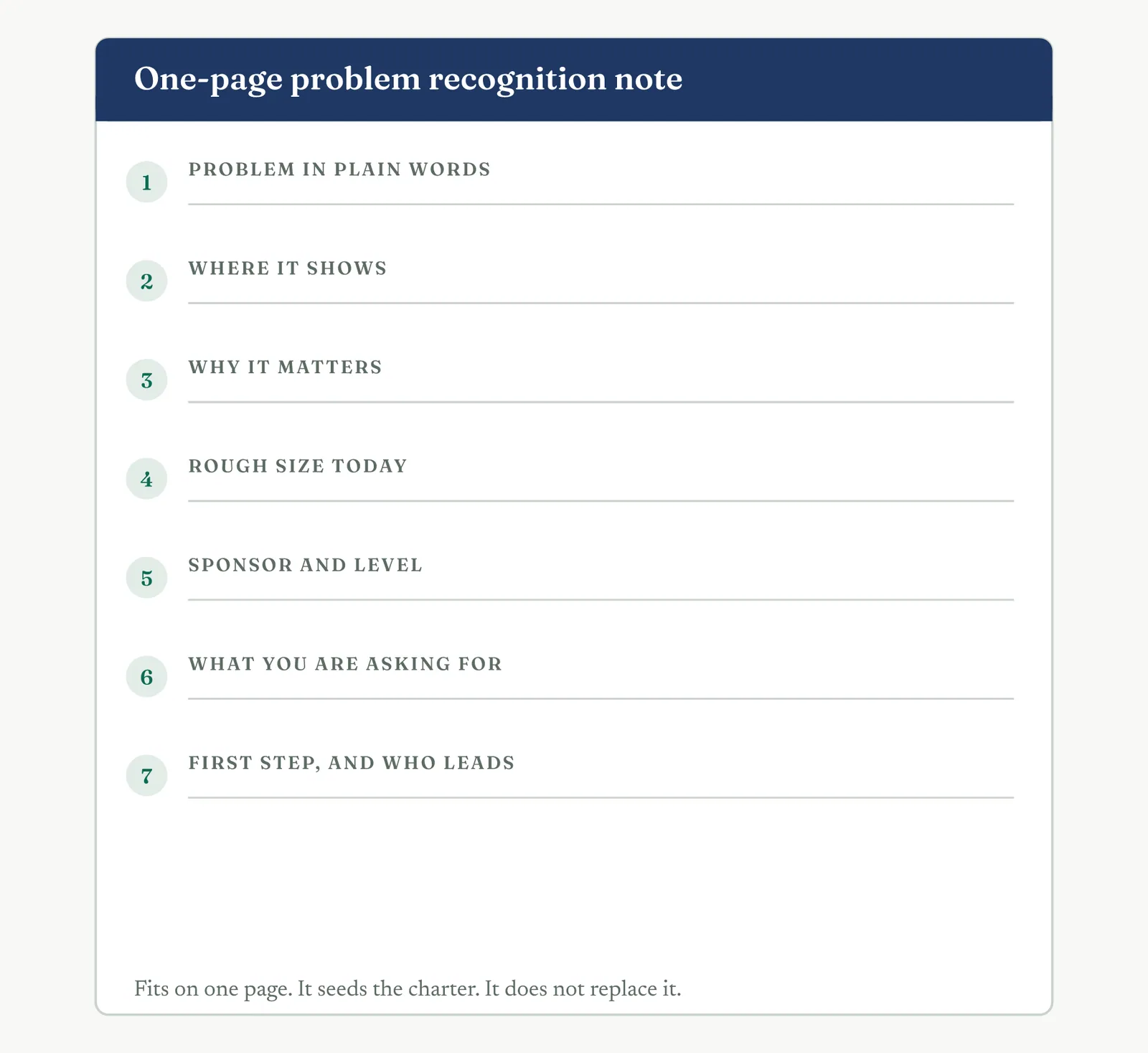
The first field states the problem in plain words, free of any assumed cause. The second says where it shows, the process and the teams it crosses. The third says why it matters, in cost and customers. The fourth records the rough size you have so far. The fifth names the sponsor and their level. The sixth states what you are asking for. The seventh names the first step and the person who will lead it. Seven fields hold everything a sponsor needs to back the work, and nothing they do not.
10.7.2 Why one page
One page forces clarity. A problem you cannot state on one page is a problem you have not finished framing, and the single page surfaces that before it reaches a sponsor. One page is also the only length a busy director will read in full. The constraint is not a formatting choice. The discipline of fitting the work onto one page is the point.
10.7.3 From note to charter seed
The note is not the charter. The charter comes in Define, with a hard scope, named CTQs, and a measurable target. The note seeds it. The problem and the baseline become the opening of the charter. The sponsor field becomes the sponsor section. The named Black Belt becomes the person who writes it. The note hands Define a running start, so the charter is built on Recognise rather than from scratch.
| TIP Keep the recognition note to one page, even when you could write ten. |
10.8 Closing Recognise
Recognise has done its work. It found the problem, routed it, framed it, chose it, and backed it. Now it ends, and it ends at a tollgate.
10.8.1 The Recognise tollgate
The tollgate is a go or hold decision taken with the sponsor. Figure 10.11 shows it, and shows what crosses it.
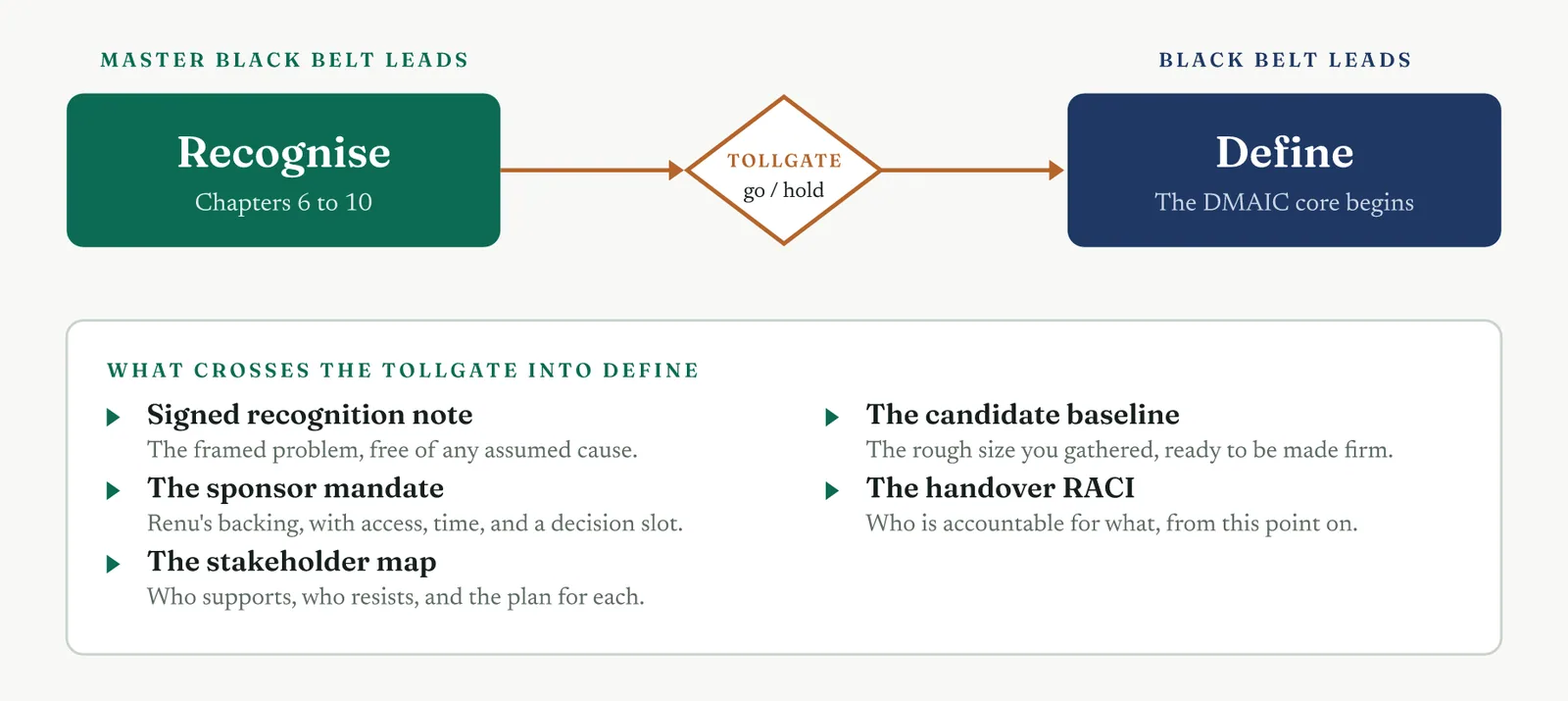
Five questions decide the gate. Is the problem framed and free of an assumed cause. Is it worth doing. Is there a baseline, however rough. Is there a sponsor with the right reach, granted by authority. Is there a mandate with access, time, and a slot. If the answer to all five is yes, the gate opens into Define. If any is no, the work holds in Recognise until it is fixed. The tollgate is the first point where the sponsor formally backs the project, not just the idea behind it.
10.8.2 The handover from Master Black Belt to Black Belt
Recognise was Master Black Belt work. Define through Control is Black Belt work. The tollgate is where the two roles meet. The Master Black Belt does not hand over a verbal summary and a good feeling. They hand over a signed note and a live mandate. If one person wears both hats, as often happens in a firm this size, the handover is still real. You change role, from the person who finds and frames the work to the person who runs it, and the note marks that change on the page.
10.8.3 What the Black Belt receives
The Black Belt opens Define with five things in hand. The signed recognition note. The sponsor mandate, with access, time, and a decision slot. The stakeholder map. The candidate baseline. The handover RACI. With those, Define starts from a known position. Without them, it starts on sand, and every gap left open in Recognise reappears later as a problem that is far more expensive to fix.
| TIP Hand the Black Belt a signed note, not a verbal summary. |
10.9 The toolkit, in the order you reach for it
Four artefacts carry the work of this chapter. Each is shown here, filled with the Crestline case, so you see it worked rather than described.
10.9.1 The stakeholder map and influence grid
The grid places each Crestline stakeholder by influence and attitude. Figure 10.12 shows it filled.
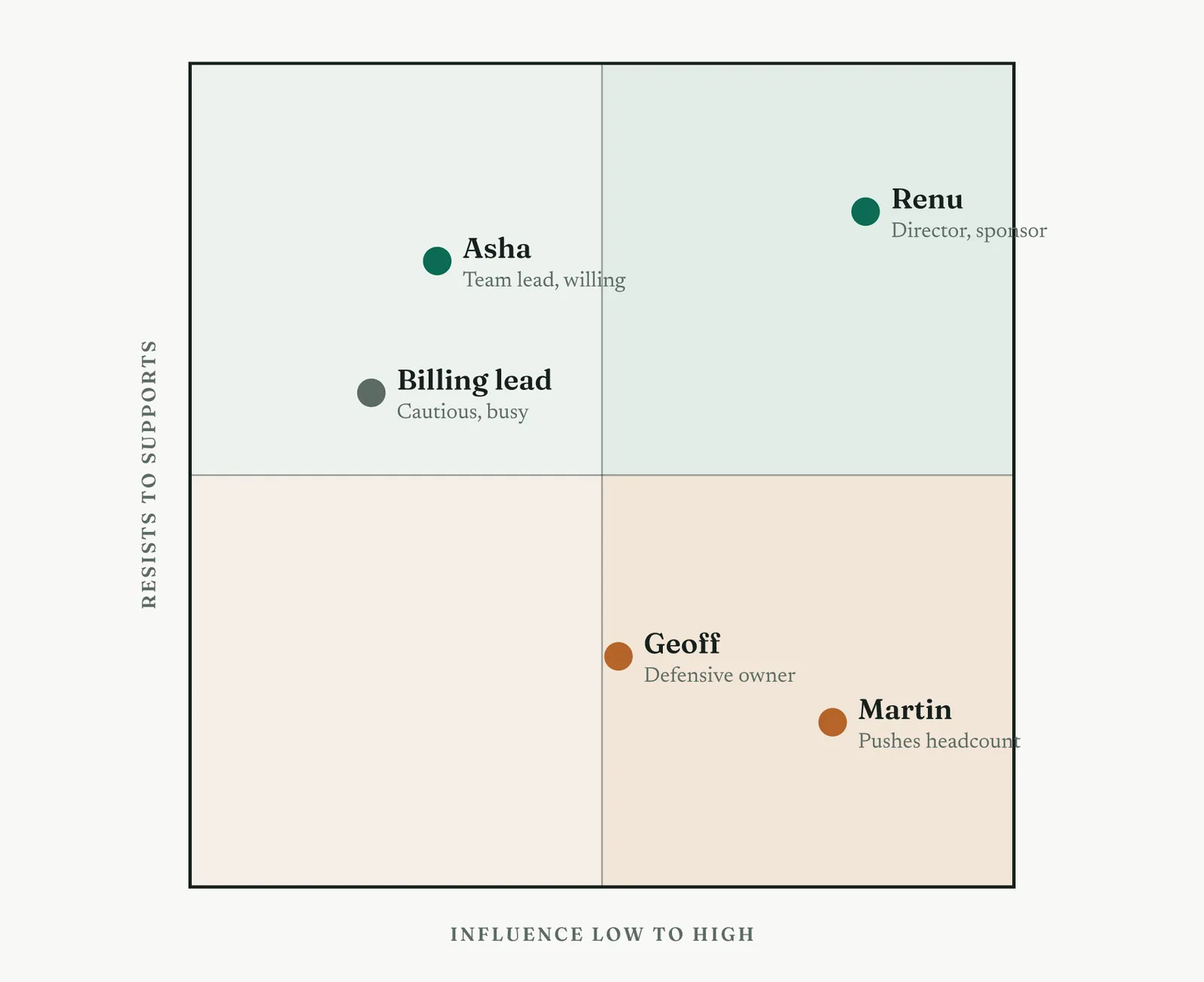
Renu sits high and supportive, your sponsor, kept close. Martin sits high and resistant, the headcount champion to win over before the data does it for you. Geoff sits in the middle and resistant, the defensive owner to bring in early. Asha sits supportive and willing, a team lead to keep informed and to lean on. The billing lead sits cautious and busy, heard but not allowed to stall. The plays follow the quadrants from Figure 10.8.
Execution note. Redraw the grid after the first workshop. People move once the work begins, and a defensive owner brought in well often crosses from resist to support.
10.9.2 The one-page recognition note, filled
This is the artefact that crosses the tollgate into Define. Figure 10.13 shows the Crestline note, all seven fields complete.
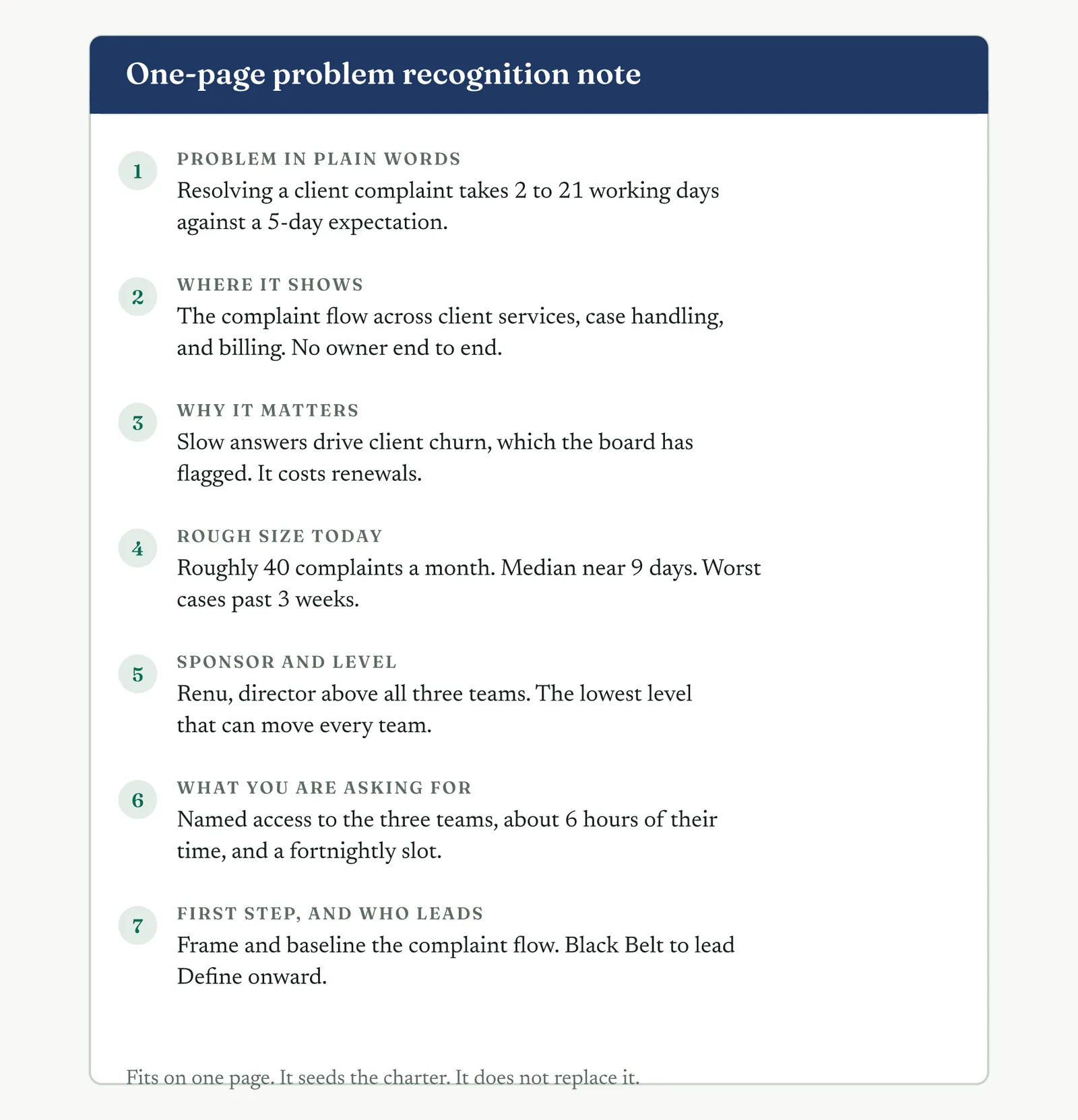
Execution note. Write it in words a director reads in two minutes. If a field needs jargon to make sense, the field is not finished.
10.9.3 The sponsor briefing one-pager
The recognition note is for the record. The briefing is for the conversation. Figure 10.14 shows the briefing you would take into the room with Renu.
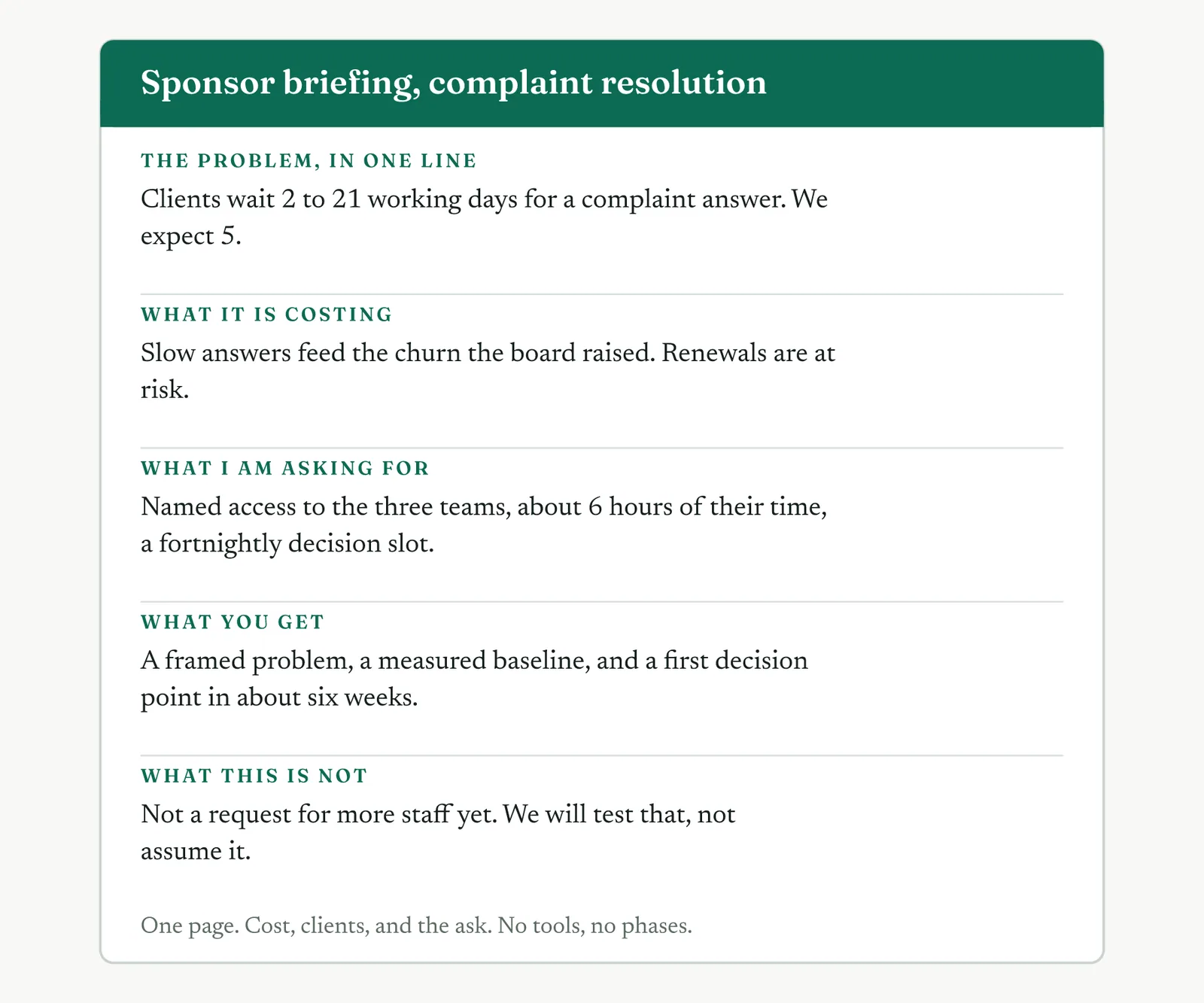
Execution note. Lead with the line that names the client's pain. It is the only line that earns you the rest of the page.
10.9.4 The project RACI at handover
The RACI fixes who is accountable for what from this point on. Figure 10.15 shows it filled for the handover.
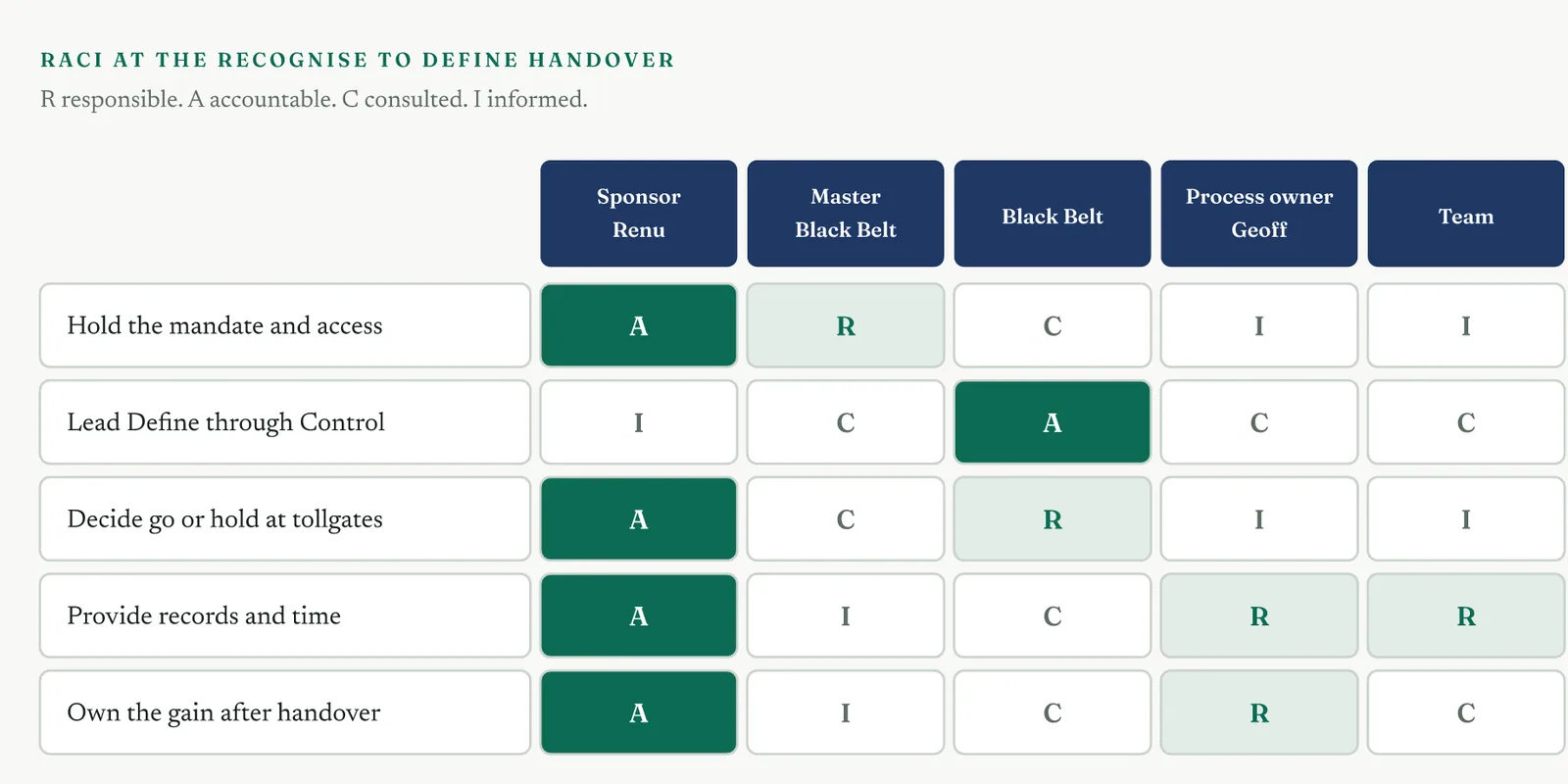
Renu is accountable for the mandate and, later, for the gain. The Black Belt is accountable for running the project from Define through Control. Geoff is responsible for the records now and for owning the gain after handover. The grid leaves no role unnamed, which is the whole point in a firm where the original problem was a process that nobody owned.
Execution note. Agree the RACI with the sponsor before the tollgate, not after. A role you assign without agreement is a role nobody accepts.
|
NEXT Recognise is closed. You hand Define a framed problem, a measured baseline, a sponsor granted by authority, and a mandate. Chapter 11 opens the DMAIC core. The Black Belt turns the recognition note into a charter that holds and a scope that does not drift, running the Define tool kit at the right depth for a firm with no data and a sponsor who wants speed. |