

PART 1 · FOUNDATIONS
Chapter 2
Where improvement should report
AIM Explain why organisational placement influences the effectiveness of Lean Six Sigma, what an effective reporting structure provides, and how an improvement team can still succeed when it is not placed in the ideal home.
You read the ground in the last chapter. Now ask a different question. Where in the organisation does improvement sit, and who does it answer to? Placement does not decide whether any single project succeeds. A good sponsor can carry one project from almost anywhere. What placement decides is whether improvement becomes a lasting capability, or stays a one-off effort that fades when attention moves.
2.1 Why reporting structure matters
Before you ask where Lean Six Sigma should report, ask a better question. What does the reporting line actually enable? The department name on the org chart matters far less than the things that line gives you, or takes away. A function can carry the most impressive title and achieve little, while a small team in the right place changes the organisation. The difference is not the name. It is what the placement provides.
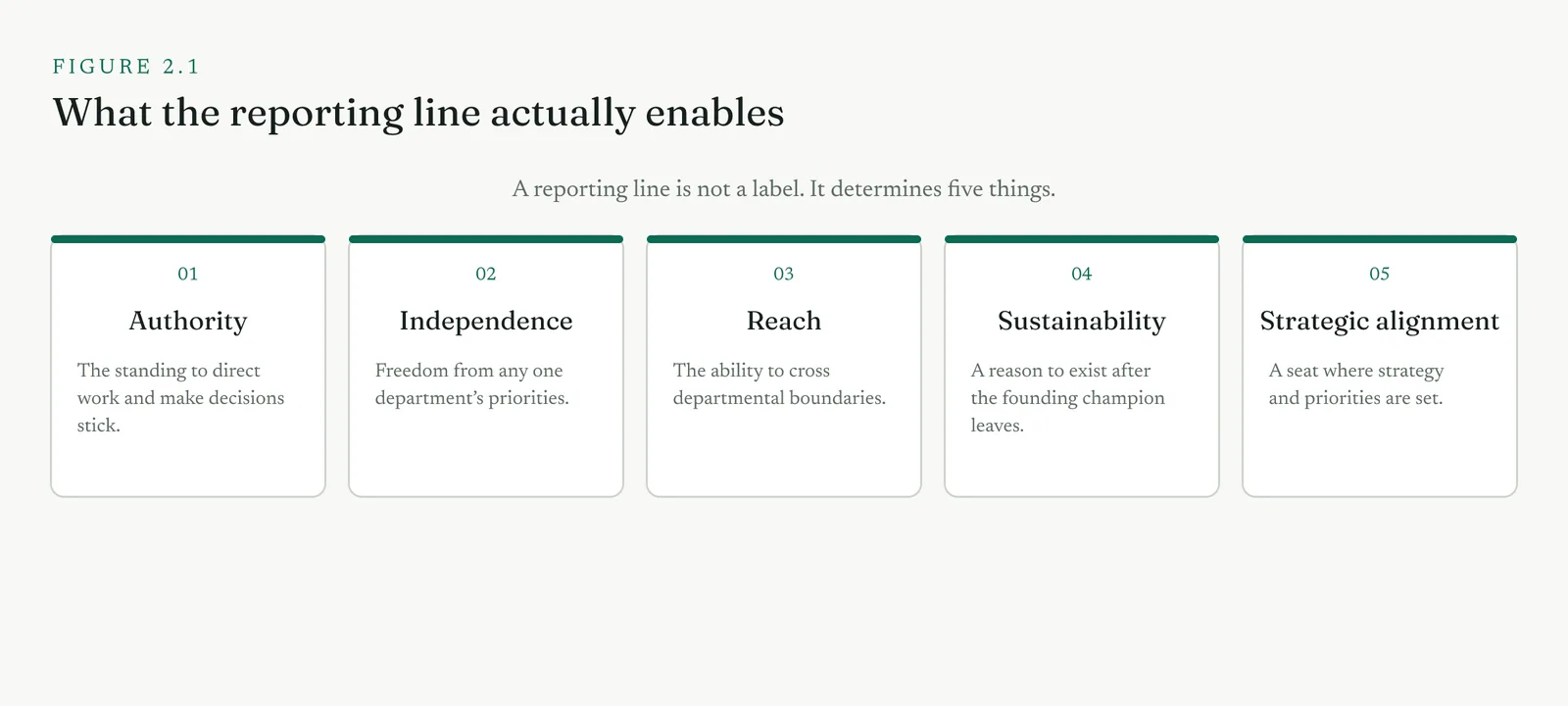
A reporting line is not a label. It determines five things, and each one shapes what improvement can do. Figure 2.1 sets them out.
The five things placement determines
The first is authority, the standing to direct work and make a decision hold when two departments disagree. The second is independence, freedom from any single department’s priorities, so the work serves the whole organisation rather than one corner of it. The third is reach, the ability to cross departmental boundaries and follow a problem wherever it leads. The fourth is sustainability, a structural reason to exist after the founding champion has moved on. The fifth is strategic alignment, a seat close enough to where strategy is set that the work stays tied to what the organisation actually cares about.
Hold these five in mind for the rest of the chapter, because they are the real test of any home. When you weigh a reporting line, you are not judging a department. You are asking how much of each of these five it gives you.
The principle underneath. Lean Six Sigma succeeds because of the authority and support it receives, not simply because of where it sits on the chart. The chart is only a proxy. What you are really securing is backing, reach, and a reason to last. A good placement supplies these by default. A poor one forces you to find them another way, which the rest of this chapter shows you how to do.
2.2 Why improvement must begin from the top
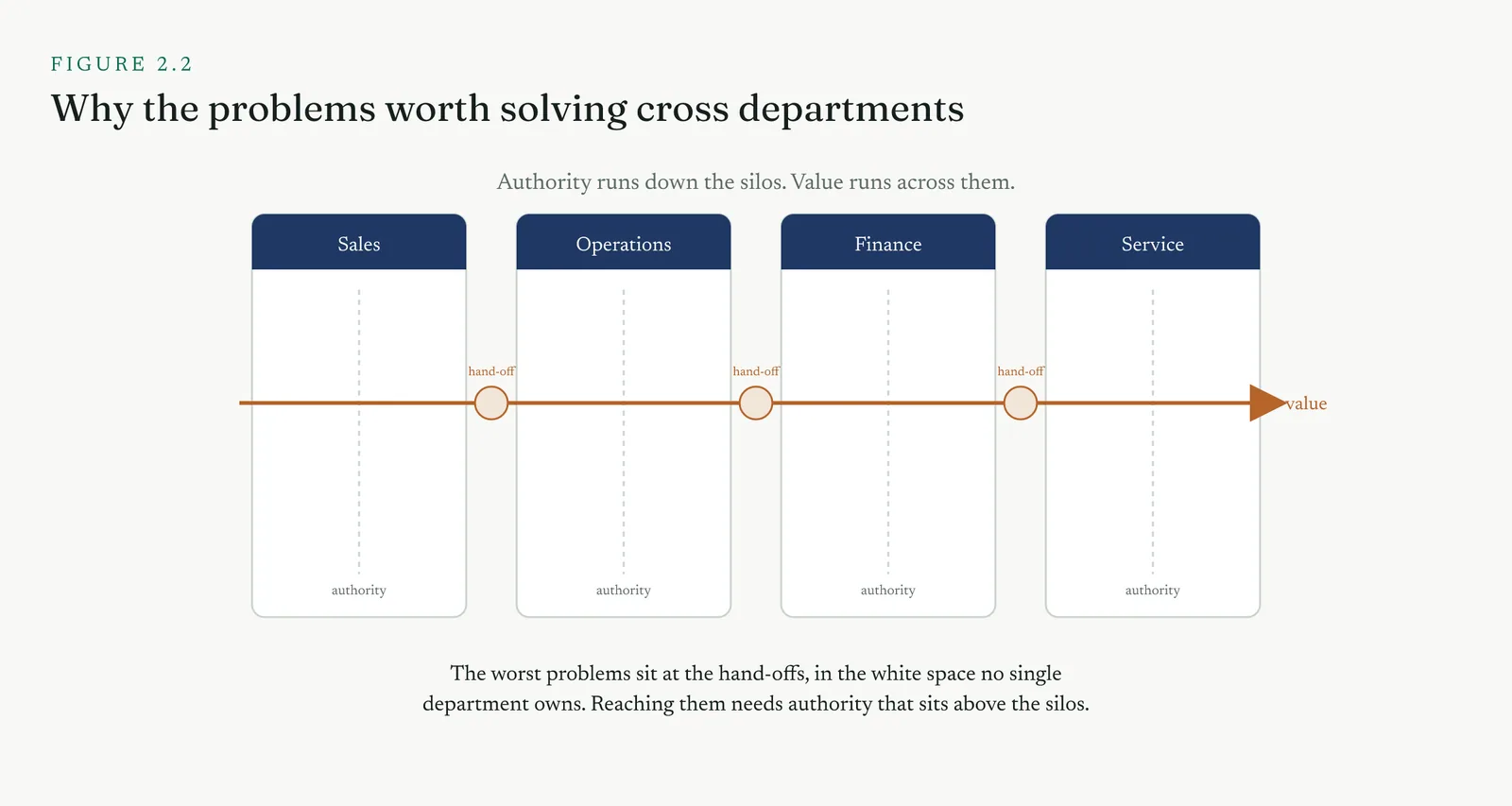
Improvement in most organisations has to be driven from above, and the reason sits in the shape of the problems themselves. The problems worth solving rarely live inside one team. They live in the spaces between teams, where work passes from one group to the next and no one owns the join. Figure 2.2 shows why.
Real problems cross departments
An end-to-end process runs sideways across the organisation, while authority runs straight down each department. Work arrives at a team, waits in a queue, gets handled, then waits again before the next team picks it up. The handling time is usually small. The waiting time, between teams, is where the days disappear. That waiting sits at the borders, in the white space that no single department owns, and it is exactly where the largest gains hide.
This is why the team that appears to own a problem often cannot fix it. Ask the first team to go faster and you compress a part of the process that was never the bottleneck. The wait still sits at the next border, untouched. To improve the whole, someone has to see and change the whole, across every team the work passes through. That requires authority above the departments, because no department can direct another.
Why immature organisations need top-down support
Bottom-up improvement is a fine idea, and it works in organisations that are already mature. A team spots a problem in its own work, fixes it, and the habit spreads. For that to happen, the organisation needs method in the teams, time set aside to use it, and a culture that expects continuous improvement. Those are the marks of a mature organisation, well up the ladder from the last chapter.
An immature organisation has none of them. There is no method in the teams, no protected time, and no expectation that work should be examined rather than just done. Ask a team to improve itself and you have asked people with no training, no time, and no mandate to do something they have never done. So improvement has to be created from the top, by someone with the standing to convene people, free their time, and settle disputes across departments. The support has to come from above before it can ever grow from below.
Why mature organisations can rely more on bottom-up improvement
As an organisation matures, the balance shifts. Once method is widespread, time is protected, and improvement is expected, teams begin to improve their own work without being told. The central push that an immature organisation needs gives way to a culture that carries improvement on its own. This is the direction every organisation is travelling toward, and the placement choices in this chapter are what move it along that road. Top-down first, so that one day improvement does not have to be driven at all.
Part 2 · Evaluating common reporting structures
There is no single home that is right for every organisation. Each common placement has genuine strengths and genuine costs, and the honest way to choose is to weigh them against the five things placement determines and against the problems your organisation most needs to solve. The next five sections evaluate the homes you are most likely to meet. None is simply wrong. Each works well in some settings and poorly in others.
2.3 Improvement under Operations
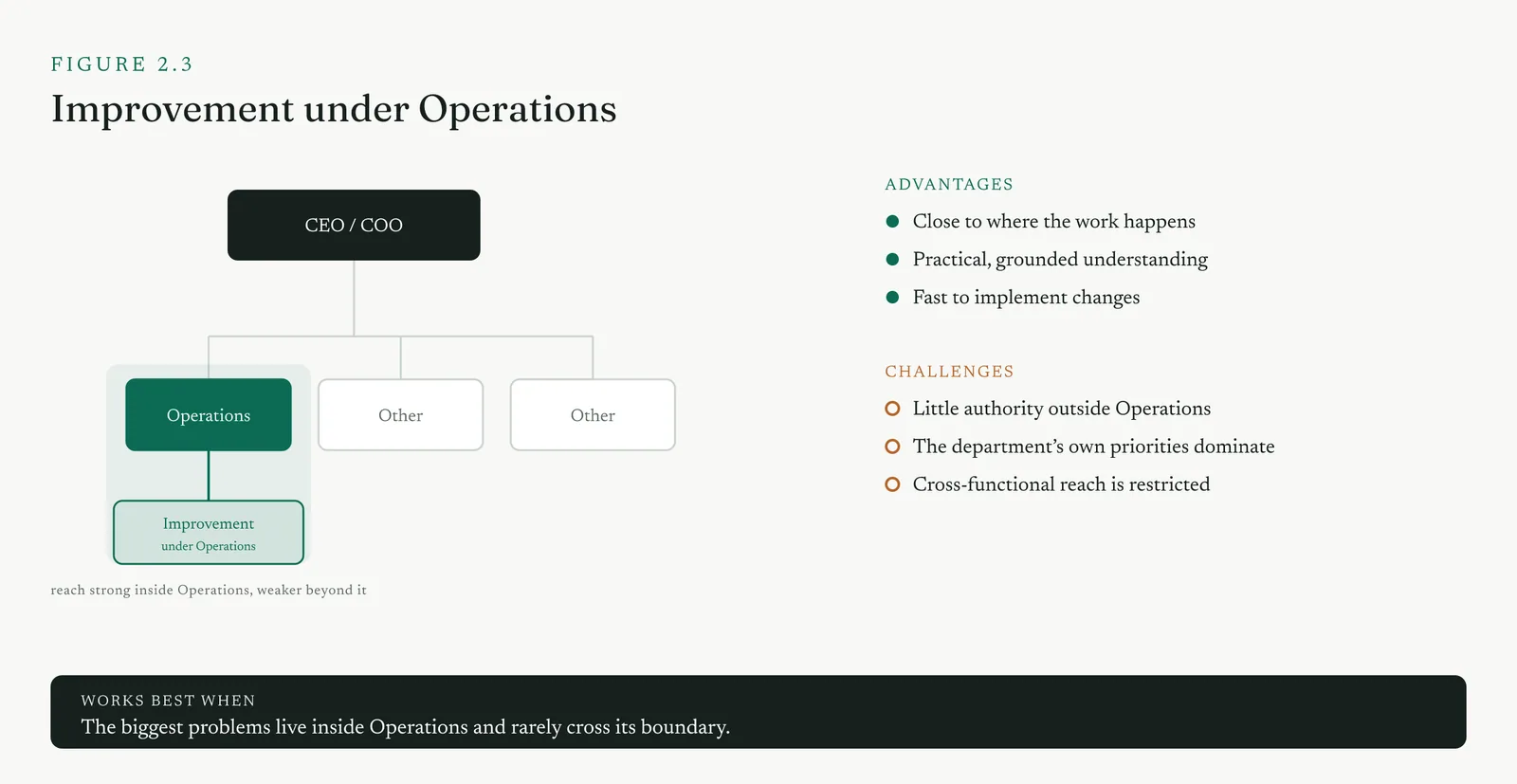
Placing improvement inside Operations puts it right next to the work, which is its great strength and its quiet limit at the same time. Figure 2.3 weighs it.
Advantages
Operations is where much of the work physically happens, so the function sits close to the process and understands it in practical terms rather than from a distance. Changes can be tried quickly, because the people who run the work and the people improving it are in the same department. There is little translation needed between the improvement and the operation, and a fix can move from idea to trial in days.
Challenges
The reach is capped at the department wall. From inside Operations you can act freely on Operations’ own work, but the moment a problem crosses into Finance or Technology you have no standing to act, because those teams do not report to your home. The department’s own priorities will also steer the function toward its concerns rather than the organisation’s, and the work risks being seen as an Operations initiative rather than an enterprise one. Since the costly problems usually cross boundaries, the most valuable work is often just out of reach.
When it works well
This home works well when the organisation’s biggest problems genuinely live inside Operations and rarely cross its boundary, and when a willing sponsor can be borrowed on the occasions a problem does reach beyond it. For an organisation taking its first steps, a contained set of Operations problems can be the ideal proving ground, provided you are honest that the wider, cross-functional work will need a different reach later.
2.4 Improvement under the PMO
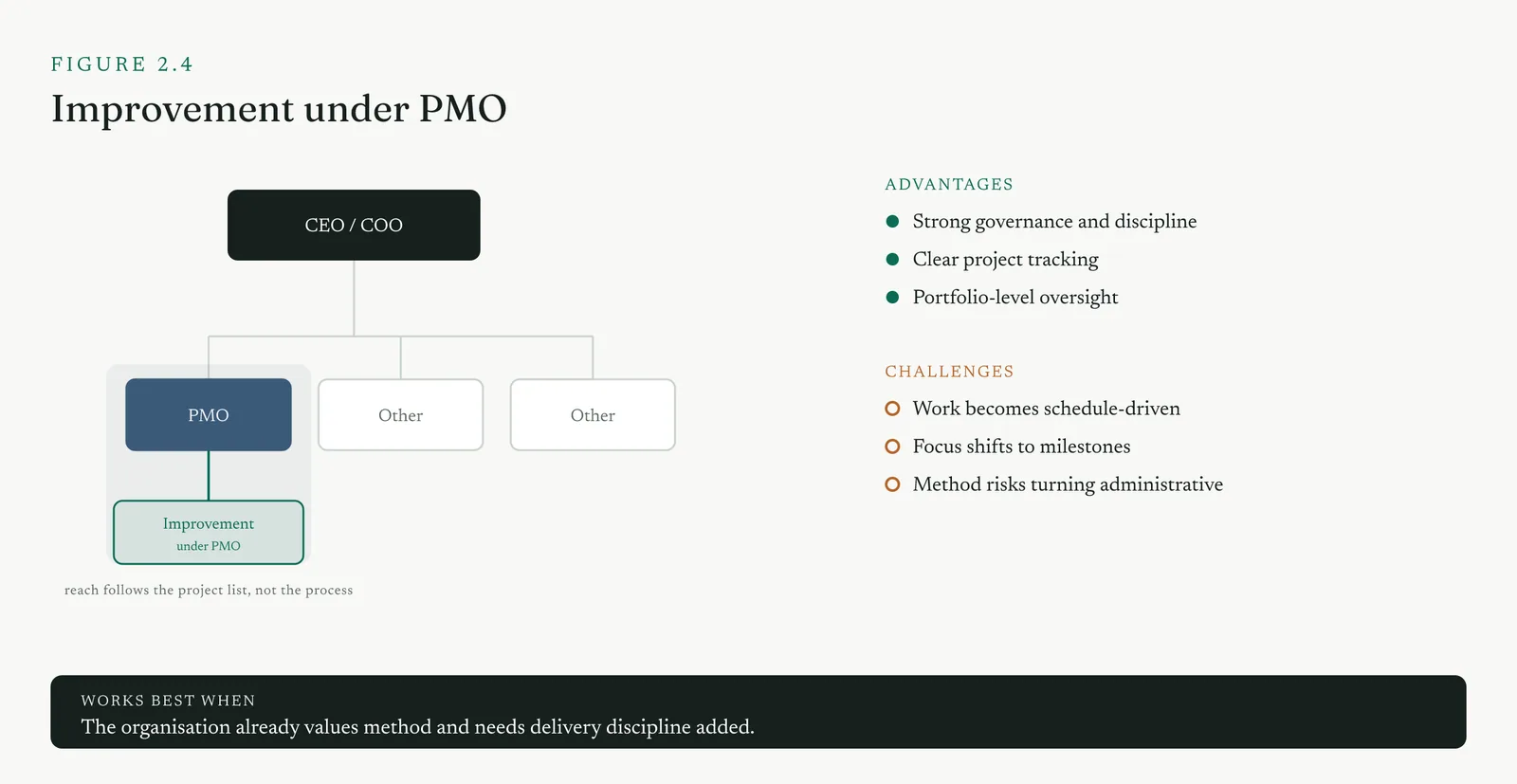
The project management office runs projects and tracks delivery, so improvement work seems a natural fit. The fit is real, and so is the distortion it can introduce. Figure 2.4 weighs it.
Advantages
A PMO brings governance, discipline, and a clear way of tracking work. Projects are scheduled, milestones are visible, and the whole portfolio can be seen in one place. For an organisation that has never run structured work, this delivery discipline is genuinely valuable, and it gives improvement a recognised home with established reporting routines.
Challenges
A PMO is built to manage schedules, and it tends to reshape whatever it holds into a schedule of tasks and milestones. Improvement carries something a PMO is not built to protect, which is the discipline of proving a cause before acting on it. Under a PMO, the method can drift toward paperwork. The gate review becomes a status update on whether tasks are on time, rather than a genuine test of whether the cause was proven and the gain is real. Tools get filled in to satisfy the process rather than used to find the answer.
When it works well
This home works well when the organisation already values method and simply needs delivery discipline added around it, and when the PMO understands that an improvement gate is a test of evidence, not a check on the calendar. Where the PMO can hold the schedule lightly and let the analytical work breathe, the pairing of discipline and method is a strong one.
2.5 Improvement under Finance
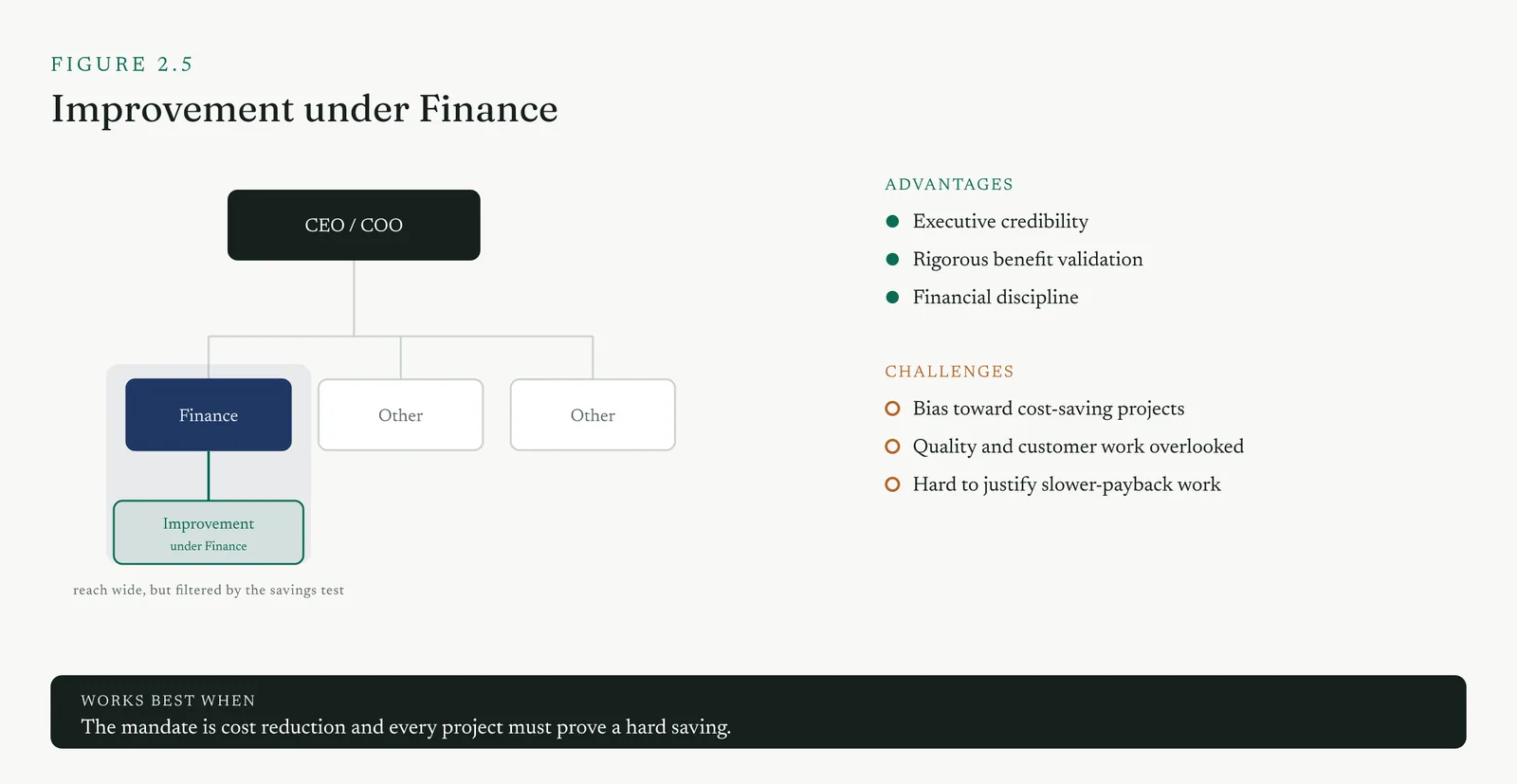
Finance is central, it reaches across the organisation, and it speaks the language of savings that improvement is often asked to produce. That makes it a tempting home, and the temptation carries a specific cost. Figure 2.5 weighs it.
Advantages
Reporting through Finance lends the function executive credibility and a central vantage point over the whole organisation. Benefits are validated rigorously, so the gains the function claims are trusted, and financial discipline keeps the work tied to real, measurable outcomes. When improvement reports through Finance, no one doubts that the numbers behind a result are sound.
Challenges
That same rigour reshapes the portfolio. When every project is judged on the money it books, work that fixes a process but pays back slowly never clears the hurdle. Projects that improve quality, reduce risk, or make a customer’s experience better without an immediate line in the accounts look like a poor use of money. So the portfolio drifts toward fast cost cutting, and the function can acquire a reputation as a cost-cutting arm rather than an improvement one. The deeper, slower-paying problems are the ones that quietly fall off the list.
When it works well
This home works well when the organisation’s explicit mandate is cost reduction and every project is expected to prove a hard saving. In a turnaround, or where margin is under real pressure, the savings filter is the right filter, and Finance’s credibility helps the work land. The caution is to recognise what the filter excludes, and to find another route for the quality and customer work it screens out.
2.6 Improvement under Change or Transformation
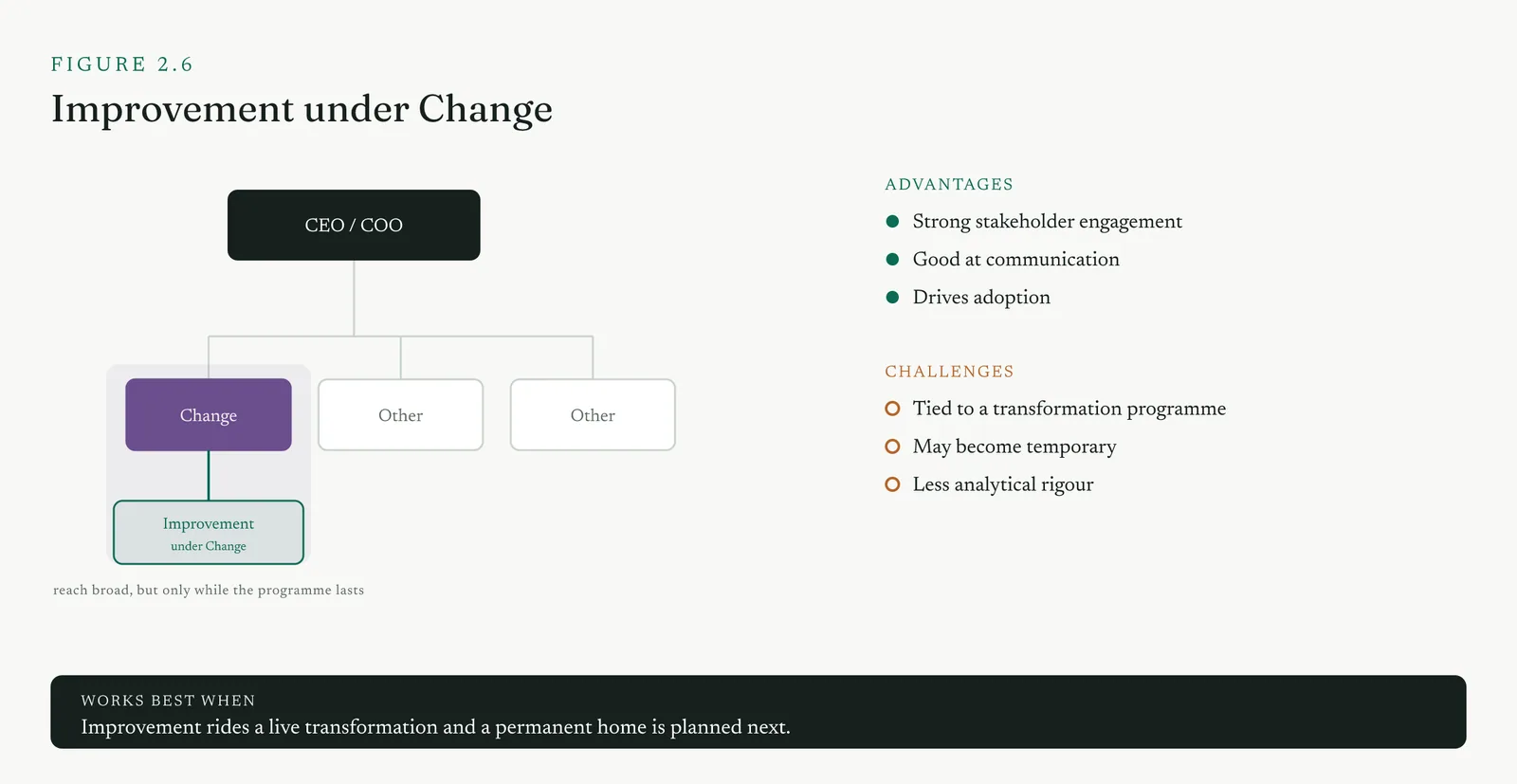
Change and Transformation functions deal with making the organisation different, so improvement feels like a natural neighbour. The fit is real, and so is the borrowed mortality that comes with it. Figure 2.6 weighs it.
Advantages
Transformation functions are good at the human side of change. They engage stakeholders, communicate well, and know how to drive adoption, which is exactly where many improvement efforts struggle. Housed here, improvement gains a partner that understands how to bring people with it, and the change is more likely to be accepted on the floor rather than resisted.
Challenges
A transformation function runs on programmes, and a programme has a start, an end, and a budget tied to a moment of appetite. Improvement placed there becomes one initiative among many, and when the appetite passes, and it always passes, the function risks being cut with the programme that housed it. There can also be less emphasis on analytical rigour, since transformation work tends to lead with communication and momentum rather than with proof of cause. Improvement is a capability the organisation should hold for good, and a temporary home can give it a temporary life.
When it works well
This home works well when improvement is riding a live transformation to gain early momentum, and when a permanent home is genuinely planned for the moment the programme ends. As a launchpad it can be excellent. As a final destination it is risky, because the function should outlast the programme that introduced it.
2.7 Improvement under Quality
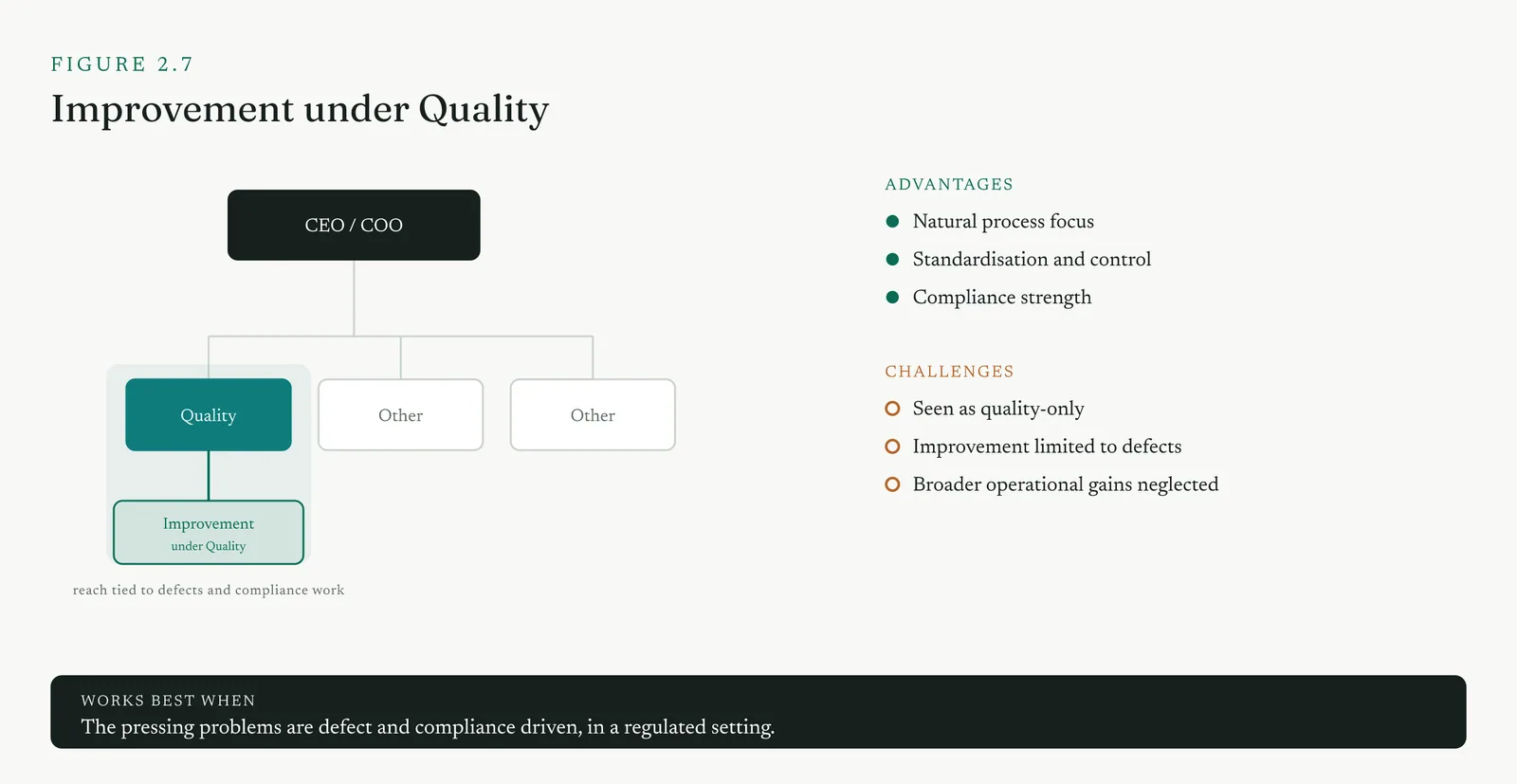
Quality has a natural affinity with improvement. It thinks in processes, it values standards, and it is comfortable with data. That affinity is a strength, and it carries a narrowing risk. Figure 2.7 weighs it.
Advantages
Quality already thinks the way improvement does. It focuses on the process, it standardises, and it understands control and compliance. A function placed here inherits a culture that respects method and measurement, and it does not have to argue from scratch that process matters. In regulated settings, Quality also carries real authority, because compliance is taken seriously.
Challenges
The risk is that improvement is seen as quality-only, and its work is boxed into defects and compliance. Problems that are about flow, cost, speed, or customer experience, rather than conformance, can be neglected, because they do not look like quality problems to the rest of the organisation. The function can be pigeonholed, and the broader operational gains that Lean Six Sigma is built to deliver may be left on the table because they sit outside the quality frame.
When it works well
This home works well when the organisation’s pressing problems are genuinely defect and compliance driven, particularly in a regulated industry where conformance is the dominant concern. Where Quality is respected and the problem set fits its frame, it is a capable and credible home. The caution is to keep the mandate wider than defects, so the function is not confined to a single kind of problem.
Part 3 · Characteristics of the best reporting structure
2.8 What makes an effective organisational home
Rather than name one department as always best, it is more honest and more useful to name the characteristics an effective home provides. Judge any placement by these, not by its label, because a department that supplies them is a good home whatever it is called, and one that does not is a poor home however senior it sounds. Figure 2.8 lists them.
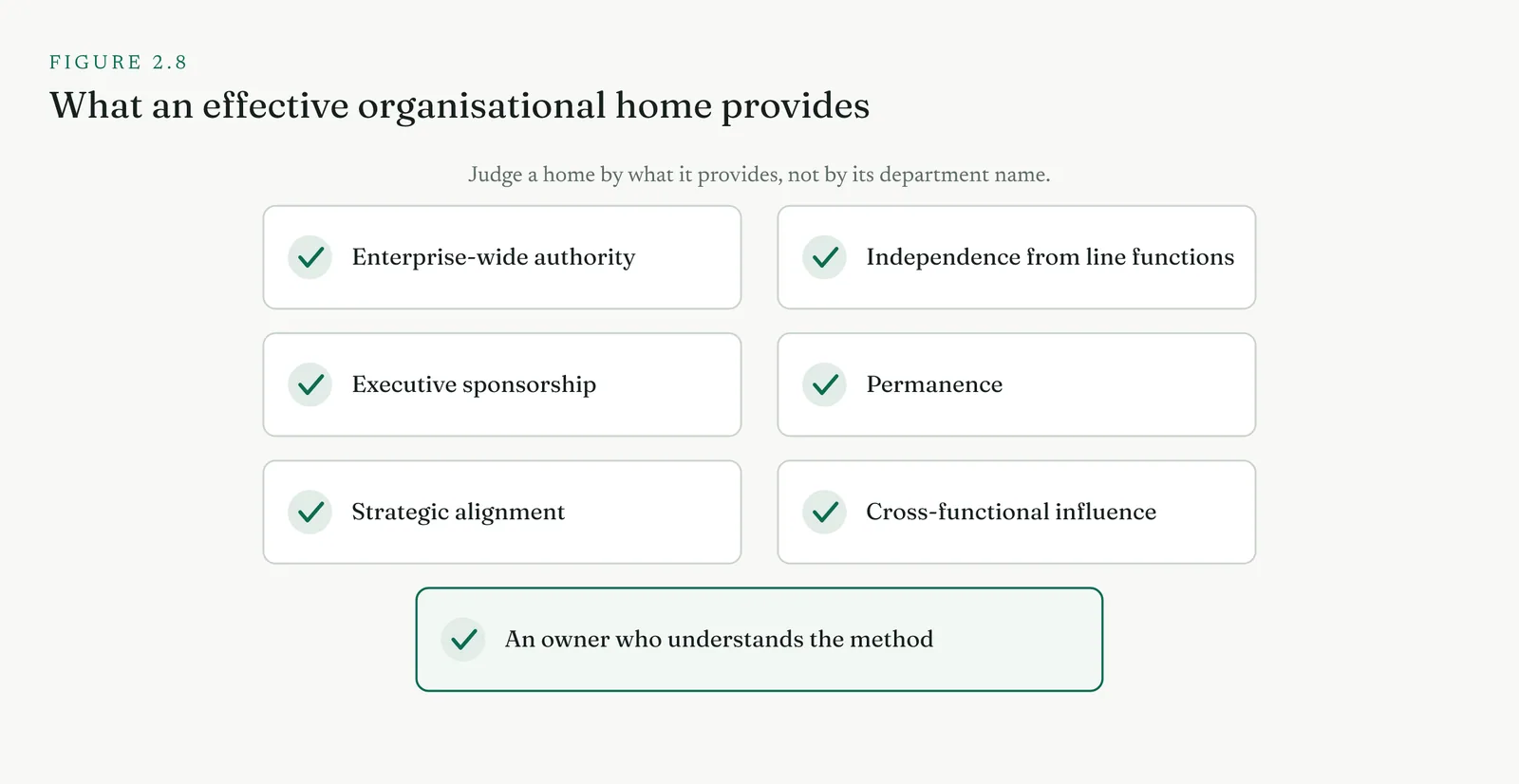
An effective home gives the function enterprise-wide authority, so it can act across the whole organisation rather than one corner. It gives independence from the line functions, so the work is not captured by any single department’s priorities. It carries executive sponsorship, so there is senior backing when decisions are hard. It offers permanence, a structural reason to exist beyond any one programme or champion. It provides strategic alignment, a seat near where priorities are set. It grants cross-functional influence, the standing to convene and direct people who do not report to it. And it provides an owner who understands the method, a reporting line that can judge the work on its merits.
These characteristics matter more than department names because they are what actually let improvement work. A function under Finance that somehow holds all seven is well placed. A grandly titled function that holds none of them is not. When you evaluate your own home, or argue for a better one, argue in these terms. They are concrete, they are testable, and they sidestep the unhelpful argument about which department is inherently right.
Why the function’s owner should understand the method
The last characteristic is the one most often missed, and it is worth drawing out, because it is separate from everything else on the list. It is not about the project sponsor, who backs a particular piece of work. It is about who owns the improvement function as a unit, the management line the function reports into, the people who control its budget, judge its output, and decide whether it lives or dies. That ownership should sit with someone who understands the methodology, and very often it does not.
Picture a function that reports through a manager who does not understand improvement, to a head who does not either, and up to an executive who has never run a project. The reporting line is senior enough on paper, yet no one in it can judge the work on its own terms. The position looks right. The comprehension is absent. This is a different failure from a low reporting line, and the org chart does not show it, because depth and seniority look fine while understanding is missing at every rung.
Three things follow when the function is owned by people who do not understand the method. The work gets judged on the wrong terms, because the owner cannot tell a sound project from a weak one and falls back on whatever they do understand, usually cost or speed. The case for resources, or for a better structure, cannot travel upward intact, because each owner who does not grasp the method cannot carry it credibly to the next level. And the function is exposed in any reorganisation, because no one in its ownership chain can defend why it should exist. Understanding in the ownership line is a quiet form of protection, and its absence is a cost you do not see until the moment it bites.
Depth makes this worse. Every additional layer between the function and someone who understands improvement is another point where the work can be misjudged or the case diluted. So two things matter together, how high the function reports and how much method understanding sits in the chain between it and real authority. A short line to an owner who understands the work beats a long line to a senior owner who does not. Where the ownership chain has no method understanding at all, the function has to lean far harder on an informed sponsor elsewhere to compensate, and it should treat that gap as a real risk to name, not a detail to ignore.
2.9 The preferred organisational model
Weigh those characteristics together and one model tends to provide the most of them. A small, central improvement function that reports to the COO or the chief executive, supports every department, and keeps its own independent governance. Figure 2.9 shows the shape.
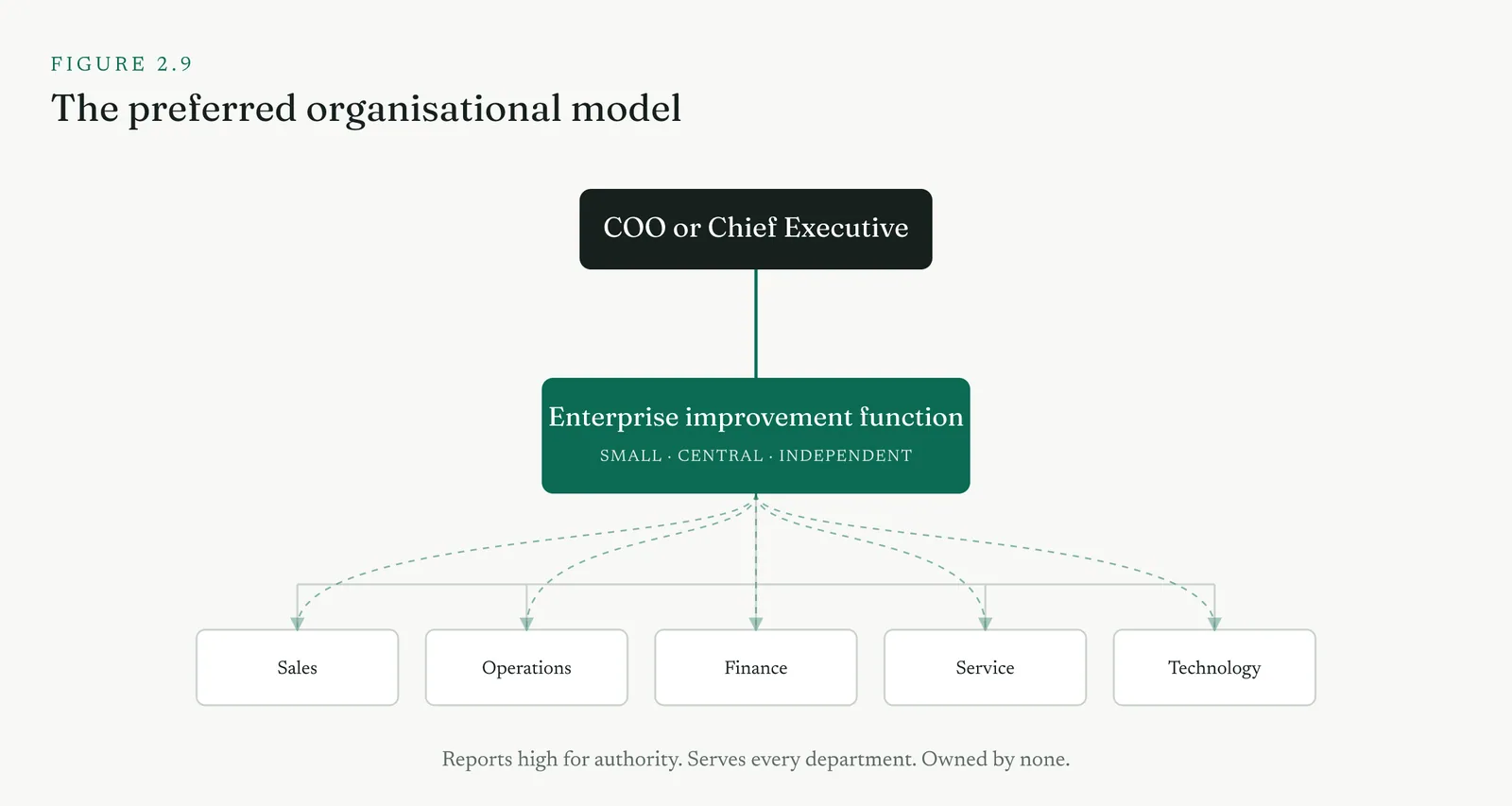
Each part of that description earns its place. Small, because improvement does not need an empire, and its strength comes from where it reports rather than its size. Central, because it belongs to the whole organisation and not to one part of it. Reporting to the COO or chief executive, because that line is the source of its authority and its strategic alignment, and it is what lets a request to three departments carry the weight of the office above them. Independent governance, because a function that sets its own project selection, free of any single department’s pull, keeps a balanced portfolio rather than one skewed to one kind of benefit.
This model generally provides the greatest effectiveness because it supplies all six characteristics at once. Authority from the reporting line, independence from sitting outside the line functions, sponsorship from the executive it reports to, permanence from being a standing function rather than a programme, strategic alignment from its seat near the top, and cross-functional influence from belonging to no single department. It is the home the other placements each approximate in part and miss in part.
An honest caveat on maturity. This central model is the scaffold an immature organisation needs while it builds the habit of improvement. A mature organisation does the opposite. Once improvement is owned by every line manager as part of daily work, the central function shrinks toward coaching and standards, and much of the work returns to the line where it belongs. The preferred model is therefore not a permanent fixture for every organisation. It is the right structure for building a capability, and it is meant to give way, in time, to improvement embedded everywhere.
Part 4 · When the ideal structure does not exist
2.10 Borrowing authority through executive sponsorship
The preferred model rarely exists when you arrive. Far more often you are placed somewhere imperfect and asked to deliver anyway. The bridge across that gap is executive sponsorship. Where the function does not yet hold authority of its own, a senior sponsor lends theirs for the length of a project.
A sponsor does several things that a weak placement cannot. The sponsor provides authority, so a request to a reluctant department carries weight it would not carry in your name alone. The sponsor removes barriers, clearing access to people, time, and data that would otherwise be refused. The sponsor aligns departments, settling the dispute when two teams that do not report to you disagree. And the sponsor does all of this on borrowed terms, standing in for the structural authority the function does not yet have.
The reach this gives you is real, and it is borrowed, and it is temporary. It lasts as long as the project and stretches only as far as the sponsor’s own standing. A sponsor who sits above all the departments your problem crosses can give you the reach you need. A sponsor who sits above only one cannot, however willing they are. Matching the level of sponsor to the spread of the problem is the first practical skill of working without an ideal home. Spend the borrowed authority carefully, ask for what the project needs and no more, and treat it as the scarce, lent thing it is. The authority is borrowed only until the function matures enough to hold its own.
2.11 Working successfully from an imperfect home
Sponsorship gets you authority for a project. Working well from an imperfect home is the wider skill, and it rests on four habits. None of them requires you to move your own placement, which is not yours to move. All of them are within your power from day one.
Understand your limitations
Start by being clear about what your home cannot do. If you sit inside Operations, you cannot freely reach into Finance or Technology. If you sit under a PMO, the pull toward schedule and status will be constant. If you sit under Finance, every project will be pressed to show a fast saving. Name the limit plainly, before it surprises you mid-project. A constraint you have named is one you can plan around. A constraint you have ignored is one that derails the work when you least expect it.
Choose projects within your influence
From a constrained home, choose first projects that fit the reach you actually have. A problem contained within your own department, or one where a willing sponsor gives you the reach to cross a boundary, is one you can finish. A problem that sprawls across departments you cannot reach, with no sponsor above them, will stall, and a stalled first project is the worst possible start. This is not lowering your ambition. It is matching the work to the reach, so that you finish what you begin.
Expand influence gradually
Reach is not fixed. Each finished project widens it. A clean result in your own department earns you the standing to attempt a cross-functional one next, and a sponsor who saw the first win is more willing to back the second. You grow your influence the way you grow trust, by delivering, not by asking for it in advance. Start contained, prove the approach, then extend into the harder, wider problems as your standing allows.
Use early wins to build credibility
A finished project is the most persuasive thing you have. It silences the doubt that method is just talk, and it gives you a concrete result to point at when you ask for more. Lead with the win, told in the language of cost, customers, and time, and let it make the case that no presentation could. In an organisation with no track record of improvement, one visible, finished result is worth more than any argument about the method behind it.
2.12 Building toward the ideal future state
No organisation jumps to the ideal structure. It travels there in stages, and understanding the journey helps you see where you are and what the next realistic step is. Figure 2.12 lays the path out.
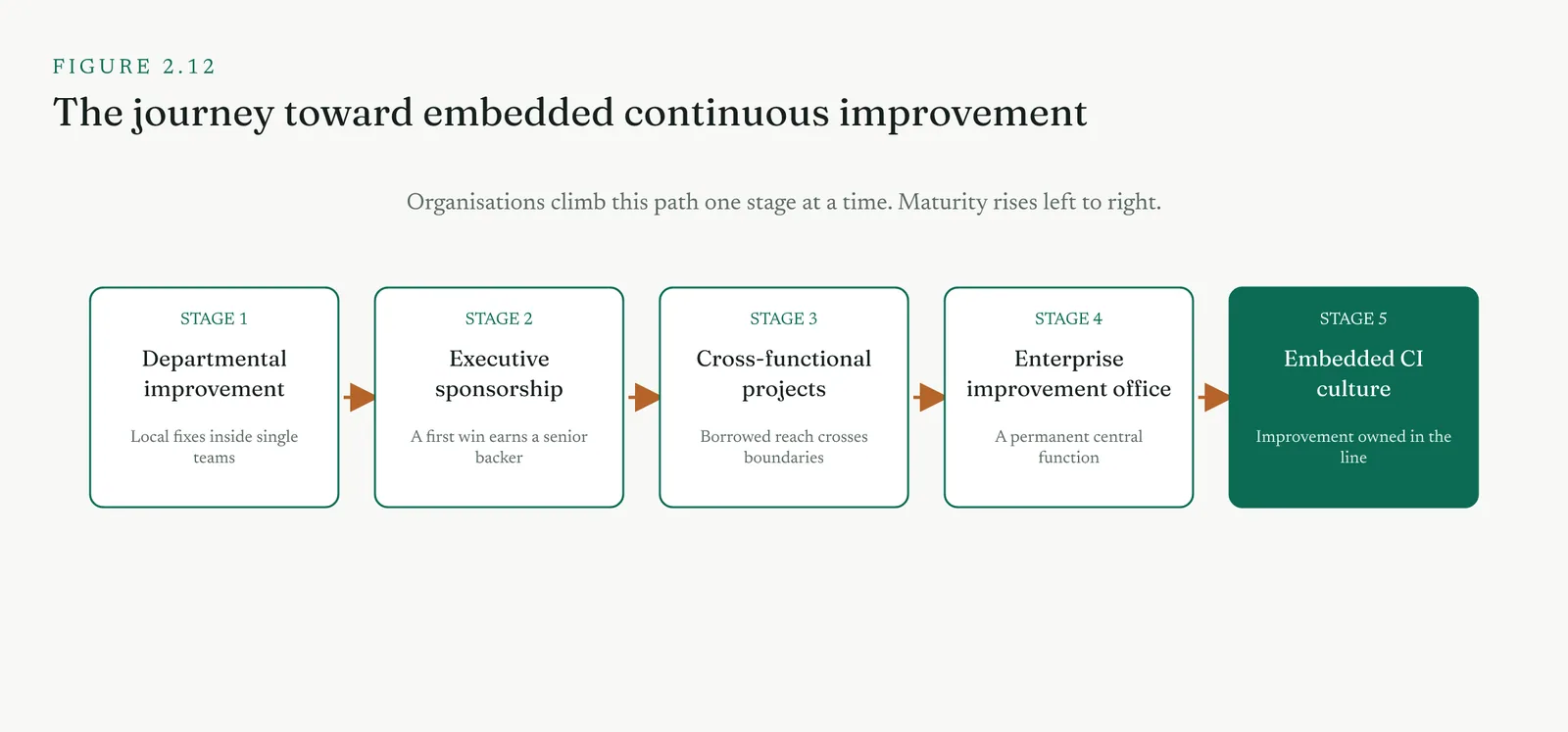
The journey usually runs through five stages, and the order is not arbitrary. Each stage creates the conditions for the next. It begins with departmental improvement, local fixes inside single teams, where most organisations start because this work needs no authority beyond the team itself. A clean, visible win here is what earns the next stage. It grows into executive sponsorship, when that first result persuades a senior leader to back the work and lend it standing. Sponsorship in turn unlocks cross-functional projects, because the borrowed authority is exactly what lets the work cross the boundaries a single team could never reach alone. A run of cross-functional wins makes the case for an enterprise improvement office, a permanent central function of the kind the last part described. And that function, over years, builds the embedded continuous improvement culture, where the work is owned in the line and the central function steps back into coaching.
The sequence matters, and it is worth being explicit about why. You cannot run a cross-functional project without authority that reaches across the functions, and in an immature organisation that authority comes from a sponsor. So sponsorship has to come before the cross-functional work, not after it. But you do not receive a sponsor cold, before anything has been proven. You earn the sponsor with a contained, single-team win that needs no cross-boundary reach at all. That is why departmental improvement sits first, sponsorship second, and the cross-functional work third. Each stage pays for the one that follows.
You do not leap this path. You climb it one stage at a time. A local win earns sponsorship, sponsorship enables cross-functional reach, a run of cross-functional results earns a permanent function, and a permanent function, over years, builds the culture that eventually makes itself less necessary. Knowing the stage you are on tells you what to reach for next, and stops you reaching for a structure the organisation has not yet earned.
Whose job is it to move the home. A fair question for anyone running an improvement team is whether arguing for a better placement is even their place, or whether it sits above their pay grade. The answer is that building the case is squarely your job, and deciding on it is not. You are the one who sees what the current home costs, who can point to the projects that stalled for lack of reach and the gains delivered despite the placement. Writing a short, evidenced case for a better structure is part of running the function well, not overstepping. What you cannot do is enact it. Moving a reporting line is a restructure, and that decision belongs to the executive who owns the organisation’s shape, usually with human resources on the mechanics. You propose. They decide. And the case lands far better when a sponsor carries it upward rather than you alone, because a structural argument made in your own name can read as the function asking for status, while the same case championed by an executive who has seen the results reads as a leadership judgement about what the organisation needs. You are the author of the case. The sponsor is its advocate. The executive is its decision-maker.
Part 5 · Practical application
2.13 Diagnosing your organisation
Your organisation is one specific case. Use the questions below to place it honestly, before you choose a project or argue for anything. Answer each for your own setting, and be strict, because an honest reading protects you and a flattering one will cost you later.
| # | ASK OF YOUR OWN ORGANISATION |
|---|---|
| 1 | Where does improvement currently report, and what does that line actually enable? |
| 2 | What authority does the function have to act beyond its own department? |
| 3 | Can it work across departments without a turf fight stopping it? |
| 4 | Does anyone in the chain that owns the function actually understand the methodology? |
| 5 | Is there a senior sponsor who understands what an improvement project needs from them? |
| 6 | What barriers, structural or cultural, stand between the function and the work? |
| 7 | What is the next realistic step toward a better-placed, more permanent capability? |
Read your answers honestly. A sponsor who nods in meetings is not a sponsor who will hold a tollgate. A function with a senior title but no reach is not well placed. When you are unsure between a generous reading and a strict one, choose the strict one. A clear-eyed view of where you stand is the foundation for every choice that follows, and it tells you which of the homes in this chapter you are really working from.
2.14 Key lessons
Four lessons carry the weight of this chapter, and they are worth holding clearly as you move on.
Reporting structure matters because it affects authority, independence, reach, sustainability, and strategic alignment, not because one department is inherently right or wrong. Judge a home by what it provides, not by its name.
Executive sponsorship is often more important than the reporting line itself. A strong sponsor can supply the authority a weak placement lacks, at least for the length of a project, which is why sponsorship is the bridge every imperfect home depends on.
Whoever owns the improvement function should understand the methodology. Sponsorship backs a project, but ownership of the function is a separate thing, the management line that judges its work, resources it, and decides its future. A function owned by people who do not understand improvement is misjudged, undefended, and exposed, however senior its reporting line looks on paper.
Improvement can succeed from almost any organisational home when it is supported appropriately. A single project does not require the ideal structure. It requires backing, reach for that piece of work, and the discipline to finish. Those can be assembled almost anywhere.
The long-term goal is an enterprise-wide improvement capability that serves the whole organisation rather than one function. Single projects can be won from anywhere. A lasting capability is what placement, over time, is really for, and building it is the work of years and many finished projects, not of a single reorganisation.
NEXT
You can now read where improvement sits, weigh any reporting home against what it truly provides, and work effectively from an imperfect one while the case for a better structure builds. The next question is human. A project needs people in defined roles, and an immature organisation has almost none of them named. Chapter 3 sets out who does what, who the reader usually is, and the conditions a project needs before it can begin.