

PART 6 · SUSTAIN, ANCHORED IN ISO 9001
Chapter 16
From control to embedded
AIM Make the change outlast you, and stop it depending on you.
Control closed with a signature. Renu signed the closure and Geoff accepted ownership on record. That is where most projects stop, and it is where most of your gains begin to slip. Sustain is the work of turning an accepted handover into a held one.
16.1 Why a signed handover is not a held gain
16.1.1 What Control hands over, and where it stops
Control left the process governed. There is a control plan, a response plan, a visual signal on the wall, a standard the team worked to while you were standing there, and a closure the sponsor signed. Every one of those is an instrument, and instruments govern a process for exactly as long as somebody works them.
Nothing in the Control tollgate tested whether anybody will still be working them in ninety days. The gate asked whether the controls exist, whether they respond to a real signal, and whether the owner accepted them, and all three pass on a process that will drift before the quarter closes. That is not a defect in Control, it is the edge of the phase, because the mechanism can be proved from inside the phase and the habit cannot. Figure 16.1 draws the line.
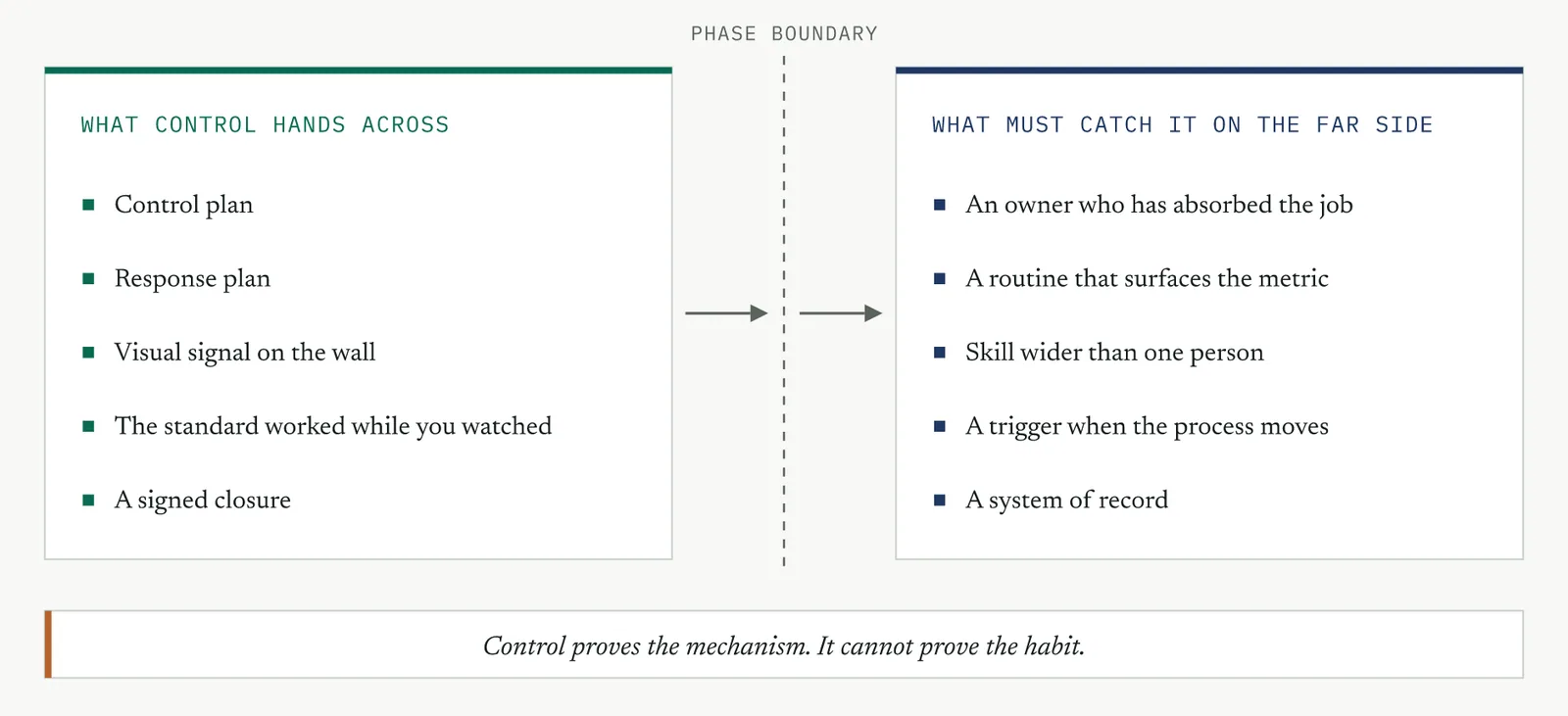
Read the right hand column against your own ground before planning a single Sustain activity. In a firm with a quality function most of it is already standing, so Sustain becomes a short phase of connection. On the grounds this book is written for, most of it is absent, and whatever is missing on the far side is not context to note. It is the build.
16.1.2 The four decay paths
Gains do not fail in unlimited ways. Across projects the failure resolves to four paths, and each one arrives on its own schedule. Figure 16.2 sets them against a timeline that starts at the closure signature.
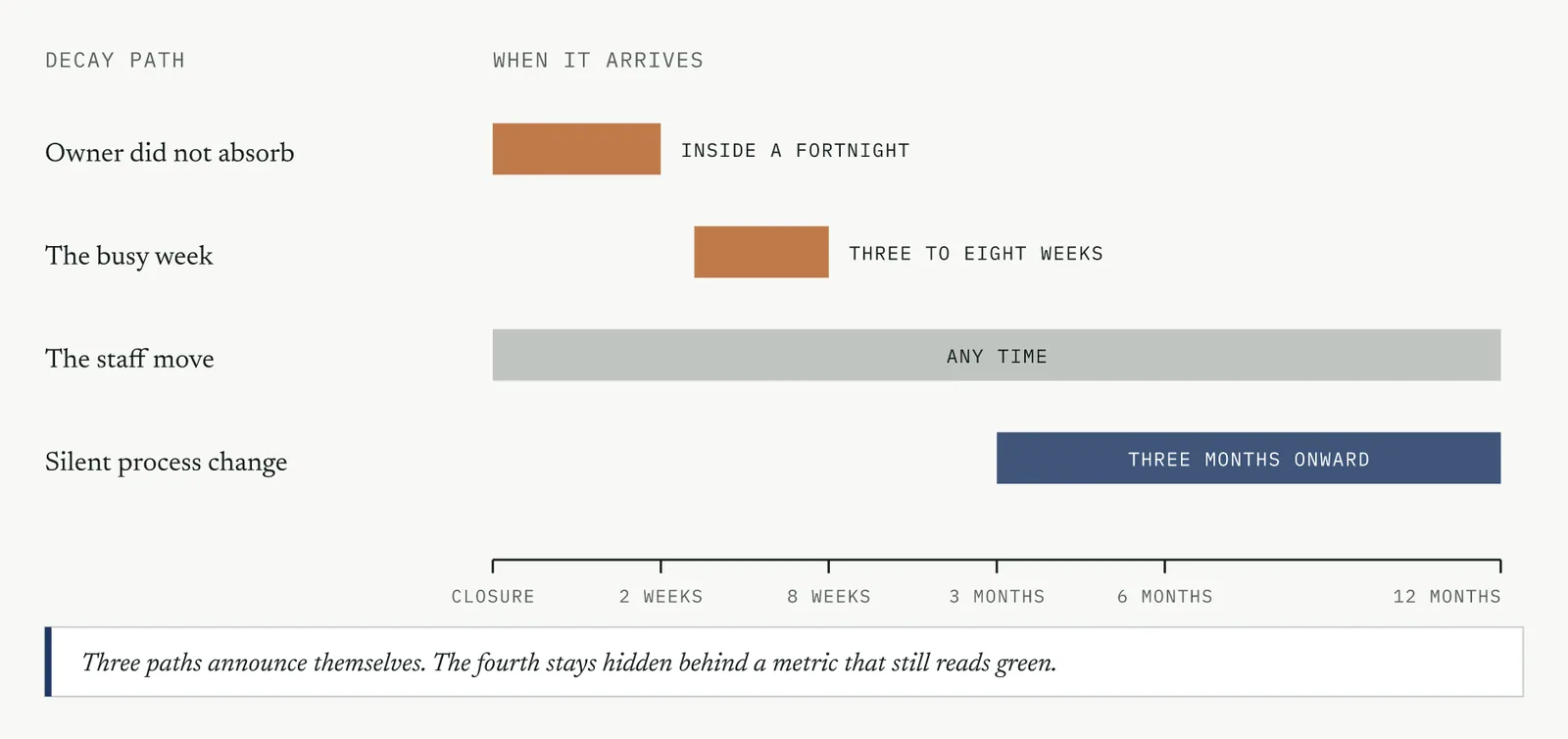
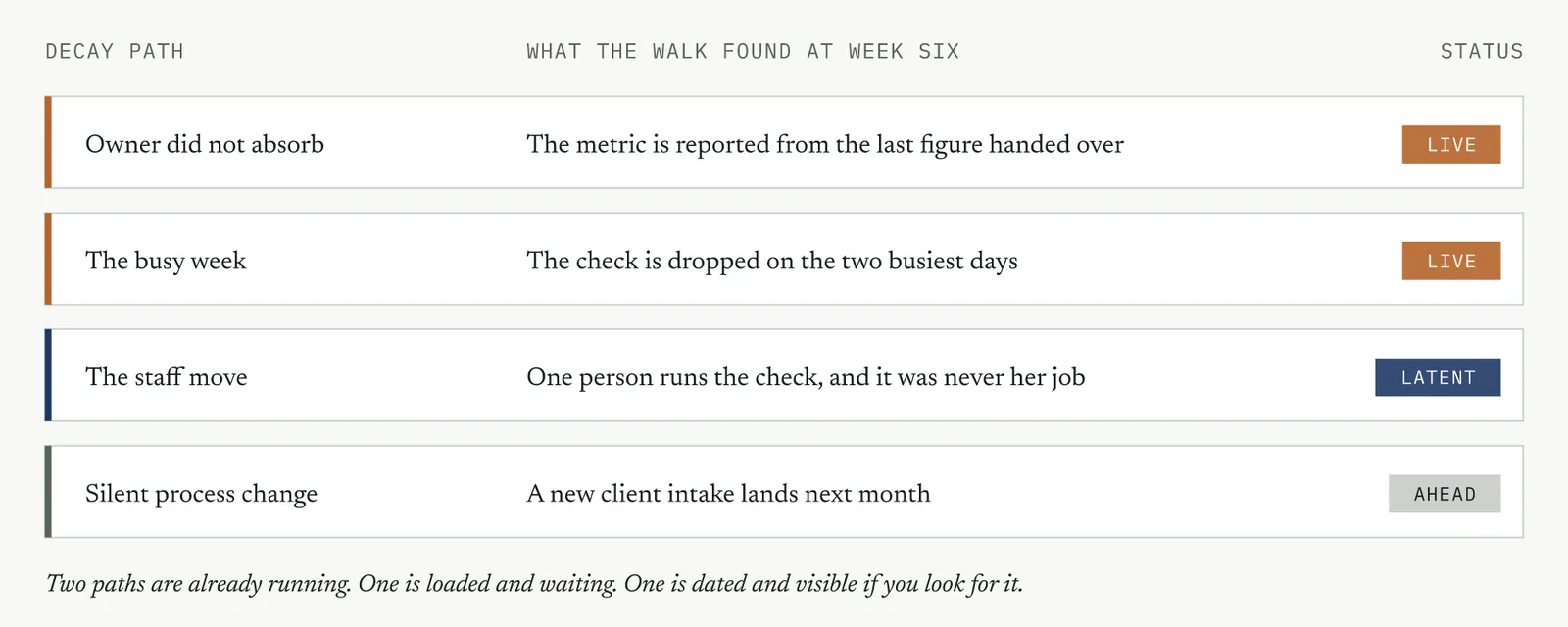
The owner who signed but did not absorb. They accepted ownership as the outcome of a meeting rather than as a change to a job, and nothing moved in how they spend a Tuesday. This one shows inside a fortnight, because the first response the control asks of them does not come.
The staff move. The new way lives in the practice of one or two people. One is promoted, takes leave, or moves team, and the practice leaves with them. The timing is unpredictable and the damage is total, because nobody who remains was ever taught the standard as a standard.
The busy week. The control competes with the day job and loses. The check is deferred, then skipped, then it stops being something anybody expects. It arrives three to eight weeks out, at the point of highest load, which is the point at which the process most needs it.
The silent process change. A system is upgraded, a policy shifts, a large client arrives with a different intake. The process moves and the control keeps measuring the process it was written for. This is the worst of the four, because the metric stays green while the result rots underneath it, and it arrives long after anybody has stopped looking.
Three of the four announce themselves to anybody who is watching, and the fourth does not. Build the checks to catch the fourth and the other three fall out on the way.
16.1.3 Why the decay runs faster where there is no quality function
The four paths are not more likely in an immature firm, they simply go uncaught. In a mature firm each one runs into machinery that already exists. An internal audit finds the procedure people stopped following. A management review notices a metric that stopped moving. A competency framework and a training record absorb the staff move. A change process forces somebody to revisit the control when the process it governs is altered. None of that is virtue, it is machinery, and it runs whether or not the belt is still in the building.
Table 16.1 sets each decay path against the mechanism that catches it in a mature firm, and against what you have in its place.
| DECAY PATH | CAUGHT IN A MATURE FIRM BY | WHAT YOU HAVE INSTEAD |
|---|---|---|
| The owner who did not absorb | A role description, objectives, and a line manager who reviews them | Nothing. Your only test is whether the owner performs the job while you are still there to see it. |
| The staff move | A competency framework, training records, and defined cover | Nothing. The knowledge sits in the person until you write it down and teach a second. |
| The busy week | Internal audit, and a management review that asks for the metric | Whatever leadership routine already runs. If none runs, you build one or your control dies quietly. |
| The silent process change | Change control, document control, and a review trigger | Nothing. Your control ages against a process that moved, unless you set the trigger yourself. |
Table 16.1 Each decay path, the machinery that catches it in a mature firm, and the gap you are standing in.
The ground changes the shape of that gap. On the blank page there is no machinery at all, so every catch has to be built and then taught, and the first one built sets the firm view of what a control is for. On the firefight the machinery is nowhere and the attention is everywhere, so the control survives only if it hangs on something leadership already does daily. On the false start the machinery exists on paper and nobody trusts it, which is worse than nothing, because a documented control everybody ignores has already taught the firm that documentation is theatre. On the quiet achiever one capable person performs all four functions without calling it a system, which holds until they move, and then all four paths open at once.
16.1.4 What Sustain has to build
Sustain builds four things, and between them they close the four paths. A named owner who has absorbed the work rather than accepted a title. The new way written into standard work so it survives the person who was taught it. A leader routine that puts the metric in front of authority on a fixed rhythm. Local capability, so the process depends on neither one person nor on you. Figure 16.3 pairs each build against the path it closes.
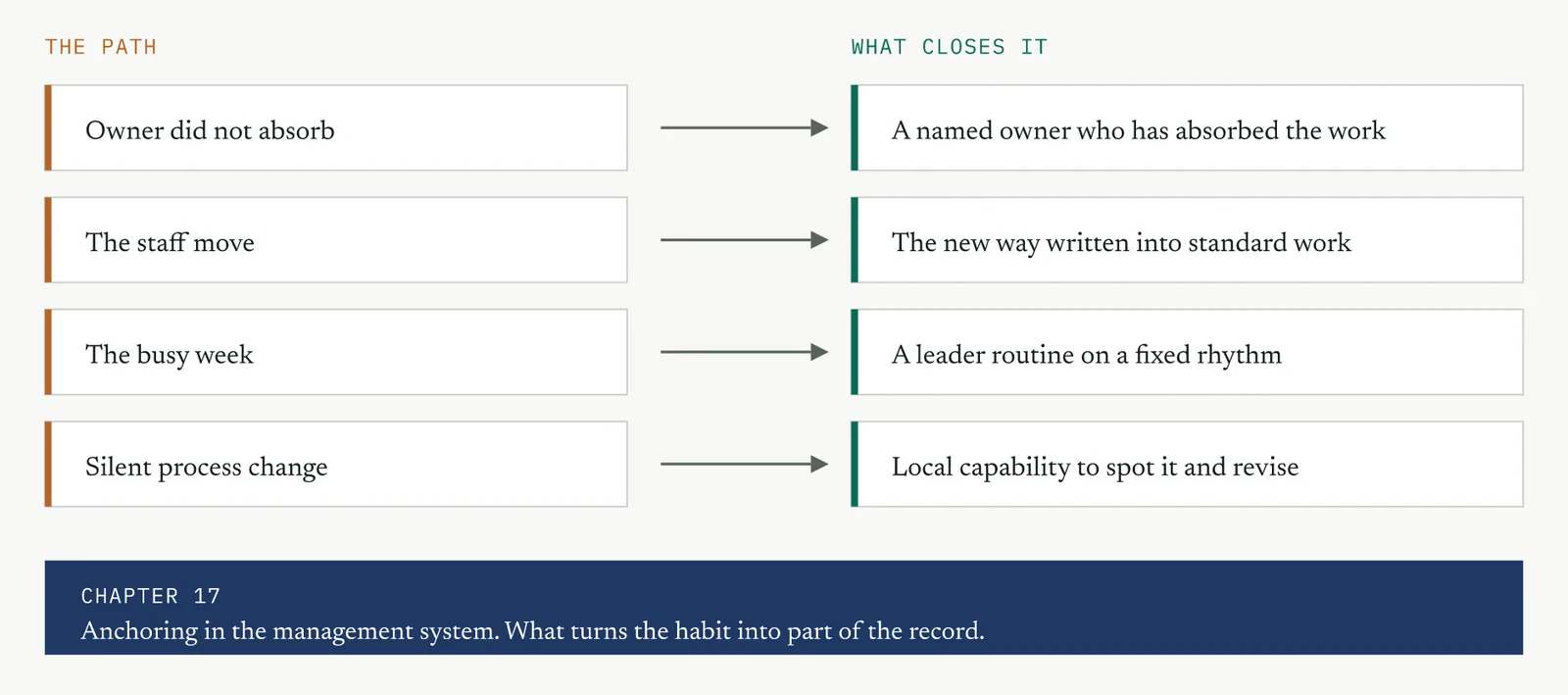
Those four hold a gain for a quarter or two. They will not hold it for a year, because all four still rest on people who can be moved, distracted, or overruled. What makes them permanent is anchoring them in the management system, clause by clause, which is Chapter 17. This chapter builds the habit and the next one puts the habit into the record.
One point about timing, because it decides whether any of the rest works. Sustain is not a week of paperwork after closure. Start the handover alongside the last third of Control, so the owner is doing the job while you are still there to correct them, and run the checks out to ninety days past the signature. Figure 16.4 shows the overlap.
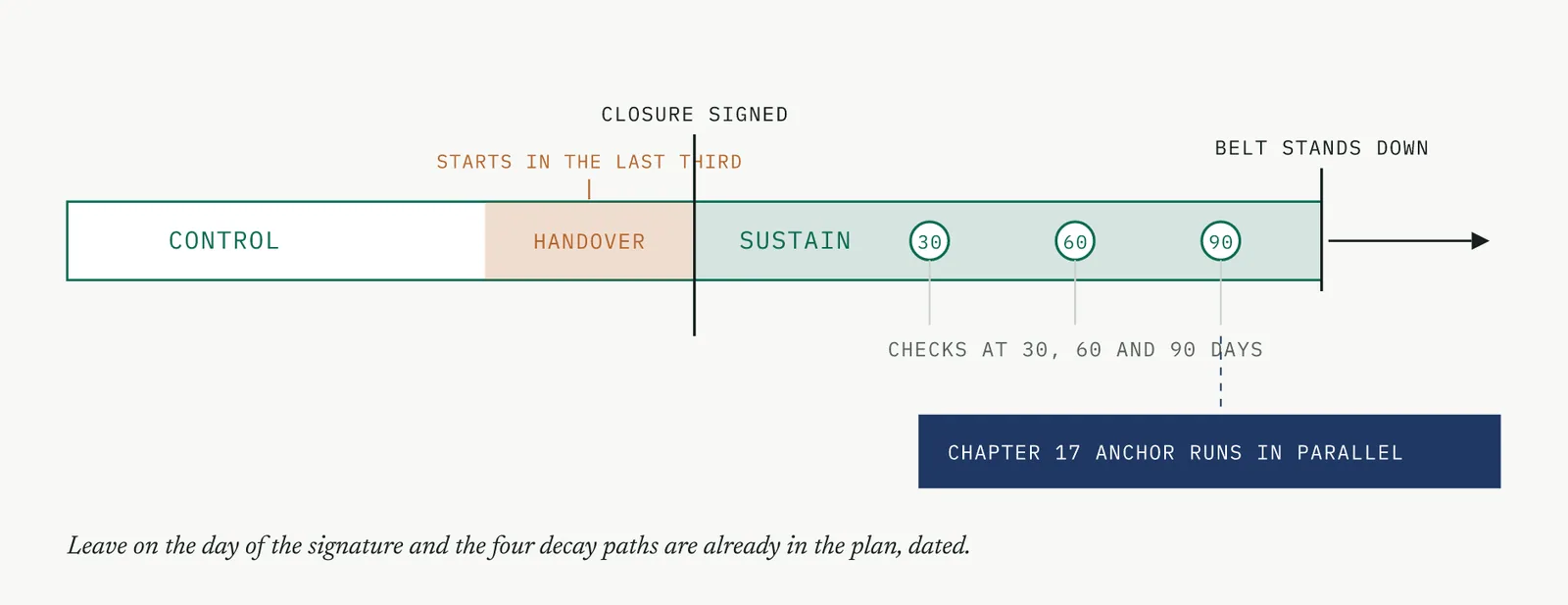
Leave on the day of the signature and the project is not finished. The four decay paths are built into the plan and given dates. That is what happened at Crestline, and the next section is what the belt found on walking back in.
| TIP Diarise the thirty, sixty and ninety day checks before the sponsor signs. Ask afterwards and you are asking a favour. Ask now and you are setting a condition of the close. |
16.2 Sustain walked on Crestline
16.2.1 Six weeks after the signature
The closure was signed on a Friday. Renu signed it, Geoff accepted ownership on record, and the project was reported closed to the leadership meeting the following week. The belt went back in six weeks later, not because anything had been escalated, but because the check was in the diary. Diarise yours the same way, because nothing on this ground escalates in time to bring anybody back.
Figure 16.5 shows what first response accuracy had done in that time. It leaves closure at 96 per cent against a target of 95, holds for three weeks, then falls away. By week six it reads 88. The action threshold at 92 was crossed twice, and nobody opened the response plan attached to it.
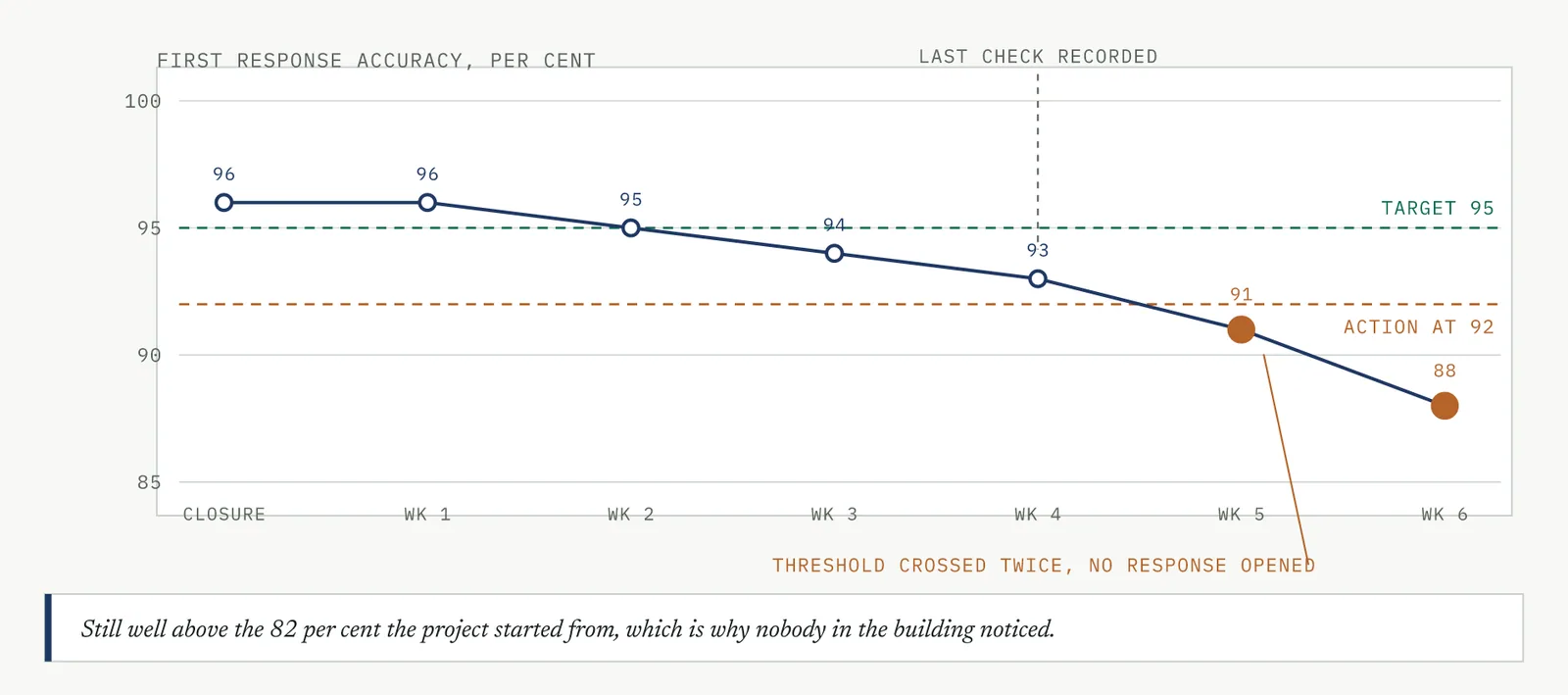
Nothing failed loudly. No client escalated, no leader raised it, and the board in the team area still carried a green marker. Note where the number sits, because this is the part that catches people out. At 88 it remains well above the 82 per cent the project started from, so nobody in the building has a reason to notice. A gain decaying from a good result does not look like a failure until it has given back most of the ground.
16.2.2 What the walk back in finds
Do not diagnose this from the number. Walk it, the same way you walked it in Recognise, and talk to the people doing the step rather than the person reporting it. Five things were true by the end of that morning, and you will recognise most of them.
The board was current to week four. Asha had been updating it. She stopped in the week her own queue went over forty open cases, and nobody asked why the marker had not moved since.
The check was hers, not his. Geoff accepted ownership. The daily check landed on Asha, because she was already looking at the queue. Nobody wrote it into a week or a job description, so it attached itself to the person with the least room to refuse it.
The response plan had not been opened. Both threshold crossings passed without a response. The plan names Geoff. The screen showing the breach sits in front of Asha. Give a response plan to somebody who does not see the signal and you have made a filing decision rather than a plan.
The standard sat in a shared folder. Two of the six case handlers had never opened it. One joined after closure and was trained by sitting next to somebody, which means the firm taught the new handler the old way inside a fortnight of closing the project that changed it.
Geoff reported the metric as green. He was reporting the last figure he had been handed, which was week four. Do not read that as dishonesty. It is what ownership looks like when somebody accepted a title rather than absorbing the work.
Read the five together and the pattern is not subtle. Every one of them is a person problem sitting on top of a control that works. Figure 16.6 marks which decay paths were already running at week six, and which were loaded and waiting.
16.2.3 A control that failed and a control nobody worked are not the same fault
The pull on that morning is to redesign the control. The chart drifted, so the chart must be wrong, so it gets rebuilt with tighter rules and a better board. Resist that. Redesigning a sound control in front of a team that stopped working the last one teaches the firm that improvement means more paperwork after every failure, and there is no third attempt.
Three questions separate the two faults, and you ask them in order. Did the mechanism produce a correct signal when the process moved. Did that signal reach a person with a defined response. Did that person have the time, the authority, and the expectation to act on it.
At Crestline the first answer was yes, twice, on a threshold set correctly against the data Measure produced. The second was no. Nobody ever tested the third, because the second failed ahead of it. The mechanism is sound and the ownership is not, and no revision to that chart touches it.
Table 16.2 gives you the same reading in a form you can run on any return visit.
| WHAT YOU SEE | A CONTROL FAULT WHEN | AN OWNERSHIP FAULT WHEN | THE CHECK THAT SETTLES IT |
|---|---|---|---|
| The metric drifted | The limits were set on unstable or thin data | The limits held and nobody acted on them | Re-read the last twenty points against the limit |
| The signal never fired | The rule is wrong for the data type | The rule fired and no one was watching | Open the log and look for the trigger |
| No response came | No response was defined for that trigger | A response was defined and given to someone who does not see the trigger | Read the response plan against who holds the screen |
| The standard is not followed | The standard does not match how the work now runs | The standard matches and nobody was taught it | Ask two people to describe the step without the document |
Table 16.2 Separating a control fault from an ownership fault. The treatments are opposite, so take the reading first.
Take care with the fourth row. If the standard no longer matches the work, you are not always looking at a control fault either. You may be watching the silent process change arrive, in which case the standard is correct for a process that no longer exists. Check the date of the last system or policy change before you decide which fault you have.
16.2.4 What Crestline needed, in the order it needed it
Take ownership first, because everything else in this chapter hangs off it. Hand a sustainment plan to an owner who has not absorbed the work and you have produced a document with a name on it. Write standard work for a team with no owner watching and you have produced another folder. Build the owner, then build what the owner runs.
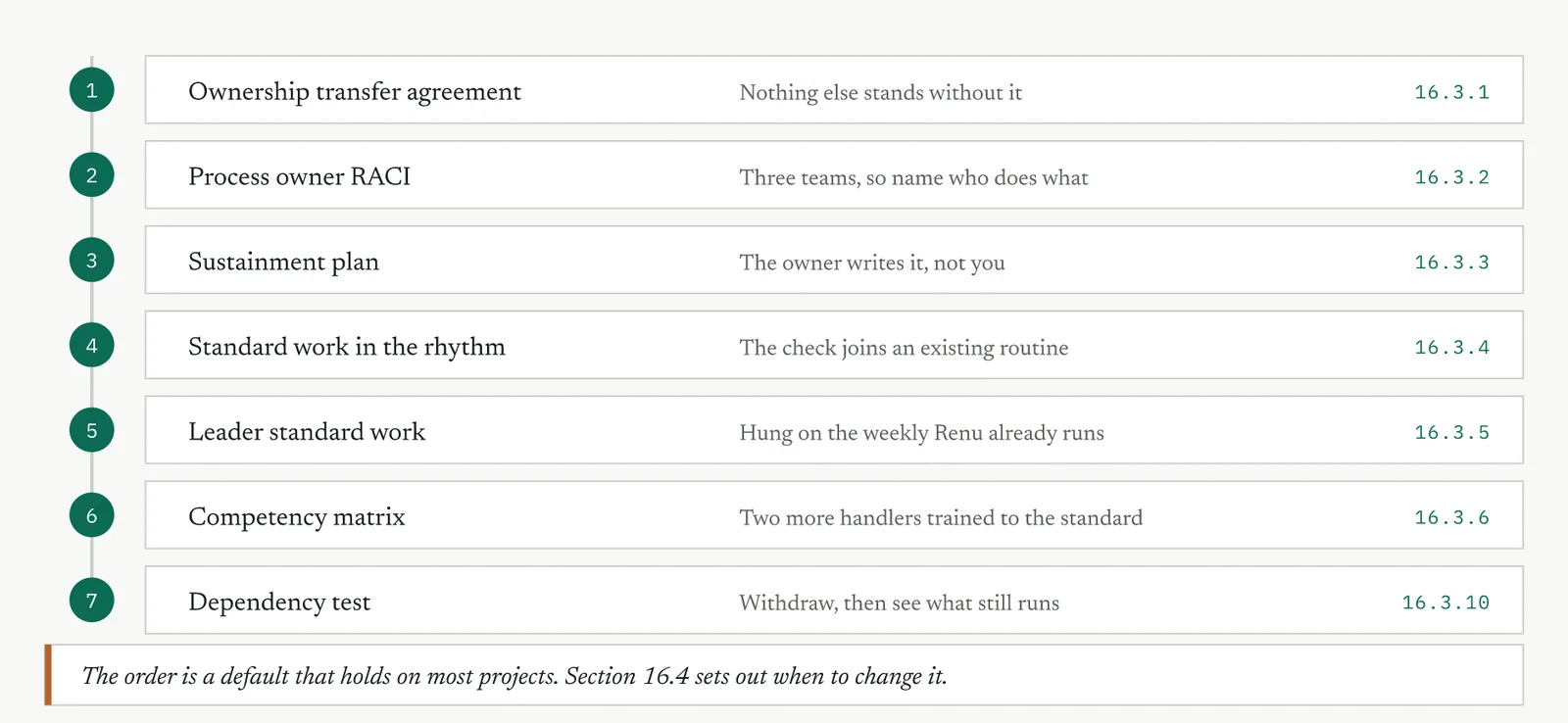
The sequence at Crestline ran as Figure 16.7 sets it out. Two choices in that order decide whether the rest holds, so read those before you copy the sequence.
The leader routine hangs on the weekly operations meeting Renu already runs. Build a new forum for one metric and you have chosen one of the reliable ways to kill a control, because your forum needs an owner of its own and the first busy month takes it. Attach the metric to something that already survives busy months.
The competency work comes before the dependency test, not after it. You cannot withdraw from a team that has one trained person, because withdrawal in that state does not test the process, it tests Asha. Train the second and the third handler to the standard, then withdraw, then read what still runs.
That order is the order of 16.3. The tools are set out in the sequence a project usually needs them, not in a sequence you are obliged to follow. Section 16.4 sets out which projects change the order and why.
| TIP On a return visit, establish whether the control was worked before you decide it was wrong. Rebuilding a sound control is the most expensive way to confirm the team was right to ignore the first one. |
16.3 The toolkit, in the order you reach for it
Every tool below is set out the same way. What it is and why you reach for it, how to set it up, how to run it, the Crestline example with the template filled, how to read what comes out, how to match it to the ground you are on, what it feeds, and where it goes wrong.
ISO 13053 does not reach past Control, so nothing here carries a mandatory, recommended or suggested status. Read the origin tag instead. Template, where the tool is a document you fill. Lean, where it comes from established Lean practice. Practice, where it is drawn from what holds a gain in firms with no quality function to hold it for them. The standard returns in Chapter 17, and there the tag is the ISO 9001 clause.
Eleven tools. Table 16.3 lists them in the order you reach for them, with the reading for Crestline.
| TOOL | ORIGIN | RUN OR SKIP | WHY, FOR CRESTLINE |
|---|---|---|---|
| Ownership transfer agreement | TEMPLATE | RUN | Ownership was accepted as a title. Everything else waits on this. |
| Process owner RACI | PRACTICE | RUN | Three teams, so the response has to name a person at each step. |
| Sustainment plan | TEMPLATE | RUN | Always. It is the document the owner works from. |
| Standard work in the operating rhythm | LEAN | RUN | The check had no named slot, so it fell to whoever was willing. |
| Leader standard work and layered check | LEAN | RUN | Renu already runs a weekly. Hang the metric there. |
| Skills and competency matrix | LEAN | RUN | One trained person on a team of six. |
| Training plan and one point lessons | LEAN | RUN | A handler joined after closure and was taught the old way. |
| Handover pack and knowledge file | TEMPLATE | LIGHT | One process and one file, so a pack would be theatre. |
| Decay risk register | PRACTICE | RUN | A new client intake lands next month. |
| Staged withdrawal and dependency test | PRACTICE | RUN | Always. It is your only evidence the handover is real. |
| The 30, 60 and 90 day check schedule | PRACTICE | RUN | Already in the diary. It now needs content. |
Table 16.3 The Crestline Sustain tool selection. Origin tags, not ISO status, because the standard does not reach here.
The four grounds run through every tool here as they did through the last five chapters. Table 16.4 recalls them in the terms Sustain cares about, which is what each ground does to your handover.
| GROUND, AND ITS LEVEL | WHAT IT DOES TO A HANDOVER | WHAT IT ASKS OF YOU |
|---|---|---|
| The blank page. Level 1 | Nobody has held a process metric as a stated job before | Teach what owning a process is while you transfer this one |
| The firefight. Level 1 | The owner agrees in the room and is pulled out of it by Thursday | Attach the task to a routine that already survives the worst week |
| The false start. Level 1 | A handover was signed once before and nothing followed it | Make the test of ownership public, because the team is what stopped believing |
| The quiet achiever. Level 2 | One capable person already holds it, informally and alone | Name what they do, then widen it past them before you leave |
Table 16.4 The four grounds from Chapter 1, read for Sustain. Each tool shows how it changes across them.
16.3.1 Ownership transfer agreement · TEMPLATE
WHAT IT IS
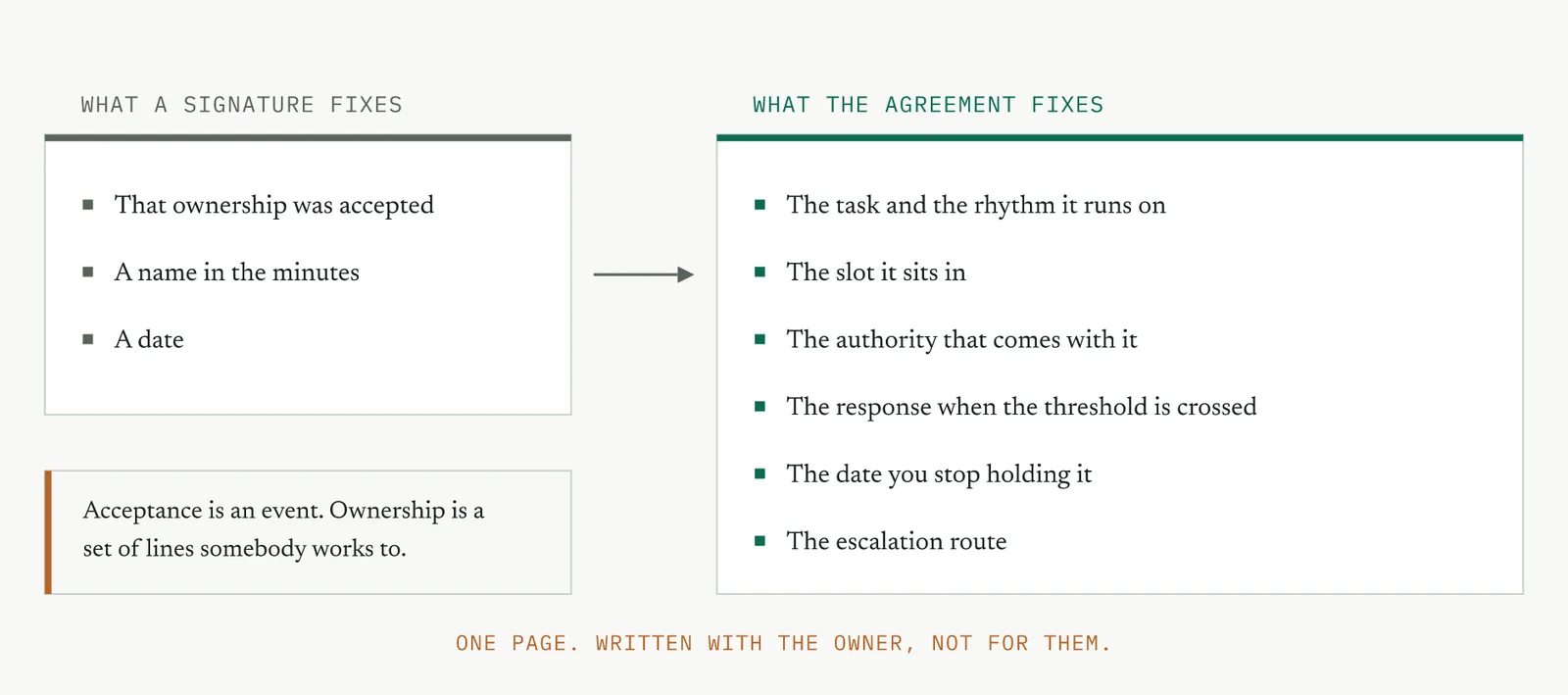
A one page agreement between you, the incoming process owner and the sponsor that converts acceptance into a defined job. It states what the owner now holds, what they will do and on what rhythm, where in the week it sits, what authority comes with it, what happens when the metric moves, and the date you stop holding any of it.
It is not a charter and it is not a role description. Your charter framed a project and died at closure. A role description sits in a system nobody opens at the point of use. This document answers, for one process, the question all four decay paths turn on. Who does what, when, and with what authority. Figure 16.8 sets what a signature fixes against what an agreement fixes.
SETUP
Get four things on the table before you draft. The control plan and the response plan your project produced, because this agreement is the ownership layer over them and not a replacement for either. The metric and its threshold, in the exact form the owner will read them. The named owner and the authority that appointed them, which is the sponsor rather than you. And an honest account of how the owner spends a week, because a task you cannot point to inside that week is not a task.
Draft it with the owner in the room. Write it for somebody and present it to them and you have reproduced the exact fault the document exists to correct. Twenty minutes of the owner writing the lines beats an hour of you drafting them, and you will see the difference six weeks later.
RUNNING IT
Six steps, and the second one decides the outcome. Figure 16.9 shows the flow.
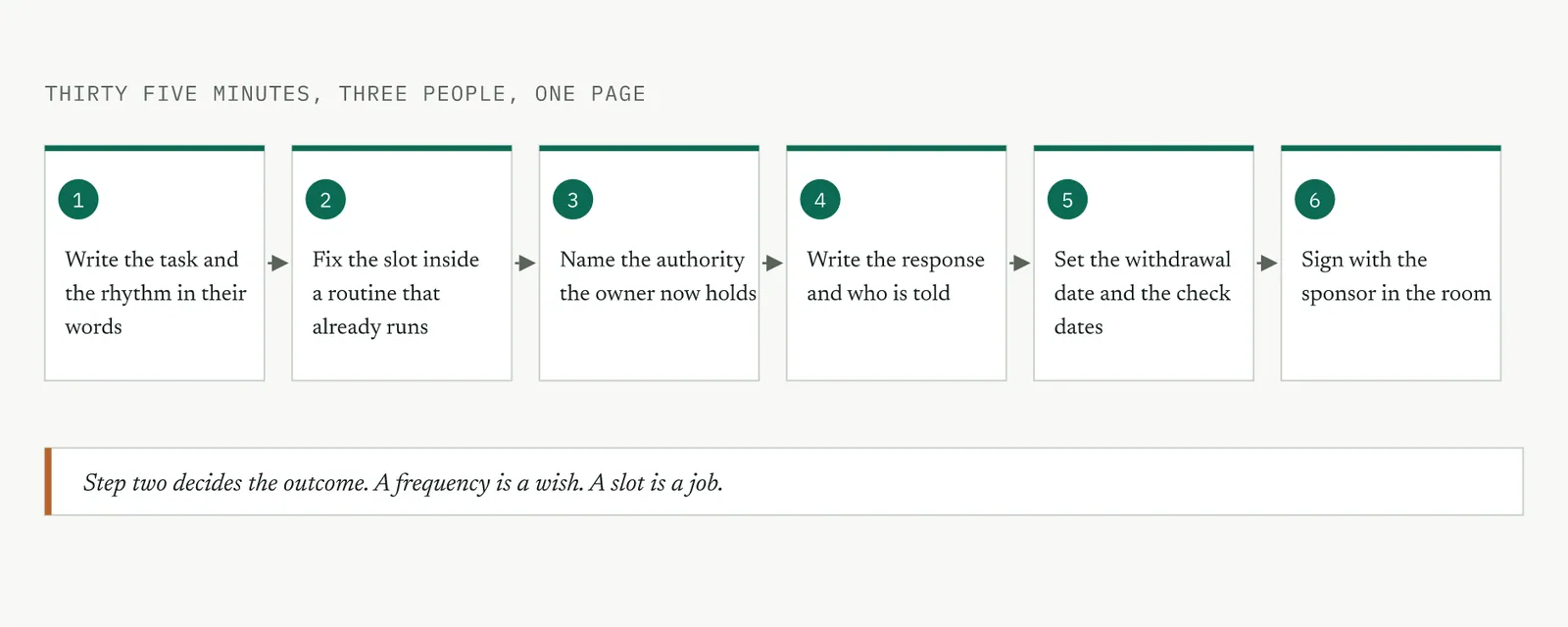
Write the task and its rhythm in the words the owner uses, not yours. Fix the slot inside something that already happens, naming the meeting and the time rather than a part of the day. Name the authority, which means what they can change without asking and what has to go up. Write the response, including who is told and inside what time. Set the withdrawal date and the check dates in the same breath, because a withdrawal date without checks is an exit and a check without a withdrawal date is a permanent attachment. Then sign it with the sponsor present, since the authority line is theirs to grant and a line granted by email is not granted.
CRESTLINE, WORKED
Geoff had accepted ownership on record and none of the six lines existed. The agreement took thirty five minutes on a Tuesday with Geoff, Asha and Renu in the room, and three of those minutes decided it. Asked where the read would sit, Geoff could not name a point in his week. Asha could, because she had been doing it since closure. That exchange moved the job from a name in the minutes to 09:15 on a Monday, and it fixed the fault the return visit had found, which was a response plan held by the one person who never saw the signal. Ask that question early, and ask it of the owner rather than the room.
Copy the split as well. Asha holds the daily update because she is at the queue. Geoff holds the weekly read and the response because he holds the authority to act. Template 16.1 is the agreement as it was signed.
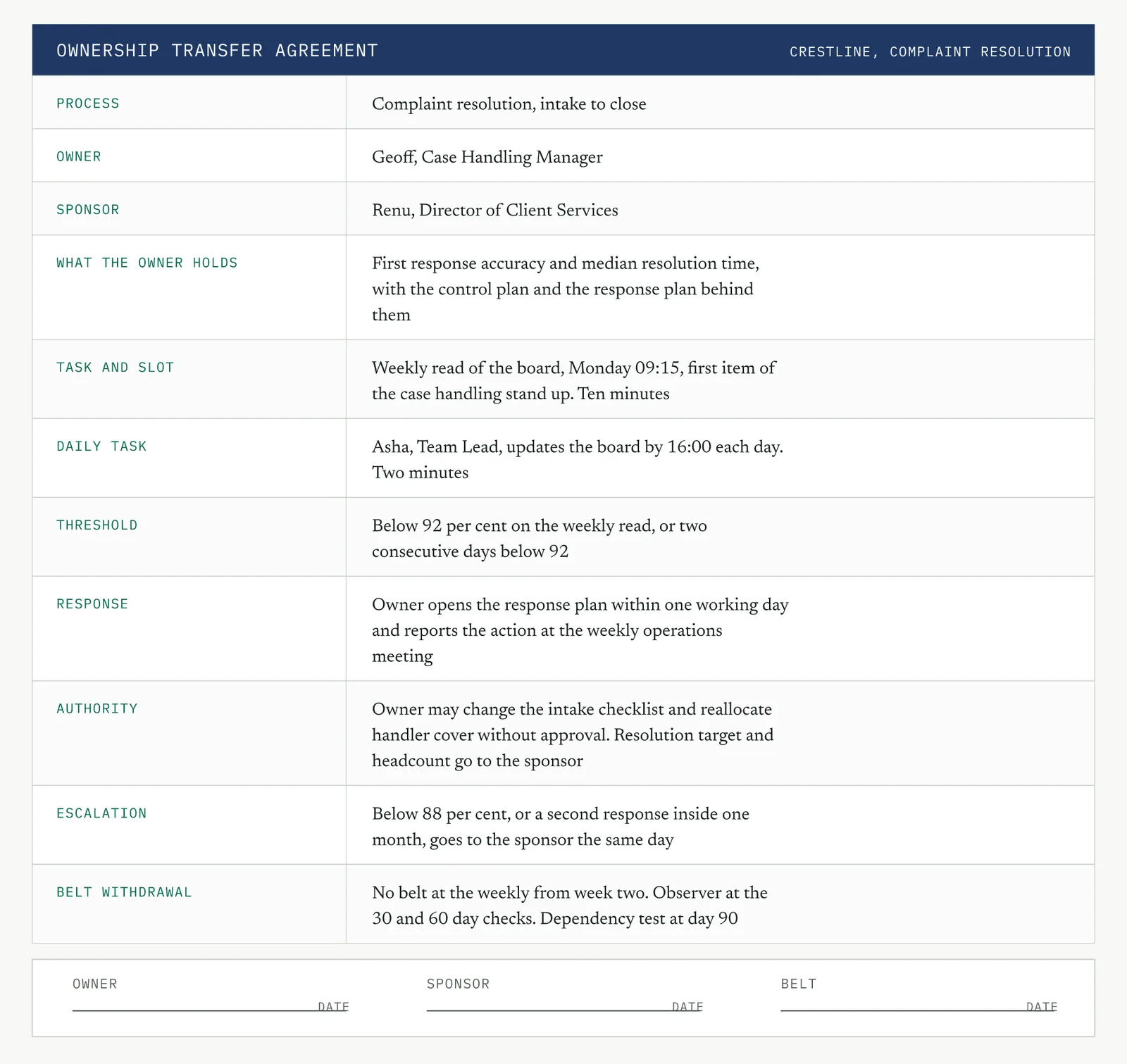
READING THE OUTPUT
Three lines carry the weight, and you can read a handover from them alone.
The slot line. Written as a time inside something that already happens, it holds. Written as a frequency, it does not. Weekly is a wish. Monday 09:15, first item of a stand up that has run for two years, is a job.
The authority line. If they can change nothing without asking, they stop reading the metric, because reading a number you cannot act on is a chore with no payoff. If they can change everything, the sponsor stops watching. Name two or three things they hold outright and one or two that go up.
The withdrawal line. Leave the date off and the result is a plan for yourself to keep holding the process. It is the most common failure of this document and the most comfortable, because it suits both of you in the moment. Write the date, and write what you will attend between now and then.
MATCHING IT TO THE GROUND
On the blank page your agreement does two jobs at once. It transfers this process, and it teaches the firm what owning a process consists of, because nobody there has held one as a stated job. Keep it to one page and read it aloud in the room rather than circulating it. Expect to draft the authority line yourself, since a first time owner does not know what they are allowed to ask for, and then have the sponsor say it out loud as well as sign it. Here a sentence spoken in front of the team carries further than a signature nobody sees.
On the firefight the owner will agree to anything while the room is calm and be pulled out of it by Thursday. Do not accept a new slot on any account. Find the routine that already survives the worst week, usually a daily operational stand up or a shift handover, and put the read inside it. Make the task shorter than you think it should be. Ten minutes that happen are worth more than thirty that get cancelled, and the cancelled thirty is what the team will remember about improvement.
On the false start somebody signed something last time and nothing followed, and the team knows it even if the sponsor has forgotten. Make your agreement visibly different from that one, which means the withdrawal date and the check dates go to the team, not just to the owner and the sponsor. The team is the population that stopped believing, so make the repair visible to them. A public ninety day test you turn up to is the repair. A private one is a repeat.
On the quiet achiever the capable person is running the process already, informally and without the title, and you risk formalising them into a bottleneck. Write the agreement so the owner holds the response while somebody else holds the daily task, and name the second and third person inside the same document. Put one name on every line and you have not transferred ownership, you have created the staff move by hand and dated it for whenever that person is promoted.
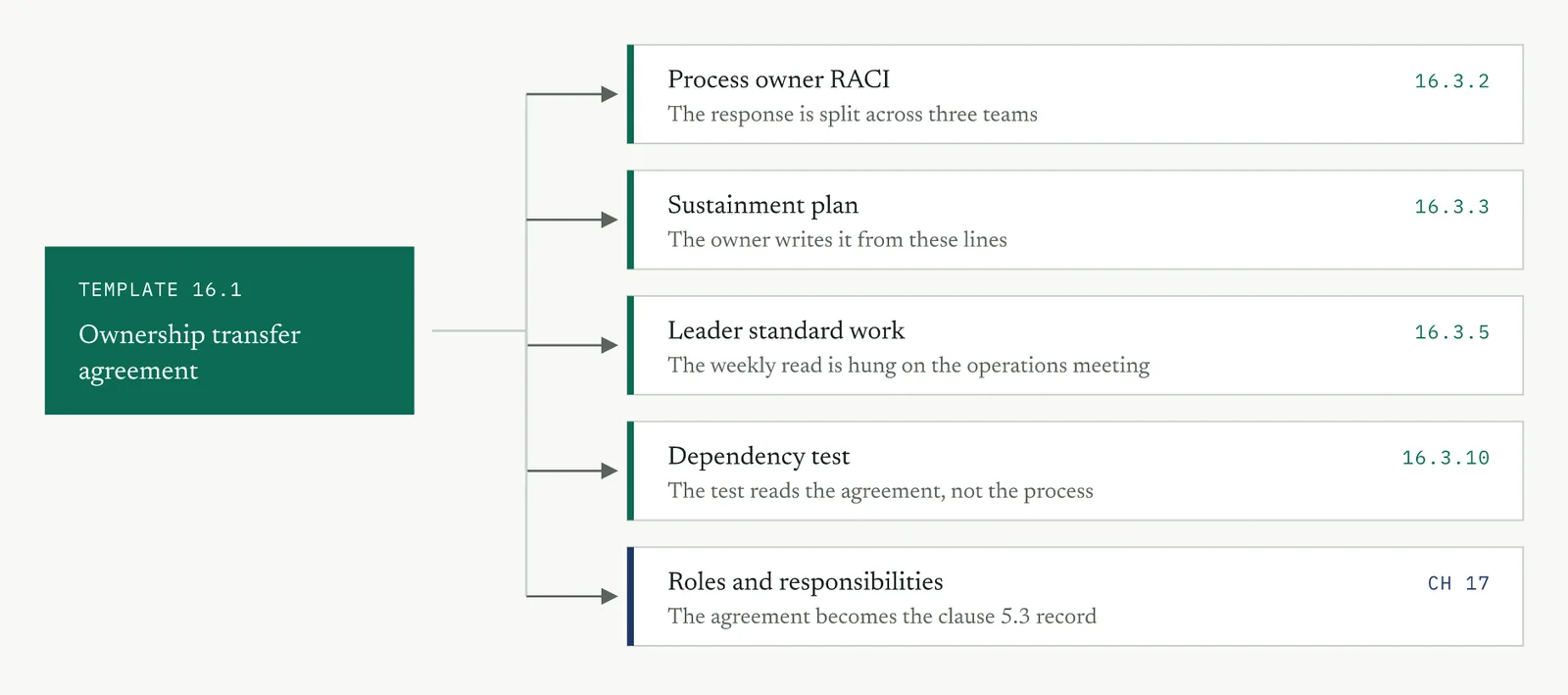
WHAT IT FEEDS
This agreement is the spine of the rest of the chapter. Four tools take their content directly from it, and one clause of ISO 9001 takes it whole. Figure 16.10 shows the paths.
TIPS AND TRAPS
The willing owner. They agree in the room to end the conversation. Test it before you leave by asking them to describe their Monday. If the task does not appear unprompted, it is not real yet, and no amount of signing changes that.
The borrowed slot. You attach the read to a meeting that is itself six weeks old. Ask how many times it has been cancelled this quarter before you hang anything on it.
The blank authority line. Left empty because filling it in is awkward with the sponsor sitting there. It is the only line the sponsor has to sign, and an empty one means the first response needs a negotiation the owner will not start.
The signature by email. The sponsor being in the room is most of the mechanism, because the team hears the authority granted. Send it for signature and you have produced another document.
At the sixty day check, ask the owner for their copy. If they cannot find it, you have your reading, and you have it thirty days before the dependency test would have told you the same thing more expensively.
| TIP Write the slot, not the frequency. Every failed handover in this book had a rhythm written on it and no place in a week where that rhythm was meant to happen. |
16.3.2 Process owner RACI · PRACTICE
WHAT IT IS
You draw a responsibility grid for the process as it will run after you leave, not for the project that changed it. Different object, different life, different question. Figure 16.11 sets the two side by side, because reaching for your Define grid here is the common error and it hands you a document that is accurate about work nobody is doing any more.
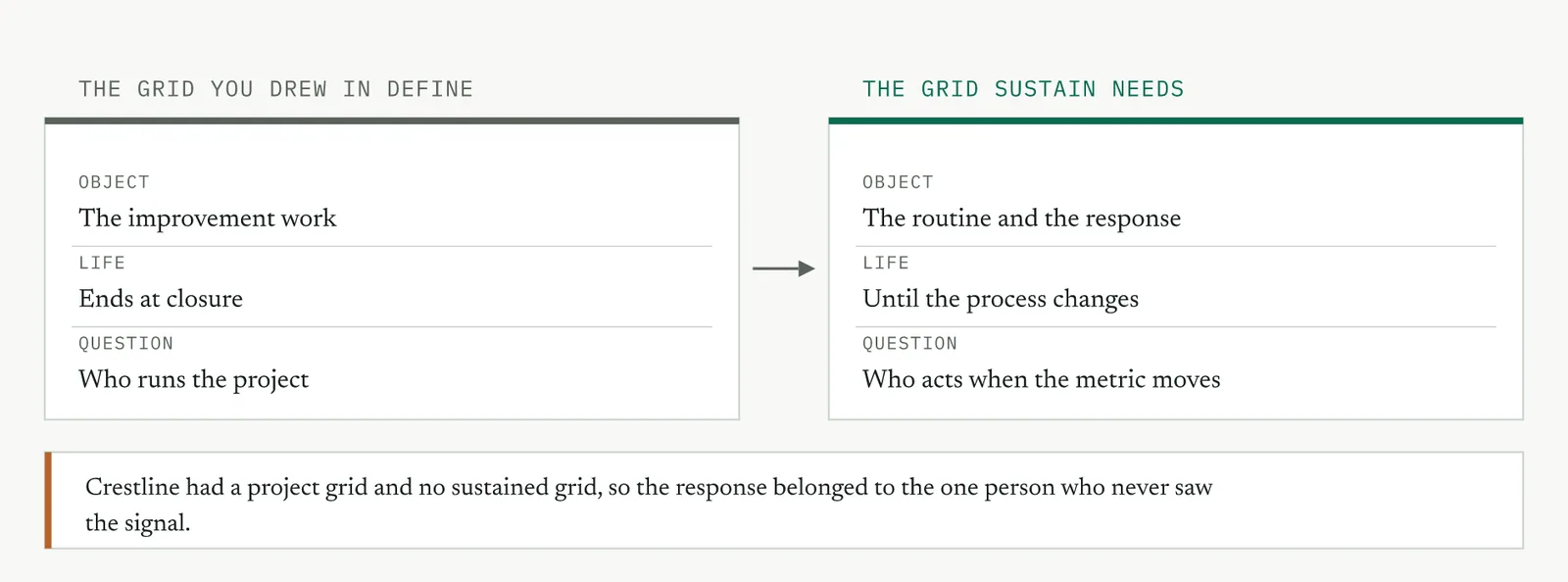
It earns its place here for one narrow reason. The Crestline fault was never an unknown role, because everybody could name who managed which team. The fault was a response owned by a person who never saw the signal, and you only see that when you write the activities down the side and the people across the top. Across three teams and two reporting lines, the wall is where your response fails.
SETUP
Bring the agreement from 16.3.1, because your grid expands its lines rather than competing with them. Bring the response plan from Control, the process map from Measure for the handoffs, and the list of teams the process touches with their reporting lines. Do not treat that last one as administrative. It tells you which rows you can settle in the room and which ones need the sponsor.
Take your rows from the sustaining activities, not the process steps. Updating, reading, responding, escalating, training a new starter, revising the standard, checking the control against a changed process, covering an absence. Six to nine rows is the working range. Go past twelve and nobody reads it, which leaves you worse placed than no grid at all, because everybody assumes the question was settled.
RUNNING IT
Six steps. Figure 16.12 shows the flow.
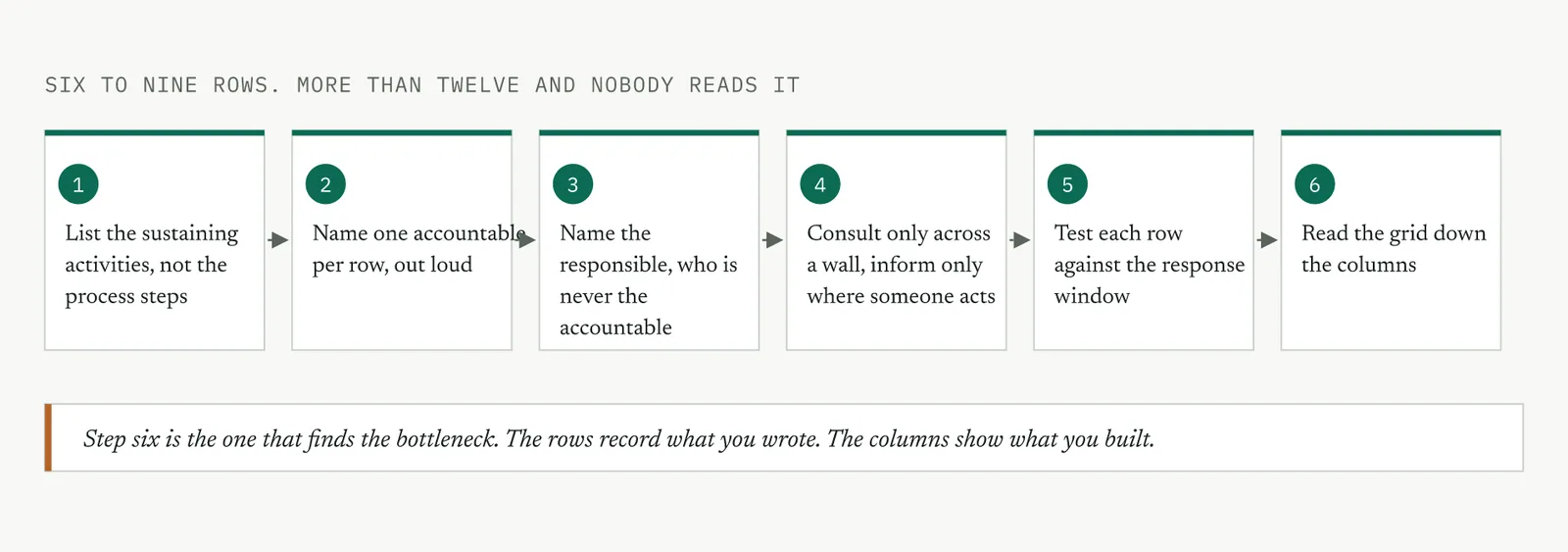
Name one accountable per row and say the name aloud with that person in the room. Two accountables is not shared ownership, it is an unowned row with a diplomatic finish. Then name the responsible, and never make it the same person as the accountable. Let the doer answer to themselves and you have removed the only check the row contained, and that is the row that stops running first. Use consulted where the activity crosses a wall, and informed only where the person hearing it will act on it. Then run each row against the response window from your agreement. An accountable who is off site three days a week cannot hold a row with a one day response, whatever you write in the cell.
Do not skip the last step. Read the finished grid down the columns rather than across the rows. The rows record what you decided. The columns show what you actually built, which is usually something you did not intend.
CRESTLINE, WORKED
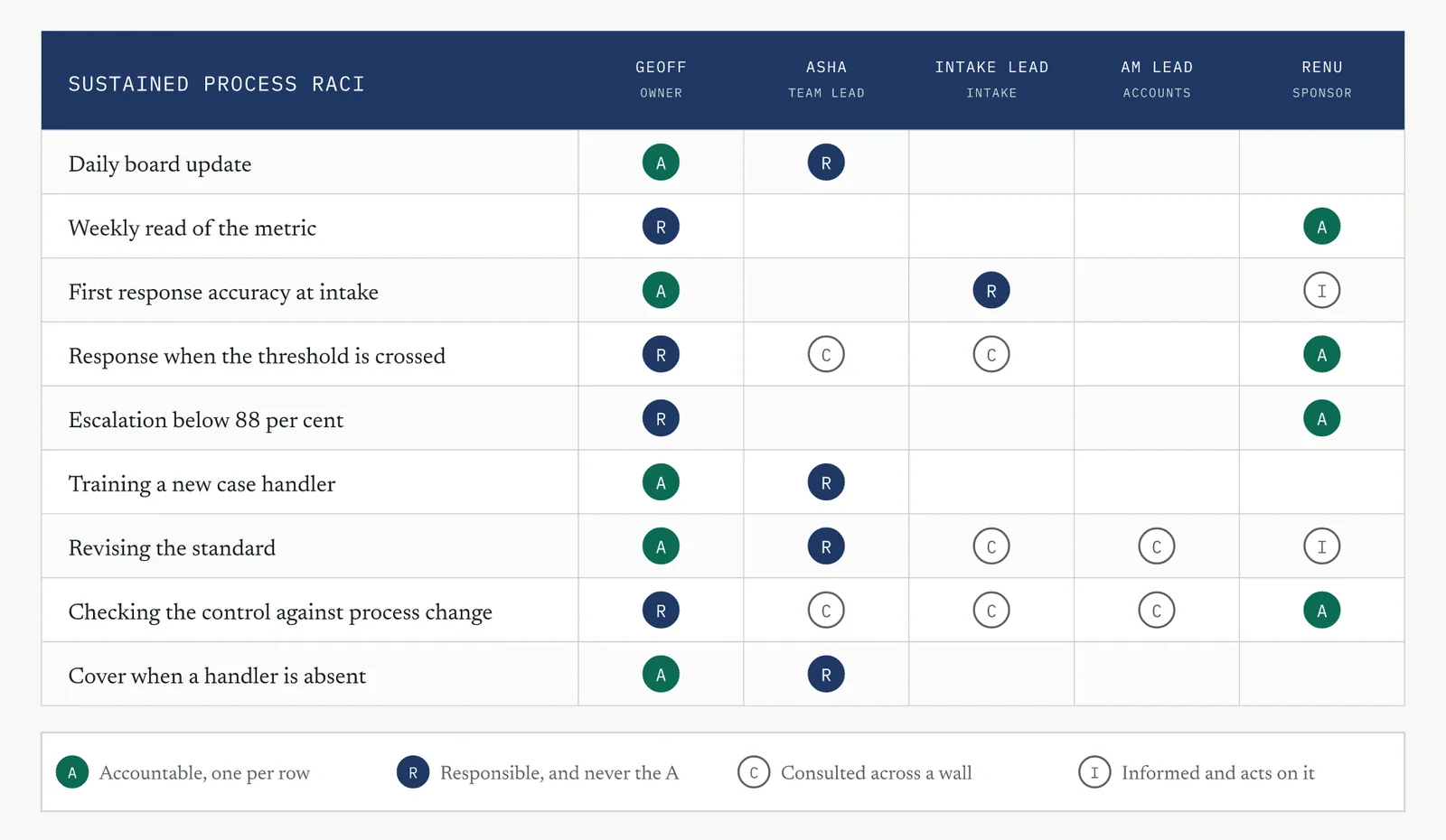
Nine rows across five people, and two of those rows were settled only because Renu was in the room. The rule that shapes the whole grid is the one in the flow above. Accountability sits a level above the doing, so the rows Geoff performs himself carry Renu as accountable, and the rows his team performs carry Geoff.
The first response accuracy row had no accountable at all before they drew the grid. The defect starts at intake, the metric is read in case handling, and Intake reports through a different manager. Geoff could not take responsibility for work in a team he does not run, and you cannot hand accountability for a metric to somebody who has never been shown it. That row is the wall. Take it to the person with authority over both teams rather than solving it in the room, which is what Renu did, in one sentence.
The second was the escalation row. Geoff is responsible and Renu is accountable, which is the arrangement that keeps a sponsor attached to a process after closure. An escalation the sponsor merely hears about is a notification. One the sponsor answers for is an escalation, and the difference shows the first time the metric goes below 88 and somebody has to decide whether to move cover.
Template 16.2 is the grid as it was agreed.
READING THE OUTPUT
Read the rows for exactly one A. A row with two accountables is unowned, and it fails first, because both of them are entitled to assume the other one moved.
Read the columns for concentration. Responsibility piling up on one person is the staff move, already written down. Asha holds responsible on four rows, which is what sends work into the competency matrix in 16.3.6. Do not read the split accountability the same way, because that is the design. Geoff answers for what his team does and Renu answers for what Geoff does.
Read the empty columns. A team that touches the process and carries no letters is a team your control cannot reach. Here the account managers carry consulted on two rows and nothing else, which is honest for their part in the process. It would not be honest if they held a handoff inside the response.
Read the blanks inside the grid. No blanks means nobody chose. Consulted costs you something, you pay it in the response window, and every extra letter adds time to the response the row exists to trigger.
MATCHING IT TO THE GROUND
On the blank page nobody has seen roles written against a routine, and naming one accountable in front of the team will feel to them like assigning blame in advance. Do it out loud before you do it on paper, keep to six rows, and use the language of the work rather than the language of the method. Nobody here needs to learn what the letters stand for to answer the question of who acts when the number moves.
On the firefight everything defaults to whoever is nearest, which is why your grid earns its place here more than anywhere. Use the negative space. The rows naming who does not respond are what stop the process re routing itself to the same three willing people in the first bad week. Put it where the work happens rather than in the folder with the plan, and take six rows on a wall over twelve in a drive.
On the false start somebody produced a matrix before and filed it without ever using it, so producing another one repeats the injury. Two things make yours different. Derive it visibly from the agreement, line by line, in front of the same people. Then run one live breach through it in the room, from signal to response to escalation, and time it. A grid the team has watched work once is a grid they will use.
On the quiet achiever one capable person already holds responsible across most rows, and your grid will document that rather than fix it unless you use the column read. Split responsible on at least two rows before you leave, and take training and standard revision first, because those two make the next person capable. The owner will resist you, because the current arrangement works. It works exactly until that person moves.
WHAT IT FEEDS
Your grid is the routing layer between the agreement and the rest of the chapter. Figure 16.13 shows where each part of it lands.
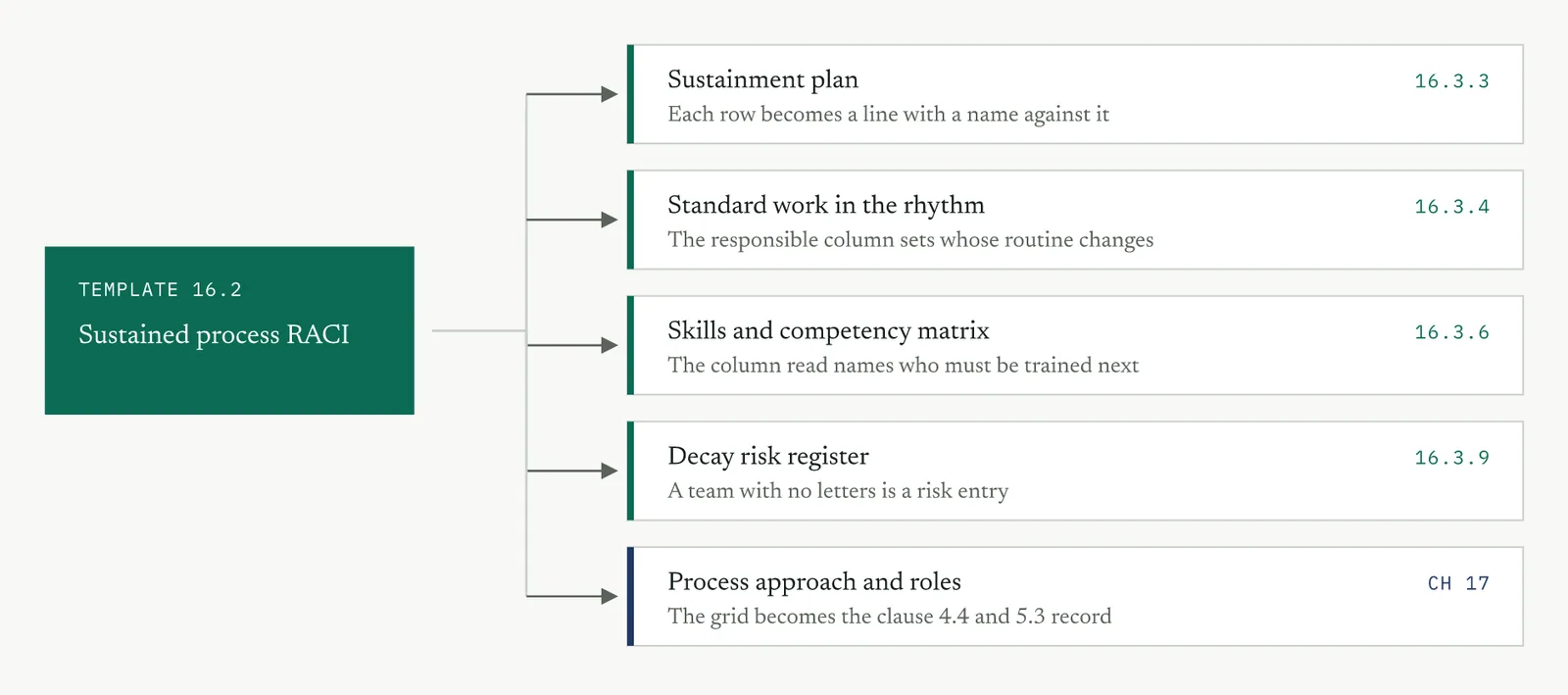
Two of those paths carry more weight than the rest on these grounds. The competency matrix is where your column read gets acted on rather than noted, and the decay risk register is where a team holding no letters becomes a dated risk with an owner instead of an observation you made once.
TIPS AND TRAPS
The complete grid. Every cell filled tells you no decision was made. Read completeness as the tell, not the standard.
The row with two accountables. It survives your meeting because it offends nobody, and it fails the first time somebody needs it.
The row where A and R carry the same name. It is the quickest way to fill the grid in and it removes the only check the row contained. Push the accountable up a level and leave the doing where it is.
The letter that outranks the roster. An accountable who is off site half the week cannot hold a one day response. Check the row against their diary, not the org chart.
The grid drawn before the agreement. With no agreement behind it, you are running a negotiation about job scope rather than expanding a job already accepted. Order matters here more than anywhere else in the toolkit.
One further check before you put it up. Ask the accountable on the response row what they would do at 4pm on a Friday. If the answer needs somebody who has gone home, the result is the row and not settled it.
| TIP Read your grid down the columns before you read it across the rows. The rows tell you what you wrote. The columns tell you what you built, including the bottleneck you did not mean to build. |
16.3.3 Sustainment plan · TEMPLATE
WHAT IT IS
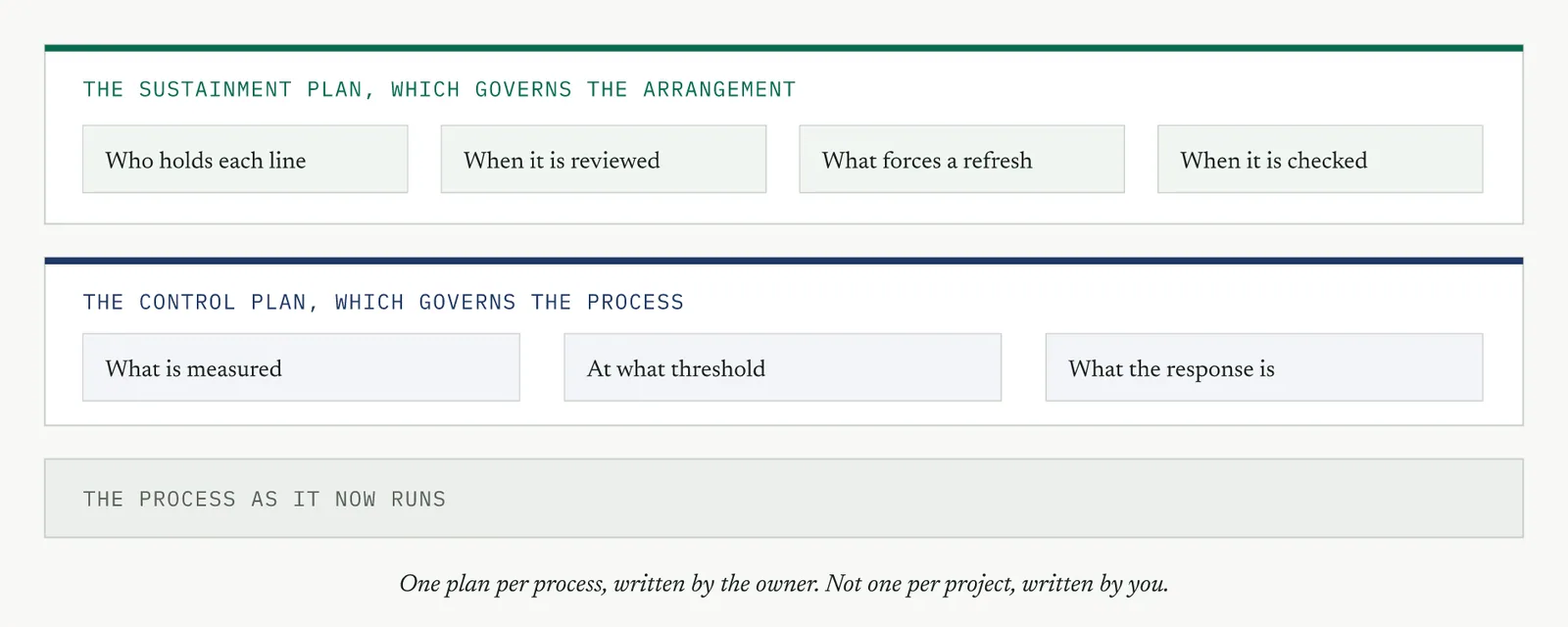
The one document the owner works from after you leave. It sits above the control plan rather than replacing it. Your control plan governs the process and says what is measured, at what threshold, and what the response is. The sustainment plan governs the arrangement around the process and says who holds each of those lines, when they are reviewed, what event forces somebody to reread them, and when the whole thing gets checked. Figure 16.14 stacks the three layers.
The owner writes it. That is the mechanism rather than a courtesy, so do not drop it when time is short. A document you write yourself reads better and holds worse, because the words are yours and so is the recall. Judge this one by whether the owner can say three of its lines out loud with it closed.
SETUP
Bring the agreement from 16.3.1, the grid from 16.3.2, and the control and response plans from Control. Bring the decay paths you found live on this process, because your refresh triggers come from those rather than from a generic list. Bring the diary as well, since half these lines carry a date, and an argument about dates in the room costs less than a plan nobody can act on.
Hold one rule on what goes in. Nothing enters without a name and a date against it. Statements of intent are why these documents get written once and filed forever, and when somebody has to act at four on a Friday they cannot tell your intention from your hope. Keep the whole thing to one page. Write four and the result is a project report.
RUNNING IT
Six steps, and only the sixth one tells you anything. Figure 16.15 shows the flow.
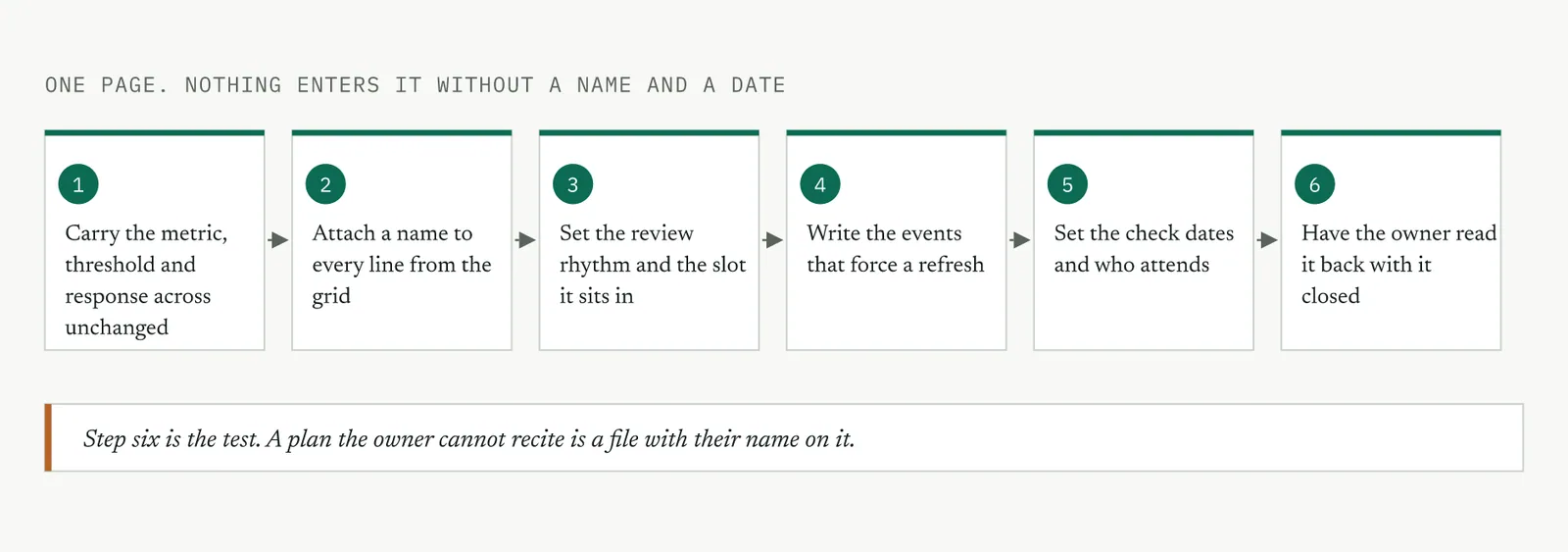
Carry the metric, the threshold and the response across from the control plan without rewriting them, because two versions of a threshold in circulation is worse than one version nobody likes. Attach a name to every line, taken from the grid rather than invented here. Set the review rhythm and the slot it sits inside. Write the events that force a refresh, as events and not as a frequency. Set the check dates with the attendee list beside them. Then close the document and ask the owner for the metric, the threshold, and the first step of the response.
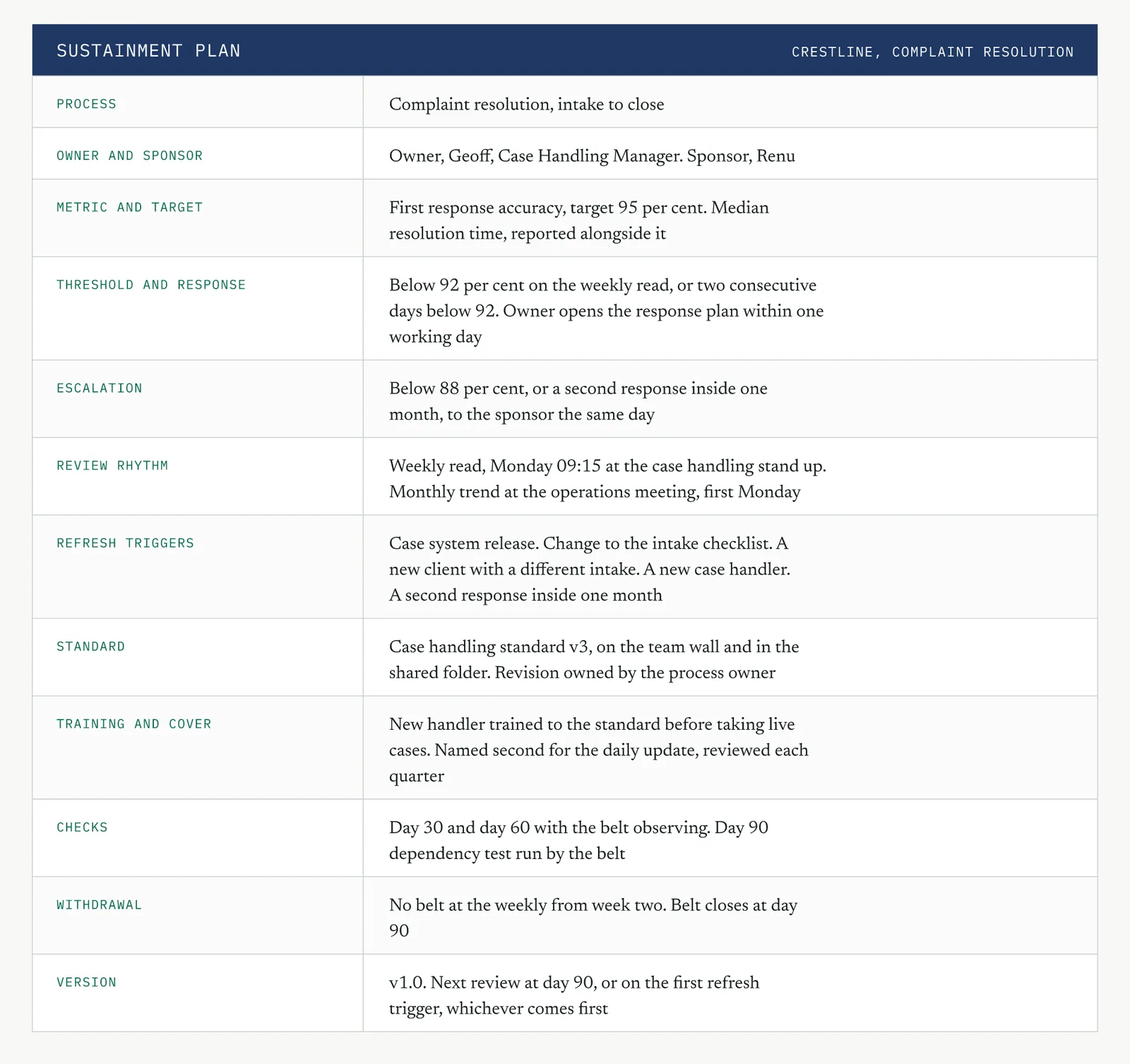
CRESTLINE, WORKED
Geoff wrote it in forty minutes, with the belt in the room correcting only where a line carried no name or no date. Two lines took most of that time, and both of them turn up on every project.
The first was the refresh trigger. Geoff wanted to write that the plan would be reviewed as required. It is a reasonable sentence and it is the exact mechanism by which the silent process change arrives, because as required means when somebody notices, and nobody notices a control that is measuring a process which has moved. The number stays green. Converting that line into five named events took ten minutes, and the case system release date was already known when they wrote it. Do not accept that phrase on any project, at any point.
The second was the review slot. The monthly trend had nowhere to go until Renu offered the first Monday of the operations meeting, which is the same hook that carries the leader routine in 16.3.5. Watch for that offer and take it when it comes, because a sponsor volunteering their own meeting is the cheapest attachment available. Template 16.3 is the plan as it was signed.
READING THE OUTPUT
Find the lines with no name. They are the lines that will not happen, because there is no third category between a line with an owner and a line that belongs to whoever is nearest. That is how the check landed on Asha in the first place.
Search for as required and regularly. These two phrases predict the silent process change better than anything else in the document. Replace both with events. An event carries a date whether or not anybody is watching for it.
Read the refresh trigger list twice. It is the part of the plan with the longest life, because the metric gets retargeted and the threshold retuned while a system release still forces a reread in three years. Put the effort there rather than into the prose.
Run the recall test before you leave. An owner who cannot state the metric, the threshold and the first response step with the document closed is holding a file with their name on it, and finding that out now leaves time to fix it.
MATCHING IT TO THE GROUND
On the blank page this is the first document of its kind the firm has produced, so the next three projects copy it whether or not that was intended. Write it as the pattern you want repeated, which argues for one page rather than four and for spending the time on refresh triggers rather than framing. The next belt copies the structure and rewrites the content anyway. Leave the format plain enough that somebody with no method training can fill it in unaided.
On the firefight nobody reads this plan during a bad week, and the bad week is the entire risk. Put everything that has to survive one onto the visual where the work happens, and leave the arrangement in the plan. Written the other way round, it becomes an accurate record of what nobody did in the week it mattered.
On the false start somebody has written a plan here before, almost always the last belt, and filed it. Two things make this one different. The owner writes it, in their file rather than yours, and it carries a version number and a next review date on its face, so a stale copy announces itself without anybody having to check. The team here has learned to treat documents as decoration, and the only counter is a document that visibly expires.
On the quiet achiever the plan already exists in somebody head, complete and unwritten, so most of the work is transcription. Do not improve it while transcribing. Write what they already do, then add the two things they will not have, which are the refresh trigger and the named second. Those two convert a capable individual into an arrangement that survives their promotion.
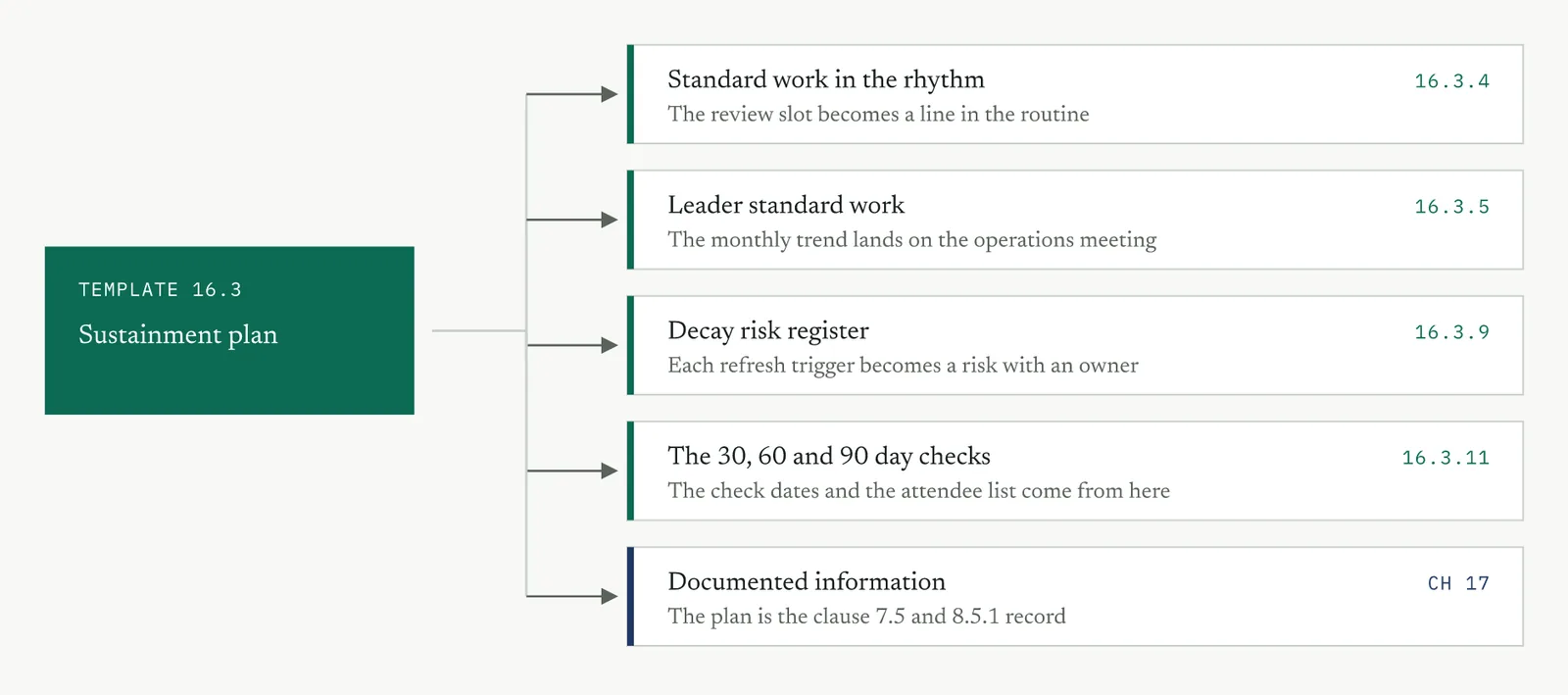
WHAT IT FEEDS
Every tool after this one takes at least one line from the plan, so Figure 16.16 shows where they go.
TIPS AND TRAPS
The plan you drafted. It reads better and it holds worse, so drafting because it is faster buys twenty minutes and sells the recall test.
The plan that repeats the control plan. A document that could be deleted without loss eventually is. It earns its place by holding what the control plan cannot, which is who, when, and on what event.
The missing version number. Two copies in circulation and the older one is on the wall. Put version and next review date on the face of the document, not in a footer nobody prints.
The blank review date. A document with no expiry ages silently, which is the failure your refresh triggers exist to prevent.
At the thirty day check, ask for the plan before the metric. A plan that comes out of a drawer unmarked means the second decay path is already running, with sixty days left to do something about it.
| TIP Ask the owner for the metric, the threshold and the first response step with the plan closed. An answer that does not come back cleanly is a fault in the plan rather than in the owner, because a line nobody can recall was written for the wrong reader. |
16.3.4 Standard work in the operating rhythm · LEAN
WHAT IT IS
Two different things carry this name and only one of them belongs here. The process standard work came out of Improve and governs the value work. What gets built now is routine standard work, which governs the tasks that keep the control alive. The update, the read, the response, the trend, the reread on a trigger. Each becomes a line with a trigger, a name, a duration and an output. Figure 16.17 separates them.
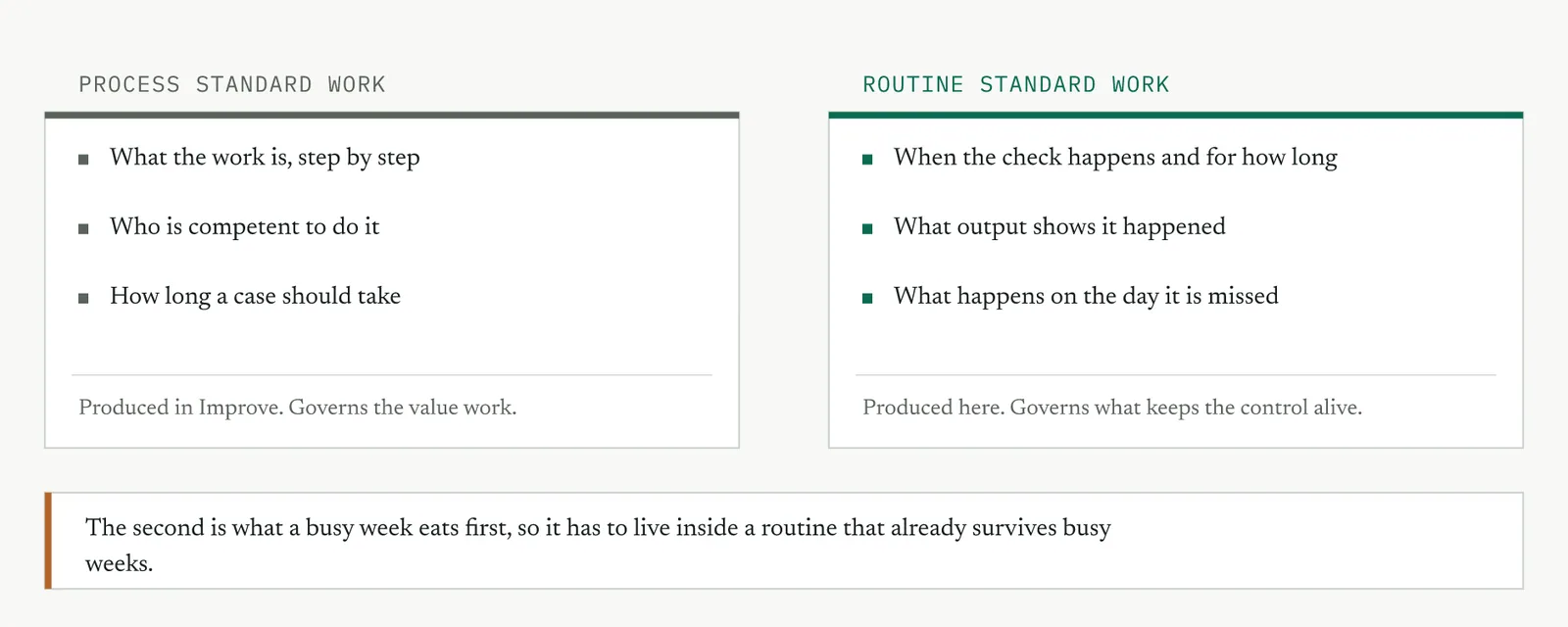
One rule carries the whole tool, which is to attach the sustaining tasks to a routine that already runs and create nothing. A new routine has to be defended, chaired, remembered and protected, and it competes for the same attention as the work it exists to protect. The third decay path is not a discipline problem. It is an attachment problem, solved by choosing the right host rather than by asking people to try harder.
SETUP
Bring the sustainment plan lines and the grid, then collect the thing most people skip. Ask for every routine that already runs in the area, with its attendance and its cancellation history for the last quarter. Stand ups, shift handovers, operations meetings, one to ones. That history is the selection criterion, because a routine that survived the last bad month will survive the next one. No amount of appropriateness compensates for a host that gets cancelled.
Then measure the tasks rather than asking about them. Two minutes claimed is usually four or five, and a routine built on claimed durations overruns in the second week and gets trimmed in the third. The task trimmed first will be the check.
RUNNING IT
Six steps. Figure 16.18 shows the flow, and treat the third one as a rule rather than a preference.
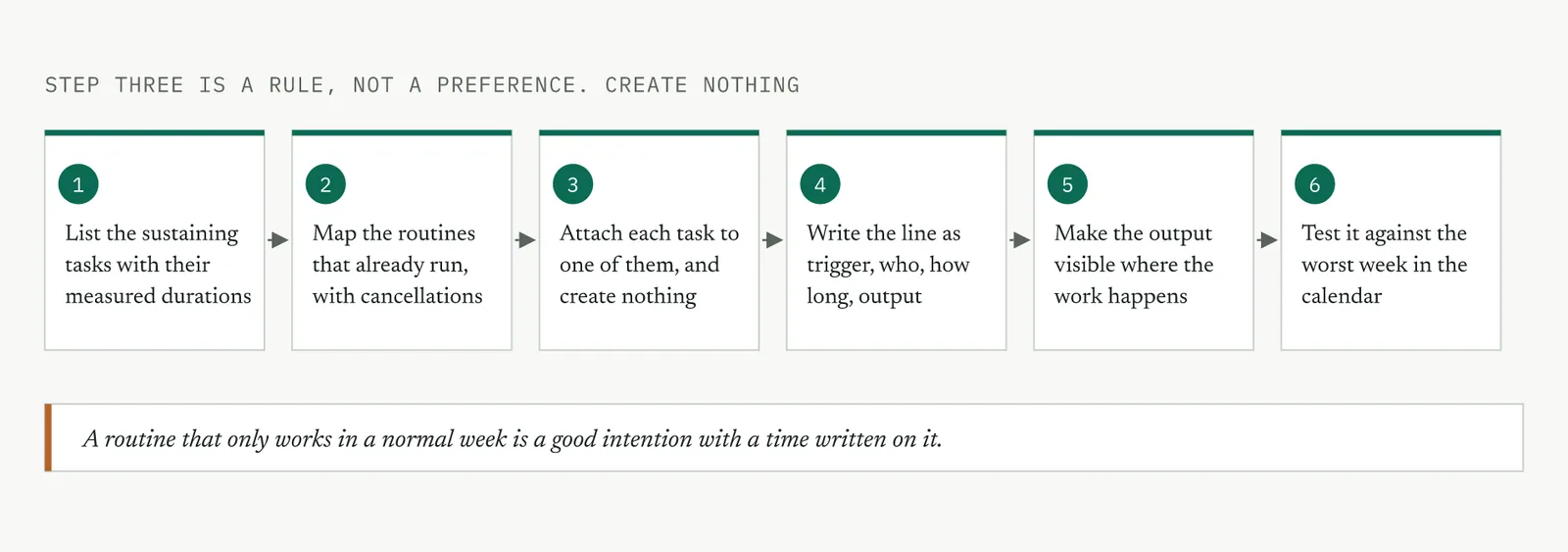
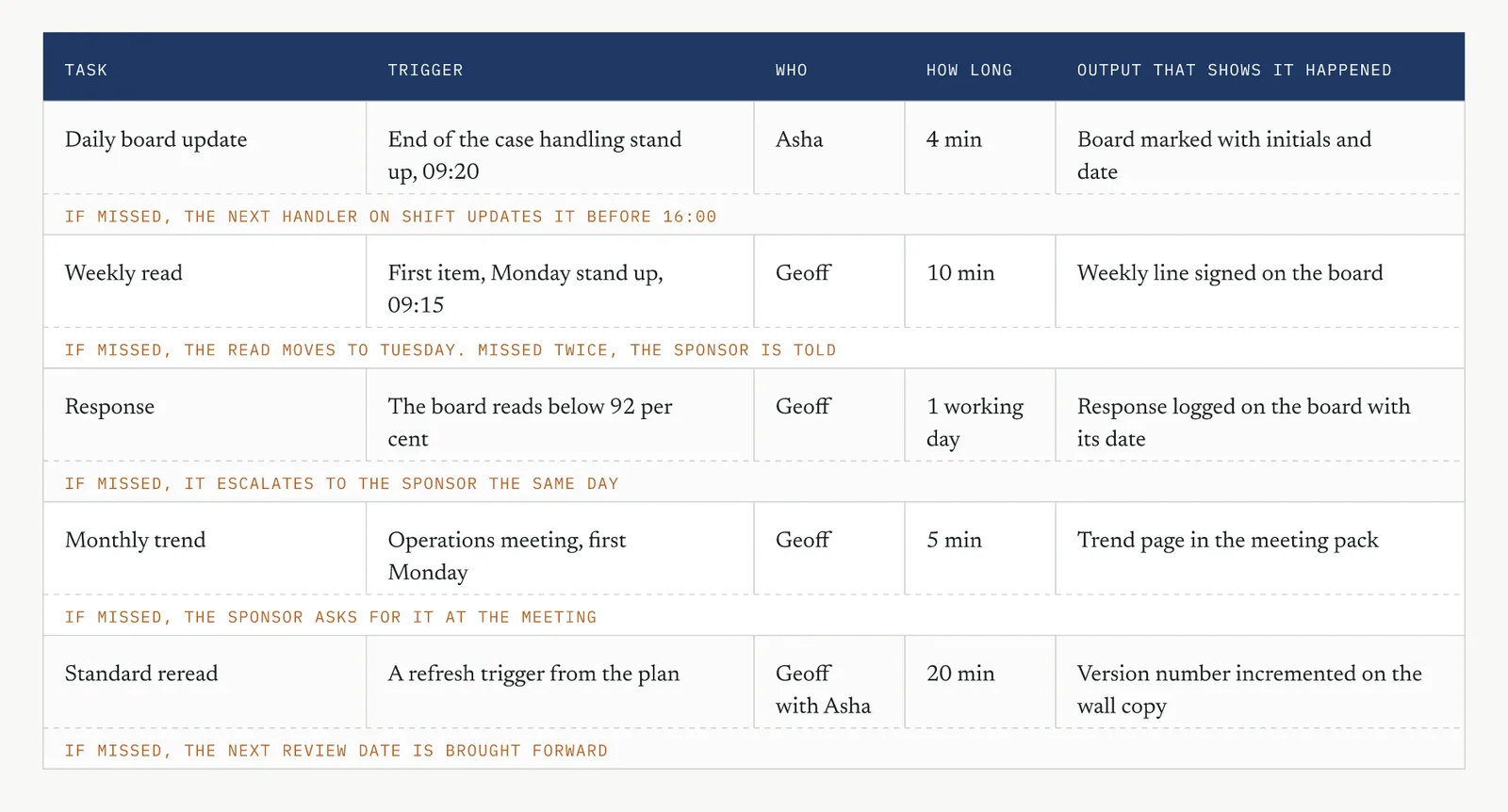
Write each line in the same four parts. The trigger, which is a routine and a time or an event on the board. The name, taken from the responsible column of the grid. The duration, measured rather than estimated. The output, visible where the work happens. Then add the line most sheets leave off, which is what happens on the day it is missed. A task with no recovery ends at the first absence, and the first absence always comes.
Test the finished sheet against the worst week in the calendar rather than a normal one. Month end, the week of the audit, the week two people are on leave. A sheet that survives only a normal week is not standard work.
CRESTLINE, WORKED
Three routines were available. The case handling stand up at 09:15, which has run for two years and was cancelled twice last quarter. The intake huddle, six weeks old and cancelled five times. The operations meeting on the first Monday, which Renu chairs. The intake huddle was the better audience for the intake row and it was rejected on its record. Make that trade the same way when you meet it.
The daily update measured at four minutes rather than the two Asha had claimed, so it went to the end of the stand up where an overrun costs nothing. The weekly read went to the first item on a Monday, because the first item of a routine survives a cancellation more often than the last one does. The monthly trend went to the operations meeting. Nothing new was created.
One line in the sheet does most of the work, and you can copy it directly. The board gets marked with the initials of whoever read it and the date, so a missed read shows on the board itself rather than in an audit six weeks later. Applied at Crestline in week four, that single rule surfaces the drift in week five, while the number is still 91 and the correction is still small. Template 16.4 is the sheet as it was written.
READING THE OUTPUT
Add up the duration column. An owner load past fifteen or twenty minutes a week will not hold, and the part that goes is the part with no audience. Cut the scope rather than hoping.
Read the trigger column for orphans. Any line whose trigger is a frequency rather than a routine or an event is an orphan, and orphans are what the first busy fortnight removes.
Check the output column for visibility. An output only an auditor can see is not an output. Make it visible to the people doing the work, because they notice daily and an auditor notices quarterly.
Read the recovery line. A row with nothing written there has no recovery and one absence ends it. That column is what separates a sheet that survives leave from a sheet that describes an intention.
MATCHING IT TO THE GROUND
On the blank page you may have no routine to attach to at all, and this is the one ground where you build one. Build exactly one. Make it a stand up owned by the process owner rather than a governance meeting, give it a fixed end time and a single output, and keep it under ten minutes. Then leave it alone. The pull here is to build the routine you wish the firm had, which produces a meeting they cannot carry and teaches everybody that improvement means more meetings.
On the firefight the routines exist and they get cancelled, so treat the cancellation history as the decision rather than as background. Attach to the routine that survived the worst month even when its audience is imperfect, and shorten the task until it fits inside a bad day. Ten minutes in the wrong room beats thirty in the right one, because the wrong room still meets in the week the client escalates.
On the false start somebody built a routine for the last initiative and the team watched it die. Build another one and you repeat the injury in a form everybody recognises. Attach the task to a routine older than the improvement function instead. That is the strongest signal available to you here, because it says the check will outlive the project, which is precisely what nobody believes yet.
On the quiet achiever the routine exists and the standard lives in one person practice rather than on paper. Write the habit down exactly as it is performed, verbatim, including the parts that look inefficient. Then compare it against the written standard and correct the standard where the habit is better, which it often is. Writing it down is also the only way a second person ever learns it, and the second person is your whole purpose here.
WHAT IT FEEDS
The sheet is the object the next four tools act on. Figure 16.19 shows where each part of it goes.
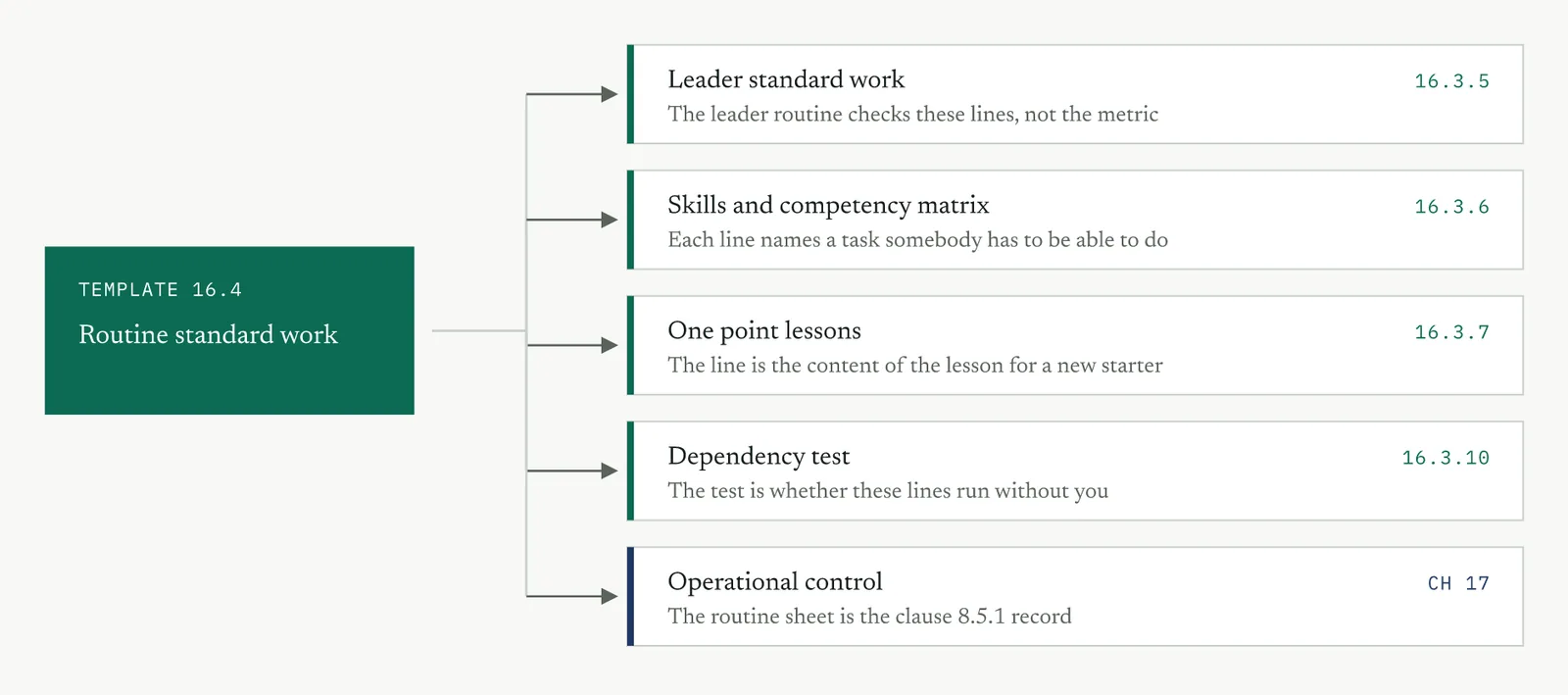
Watch the second path in particular. A competency matrix built from this sheet asks a narrow question, which is who else can perform this line at this time, and a manager can answer that without a framework behind it.
Watch the fourth as well. Your dependency test does not ask whether the process still performs. It asks whether these five lines still run on a day nobody expects a visit, so write them in terms somebody other than the owner can verify.
TIPS AND TRAPS
The new meeting. It is the most common failure in this section and it feels like progress while you are doing it. If you are building a forum to hold a ten minute check, the check is not your problem.
The claimed duration. Time the task yourself, once. The gap between claimed and actual is where your sheet fails, and it runs in one direction only.
The invisible output. A completed check that leaves no mark looks exactly like a skipped one, and after four weeks nobody can tell you which they had.
The host chosen on audience fit. The right people in a routine that gets cancelled is worse than adjacent people in a routine that does not.
Walk the sheet once yourself, at the real time, in the real room, before you leave. If it has never been performed at the hour it names, you are holding a draft, and the things that break are the things you cannot see from a desk.
| TIP Test the routine against the worst week in their calendar, not a normal one. Anything that works only in a normal week is a good intention with a time written on it. |
16.3.5 Leader standard work and the layered check · LEAN
WHAT IT IS
Standard work for the people above the owner, layered so that each level checks the level below performing its routine. No layer checks the metric, because a leader asked for the number will produce the number, and at Crestline that number was four weeks old and still green. Stand the same leader at the board asking whether the line was signed last Tuesday and they learn something the number cannot tell them. Figure 16.20 sets out the layers.
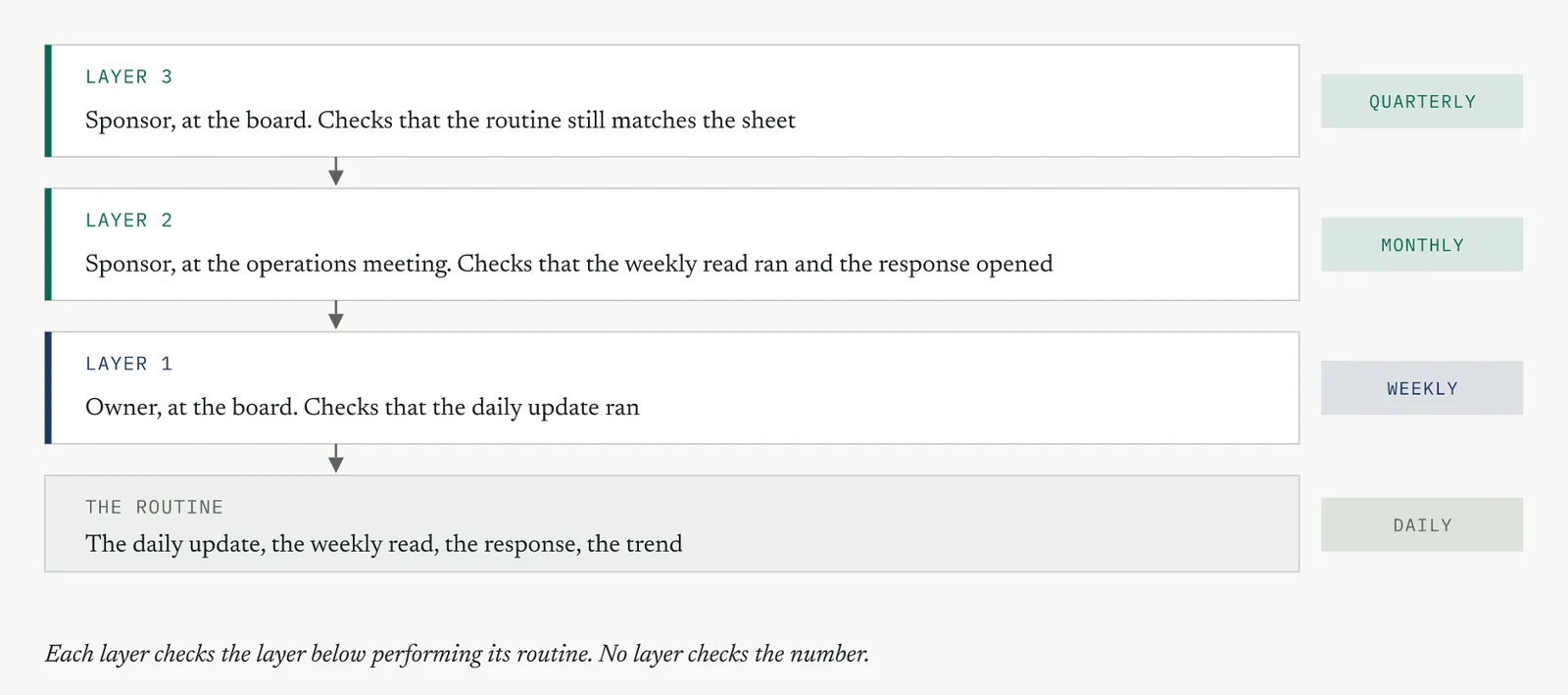
Take three layers as the ceiling in a firm of four hundred people, and accept that two is often right. More layers than the firm has levels produces theatre, which is worse than nothing, because a signed audit nobody performed teaches the team that signatures are decoration. The leader check is standard work like any other line, so it carries the same four parts. Trigger, name, duration, output.
SETUP
Bring the routine sheet from 16.3.4, because it is the object of the whole exercise, and bring the grid so you know who sits above the owner in fact rather than on the chart. Then find out what the layers above already do. Most sponsors already walk somewhere on a fixed day. Attaching to that walk costs you nothing. Creating a new one costs you the thing you are protecting.
Give every layer the same three questions, which are whether the line is running, what the evidence looks like, and what happened the last time it was missed. The third question finds the decay, because a process that stopped weeks ago can still answer the first two comfortably.
RUNNING IT
Six steps. Figure 16.21 shows the flow.
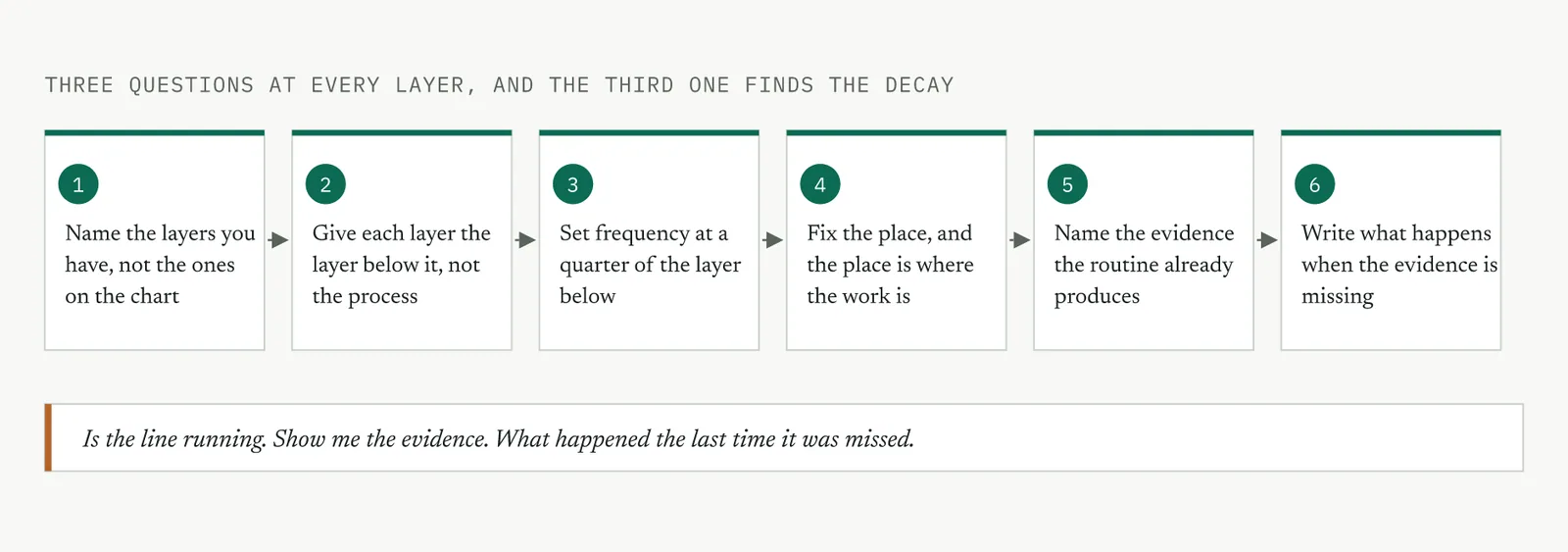
Give each layer the layer below it rather than the process, so the owner checks the daily update and the sponsor checks the owner weekly read. Set each frequency at roughly a quarter of the one beneath it. Run two layers at the same frequency and you are duplicating, and the one with less authority stops first. Fix the place, and for the layer that matters put it where the work happens rather than where the meeting happens. Name the evidence the routine already produces rather than inventing a form, because a check that needs new paperwork gives you a second thing to sustain. Then write what happens when the evidence is missing. Leave that line out and you have built observation, and observation changes nothing.
CRESTLINE, WORKED
Renu already chaired the operations meeting on the first Monday and already walked the floor, unpredictably, roughly once a month. Both were used. The monthly layer sits inside the meeting she already runs, and the quarterly layer is the walk, made predictable in date but not in what it examines. Nothing was created. Look for those two things on your own ground before you propose anything. Template 16.5 is the schedule as agreed.
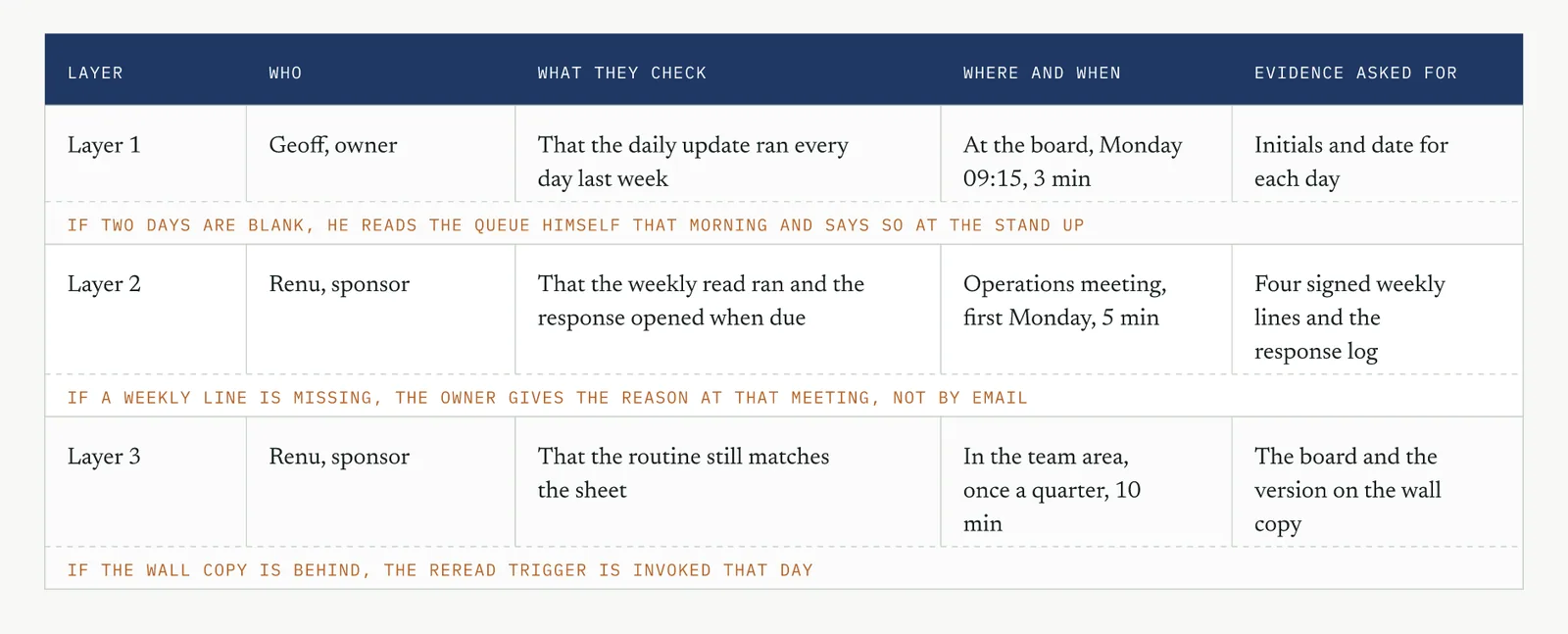
Two things in it are worth copying. The top two layers are the same person, which is normal at this size and acceptable as long as the object and the place differ. Renu at the operations meeting is checking a record, and Renu at the board is checking a routine. The second one is the check that would have caught week four.
The second is the layer two action. A missing weekly line gets reported by the owner at the meeting, out loud, rather than by email beforehand. Do not soften that when you write yours. Email lets both of them settle it privately, which is exactly how the first missed check becomes the second, and the meeting is where the rest of the leadership team learns that the check has consequences.
READING THE OUTPUT
Check what each layer examines. A layer looking at the number rather than at the routine is a report with a different name on it, and it will confirm a green metric on a process nobody is measuring.
Read the frequencies as a ratio. Daily, weekly, monthly, quarterly is the shape you want. Two adjacent layers at the same frequency means one is redundant, and redundancy resolves itself by the weaker layer disappearing.
Read the action column. Every layer needs a defined consequence when the evidence is absent. A layer that finds a gap and does nothing has taught the level below that your check is optional, which leaves you worse placed than never having checked.
Read the durations. A top layer check running longer than five or ten minutes gets cancelled inside a quarter, so take short and frequent over thorough and abandoned. This trade is not close.
Then ask the leader one question, which is what their last check found. An answer of nothing across four visits means either the process is genuinely stable or the check is happening at a desk. Asking where they were standing settles which one it is.
MATCHING IT TO THE GROUND
On the blank page no leader here has ever checked a routine, and most will assume you are asking them to supervise adults. Start with one layer above the owner rather than three. Write the three questions on a card and hand it over, because the questions are the entire method and they do not need the theory behind them. Attend the first two checks and say nothing while they run, then debrief afterwards. Correct a leader in front of the team on their first attempt and you will not get a third.
On the firefight the leaders are the people being pulled around hardest, so make the top layer three minutes at the board on a fixed day and nothing else. Anything needing preparation gets dropped and anything scheduled as a meeting gets cancelled for a client call. Put the sponsor at the top layer rather than a middle manager, because here the sponsor is the one person whose diary defends itself.
On the false start you are working with a history of audits signed by people who did not perform them, and the team knows which ones. Use two counters. Ask for evidence the routine itself produces, so nobody can manufacture it at a desk on the day. And run the check where the team can see it, because a check they never witness looks exactly like one that never happened. On this ground visibility is not a nice property of your check. It is the repair.
On the quiet achiever a leader is already doing an informal version of this, walking and asking, and usually doing it well. Write down what they already do rather than replacing it. Then add the two parts an informal walk never has, which are a fixed frequency and a defined action when the evidence is missing. Formalise the rest and you will spend the goodwill and gain nothing, because the part that works is the part they invented.
WHAT IT FEEDS
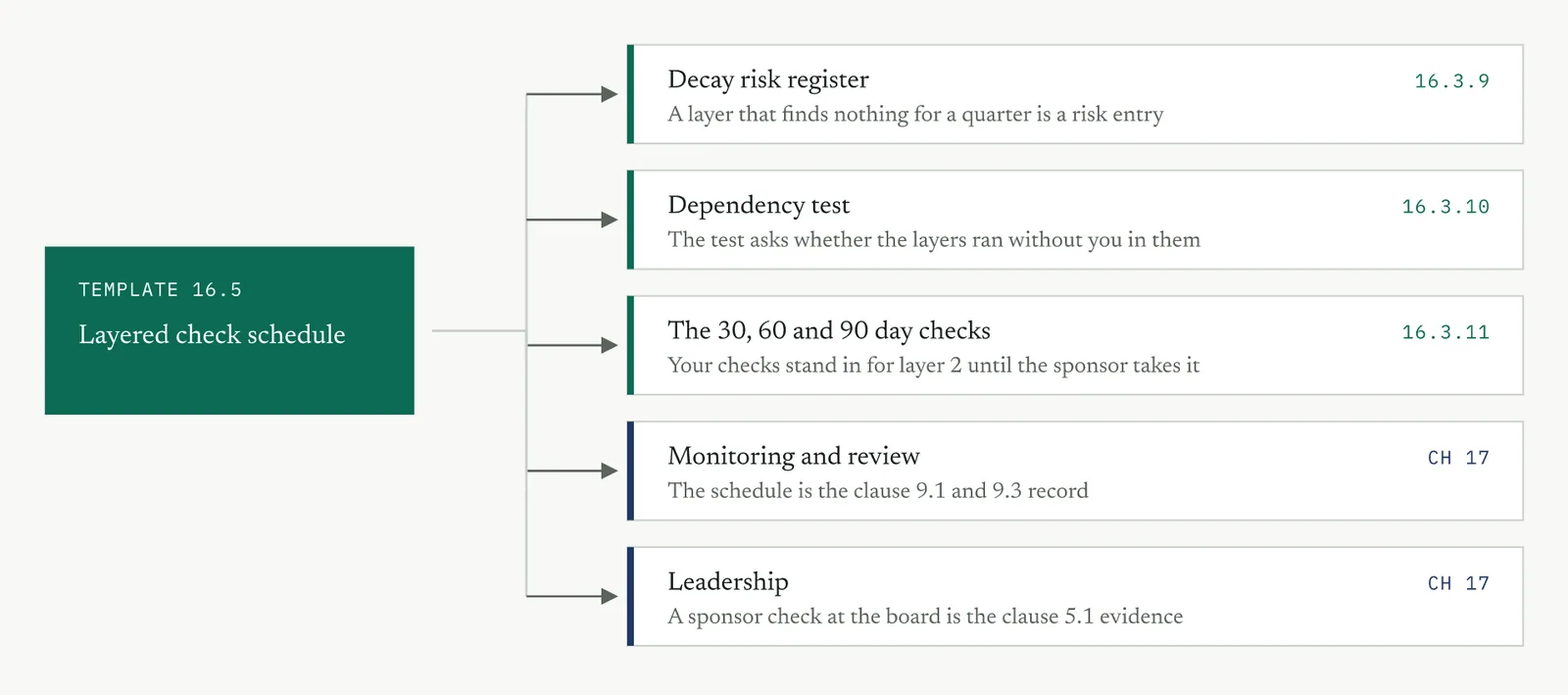
This schedule is what your withdrawal tests against, and it is the first thing Chapter 17 anchors. Figure 16.22 shows the paths.
TIPS AND TRAPS
The check that asks for a number. It is the default behaviour of every leader who has ever been handed a dashboard, and it is why Crestline reported green in week six.
The audit performed from a desk. You get a completed schedule and no information. Ask where they were standing, not whether it was done.
The leader who fixes it personally. A sponsor who finds a gap and closes it themselves has taken the owner out of the loop, and they will be closing it personally for the rest of the year.
The check with no consequence. Observation dressed as governance. If nothing follows a missing signature, the signatures stop.
| TIP Ask the leader what their last check found. Nothing, four times running, tells you the check is happening at a desk rather than at the board. Change the place, not the frequency. |
16.3.6 Skills and competency matrix · LEAN
WHAT IT IS
A matrix scoped to one question. What stops running when the person who holds it is away. The firm probably has something called a training matrix already, and it will not answer that, because it maps every skill in the team, it is scored on tenure, and somebody reviews it once a year if they remember. Figure 16.23 sets the two apart, and that distinction is what you need in the room when the existing one is offered.
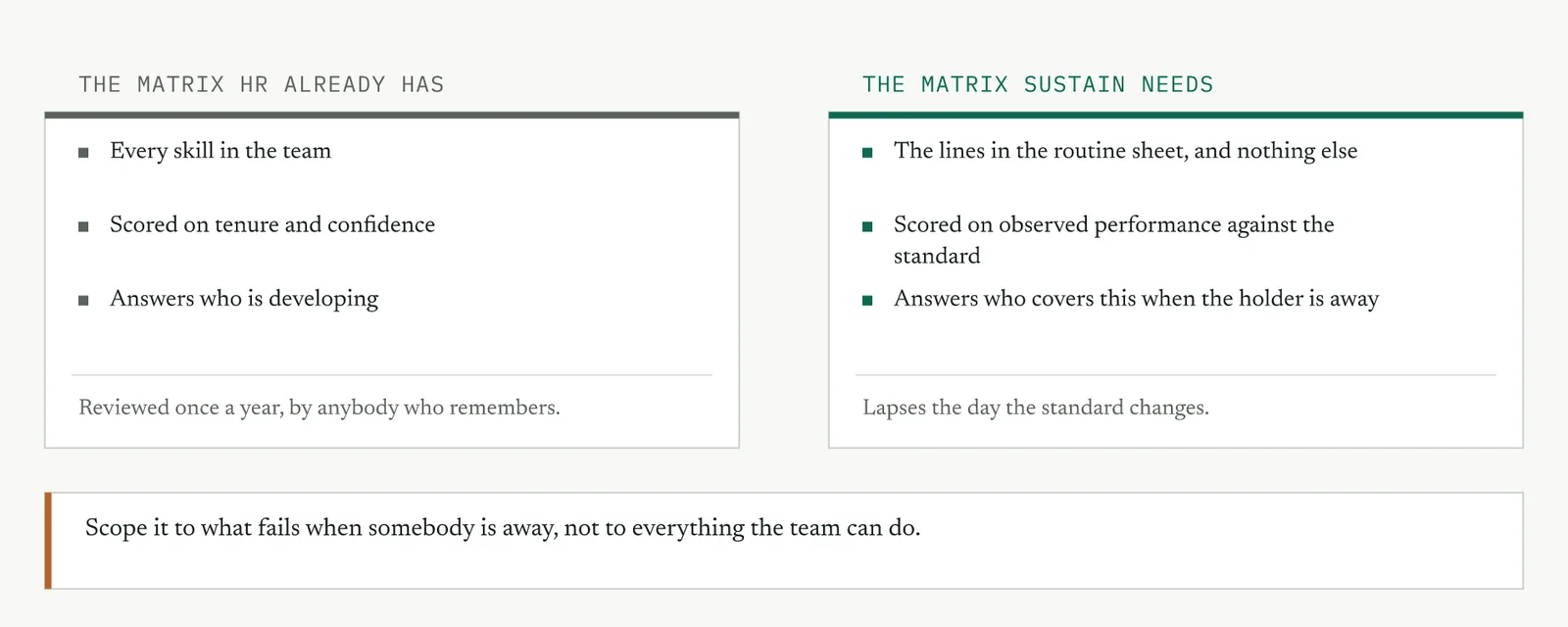
Take the rows from the routine sheet plus the process steps that carry the defect, and take nothing else, because narrow is what makes it usable. Forty skills gets maintained by nobody, whereas six gets updated by the team lead in the stand up. This is a gap map rather than a training plan. The plan is 16.3.7, and keeping the two apart is what stops the gap analysis turning into a wish list.
SETUP
Bring the routine sheet, the standard the work is judged against, and the roster including leave and shift patterns. Read the roster properly, because depth is only real when the two people holding a line are not always absent together. Two deep across a team that takes school holidays at the same time is one deep in July.
Set the required depth before anybody scores anything. Two deep on every line in the routine sheet, and three on the line that carries the metric. Set it afterwards and it lands at whatever the scoring found, which is how these documents end up confirming that the current arrangement is adequate.
RUNNING IT
Six steps. Figure 16.24 shows the flow.
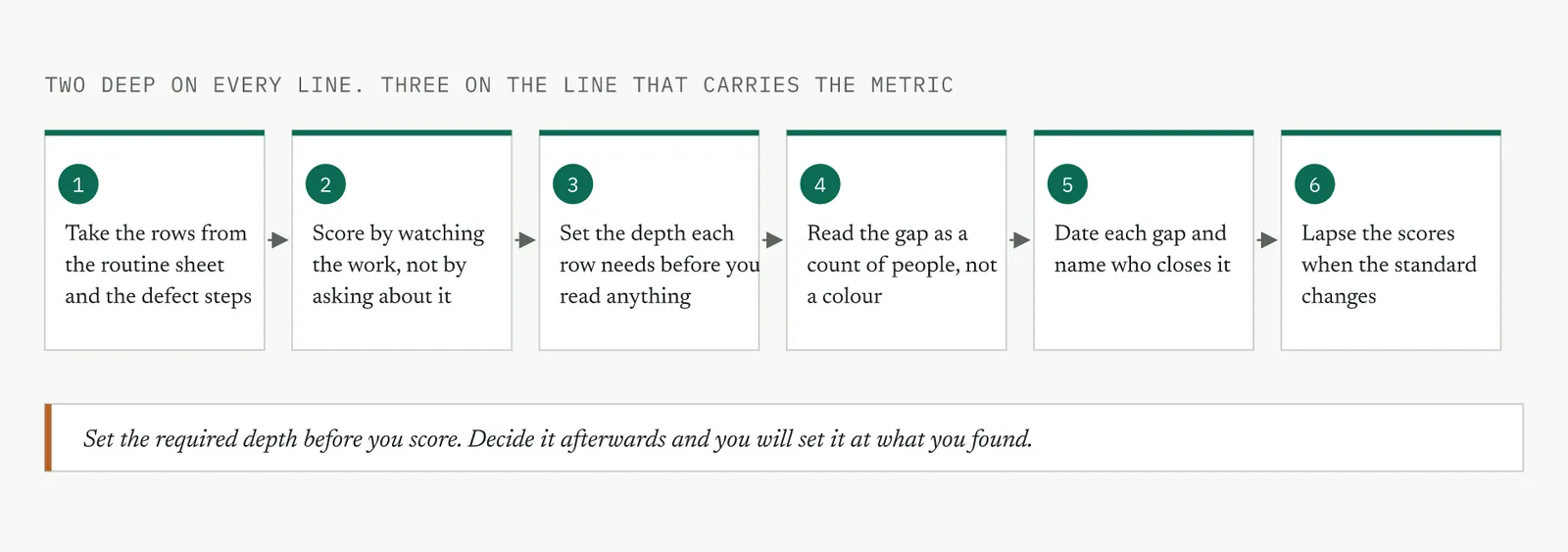
Score by watching the work rather than by asking about it, because a matrix built from a conversation records confidence, and confidence and competence diverge most in the people who have been doing the job longest. Four levels are enough. Aware of it, can do it with help, can do it alone, can teach it. The last one carries the weight, because a task nobody can teach cannot be spread, and a team that cannot spread a task is one absence from losing it.
Write the lapse rule into the document itself, so that when the standard changes every score against it lapses and gets reassessed. That sounds heavy until you notice it is the same event that already triggers a reread of the plan, which makes it one line rather than a new process.
CRESTLINE, WORKED
Six rows, six people, scored over two mornings by observation. Template 16.6 is the matrix as it came out, before anybody was trained.
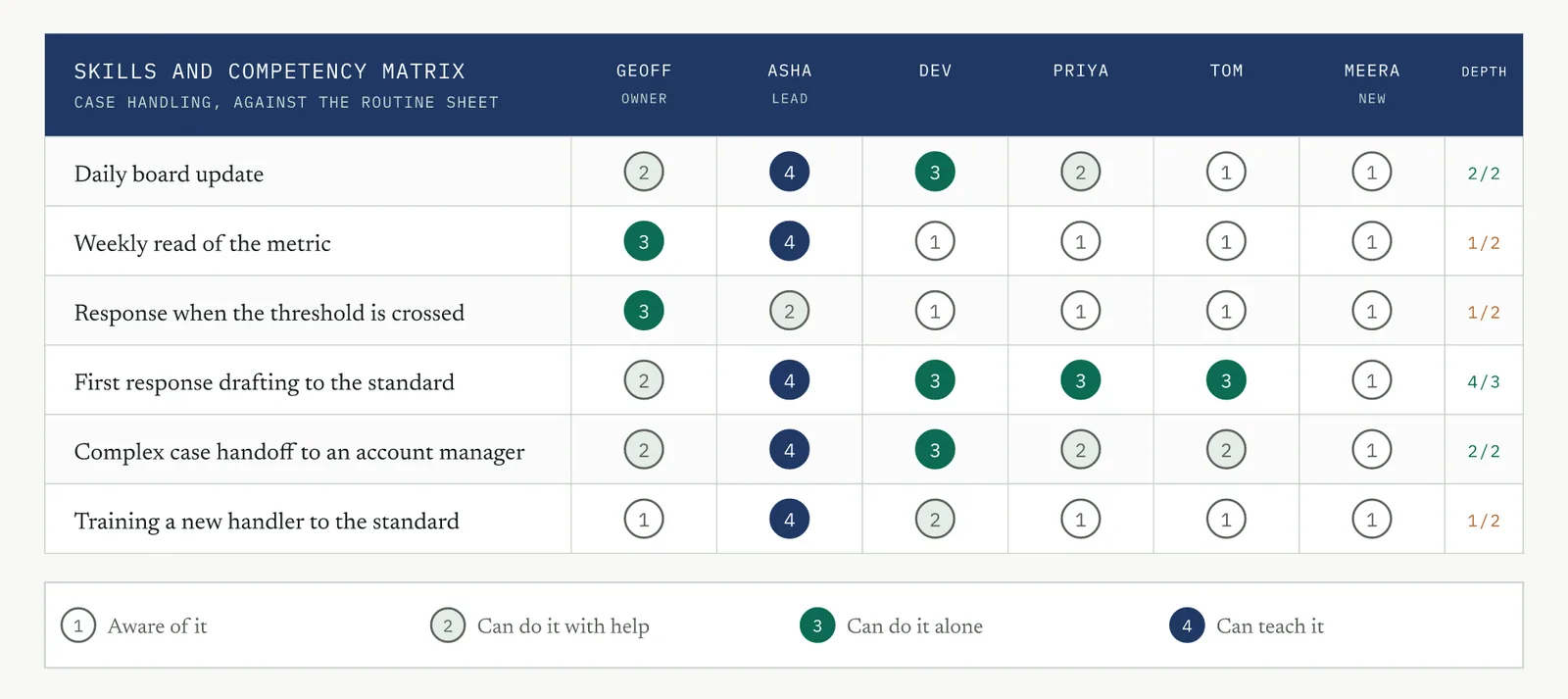
Three readings come straight off it, and the same three turn up on most projects. Asha is the only person at teach level, on five rows of six, which is what the RACI predicted when she held responsible on four rows. The response row is one deep and the holder is Geoff, so on the day the owner is away the response has nobody, which is a worse exposure than the one the project was run to fix. Meera, hired three weeks after closure, sits at aware on every row, which is the training fault from the return visit rendered as a column of ones.
Keep the gap closure small. Two handlers to can do alone on the daily update inside four weeks, one of them to teach level by day ninety, and Asha teaching the response to Geoff second rather than to another handler. Copy that last choice, because the response row needs depth at the owner layer rather than the team layer. The authority to act sits with the owner, and training a handler to do something they cannot authorise produces a second bottleneck.
READING THE OUTPUT
Read the count, not the colour. A row is one deep or two deep, and the shading tells you nothing the count does not. Read it as a heat map and it invites you to conclude that most of it looks fine.
Read the teach column first. Every row needs at least one person who can teach it, and a row where the only teacher is also the only doer is a single point of failure with a promotion date attached.
Read the newest column. The person hired most recently is the honest test of whether the training route works, and a column of ones beside a standard published four months ago says it is not reaching new starters.
Read the owner row against the roster. Depth on the tasks the owner performs personally is the exposure you will forget, because nobody ever models the owner as absent.
MATCHING IT TO THE GROUND
On the blank page nobody has been assessed against a written standard before, so this reads as appraisal unless it is framed first. Say plainly that the scores describe the arrangement rather than the person, and that a one against a task nobody has ever been shown is a statement about the firm. Score the team lead first and in the open, at whatever level the observation gives. A matrix that starts by finding a gap above the team is a matrix the team will help fill in.
On the firefight the whole team scores can do it alone on everything urgent and aware on everything that prevents urgency, which is the shape that produces the firefight in the first place. Keep to four rows here. Take the line that carries the metric and get it three deep, and leave the rest until the first month of stability. Full coverage on this ground produces a document that ages faster than the roster.
On the false start somebody produces a matrix from a drawer, complete and green, scored on tenure two years ago. Do not update it. Build a new one from the routine sheet in front of the team and use the contrast between the green document and the observed one, because that is the most useful conversation available on this ground. Say out loud that the old one was not wrong, it was answering a different question.
On the quiet achiever the capable person is at teach level on everything and everybody knows it, so the matrix documents what the team already says out loud. Put the effort into the closure plan rather than the map. Set the depth requirement, agree two names, and get dates against them while the capable person is in the room and agreeing, because their agreement is what makes the training happen. Their absence is what the matrix exists to survive.
WHAT IT FEEDS
The matrix feeds the training work and gates the withdrawal. Figure 16.25 shows the paths.
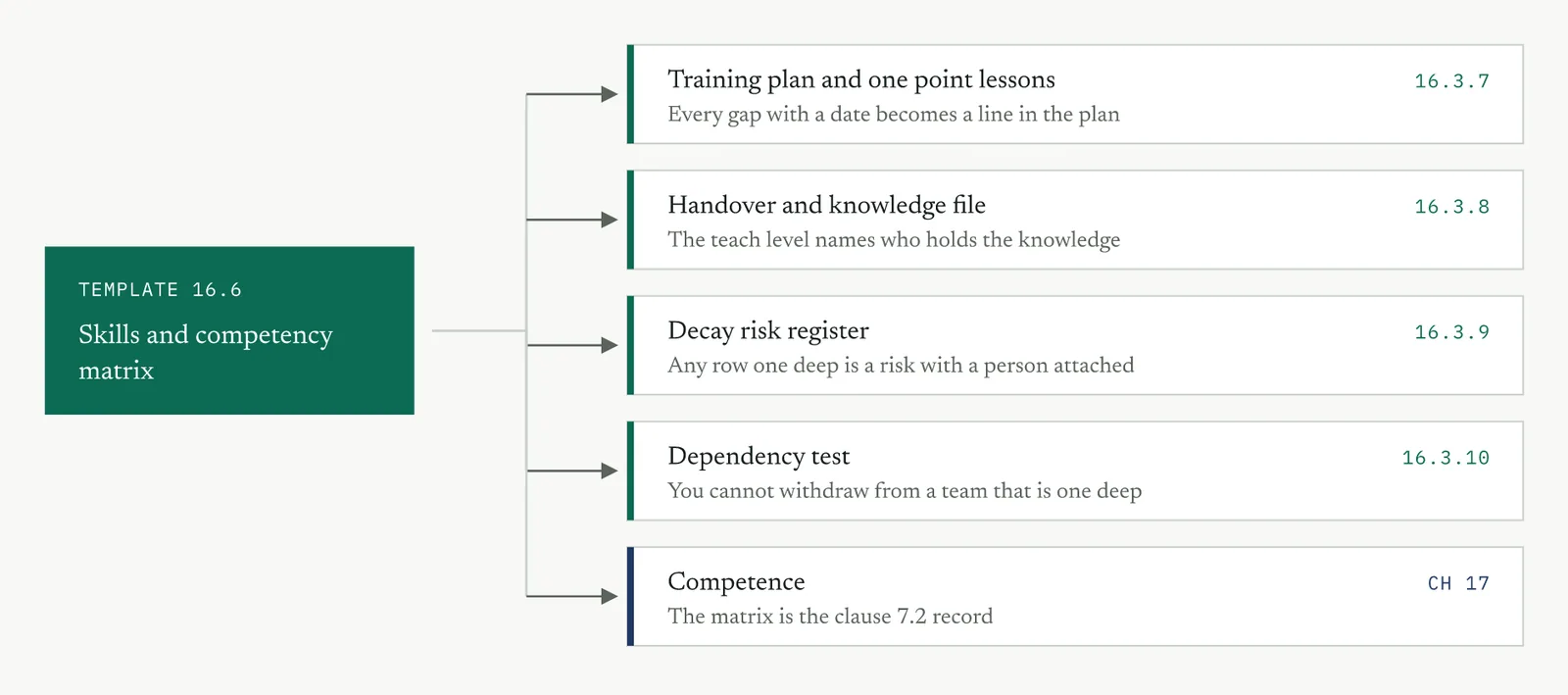
Watch the path into 16.3.10, because it governs the rest of your chapter. Run a dependency test on a team that is one deep and you are testing the availability of one person. It will pass on the week they happen to be in.
TIPS AND TRAPS
Scoring from the desk. Ask three people to rate themselves and you get a matrix that is accurate about confidence. Watch the work instead, because it costs you one morning.
The forty row matrix. Maintained for one quarter, then wallpaper. Six rows that stay current beat forty that were true in March.
Depth that exists only on paper. Two people always rostered together, or always on leave together, are one person as far as the control is concerned.
The unassessed owner. The person at the top is usually missing from the matrix, and the tasks only they perform are the ones with no cover at all.
| TIP Set the required depth before you score anything. Set it afterwards and it lands at whatever the team already has, which turns your matrix into a description instead of a decision. |
16.3.7 Training plan and one point lessons · LEAN
WHAT IT IS
Two artefacts close the gaps the matrix found. A plan that says who reaches what level, taught by whom, by when, and confirmed by whom. A set of cards that carries the content, one step per card, so somebody other than the belt can teach it twice. If either one turns into a course or a slide deck it will not survive your departure, because a course needs a trainer and this firm does not have one.
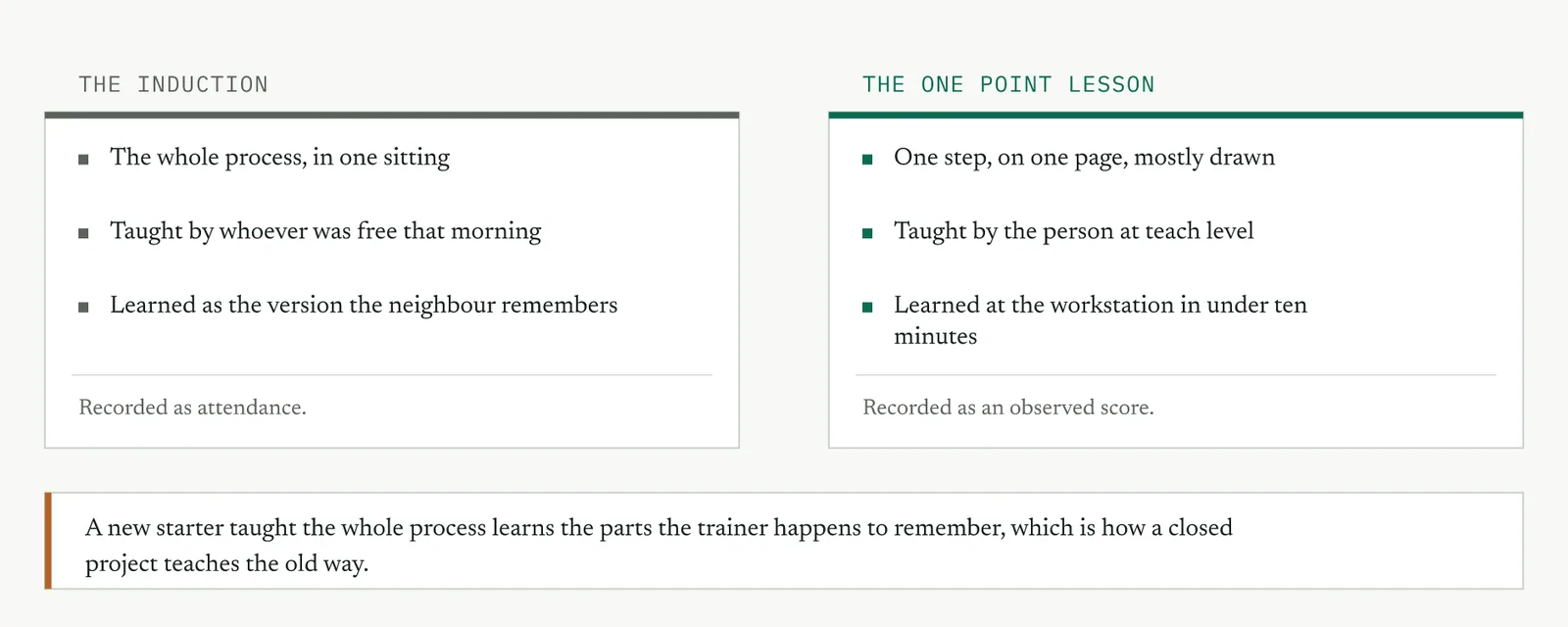
The unit matters more than the format, so settle it first. A new starter taught the whole process in one sitting learns the parts the trainer happened to remember that morning, which is what happened at Crestline three weeks after closure. Meera was trained by sitting next to somebody and learned the process the project had just changed. Figure 16.26 puts the two units side by side.
SETUP
Bring the matrix with its gaps and required depths, the standard, and the roster. Then write down one more list, because it governs everything that follows, which is who sits at teach level on each row. No task spreads faster than teachers are created, so the plan sequences by teacher availability rather than by how urgently the cover is wanted. Written the other way round, the dates start slipping in week two.
Decide the confirmation method before writing a single line. Confirmation is watching the work against the standard, and the person watching is never the person who taught it. A trainer confirming their own teaching is the same defect the RACI removed, and it fails in the same way.
RUNNING IT
Six steps. Figure 16.27 shows the flow.
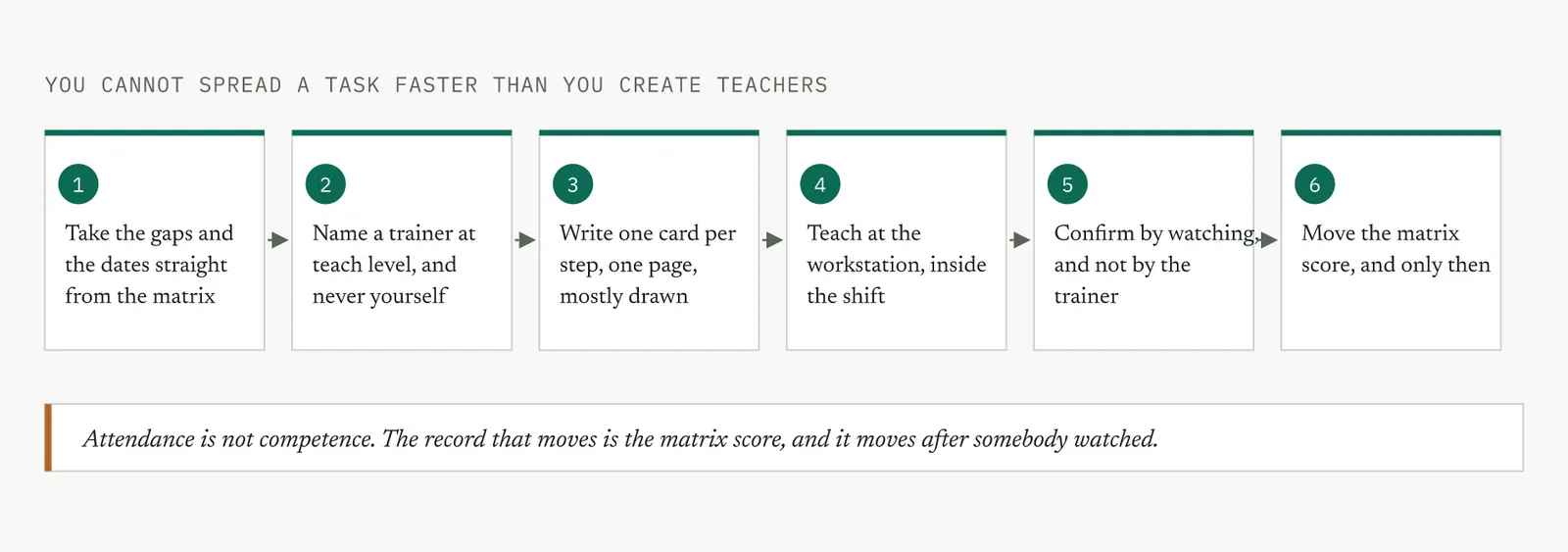
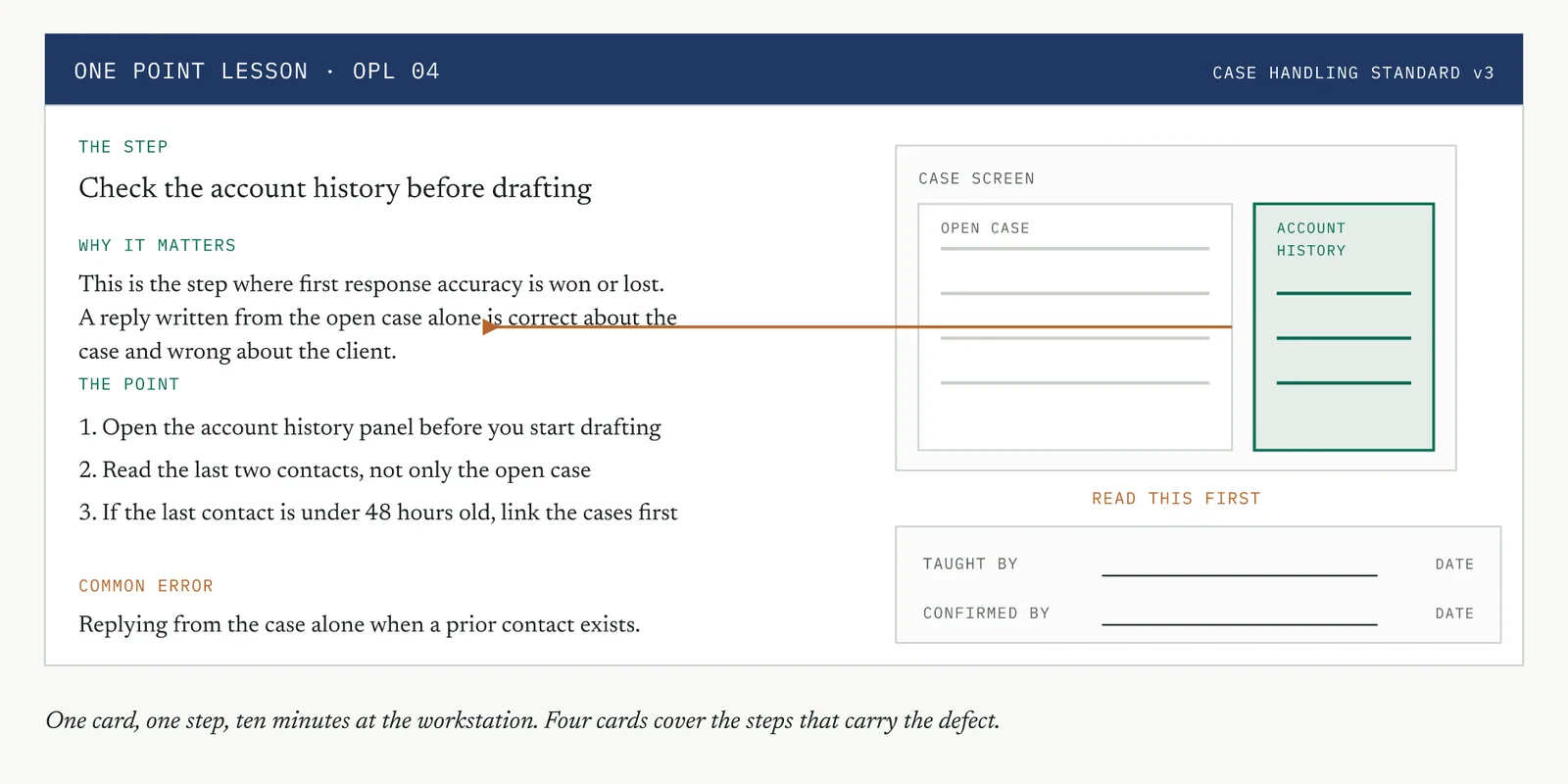
Write one card per step, on one page, and draw most of it, because a card somebody has to read is a card they paraphrase and the paraphrase is where the standard drifts. Hold each card to four things. The step, why it matters, three points, and the common error. Teach it at the workstation during the shift, in under ten minutes. Then send somebody who is not the trainer to watch the work, and move the matrix score after that rather than before.
CRESTLINE, WORKED
Five lines closed the gaps that mattered. Read the sequencing in them rather than the content. Template 16.7 is the plan.
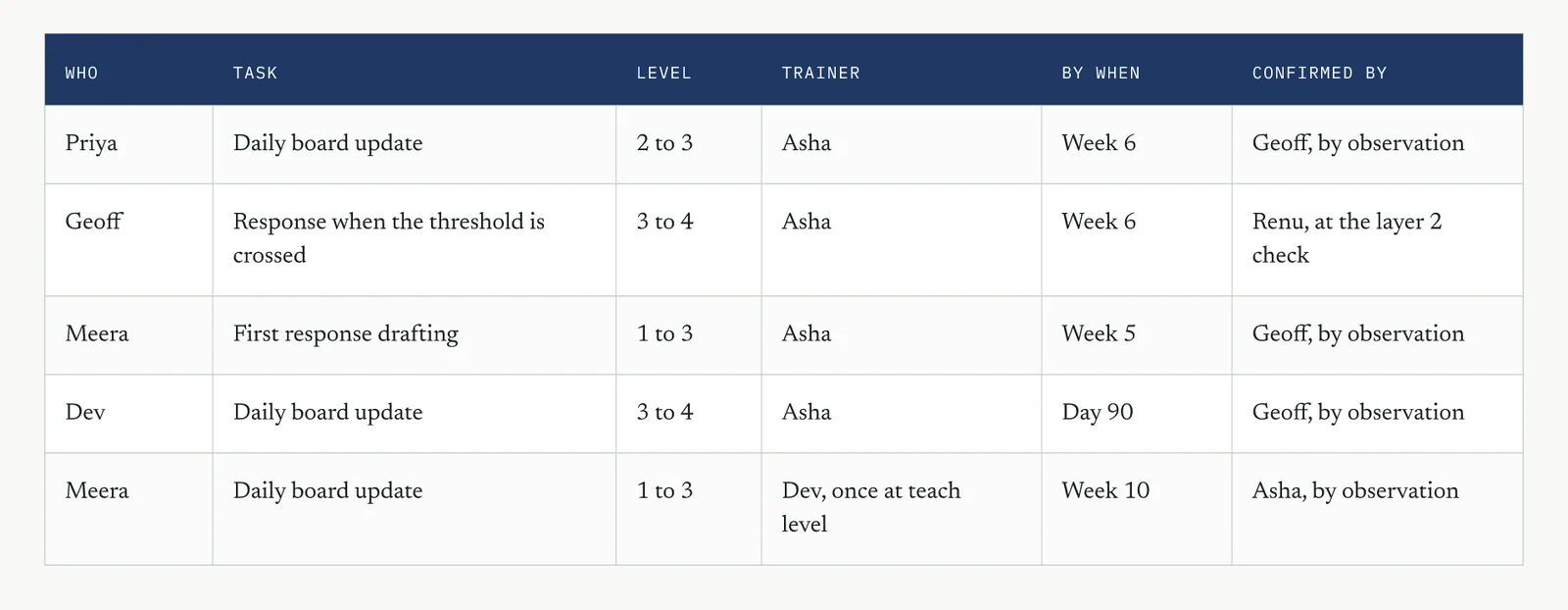
Asha is the trainer on four of the five lines, which looks like the concentration the matrix already flagged and was the only lawful arrangement at the start, since she was the only person at teach level on those rows. The fifth line is the one worth copying. Dev trains Meera on the daily update at week ten, once he has reached teach level himself. That line moves the teaching out of Asha rather than moving the task, and it is dated later than it needs to be for that reason. Put the equivalent line in early on your own plan and defend the date.
The second line is the one most belts work around. Asha teaches Geoff, her own manager, to run the response. Say it out loud in the room rather than arranging it quietly, and have the sponsor confirm it at the layer two check so it reads as a normal event. The alternative was to train another handler on the response, which produces somebody who can perform an action they cannot authorise. That choice comes up on most projects, and the awkward version is the correct one.
Asha wrote four cards, covering the steps that carry the defect, and each took her about twenty minutes. Template 16.8 is the one that does the most work.
READING THE OUTPUT
Look for the belt in the trainer column. A plan with your name in it is a demonstration rather than a transfer, because teaching it yourself proves only that the task can be taught by somebody who already knows it.
Compare the confirmer column against the trainer column. The same name in both is an unverified line, and it will be reported as complete having moved nothing.
Check the dates for clustering. Half the plan landing in one fortnight means it was written to the belt visit rather than to the roster, and the second half will slip into the following month.
Score the matrix again afterwards. The count of one deep rows should fall. A completed plan that leaves the count unchanged means signatures were given where observations were asked for.
MATCHING IT TO THE GROUND
On the blank page there is no training route at all, so build the cards before the plan. The cards are the route, and they are the first thing the firm will own that lets one person teach another against something written. Write two of them as the pattern, then hand the rest to the team lead and correct only what is wrong rather than what is put differently from how you would put it. A card set the team wrote gets maintained, and one you wrote gets archived.
On the firefight training is the first thing cancelled, so nothing here can take anybody off the floor. Ten minutes at the workstation, one card, one person, inside the shift. Booking a room is the signal to stop, because a scheduled session is the thing the next bad week deletes, and the bad week is when a new starter learns what the firm really does.
On the false start somebody will produce a training record, usually an attendance sheet against a deck, proving everybody was trained. Do not argue with it. Say that the record here is the matrix score and the observation that moved it, then let the team watch one confirmation happen at the workstation. That single event buys more than the whole plan, because the people who stopped believing need to see the difference rather than hear about it.
On the quiet achiever somebody will say the training problem is already solved, and they are usually right about today. Ask them for four cards. They will resist, because the content is obvious to them, and what is obvious to them is precisely what walks out when they are promoted. Write the first card sitting beside them in their own words, and the other three normally follow without a further conversation.
WHAT IT FEEDS
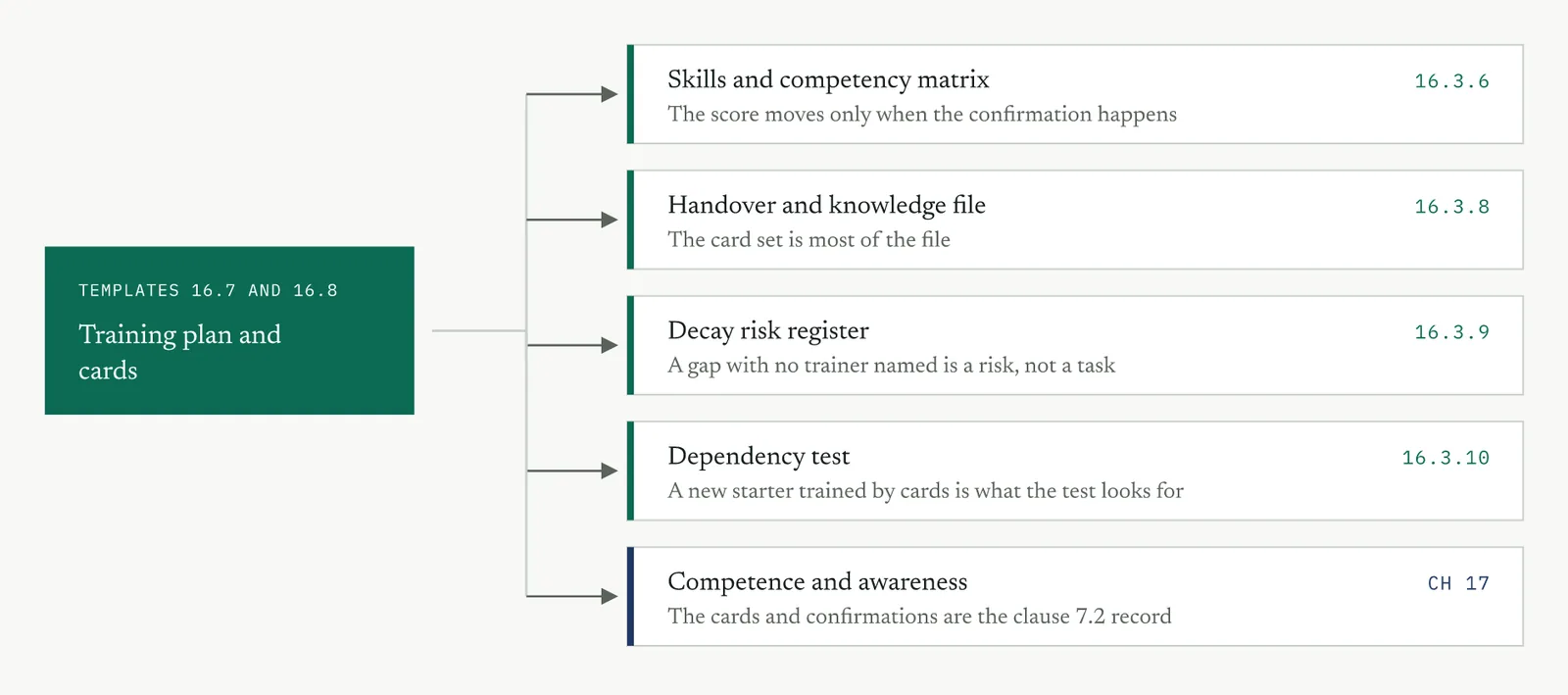
This work closes the loop back into the matrix and opens the gate on the withdrawal. Figure 16.28 shows where each part of it goes.
TIPS AND TRAPS
The belt in the trainer column. It is faster and better taught, and it transfers nothing. Put the person at teach level in front and stand at the back.
The card that is all words. It gets read once and paraphrased for the next person, and the standard drifts one paraphrase at a time.
The plan batched into the site visit. This plan has to outlast your presence, so do not compress it to fit inside it.
Attendance offered as evidence. A signature on a sheet records that somebody was in the room, so ask instead who watched them do the work, and when.
| TIP Take your own name out of the trainer column. The point of this tool is not that the task gets taught while you are there. It is that they can teach it again after you have gone. |
16.3.8 Handover pack and knowledge file · TEMPLATE
WHAT IT IS
One index page answering a single question. If the owner leaves tomorrow, what does the next person need in the first hour, the first day, and the first month. Scoped by time to need rather than by category, it runs to one page instead of forty. Figure 16.29 shows the two scopings side by side.
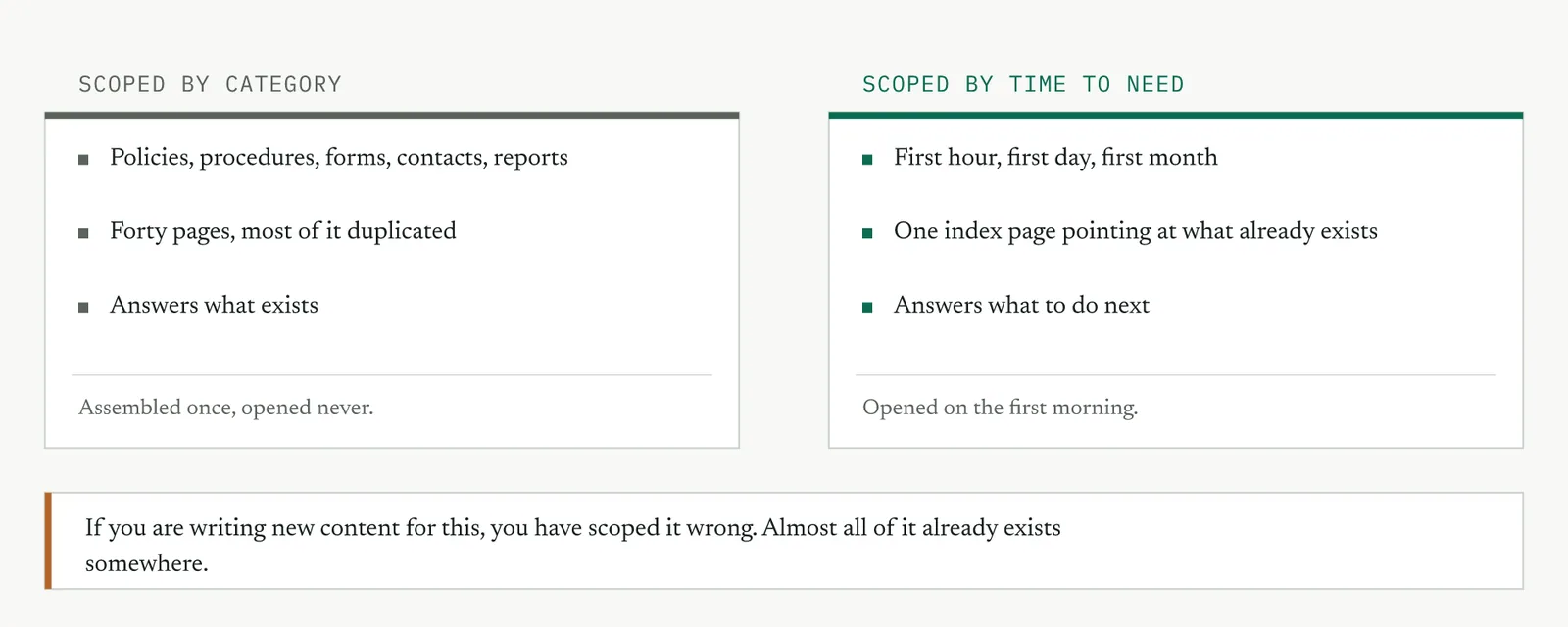
Most of the content already exists, because the agreement, the grid, the plan, the routine sheet, the cards and the matrix are all written. What this tool produces is a set of pointers with locations against them. New content appearing here is the signal to stop and check the scope, since it means something is being duplicated or a tool was skipped earlier in the chapter.
One exception carries the value of the whole document. Nobody has written down what the current owner knows from doing the job, so capture five of those and leave the rest.
SETUP
Bring everything the chapter has produced so far, with its actual location rather than its name. Not the sustainment plan, but the sustainment plan on the wall beside the board and in the shared folder under a stated path. A pointer without a location is a memory test, and the person using this index has never run the process.
Then take twenty minutes with whoever currently holds the process and ask one question. What do people ask you that is not written down anywhere. Write the answers in their words, because that list is the only original content in the document and the reason the document exists.
RUNNING IT
Six steps. Figure 16.30 shows the flow, and give step four most of your time.
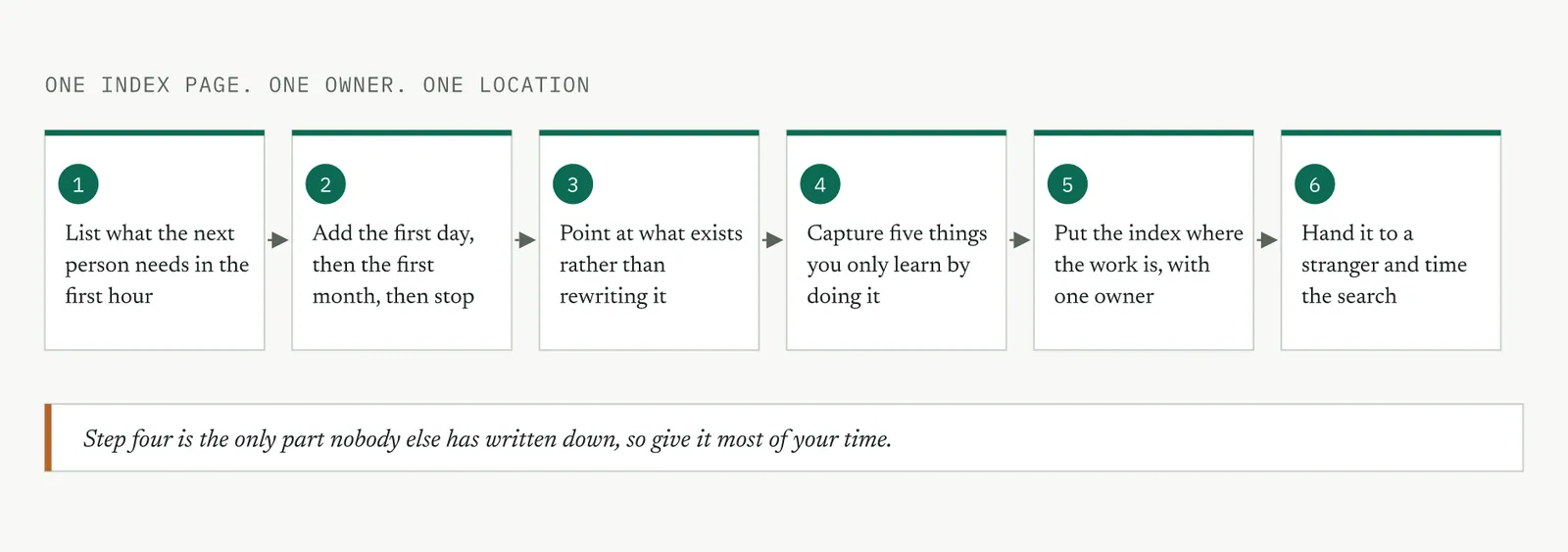
Work forwards through time rather than through the filing system. First hour is the metric, the threshold, what to do when it breaches, and who to tell. First day is how the routine runs and who covers what. First month is what forces a reread and who can teach each task. Then stop, because anything beyond the first month belongs in the folder rather than on the index.
Give it one owner and one location, and put that location where the work is, because an index in the project folder disappears when your access does.
CRESTLINE, WORKED
Crestline ran this one light. One process, one team, and every document already written, so a pack would have been theatre. What it needed was a single page pinned beside the board with the folder path on it. Template 16.9 is that page.
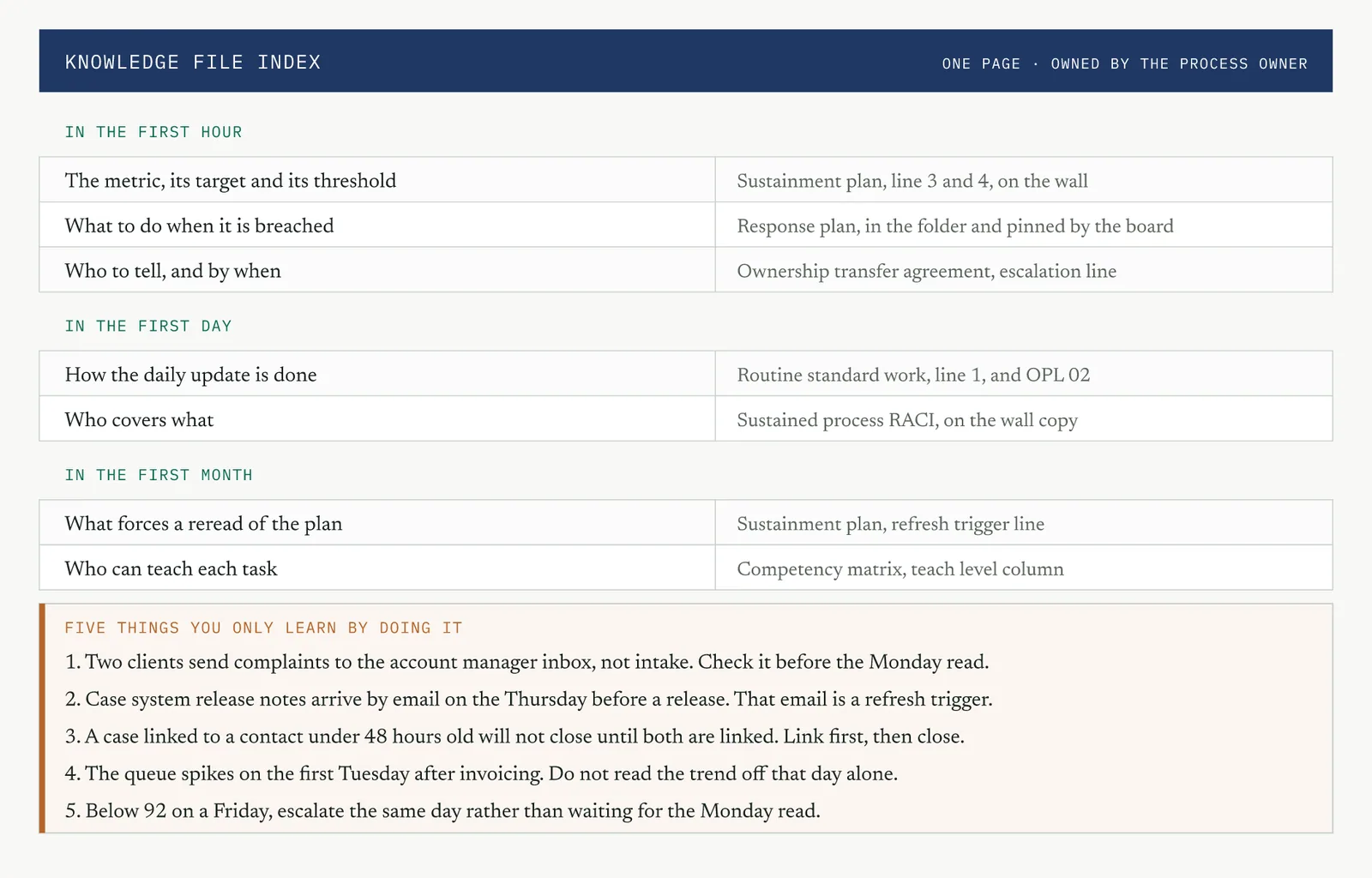
Asha dictated the five in about ten minutes, once the question was put to her properly. Asking what people ask her produced a useful list, whereas asking her to document her knowledge would have produced an apology and a blank page. Two of the five are worth reading closely, because the same kind turns up on every project.
The release notes line turns an email nobody thought about into a refresh trigger, which catches the silent process change eight weeks before it would have arrived. The Friday line closes a gap in the response plan that nobody had noticed, because the plan says the owner responds within one working day and on a Friday that lands on Monday, three days after the breach. Neither came from the analysis. Both came from asking one person what she gets asked.
READING THE OUTPUT
Time the stranger search. Hand the index to somebody who does not run the process and ask them to find the response threshold. Over a minute means the index has failed, whatever else is on it.
Count the original content. Anything on the page that is not a pointer or one of the five is duplication, and duplication is what makes the whole thing stale inside a quarter.
Check every location. A pointer to a document name rather than to a place is not a pointer, so follow three of them yourself before handing it over.
Read the five. Pleasant generalities about the team mean the wrong question was asked, so go back and ask what people come and ask them.
MATCHING IT TO THE GROUND
On the blank page there is nowhere obvious to put this, and whatever gets chosen becomes the firm convention by default. Choose the place the team already looks rather than the place a document should live. If the standard is on the wall, the index goes on the wall beside it. Findable matters more than tidy here, because the next project copies whatever was done.
On the firefight nobody reads a page during a crisis, so write the first hour block for somebody already under pressure. Four lines, largest type on the page, with the threshold and the escalation number visible from standing distance. The rest of the index is a filing convenience, so put the effort into those four lines.
On the false start somebody produces the handover pack from last time, usually thorough, and nobody has opened it. Do not rework it. Produce the one page index beside it and let the contrast make the point. If somebody argues that the pack already covers this, hand them the pack and ask them to find the response threshold while you time it.
On the quiet achiever the capable person carries the entire file in their head and will say honestly that writing it down would take weeks. They are right about the whole of it and wrong about the part that matters. Ask for the five, take them in their own words, and leave the rest. The aim is not to replicate what they know. It is to stop the next person losing three months to things that fit on one page.
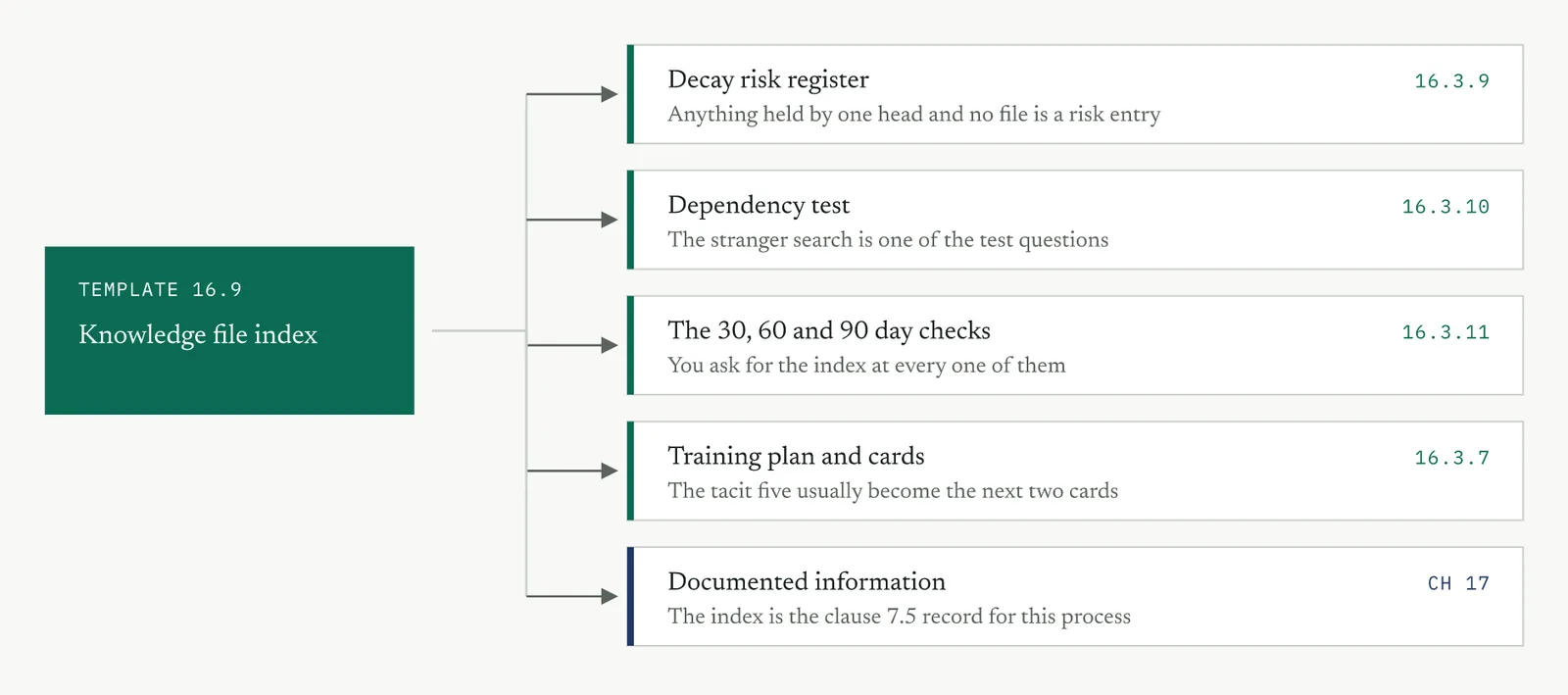
WHAT IT FEEDS
The index is what the dependency test reaches for and what the check schedule asks to see. Figure 16.31 shows the paths.
TIPS AND TRAPS
The pack that becomes a project. Somebody will offer help to make it comprehensive, and comprehensive is how this artefact dies. Decline it, because it dies quietly and everybody agrees it was a good idea.
The index in the project folder. It vanishes with your access, so put it where the work is and give it an owner who is not you.
Pointers with no place. A name is not a location, so follow three of your own pointers before handing the page over.
Five generalities. A tacit list that reads like a team charter came from the wrong question. Ask what people come and ask them, and write the answers down as they say them.
| TIP Hand the index to somebody who has never run the process and time them finding the response threshold. Under a minute and the page works. Over a minute and it does not, however complete you think it is. |
16.3.9 Decay risk register · PRACTICE
WHAT IT IS
A register of the ways the arrangement fails, rather than the ways the process fails. The process was analysed already and its failure modes sit in the control plan. This register holds what stops the owner owning it, what stops the routine running, what makes the control measure the wrong thing, and how anybody would find out.
Score two axes and no more, which are how likely it is in the next ninety days and whether anybody would see it. Rank on the second rather than the first, because a likely failure you can see is already handled by the routine you built, while an unlikely one nobody can see will still be running in March. Figure 16.32 gives the quadrants.
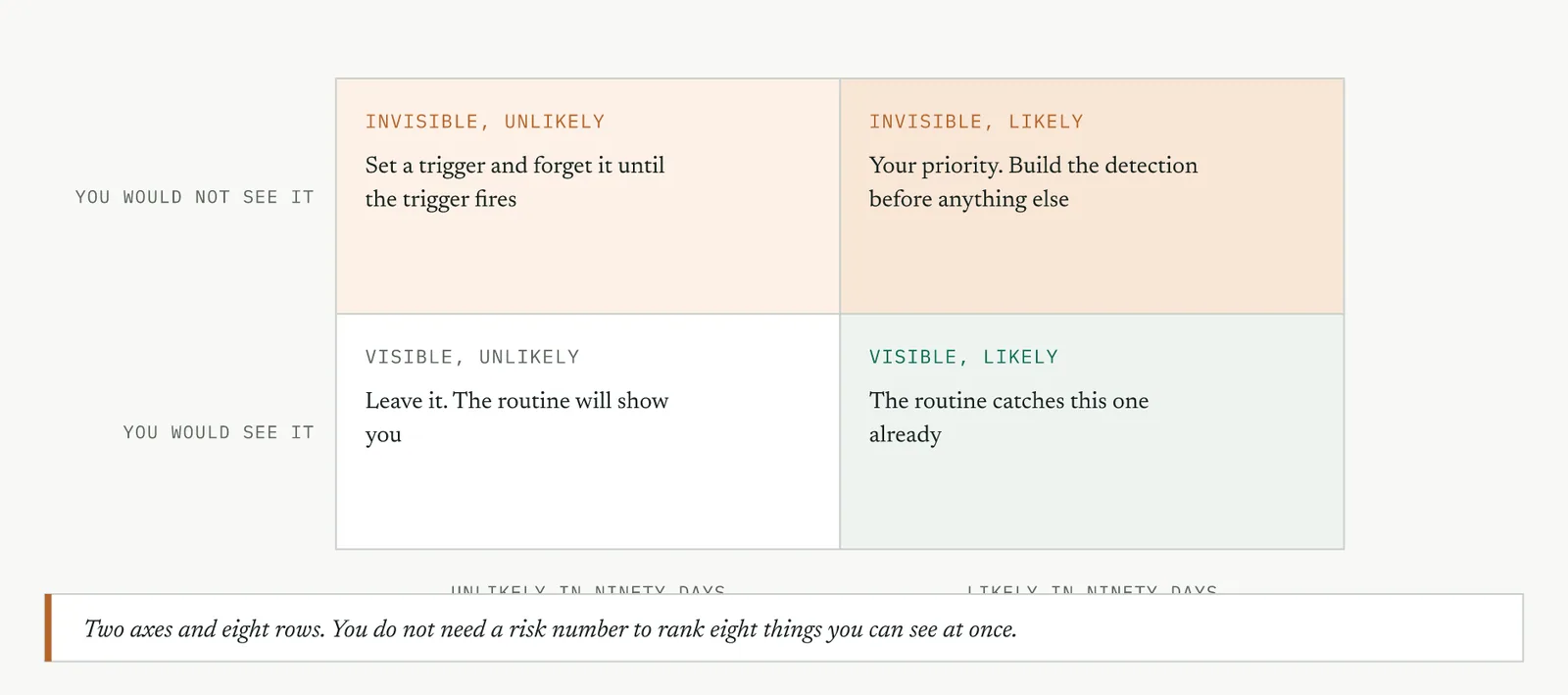
Do not build a risk number here. Eight rows fit in one head at once, so multiplying three estimates together to order them adds arithmetic rather than judgement. Keep it to eight, because past that nobody reads it at the sixty day check, and the register only works when somebody reads it.
SETUP
The content is already collected across this chapter and sitting in four places. Write each of the four decay paths as a named event on this process rather than as a category. Take every refresh trigger from the sustainment plan, since each one is a risk with a detection already attached. Take the exposures the earlier tools surfaced, which will include the one deep rows, any team carrying no letters on the grid, and any host routine with a cancellation history. Then add the row nobody writes down, which is the sponsor moving role.
Fix the horizon at ninety days before anybody scores anything, because without it everybody scores against a different time frame and the register sorts itself into an argument.
RUNNING IT
Six steps. Figure 16.33 shows the flow.
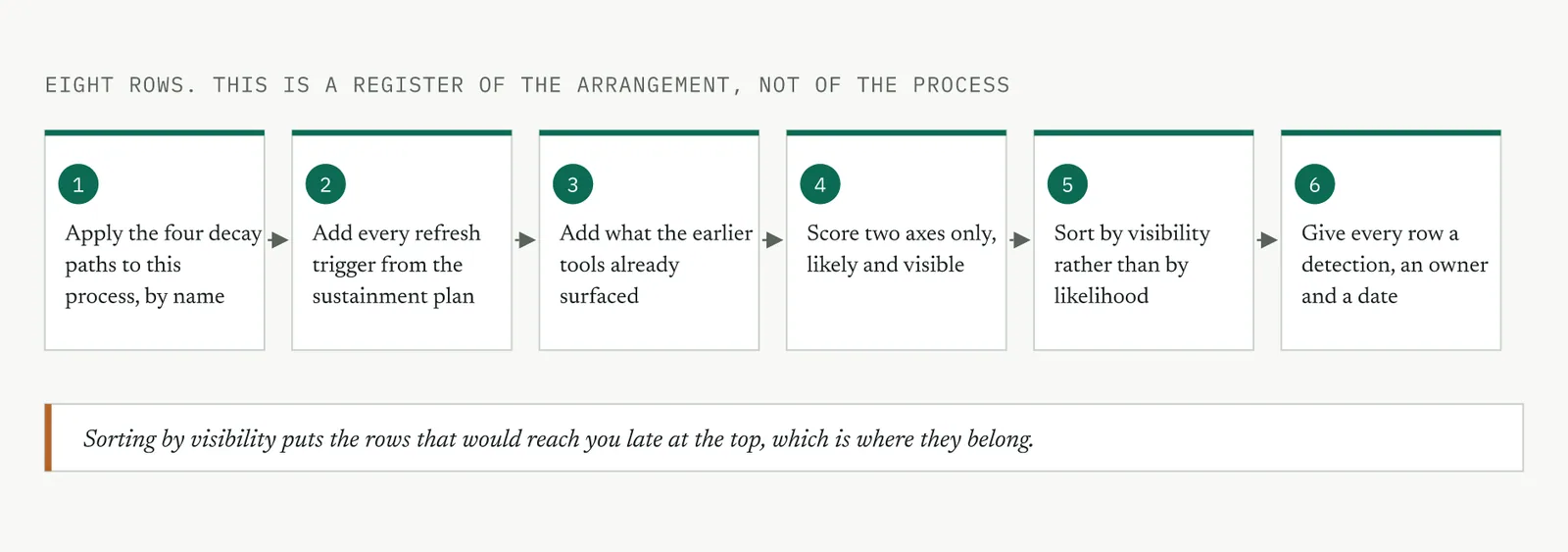
Write a detection line for every row and make it something that already happens, because a detection you have to build is a second control and that is where the chapter started. Most detections will be a line on the routine sheet, a column in the matrix, or a question at one of the layered checks. The register creates no surveillance of its own. It tells you which existing check would catch which failure, and which failures nothing currently catches.
A row with no detection against it is the register earning its keep, since that row is the reason for building it at all. Fix it before you leave rather than noting it in the file.
CRESTLINE, WORKED
Eight rows, sorted with the invisible ones at the top. Template 16.10 is the register as it was written at day sixty.
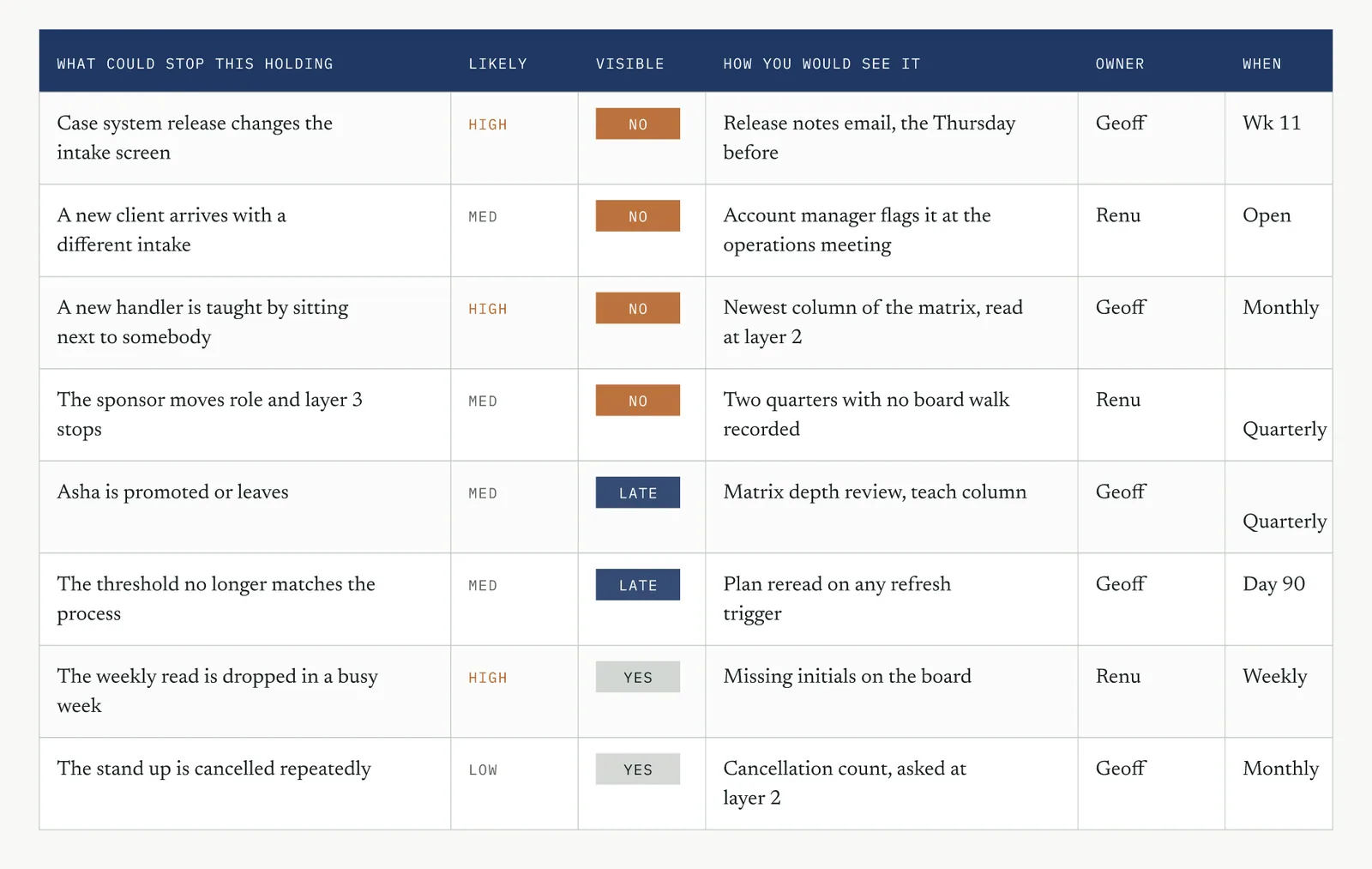
Read the top four rows first, because they carry the whole argument. None of them would reach the metric before the damage was done, and none appeared in the project risk log during Define. They are failures of the arrangement rather than of the process.
The release row carries a date, which is the most useful thing on the page. The release lands in week eleven, the detection is an email that already arrives on the Thursday before, and Geoff owns it. That converts the silent process change from a category to worry about into a Thursday with a name against it.
The sponsor row is the awkward one and it goes in anyway. If Renu moves, layer three stops and nothing else in the arrangement notices for two quarters. Naming it in front of her took ten seconds and produced the detection, which is that a quarter with no board walk recorded gets raised by the owner. Write that row on your own projects, because sponsors move more often than owners do.
READING THE OUTPUT
Read the top of the sorted list. Everything visible at the top means it was sorted by likelihood out of habit. Sort again, and expect the top rows to be the ones nobody has been worrying about.
Look for rows with no detection. Those are not risks being carried, they are risks nobody would ever find out about, so fix them before you leave rather than logging them.
Check the detections against what exists. A detection needing a new report, a new meeting or a new form is a second control, so push it back onto the routine sheet or the layered check instead.
Count the owners. A row carrying your name expires when your involvement does, so every row belongs to the owner or the sponsor.
MATCHING IT TO THE GROUND
On the blank page the word risk gets heard as a governance exercise, and somebody will offer the corporate template with likelihood and consequence scales on it. Decline it and keep the two axes. Write the rows in plain language about people and events, so the register reads as a list of things that might happen here rather than as a compliance artefact. This is also the first risk thinking the firm has done on a process, so keep it short enough to be copied.
On the firefight everything scores likely and everybody knows it, so the likelihood axis tells you nothing. Run it on the visibility axis alone. Four rows, all of them the ones nobody would see, each with a detection attached to a routine that survives a bad week. Anything visible in a firefight is already being noticed, because noticing is the one thing that ground does well.
On the false start there is a risk log somewhere from the last attempt, carrying the same risks and none of them owned. Do not merge into it. Keep the register to the arrangement just built, put the owner names on it, and take it to the sixty day check. The difference the team needs to see is that this list gets read out loud by somebody who then does something.
On the quiet achiever most of the rows are the same row, which is that the capable person leaves and everything they hold leaves with them. Write it once, honestly, then split it into the specific tasks that would stop, because a single row saying Asha might leave produces sympathy and no action. Four rows naming four stopped tasks produce four training lines.
WHAT IT FEEDS
The register sets the agenda for the remaining checks and the shape of the withdrawal. Figure 16.34 shows the paths.
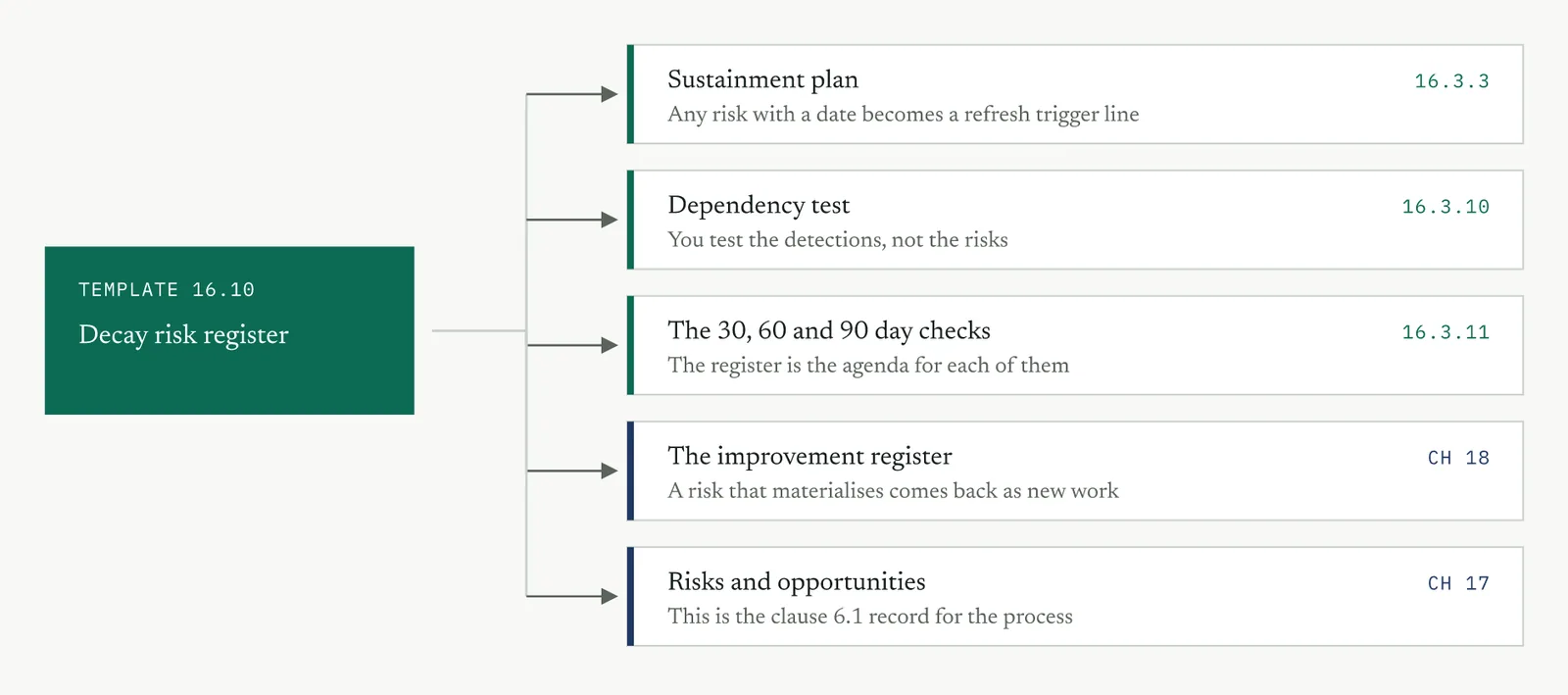
TIPS AND TRAPS
The process FMEA in disguise. Rows about defects rather than about the arrangement rebuild something Analyse already gave you, and leave the actual exposure unwritten.
The risk number. Three estimates multiplied together will order eight rows for you and hide the judgement that should have ordered them.
Detections that do not exist yet. Each one needs somebody to build and maintain it, which is the problem being solved rather than the solution to it.
The twenty row register. It gets read once, at the meeting where it was written, whereas eight rows get read at every check for a year.
| TIP Sort by whether anybody would see it rather than by how likely it is. The routine already catches the visible failures, and the ones that take a gain back quietly are the ones nothing currently looks at. |
16.3.10 Staged withdrawal and the dependency test · PRACTICE
WHAT IT IS
Your exit runs as four stages, each ending on a condition rather than a date, with one test at the end. You reach for it on every project, because a handover you have not tested is a handover you are hoping about. Figure 16.35 sets out the stages.
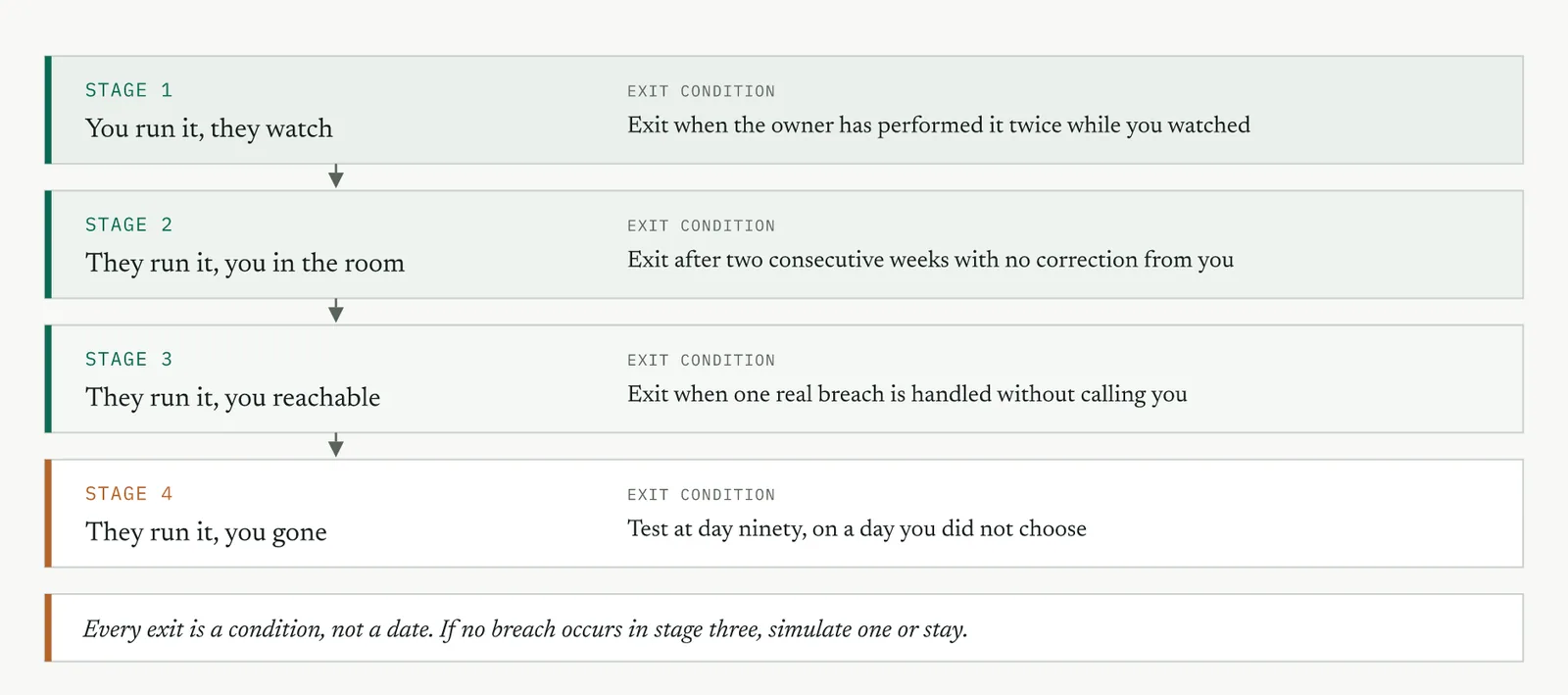
Most belts stall at stage three, because its exit needs a real breach handled without you and ninety quiet days will not produce one. The choice at that point is to simulate a breach with the sponsor briefed and the owner not, or to stay in stage three until one arrives. Exiting because nothing went wrong is the mistake, since a quiet quarter makes every arrangement look sound.
The test itself is not an audit of the process. It checks whether the lines still run on a day nobody expects you, which is why the metric is no help here. It read green at Crestline in week six while every line beneath it had stopped.
SETUP
The routine sheet, the risk register, the knowledge index and the layered check schedule are the test script between them, so all four have to exist before the test means anything. If one is missing, go back two tools and finish it rather than testing around the gap.
Agree the test with the sponsor rather than the owner. The owner needs to know it exists but not when it lands, so say it plainly in week one and set the expectation that the belt returns once, unannounced, inside a stated fortnight. Nobody argues with that in week one, and everybody argues with it in week twelve.
RUNNING IT
Six steps. Figure 16.36 shows the flow.
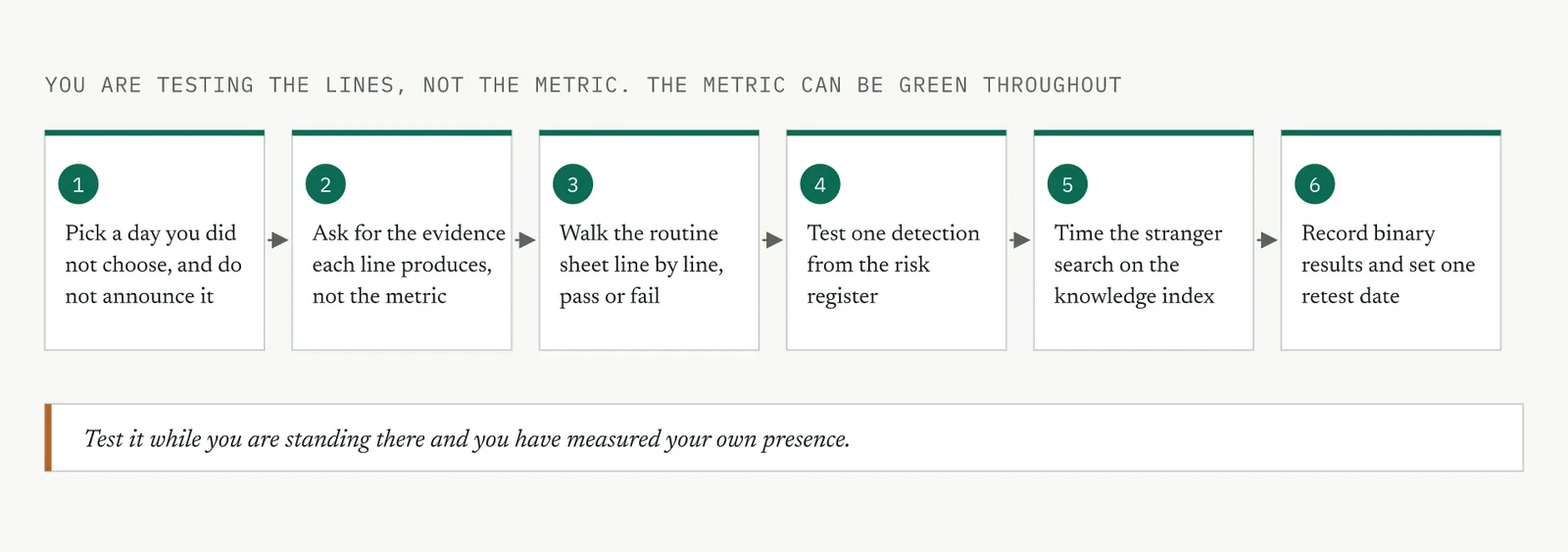
Ask for evidence rather than answers, which means initials on the board for the last ten days, the signed weekly lines, the response log entry against a named breach, and the version number on the wall copy. Score each line pass or fail and resist averaging them, because a partial pass is a fail with a date on it. A line that runs most weeks stops in the week it matters.
Test one detection from the register while you are there, since a detection nobody has ever used is an assumption rather than a control. Ask where the release notes email lands, who reads it, and to see the last one. Finish by timing somebody who does not run the process against the knowledge index.
CRESTLINE, WORKED
The test ran at day ninety, unannounced, on a Tuesday. Eight things were tested and one failed clearly, and the failure is the part worth reading. Template 16.11 is the record as it was written that morning.
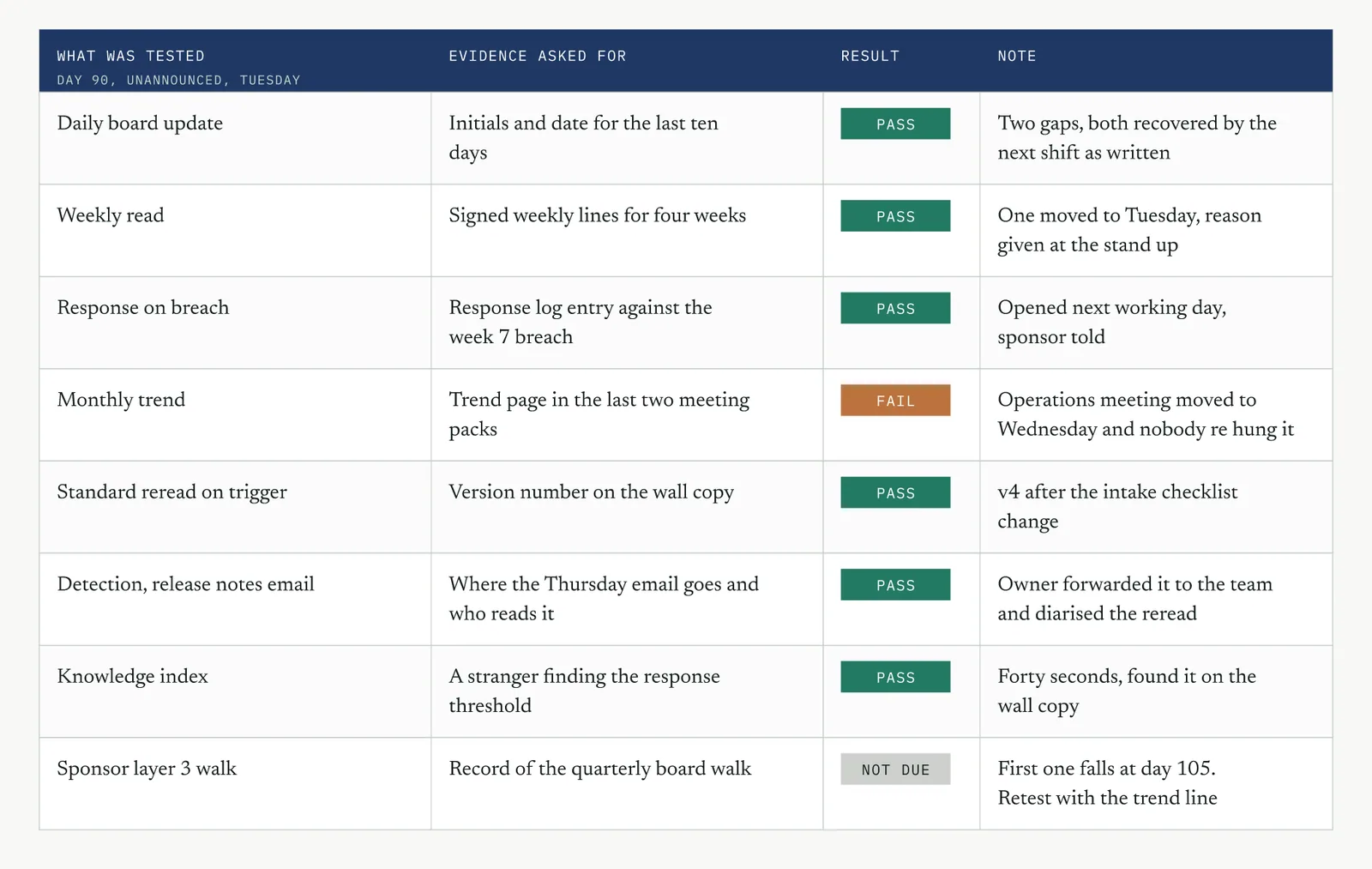
The monthly trend failed because the operations meeting moved from Monday to Wednesday, everybody moved with it, and nobody re hung the trend line on the new slot. The host survived. The attachment did not. That single mechanism takes down more sustained gains than anything else in this chapter, because you attached your tasks to routines and a routine that changes shape drops what was hanging on it.
The failure produced two things rather than an argument. A retest at day one hundred and twenty on that line alone, and a new register row saying that any change to the operations meeting triggers a reread of the routine sheet. Write that row on your own projects before the meeting moves, because it will move.
The sponsor walk is marked not due rather than passed, since the first quarterly walk fell at day one hundred and five and there was nothing yet to look at. Record that honestly and carry it into the retest. Mark an untested line as a pass and the test becomes a formality, which is the one thing it cannot afford to be.
READING THE OUTPUT
Read the failures rather than the ratio. Seven of eight is not eighty eight per cent sustained. It is one broken line, and the arrangement is only as strong as the line carrying the response.
Ask what the failures share. One failure is a fix. Two failures with the same cause is a design fault, usually a host that moved or a person who left, so change the design rather than the line.
Check who produced the evidence. The owner should be able to hand over each item without leaving the room. If everything came from somebody else, the record belongs to the owner and the practice does not.
Count what you had to explain. Mark every line where you reminded somebody what it was for, because those are the lines that will be gone at six months whatever they scored today.
Set one retest, at thirty days, on the failed lines only. A line that fails twice ends the retesting, because at that point the arrangement is wrong rather than the effort, and the fix belongs back in the routine sheet or the agreement.
MATCHING IT TO THE GROUND
On the blank page an unannounced visit reads as an inspection unless it is framed in week one, so say plainly that the test is of the arrangement rather than of the people. On the day, walk to the board before you walk to an office, and start with a line you expect to pass. What they watch the belt do the first time sets what this test means in the firm for years afterwards.
On the firefight two or three failures is the normal result and not a bad one. What matters is which lines survived, because lines hung on the routine with the best cancellation record surviving tells you the selection method worked and gives you the argument for moving the rest. Fix the attachment rather than the discipline.
On the false start this test is the repair. The team watched a project close before and nothing followed, so somebody returning on day ninety and asking for evidence is the difference they have been waiting to see. Run it at the board where they can watch, and give the result out loud including the failure. One announced failure with a retest date buys more credibility here than eight passes reported quietly to the sponsor.
On the quiet achiever the test will pass, so the question is whether it passed on one person. Check who produced each piece of evidence, then check the roster for the week of the visit. If the capable person was in all five days, book the retest for a week they are on leave, because that is the only version of this test that tells you anything on this ground.
WHAT IT FEEDS
This record closes your involvement, and the tollgate asks for it later. Figure 16.37 shows the paths.
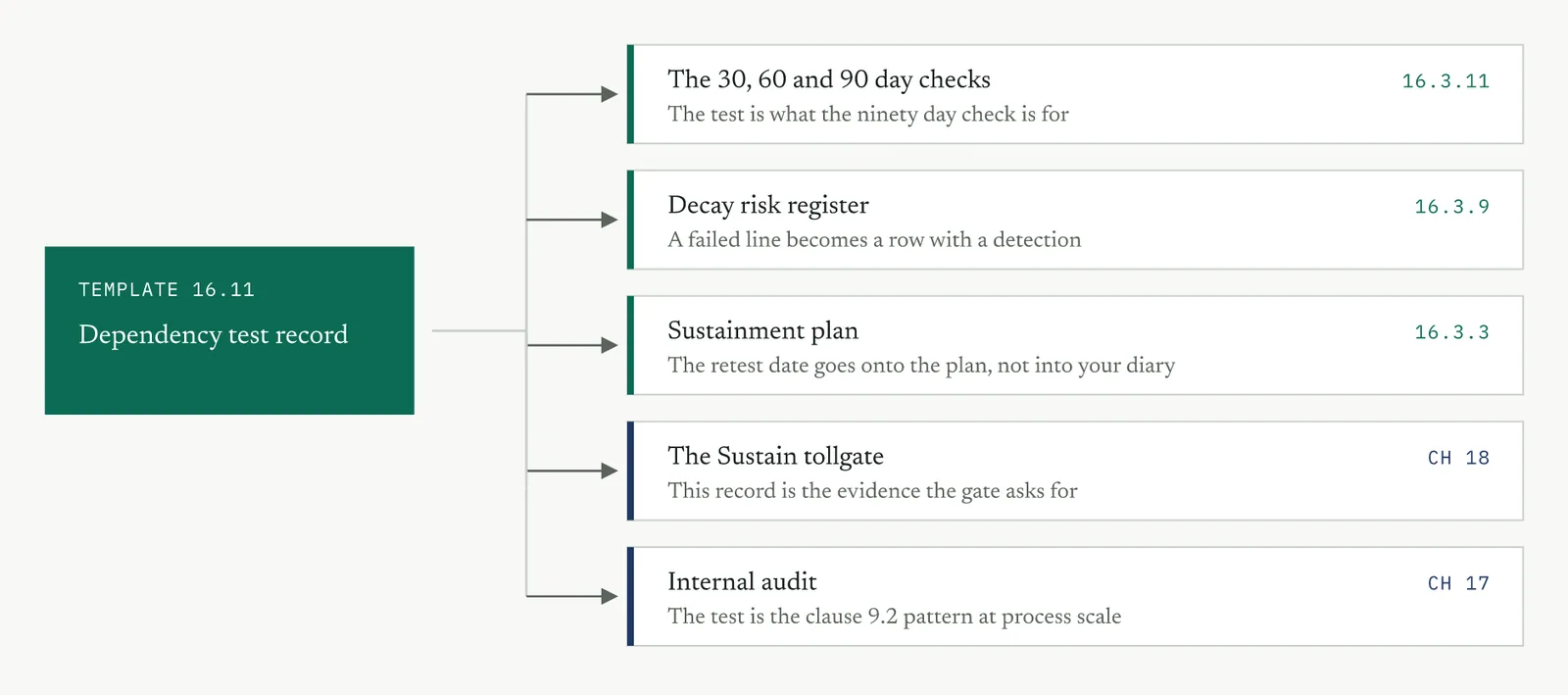
TIPS AND TRAPS
The announced test. Give them the date and the result measures their preparation. Everything will be signed, and none of it tells you what an ordinary week looks like.
The test you join in. A leading question or a correction at the board puts the belt back inside the process. Watch, ask for evidence, and write.
The averaged result. A percentage hides the one line that matters, so score each line binary and let the failures stand on their own.
The endless retest. One retest at thirty days is enough, because after two failures the design is wrong and a third test is a way of not saying so.
| TIP Do not run this while you are still in the building every week. You are measuring the arrangement without you in it, so if you turn up often enough to be part of the week, you are measuring yourself. |
16.3.11 The thirty, sixty and ninety day check schedule · PRACTICE
WHAT IT IS
Three visits, each with a different object, set as dates before the sponsor signs the closure. The thirty day check asks whether the arrangement started at all. The sixty day check asks whether it survived a normal month. The ninety day check is the dependency test from 16.3.10, run in full and unannounced. Figure 16.38 sets the three against each other.
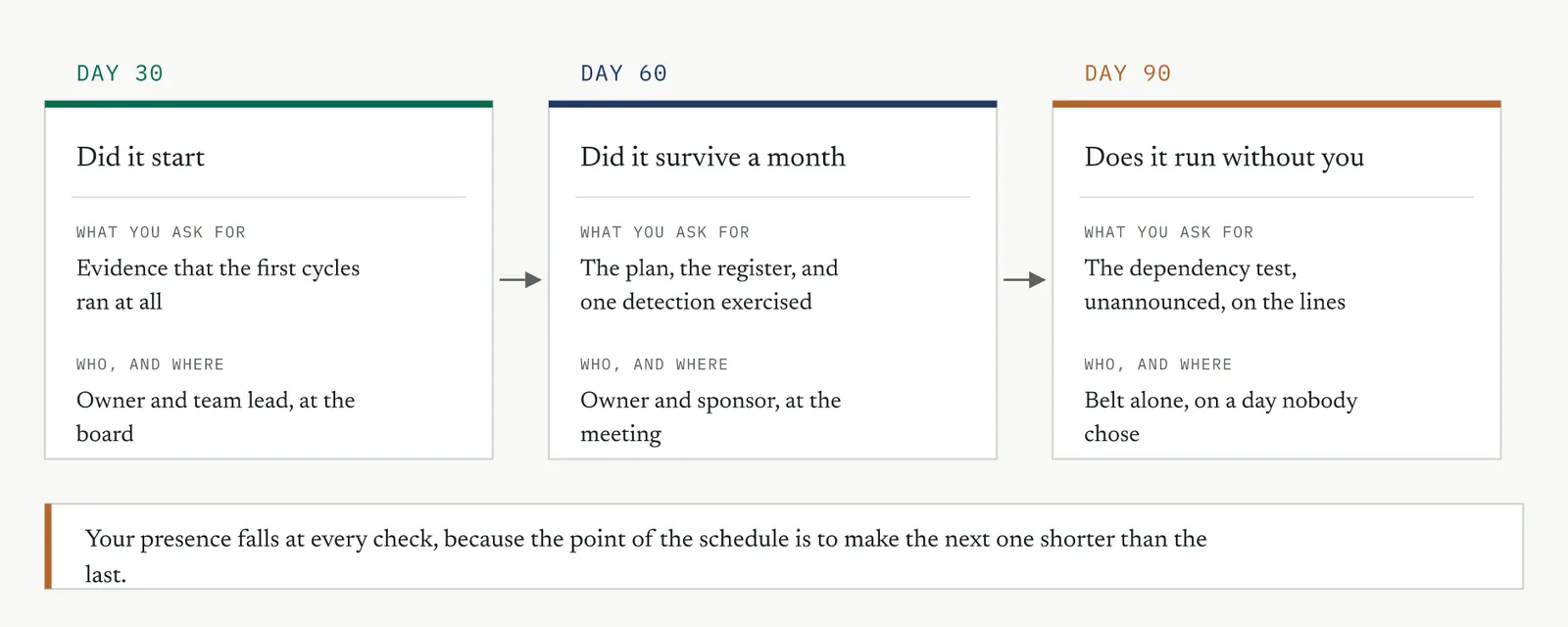
The schedule matters more than any individual check, because a single follow up visit is a courtesy and three dated ones are a condition of the close. It also gives the owner something the agreement cannot, which is a horizon. A task that will be looked at twice more in the next two months is a task that gets done in week three.
SETUP
Set all three dates before the closure signature, and put them on the sustainment plan rather than in your own diary. Dates in your diary belong to you, so they move when your next project starts. Dates on the plan belong to the arrangement, and the owner can see them coming.
Decide who attends each one at the same time. Thirty is the owner and the team lead, at the board, because the object is the daily practice. Sixty is the owner and the sponsor, at the meeting, because the object has moved up to the plan and the register. Ninety is you alone, on a day nobody chose, because the object is what happens when nobody is expecting you.
RUNNING IT
Six steps. Figure 16.39 shows the flow, and the third one keeps the whole schedule honest.
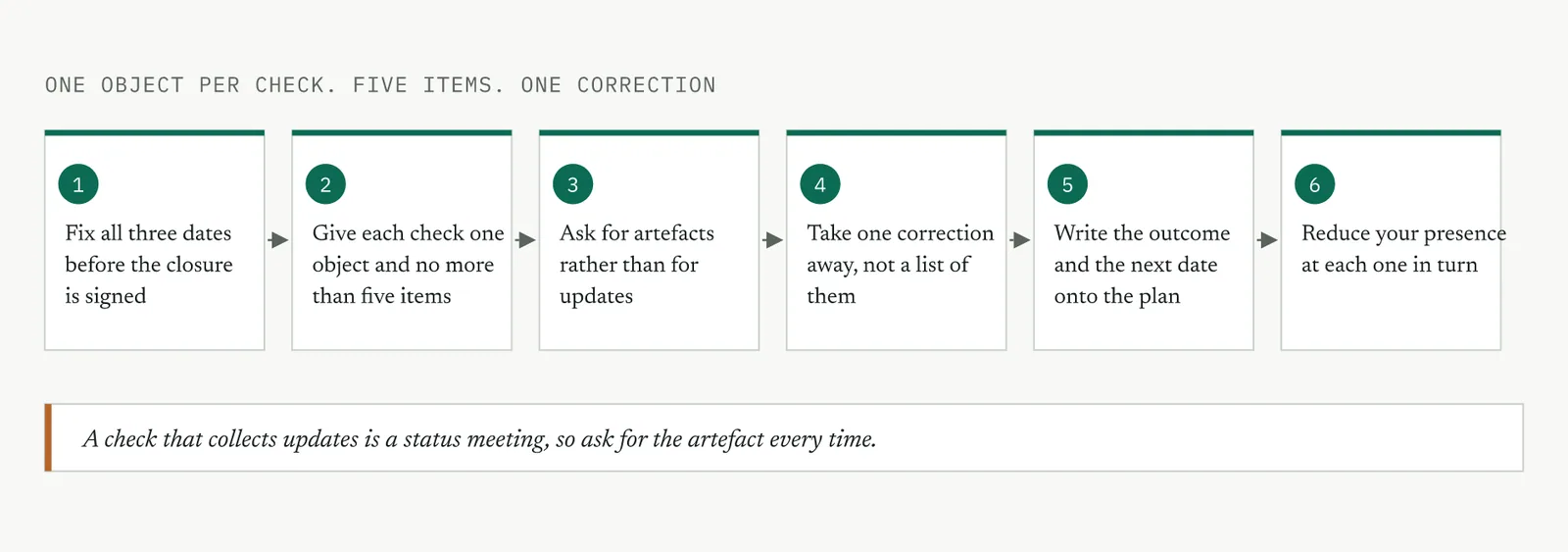
Ask for artefacts rather than updates, because an update is a description of the arrangement and an artefact is the arrangement itself. The distinction sounds fussy until the first check, where asking how the daily update is going produces a confident answer and asking to see ten days of initials produces the truth.
Take one correction away from each check rather than a list. A list of six gets prioritised down to two by the people who have to do them, and they will not be the two you would have chosen. Name the single thing, put a date on it, and write it onto the plan before you leave the room.
CRESTLINE, WORKED
Template 16.12 is the schedule as it was written into the plan on the day of the closure. Twenty minutes for the first two checks, and the third one open ended.
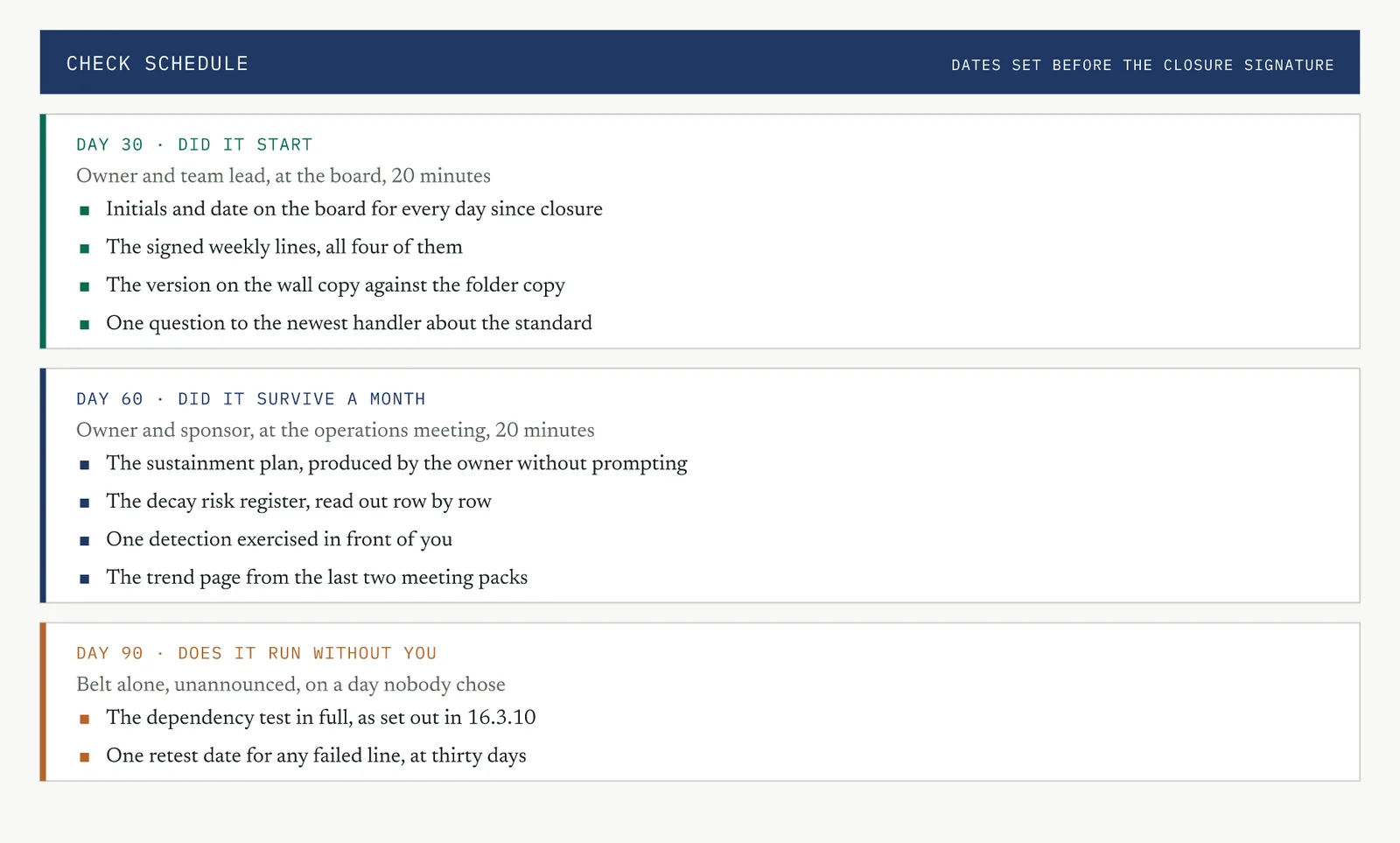
The thirty day check found the practice running and one document out of step. The response plan pinned at the board was version one, while the folder held version two after the intake checklist change. That is a small correction and it is the kind that becomes a large one, because the team works from the copy on the wall and nobody reads the folder. One correction, dated, and the check closed in fifteen minutes.
The sixty day check found the monthly trend missing from the last operations meeting, because the agenda ran out of time before it was reached. Renu moved it to the first item that morning. Read that against what happened at day ninety, where the trend failed again after the meeting moved to a Wednesday, and the pattern is clear. The trend line had a weak attachment from the start, and both checks were telling you the same thing in different ways.
READING THE OUTPUT
Compare what you were shown against what you asked for. A check where the owner produced every artefact without leaving the room is a different result from one where three of them had to be sent on afterwards.
Watch the length of each check. The sixty should be shorter than the thirty. A check that grows is a check turning into a status meeting, and it will be cancelled by the fourth month.
Look for the same line failing twice. One line missing at thirty and again at sixty is not two corrections. It is one weak attachment, and the fix belongs in the routine sheet rather than in a reminder.
Read who spoke. If the owner answered every question and the team lead said nothing, the practice may still be sitting one level below the person who holds it.
MATCHING IT TO THE GROUND
On the blank page these three visits are the firm first experience of anybody coming back after a project closed, so they set an expectation that outlives the project. Keep them short and keep them at the board. If the thirty day check runs to an hour in a meeting room, the firm learns that improvement produces meetings, and the next sponsor will price that in when you ask for a project.
On the firefight the checks get cancelled unless they are short and unless they are attached to something already in the diary. Take the thirty and the sixty inside routines that already run rather than booking them, and accept fifteen minutes at the end of a stand up. The ninety cannot be attached to anything, because it is unannounced, so tell the sponsor early that this one takes an hour of nobody time.
On the false start the schedule is the promise the team is watching. They have seen a project close and nobody return, so the thirty day check matters more here than anywhere in the chapter and it matters mostly for turning up. Turn up on the date, at the board, in front of the people. Being early is better than being thorough, because the date is the message.
On the quiet achiever the checks will be easy and slightly pointless, because the capable person has it running and will tell you so. Use them differently on this ground. Spend the thirty on the second name, the sixty on whether the second name has done anything, and the ninety on a week when the capable person is away. Anything else confirms what everybody already knew.
WHAT IT FEEDS
The three records close your involvement and become the evidence the tollgate asks for later. Figure 16.40 shows the paths.
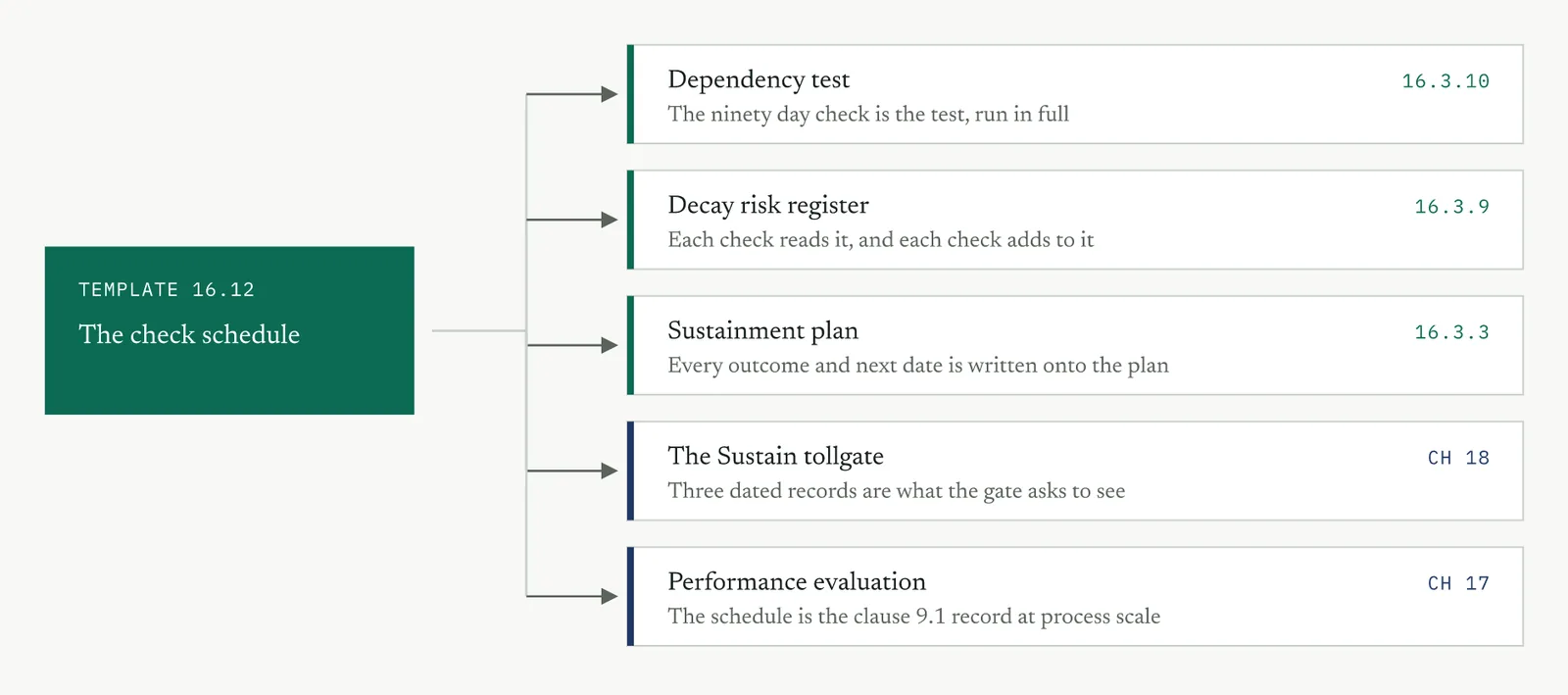
TIPS AND TRAPS
The check that becomes a status meeting. It starts when somebody offers a verbal summary and you accept it, so ask for the artefact every time even when you are confident of the answer.
The date in your diary. It moves when your next project starts. Put all three on the plan where the owner and the sponsor can see them.
The list of corrections. Six items get prioritised down to two by the people who have to do them, and the two chosen will not be yours. Take one.
The check that grows. If sixty took longer than thirty, something has been added that does not belong to the object of the check.
| TIP Ask for the artefact rather than the update. Asking how the daily check is going produces a confident answer, and asking to see ten days of initials produces the truth. |
16.4 Choosing the tools for your project
16.4.1 The rule
Four tools run on every project, whatever it is. The ownership transfer agreement, the sustainment plan, the decay risk register, and the staged withdrawal with its test. Those four close the four decay paths at their narrowest. Drop any of them and a path is left with nothing across it. The check schedule is a fifth, separable from the withdrawal only on paper.
Everything else is chosen on evidence. Sustain carries less statistical weight than any phase in the book, so the pull here is to over build rather than to over analyse. Each tool lands on somebody who already has a job. Run the ones the project needs, and write down the one reason you skipped each of the others. That short record stops the next belt rebuilding the arrangement from scratch.
16.4.2 The three readings that settle most of the choice
Three readings decide most of the kit. Figure 16.41 sets them out with the branch each one takes.
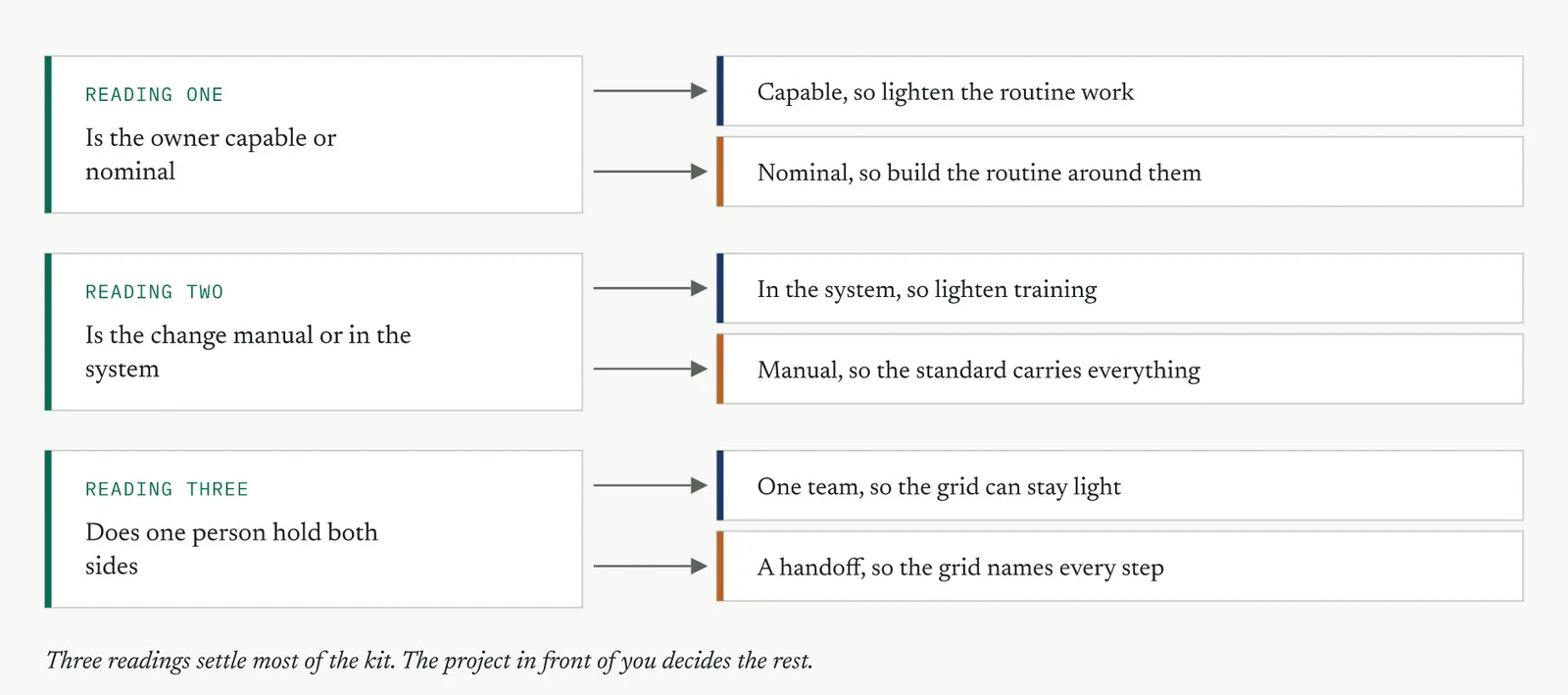
The first reading is whether the owner is capable or nominal. Take it from the agreement rather than from the appointment. An owner who named their own slot and argued about the authority line is capable, so the routine work can be lighter. An owner who accepted every line offered is nominal until proven otherwise, and the rest of the kit has to hold them up.
The second is whether the change lives in a system or in a practice. A workflow enforced by the case system carries itself. Training and standard work lighten, and the refresh trigger becomes the tool that matters. A manual change carries nothing on its own, because the standard is the only thing between the new way and the old habit.
The third is whether one person holds both sides of the work. Inside one team the grid stays light, and the agreement does most of the naming. Across a handoff the grid names every step. The response that failed at Crestline failed on exactly that boundary.
16.4.3 The four types and their kit
Most projects land in one of four types. Table 16.5 sets the eleven tools against them. Your own project will usually sit between two columns rather than inside one.
| TOOL | CAPABLE OWNER | NOMINAL OWNER | SYSTEM CHANGE | SPLIT OWNERSHIP |
|---|---|---|---|---|
| Ownership transfer agreement | RUN | RUN | RUN | RUN |
| Process owner RACI | LIGHT | RUN | LIGHT | RUN |
| Sustainment plan | RUN | RUN | RUN | RUN |
| Standard work in the rhythm | RUN | RUN | LIGHT | RUN |
| Leader standard work and layered check | LIGHT | RUN | LIGHT | RUN |
| Skills and competency matrix | RUN | RUN | LIGHT | RUN |
| Training plan and one point lessons | LIGHT | RUN | LIGHT | RUN |
| Handover pack and knowledge file | LIGHT | RUN | LIGHT | RUN |
| Decay risk register | RUN | RUN | RUN | RUN |
| Staged withdrawal and dependency test | RUN | RUN | RUN | RUN |
| The 30, 60 and 90 day check schedule | RUN | RUN | RUN | RUN |
Table 16.5 The eleven tools against the four common project types. Four rows run everywhere, and the rest are chosen on the readings.
Two columns are worth reading against each other. The nominal owner column runs almost everything, because every tool in the middle of the kit exists to hold up an owner who is not yet holding themselves up. The system change column lightens those same tools, since the workflow enforces the sequence and training only covers the exceptions. It does not lighten the register. A system that enforces the process today is the same system that changes it in a release, without telling anybody who reads the metric.
16.4.4 What to drop when there is no leader routine
On some grounds there is no routine to hang the leader check on, and no prospect of one inside your project. Do not build a governance meeting to solve it. A forum created to hold one metric needs an owner of its own, and the first busy month takes it.
Drop the layered check to a single layer, and put that layer on the sponsor rather than a middle manager. Then move the weight onto the two things that need no meeting. The visible output on the board, and the check schedule you already control. A missing initial on a wall is a leader check that runs without anybody scheduling it. Three dated visits carry the arrangement until the firm grows a routine of its own.
Write the missing layer into the register as a risk. The detection is that nobody has asked for the metric in a month. That records the gap rather than quietly accepting it, so the next belt inherits the reason as well as the arrangement.
16.4.5 The load budget
Price the kit before you finish choosing it. Add up what it costs the people carrying it, in minutes a week. Figure 16.42 shows the Crestline arrangement as it was signed.
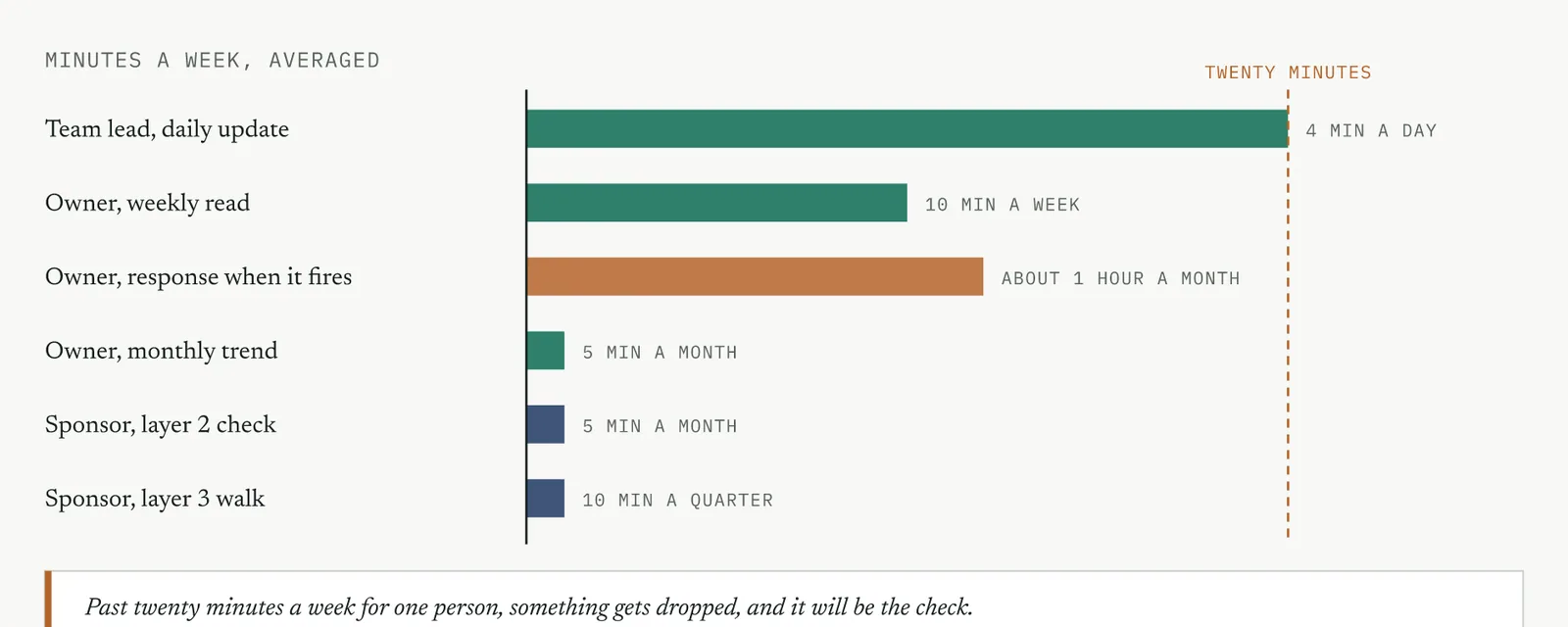
Twenty minutes a week for one person is the working ceiling. Spread the load across at least two people rather than concentrating it on the owner. Past that ceiling something gets dropped in the first busy fortnight, and it will be the check rather than the client work. The client work has somebody chasing it.
If the kit exceeds the budget, cut tools rather than frequency. A weekly read that becomes fortnightly loses half its detection power and keeps all of its overhead. Dropping the handover file costs one artefact and no weekly time. Cut the tools that produce documents before the tools that produce evidence.
| TIP Price your kit in minutes a week per person before you commit to it. An arrangement that costs the owner an hour a week is an arrangement you have designed to fail in the first busy month. |
16.5 Scenarios
Five situations that change what you run. Each one is drawn from the same Crestline arrangement, so the difference in each case is the situation rather than the process.
16.5.1 The capable owner and the nominal owner
Same process, two owners, and the kit diverges from the first meeting. Judge which one you have from the drafting session rather than from seniority. A capable owner names their own slot. They argue about the authority line, and they ask what happens if the response lands while they are on leave. A nominal owner accepts every line you offer.
With a capable owner, lighten the middle of the kit. Six rows on the grid. A monthly leader check rather than weekly. A training plan of two lines. Spend what you save on the refresh triggers and the second name, because a capable person will not do either for themselves. They are running it well today. Tomorrow is your job rather than theirs.
With a nominal owner, run everything in the middle and slow the withdrawal. Stay in stage two for four weeks rather than two. Start the leader check weekly, and let it fall to monthly once two checks in a row find nothing. Write the authority line in more detail than feels necessary. A nominal owner will not ask for authority they were not given explicitly.
16.5.2 The staff move at week eight
Asha is promoted into another team at week eight. The training plan has run for one line only. This is the decay path that arrives without notice, so what you built already is the whole answer. Figure 16.43 splits what holds from what goes.
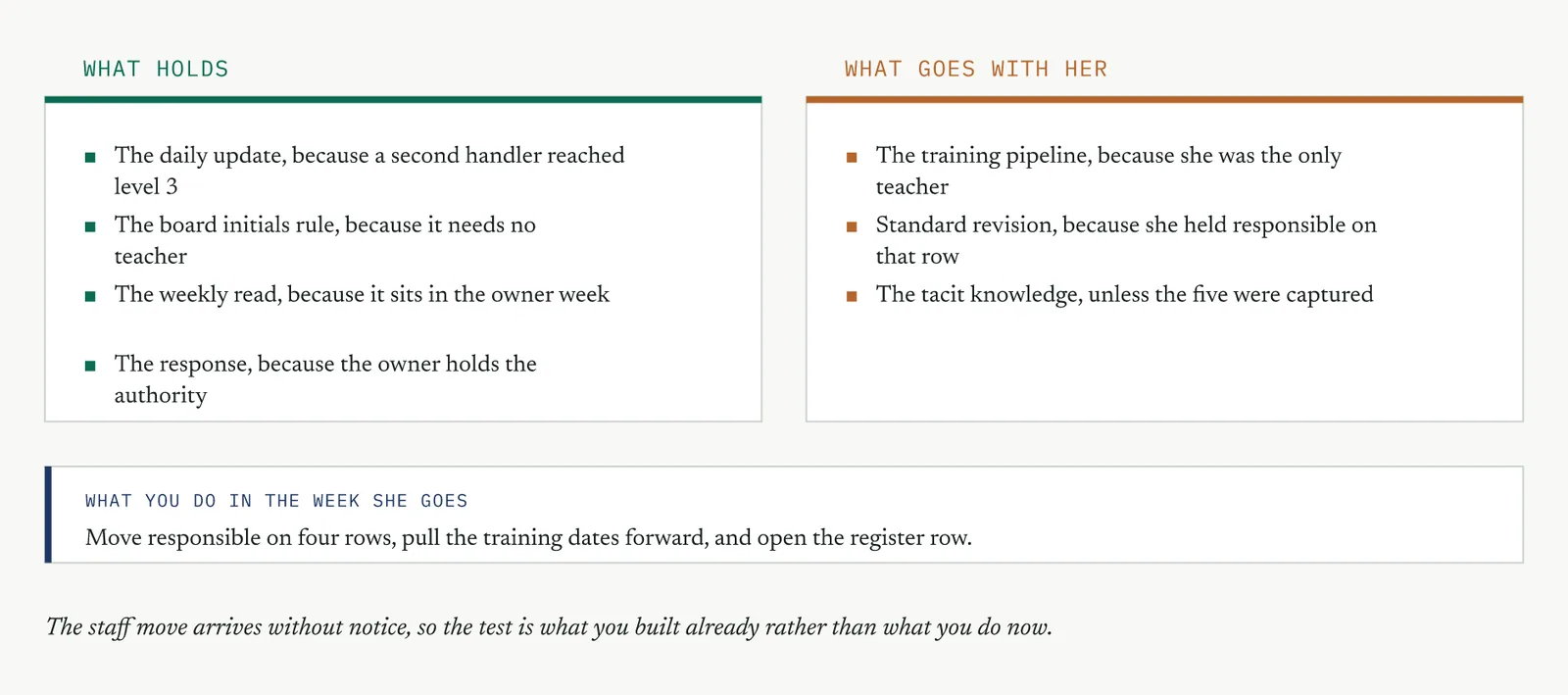
The daily update holds. Dev reached level three at week four, and the board rule needs no teacher. The weekly read and the response hold too, because they sat in the owner week and carried the authority. What goes is the teaching. She was the only person at teach level on five rows, so the pipeline stops the day she does.
Do three things in that week. Move responsible on the four rows she held, using the grid rather than a conversation. Pull the remaining training dates forward, and accept that the next teacher will be less good. Then open the register row. A risk that materialises goes back to the improvement register as new work, rather than being absorbed quietly by whoever is left.
16.5.3 Lean led and systems led sustainment
A Lean led arrangement holds through standard work and a leader routine, so it decays through attention. Somebody stops looking, and nothing underneath catches it. Run the full middle of the kit here. Put the effort into the attachment, because the host routine is the single point of failure.
A systems led arrangement holds because the workflow enforces the sequence, so it decays through release. The temptation is to skip standard work entirely, on the grounds that the system will not let anybody do it wrong. Resist that. A locked workflow enforces the order of steps and never the judgement inside them. At Crestline the system could force a case to be linked. It could not force anybody to read the account history first.
The register carries more weight here than anywhere else in the chapter. Every release is a silent process change with a date on it. The refresh triggers become the main control, and the release notes email is worth more than the leader check.
16.5.4 Ownership split across a handoff
The defect starts in one team and the metric is read in another. No single manager holds both. Do not give the owner a metric they cannot influence, and do not split ownership across two people. A metric with two owners has none.
Name the owner where the response has to be taken, which is normally where the metric is read. Then put accountability for the originating row above both teams, on the person with authority over the boundary. Renu settled that at Crestline in one sentence. It is the only version that survives a disagreement between the two managers.
Give the handoff its own line on the routine sheet as well. A boundary with no line against it is invisible in the daily practice, and it is the place the response was lost the first time.
16.5.5 The wrong tool trap
The trap in this chapter is the sustainment plan you wrote yourself. It happens when the owner is busy and the document is due, because drafting it takes you twenty minutes against their hour. The plan that comes out is better written than theirs. It fails the recall test on the same day.
The symptoms show at the thirty day check. The owner cannot produce it without looking. They quote the threshold approximately and describe the response in general terms. None of that is carelessness. It is what happens when somebody works from a document written in another person voice.
The fix costs twenty minutes, and it belongs at thirty days rather than sixty. Sit with the owner, cut the plan to one page, and have them write each line as they would say it. Run the recall test again before you leave. Left until the sixty day check, the plan is in a drawer and the arrangement is already running on memory.
| SCENARIO | THE MOVE THAT DECIDES IT | WHAT CHANGES IN THE KIT |
|---|---|---|
| Capable owner | Judge capability from the drafting session, not the title | Lighten the middle, spend the time on triggers and the second name |
| Nominal owner | Slow the withdrawal rather than adding documents | Run the middle in full, leader check weekly until it finds nothing |
| Staff move at week eight | Move responsible using the grid, not a conversation | Training dates pull forward, register row opens as new work |
| Lean led | Protect the host routine above everything else | Full middle of the kit, effort into the attachment |
| Systems led | Treat every release as a dated process change | Lighten training, weight the register and the refresh triggers |
| Split ownership | Put accountability above both teams, not between them | Grid names every step, handoff gets its own routine line |
| Plan written by the belt | Rewrite with the owner at thirty days, not sixty | One page, their words, recall test run again before you leave |
Table 16.6 The seven situations from this section, with the move that decides each one.
| TIP Judge the owner from how they behave while the agreement is being drafted. Enthusiasm in the room and seniority on the chart both predict nothing, and the drafting session predicts most of the next ninety days. |
16.6 Hiccups and how to clear them
Five things go wrong in Sustain more often than everything else combined. Each one has a tell you can spot early, and each one routes back to a tool rather than to more effort.
16.6.1 The owner signed to end the meeting
The tell is agreement without amendment. Nothing in the draft was argued, no line was moved, and the slot you proposed was accepted without a look at the diary. That is not a person who has taken on a job. It is a person who has ended a meeting.
Clear it before you leave the room. Ask them to describe their Monday from the start, without prompting, and listen for the task appearing in its own place. If it does not appear, the agreement is not real yet, and no amount of signing will change that. Rewrite the slot line with them until the task turns up unprompted.
Where it routes. Back to 16.3.1, and specifically to the slot line and the authority line. Then slow your withdrawal and stay in stage two for twice as long as you planned.
16.6.2 The new way lives in one person habit
The tell is a process that runs beautifully and a folder nobody has opened. Ask two people to describe the same step without the document, and if the answers differ in a way that matters, the standard is decoration and the practice is memory.
This one is comfortable, which is why it survives. The metric holds, the team is content, and the capable person enjoys being the person who knows. Nothing looks wrong until the day they move, and then everything goes at once.
Where it routes. Into 16.3.4 to get the habit written down as it is actually performed, and into 16.3.6 to find out how deep it goes. Expect one deep on most rows, and expect the owner to tell you the depth is fine.
16.6.3 Leadership stopped asking
The tell is a metric that nobody has requested for a month. The board is current, the owner is doing the work, and no one above them has looked at it since the closure meeting. That gap closes quietly, because an owner who is never asked eventually stops preparing an answer.
Do not fix this by sending the sponsor a report. A report answers the question without anybody having to ask it, so it accelerates exactly the behaviour you are trying to correct. Hang the metric on a routine the sponsor already runs, and make the owner present it rather than sending it.
Where it routes. Into 16.3.5, and into the register as a risk if there is no routine to hang it on. The detection is that nobody has asked for the metric in a month.
16.6.4 The process changed and the control did not
The tell is the hardest to see, because everything looks correct. The board is updated, the check is running, the metric is green, and the number is being taken from a process that no longer works the way the control assumes. You will usually find it by accident, or by asking when the last system change landed.
Clear it by dating the changes rather than by tightening the control. Ask for the release calendar, the policy change log, and the list of clients onboarded since closure. Any of those that postdates the control plan is a reread you owe the arrangement.
Where it routes. Into 16.3.9, with a refresh trigger written as an event and an owner against it, and into the plan so the trigger sits where the owner reads it.
16.6.5 You are still being called
The tell is your own phone. Count the calls and messages you receive about this process each week and plot them, because the shape tells you more than any check will. Figure 16.44 shows the two shapes you will see.
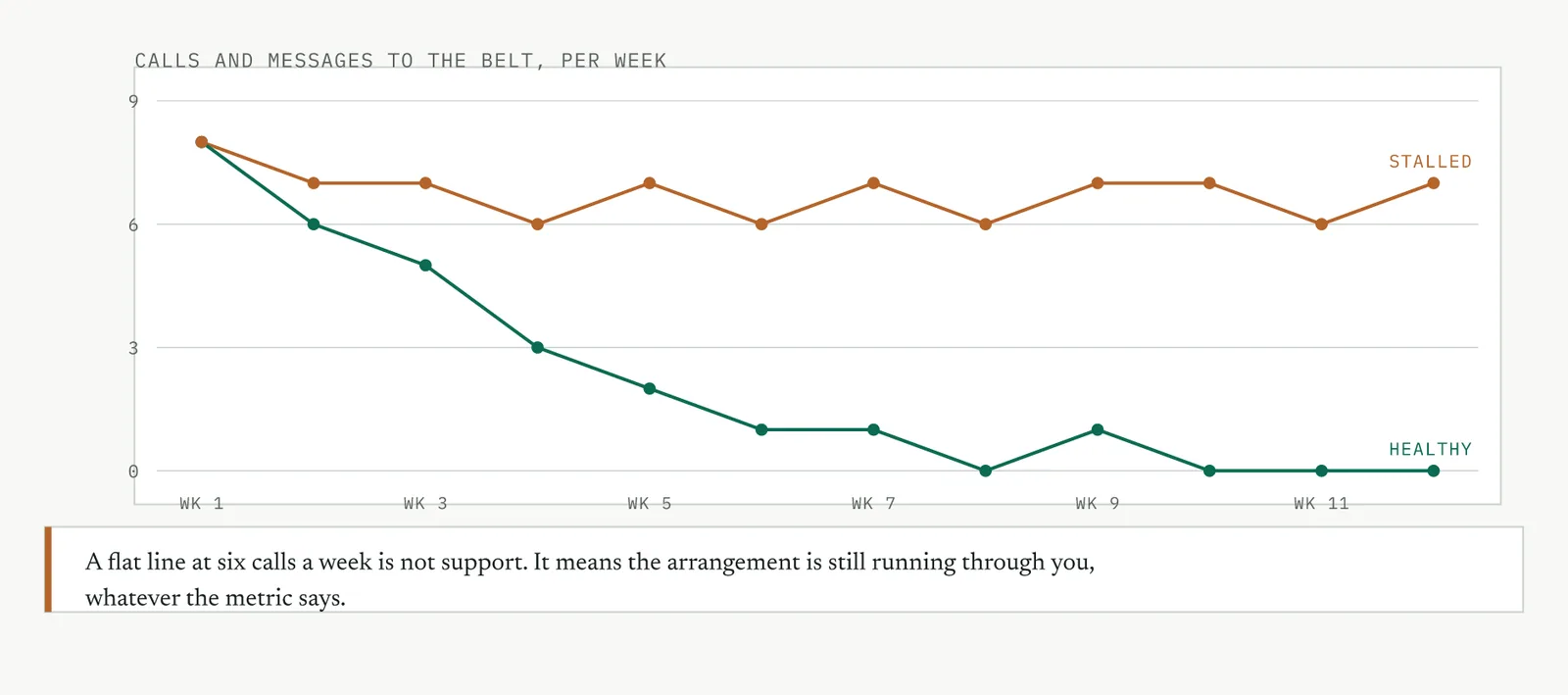
A falling line is a handover working as intended. A flat line at six calls a week is an arrangement still running through you, whatever the metric reads. The uncomfortable part is that a flat line usually feels good, because being needed is pleasant and each individual call is reasonable.
Clear it by refusing the next three calls in a particular way. Do not decline them. Answer each one with a question about where the answer already exists, then send the person to the plan, the routine sheet or the index. If the answer is not in any of those, you have found a gap in the documents rather than a gap in the person.
Where it routes. Into 16.3.8 if the answers exist and nobody can find them, and into 16.3.10 if they exist and are being ignored. A call pattern that will not fall after three deflections is a failed stage three, so go back and finish it.
| THE TELL | WHAT IT MEANS | WHERE IT ROUTES |
|---|---|---|
| Agreement without amendment | The owner ended a meeting rather than taking a job | 16.3.1, then slow the withdrawal |
| Two people describe the step differently | The standard is decoration and the practice is memory | 16.3.4 and 16.3.6 |
| Nobody has asked for the metric in a month | The leader layer never started, or it has lapsed | 16.3.5, and a register row if no routine exists |
| Everything green after a system release | The control is measuring a process that moved | 16.3.9, with the trigger written onto the plan |
| Your call volume is flat | Stage three was never completed | 16.3.8 or 16.3.10, depending on the answers |
Table 16.7 The five common hiccups, what each one means, and the tool that clears it.
| TIP Plot the calls you receive about the process each week. A falling line is a handover. A flat line is an arrangement running through you, and it will feel like being useful right up to the point it fails. |
16.7 The bridge into the management system
16.7.1 What people hold, and what the system has to hold
Everything this chapter built rests on people. A named owner. A routine somebody performs. A leader who looks. A second person who was taught. That is a real arrangement and a good one, and every load bearing part of it can be moved, distracted or overruled. Figure 16.45 sets what people hold against what the system will hold instead.
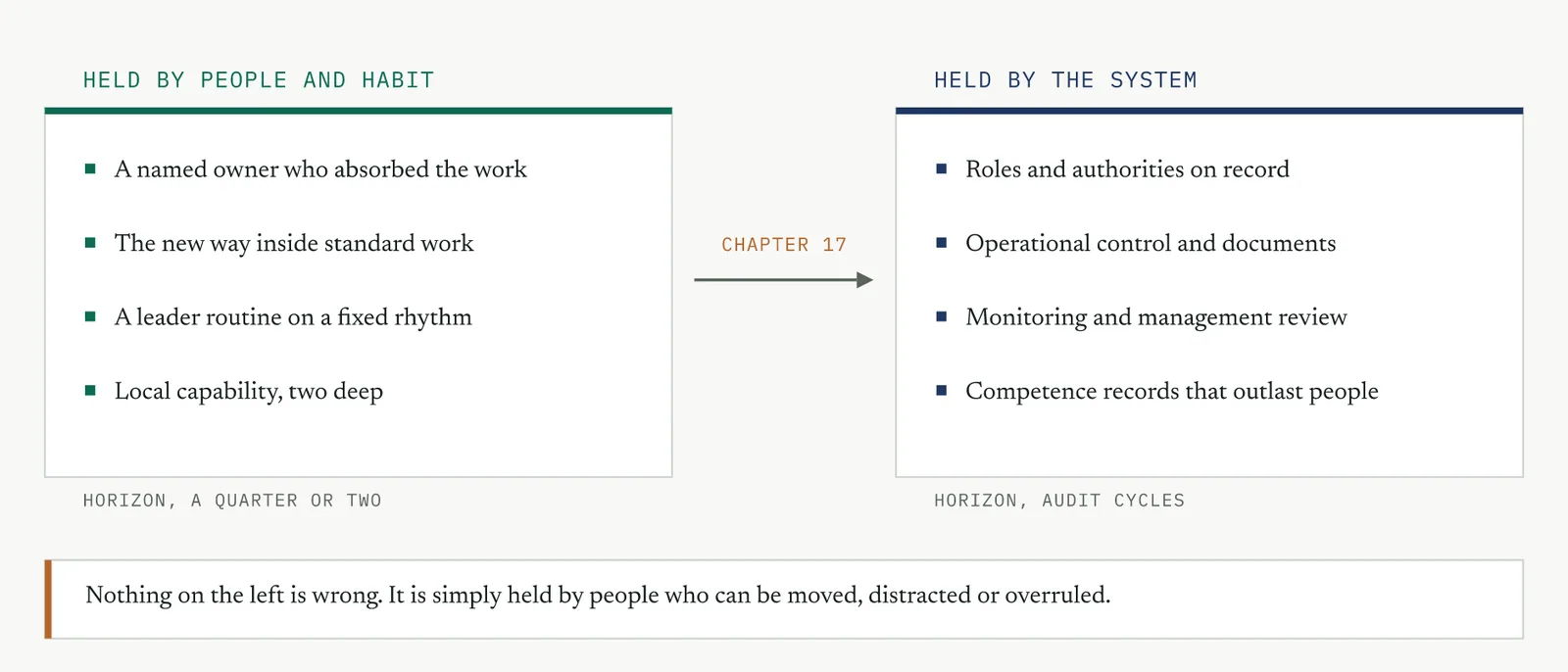
The difference is horizon. A gain held by habit lasts a quarter or two, because that is how long an arrangement survives on attention. A gain held by the system lasts through audit cycles. The machinery keeps asking whether or not anybody remembers to.
Two things survive without a system anyway. The visible output on the board, because it needs no meeting and no appointment. A task attached to a routine that predates your project, because the routine defends itself. Everything else needs a record that outlasts the people named on it.
16.7.2 Which decay paths are still open
Look back at the four paths and ask which ones closed. The busy week closed, because the task sits inside a routine with a recovery line against it. The owner who did not absorb closed too. The agreement, the checks and the test between them find that inside thirty days.
The other two narrowed rather than closed. The competency matrix and the training plan narrow the staff move, and it reopens the moment a new starter arrives and nobody reruns them. Closing it needs a competence record and an induction route the firm owns. That is Chapter 17 rather than you.
The register and the refresh triggers narrow the silent process change, and it reopens the day the trigger owner moves on. A trigger held by one person has a half life. Held by document control and change control, it survives whoever holds it this year.
16.7.3 What Chapter 17 anchors
Every artefact you produced has a clause waiting for it. Table 16.8 sets them out. Do not read it as homework, because the artefacts already exist and are already in use. The work in Chapter 17 is registration rather than creation.
| WHAT THIS CHAPTER PRODUCED | CLAUSE | WHAT THE CLAUSE ADDS |
|---|---|---|
| Ownership transfer agreement | 5.3 | The role survives the person who accepted it |
| Process owner RACI | 4.4 and 5.3 | The boundary is recorded, not remembered |
| Sustainment plan | 7.5 and 8.5.1 | Version and review are controlled by the firm |
| Routine standard work | 8.5.1 | The routine is a controlled document |
| Layered check schedule | 9.1, 9.3 and 5.1 | The leader check has a home when the leader changes |
| Skills and competency matrix | 7.2 | Competence is a record rather than an assessment |
| Training plan and cards | 7.2 and 7.3 | New starters meet the standard before the habit |
| Knowledge file index | 7.1.6 and 7.5 | The tacit five become organisational knowledge |
| Decay risk register | 6.1 | Risks are reviewed on a cycle, not on your visit |
| Dependency test record | 9.2 | The test becomes an audit the firm runs itself |
| The check schedule | 9.1 | Monitoring continues after your last date |
| Any failure the checks found | 10.2 | Correction is a process rather than a favour |
Table 16.8 What Chapter 16 produced, and the clause that will hold each artefact once Chapter 17 registers it.
Crestline closed at day one hundred and twenty. The trend line passed its retest after Renu moved it to the first item on the new Wednesday slot. The register now carries the row that catches the next move. First response accuracy sits at 94 per cent, below the target and well above the 82 per cent the project started from. Closing that gap is somebody job now rather than yours.
That is the correct place to stop. You handed over a process that runs without you. You also handed over four things that decay at a known rate unless the firm puts them into its system. Chapter 17 does that, clause by clause. It is the shortest route from a sustained project to a firm that sustains projects.
| TIP Do not treat Chapter 17 as certification work. Every artefact it registers already exists and is already in use, so the task is putting them where the firm keeps its records rather than writing anything new. |