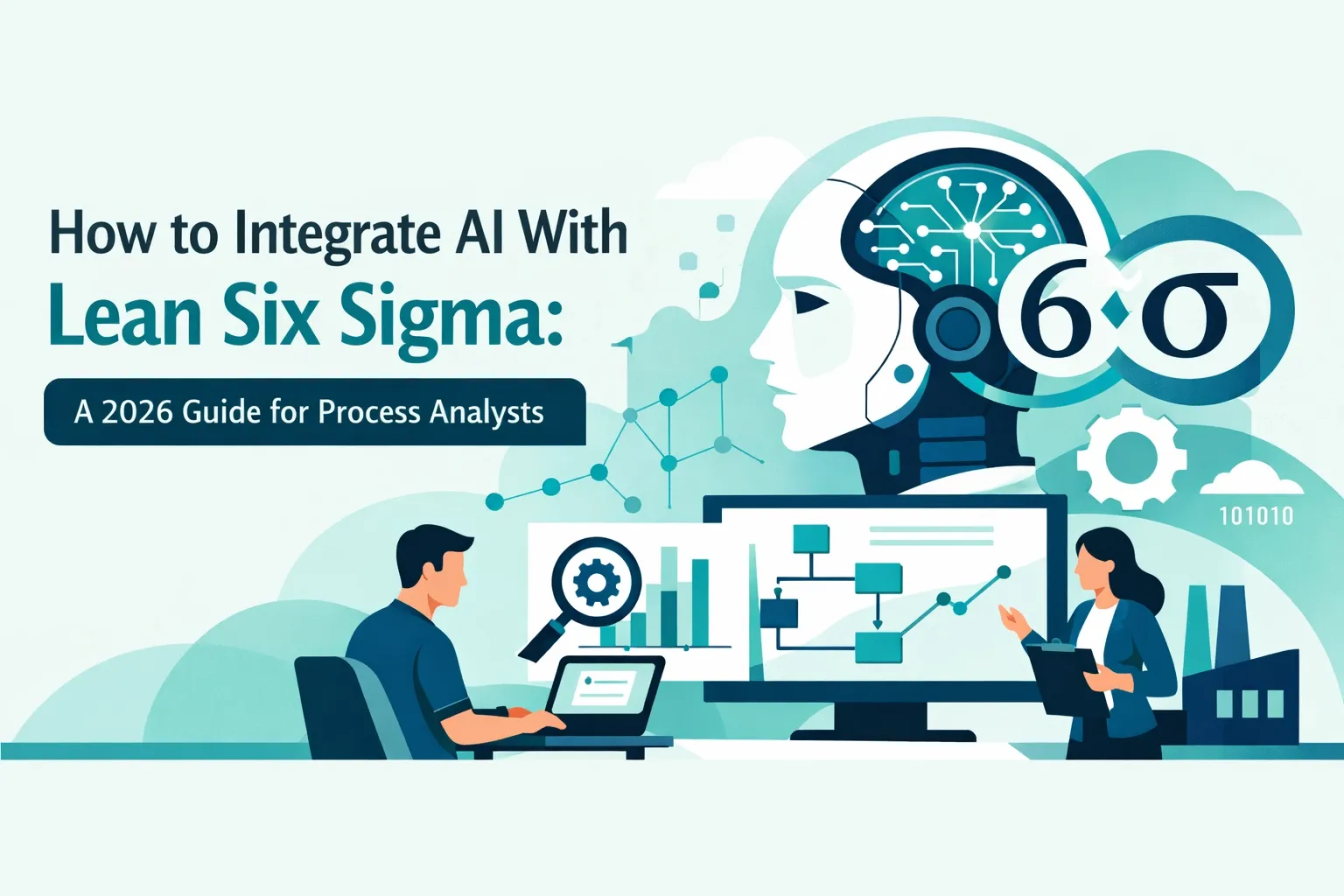
It is March 2026, and the landscape of process improvement has shifted dramatically. A few years ago, people were asking if Artificial Intelligence would make Lean Six Sigma (LSS) obsolete. Today, we have the answer: AI hasn't replaced Lean Six Sigma; it has given it a pair of jetpacks.
For the modern process analyst, the challenge isn't choosing between "traditional" methods and "new" AI tools. The magic happens when you integrate the two. While AI provides the raw computational power to sift through petabytes of data, Lean Six Sigma provides the disciplined, human-centric framework to ensure those insights actually lead to value.
In this guide, we’ll explore how to fuse AI: specifically Large Language Models (LLMs), predictive analytics, and process mining: with the classic DMAIC framework to drive results that were previously impossible.
The Synergy: Why AI Needs a Methodology
If you throw AI at a messy process without a framework, you usually just end up with a faster version of a messy process. AI is an incredible "Data Detective," but it lacks business context. It doesn't know that a specific "efficiency gain" it found might actually violate a regulatory requirement or destroy customer trust.
That is why Lean Six Sigma is more relevant than ever. Concepts like Voice of the Customer (VOC) and Root Cause Analysis (RCA) act as the guardrails for AI. By using the Project Selection Scoring Calculator, you ensure that you aren’t just applying AI because it’s "cool," but because it’s the most effective way to solve a high-impact business problem.

AI-Powered DMAIC: A Phase-by-Phase Breakdown
The DMAIC (Define, Measure, Analyze, Improve, Control) cycle remains the gold standard for process improvement. Here is how AI supercharges each step in 2026.
1. Define: Beyond the Basic Charter
In the Define phase, your goal is to clarify the problem. In the past, this meant manual interviews and long workshops to capture the Voice of the Customer.
Today, we use LLMs to perform sentiment analysis on thousands of customer emails, chat logs, and social media mentions in seconds. Instead of guessing what customers want, you can use a Voice of Customer Priority Matrix Calculator fed by AI-distilled data.
AI also assists in drafting SIPOC diagrams and identifying initial project scope. By using a SIPOC Complexity Score Calculator, you can determine if your project is too broad for a Green Belt or if it requires the heavy lifting of a Black Belt.
2. Measure: Real-Time Data Streams
The "Measure" phase used to be the most tedious part of any LSS project. Analysts spent weeks gathering manual logs or cleaning messy Excel sheets.
In 2026, we lean heavily on Automated Data Gathering. Systems now feed real-time process data directly into your analysis tools. Whether you are looking at statistical sampling plans or high-frequency sensor data, AI ensures that the "data debt" is kept to a minimum.
Process mining tools now automatically map out the "as-is" process by looking at digital footprints in your ERP or CRM, highlighting where the actual path deviates from the standard operating procedure.

3. Analyse: The "Data Detective" Era
This is where AI truly shines. In the Analyse phase, we hunt for root causes. Traditional hypothesis testing is still vital, but AI-driven predictive analytics allows us to find correlations that the human eye (and standard Minitab charts) might miss.
Imagine running a Lean Six Sigma Hypothetical Project where the AI identifies that defects increase only when humidity is above 60% and a specific supplier’s batch is used. This level of multi-variate analysis used to take days; now it takes seconds.
However, don't let the machine do all the thinking. You still need to validate these findings using a classic Fishbone Diagram. AI can suggest categories for the bones, but the process analyst must verify the logic.

4. Improve: Generative Solutions
Once you know the root cause, you need a solution. Generative AI is a fantastic brainstorming partner. You can prompt an LLM with your constraints: budget, time, and resources: and ask it to generate 10 potential process redesigns based on Lean principles.
Furthermore, digital twins allow us to simulate these improvements before we touch the real-world process. We can predict the ROI of a project with high accuracy by running thousands of "what-if" scenarios in a virtual environment.
5. Control: Proactive vs. Reactive
The Control phase has evolved from "checking the charts once a week" to "automated anomaly detection." Instead of a human looking at a P-chart to see if a process is out of control, AI monitors the process 24/7.
When the AI detects a trend: even a subtle one that hasn't hit a control limit yet: it can alert the process owner or even trigger an automated corrective action. This makes conducting process audits a much more streamlined, data-backed experience.
Role-Specific Guidance for 2026
The way you use AI depends on your certification level.
- Yellow Belts: Focus on using AI to summarize VOC and help with basic data visualization. AI lowers the barrier to entry, making it easier for everyone to contribute to a culture of continuous improvement. If you're just starting, check out our Free White Belt Practice Exam.
- Green Belts: You are the bridge. You'll use process mining to identify bottlenecks and LLMs to help structure your DMAIC narrative. You must ensure the data fed into the AI is clean and unbiased. Test your skills with the Free Green Belt Practice Exam.
- Black Belts: You are the "AI Orchestrator." You lead cross-functional teams to implement predictive models and ensure that AI initiatives align with the overall organizational strategy. You’ll be looking at complex integrations and high-level Project Charters.
The "Human" Guardrails: Why Foundational Principles Still Matter
With all this talk of AI, it’s easy to think we can just "set it and forget it." But as any experienced Black Belt will tell you, the human element is where most projects fail.
- Hallucinations vs. Reality: AI can be confidently wrong. If an LLM suggests a root cause, you must verify it on the "Gemba" (the actual place where work happens).
- Stakeholder Buy-in: People don't trust "black box" algorithms. They trust a structured LSS process that they can understand. Use a Stakeholder Impact Assessment Calculator to manage the change.
- Ethics and Bias: If your historical data is biased, your AI will be biased. Lean Six Sigma's focus on objective data and "fact-based decision making" is the best defense against biased AI.
Getting Started: Your 2026 Action Plan
If you're a process analyst looking to stay ahead of the curve, here is how to start integrating AI today:
- Master the Fundamentals: You can't automate a process you don't understand. Ensure your LSS foundations are rock solid.
- Learn Prompt Engineering for LSS: Start using LLMs to help you write problem statements, brainstorm "5 Whys," and draft project charters.
- Explore Process Mining: Look for tools that can visualize your data logs. It will change the way you see the "Measure" phase.
- Stay Certified: The world is changing, but the demand for certified professionals who can navigate both data and people is at an all-time high.
The integration of AI and Lean Six Sigma is the most significant leap in process improvement history. By combining the speed of the machine with the wisdom of the methodology, you aren't just improving processes: you're future-proofing your career.
Ready to lead the next generation of process improvement? Elevate your career by getting certified today. Explore our Green Belt and Black Belt programs to master the tools of the future.