In the realm of process improvement, the Define phase of the DMAIC (Define, Measure, Analyze, Improve, Control) methodology stands as the most critical pillar for organizational success. The fundamental purpose of this phase is to articulate the specific issue at hand with surgical precision. Without a robust, data-driven problem statement, even the most skilled Lean Six Sigma Black Belts risk squandering corporate resources on symptoms rather than root causes.
To fully appreciate the gravity of this step, one must recognize that a project is only as strong as its definition. A vague problem statement leads to scope creep, team frustration, and ultimately, a failure to deliver measurable ROI. In this comprehensive guide, we will dissect the anatomy of an effective problem statement and provide 15 industry-specific examples to serve as benchmarks for your next initiative.
The Anatomy of a High-Impact Problem Statement
A professional problem statement does not merely describe a "bad situation." It quantifies the gap between the current state and the desired state. To align with global standards taught in our Lean Six Sigma Green Belt certification, every statement should address the following elements:
- The Metric: What specific KPI is being impacted?
- The Magnitude: What is the current value versus the historical or target value?
- The Timeline: Over what period has this issue been observed?
- The Scope: Where is this happening (department, product line, or region)?
- The Impact: What is the financial or operational consequence of inaction?

15 Problem Statement Examples Across Diverse Industries
Manufacturing and Engineering
1. Defect Rate in Electronics Assembly
"During the last fiscal quarter (Q4 2025), the printed circuit board (PCB) assembly line in the Austin facility experienced a defect rate of 8.5%, significantly exceeding the 2% quality threshold. This variance resulted in $240,000 in scrap costs and delayed shipments to three major Tier-1 clients."
2. Machine Downtime in Heavy Industry
"Between January and June 2025, Hydraulic Press #4 in the stamping department averaged 18% unscheduled downtime due to seal failures. This is 10% higher than the fleet average, resulting in a production deficit of 12,000 units and an estimated lost opportunity cost of $450,000."
Healthcare and Pharmaceuticals
3. Patient Wait Times in Emergency Departments
"Analysis of patient flow data from July to December 2025 indicates that the average 'door-to-doctor' time in the Emergency Department is 215 minutes, which is 45 minutes above the national accreditation standard. This delay has contributed to a 12% increase in patients leaving without being seen (LWBS)."
4. Medication Administration Errors
"In the surgical ward of St. Jude’s Hospital, medication documentation errors have risen from 2 incidents per 1,000 doses to 7 incidents per 1,000 doses over the past 12 months. These errors increase the risk of adverse drug events and have extended the average patient stay by 0.8 days."
Finance and Banking
5. Commercial Loan Processing Cycle Time
"The current average cycle time for commercial loan approvals is 28 business days, compared to the industry benchmark of 15 days. Data from 2025 shows this inefficiency has led to a 15% drop in application pull-through rates, as prospective clients migrate to more agile competitors."
6. Fraudulent Transaction Detection Latency
"Within the credit card division, the 'time-to-detection' for fraudulent international transactions currently averages 14 hours. This latency allowed for $1.2 million in avoidable losses in the first two months of 2026 alone, exceeding the risk tolerance set by the Board of Directors."

Information Technology and Software
7. System Latency in Cloud Infrastructure
"User experience logs for the 'Alpha' SaaS platform show that API response times have increased from 200ms to 850ms since the version 4.2 deployment in January 2026. This degradation has resulted in a 20% increase in customer support tickets citing 'unresponsive interface' issues."
8. Software Bug Density in Post-Release
"The Q1 2026 release of the Enterprise Resource Planning (ERP) suite exhibited a bug density of 4.2 critical defects per 1,000 lines of code (KLOC). This is nearly triple the internal quality target of 1.5 KLOC, necessitating an emergency patch cycle costing $85,000 in unplanned labor."
Retail and E-commerce
9. Shopping Cart Abandonment Rates
"Monthly analytics for the E-commerce portal reveal a shopping cart abandonment rate of 74% for mobile users, compared to 48% for desktop users. This gap represents an estimated $2.1 million in lost annual revenue and suggests a failure in the mobile checkout UX flow."
10. Inventory Shrinkage in Distribution Centers
"Inventory audits conducted in February 2026 at the Northern Regional Distribution Center identified a shrinkage rate of 3.2% of total stock value. This is double the corporate allowance of 1.5%, totaling a $115,000 loss in high-demand consumer electronics."
Human Resources and Corporate Operations
11. High Employee Turnover in Entry-Level Roles
"Exit interview data from 2025 shows a 35% voluntary turnover rate for customer success associates within their first 90 days. The cost to recruit and train a replacement is estimated at $12,000 per head, leading to an annualized loss of $420,000."
12. Onboarding Completion Delays
"Current internal tracking indicates that only 40% of new hires complete their mandatory compliance training within the required 14-day window. This lack of compliance exposes the organization to significant legal risks and has delayed the full productivity of the 2026 cohort by an average of 5 days."

Logistics and Supply Chain
13. Last-Mile Delivery Failures
"During the peak holiday season of 2025, 'first-attempt' delivery success dropped to 82% in metropolitan zones, down from 91% the previous year. This decline increased fuel and labor costs for redelivery by $180,000 and decreased the Net Promoter Score (NPS) by 15 points."
14. Supplier Lead Time Variability
"The standard deviation of lead times for 'Component X' from primary suppliers has increased from 2 days to 9 days over the last eight months. This inconsistency has forced the production department to maintain $300,000 in excess safety stock to prevent line stoppages."
Education and Public Sector
15. Student Enrollment Attrition
"Preliminary data for the 2025-2026 academic year shows a 15% decrease in re-enrollment for the online professional development certificate program. If this trend continues, the department faces a $500,000 budget deficit for the upcoming fiscal cycle."
Transitioning from Problem Statement to Project Charter
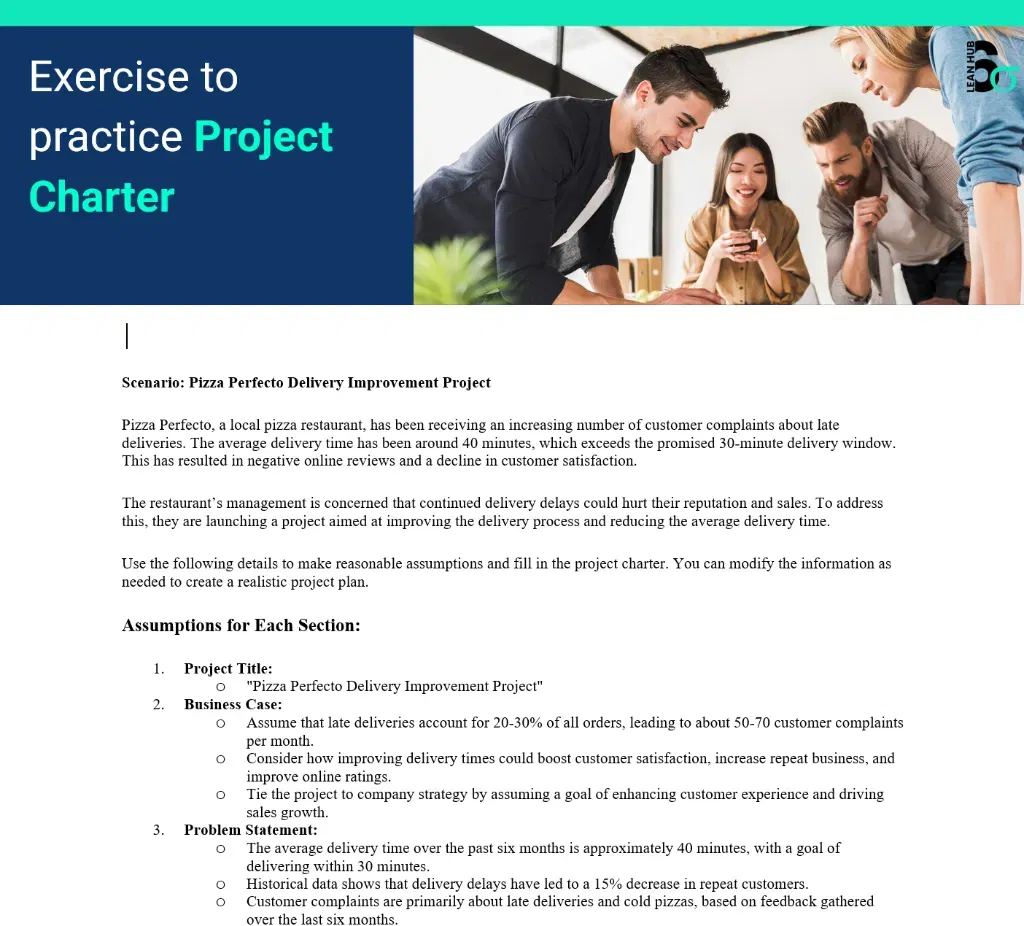
Once you have crafted a precise problem statement using the examples above as a guide, the next logical step is to embed this into a formal Project Charter. A charter serves as the "contract" between the project team and the executive sponsor.
To streamline this process, we recommend utilizing our Project Charter ROI Calculator to determine if the financial impact of the problem justifies the resource allocation. Furthermore, you can download our Project Charter Template to ensure your project receives the necessary approval from senior leadership.
Avoid These Three Common Mistakes
Even seasoned practitioners can falter when defining a project. Avoid these "trap" behaviors:
- Including the Solution: A problem statement should never say "The problem is we don't have enough staff." This assumes the solution (hiring staff) before the Root Cause Analysis has been conducted.
- Being Too Broad: "Our quality is low" is not a problem statement; it is a complaint. Use specific metrics like PPM (Parts Per Million) or DPMO (Defects Per Million Opportunities).
- Lacking Financial Context: Leadership cares about the bottom line. Always attempt to translate the operational gap into a dollar figure. If you are unsure of the financial impact, our Project Selection Scoring Calculator can help you prioritize issues based on their business value.
Taking the Next Step in Your Professional Development
Mastering the art of project definition is just the beginning of a successful career in process excellence. Whether you are aiming for a Yellow Belt, Green Belt, or the prestigious Lean Six Sigma Black Belt, having the ability to quantify organizational pain points is a skill that will distinguish you in the job market.
In the rapidly evolving landscape of 2026, data-driven decision-making is no longer optional: it is a requirement. Explore our accredited online training programs to gain the tools, templates, and 1-on-1 coaching needed to transform your organization.
If you are ready to stop guessing and start solving, we invite you to enroll in our Lean Six Sigma White Belt for free today and begin your journey toward mastery.