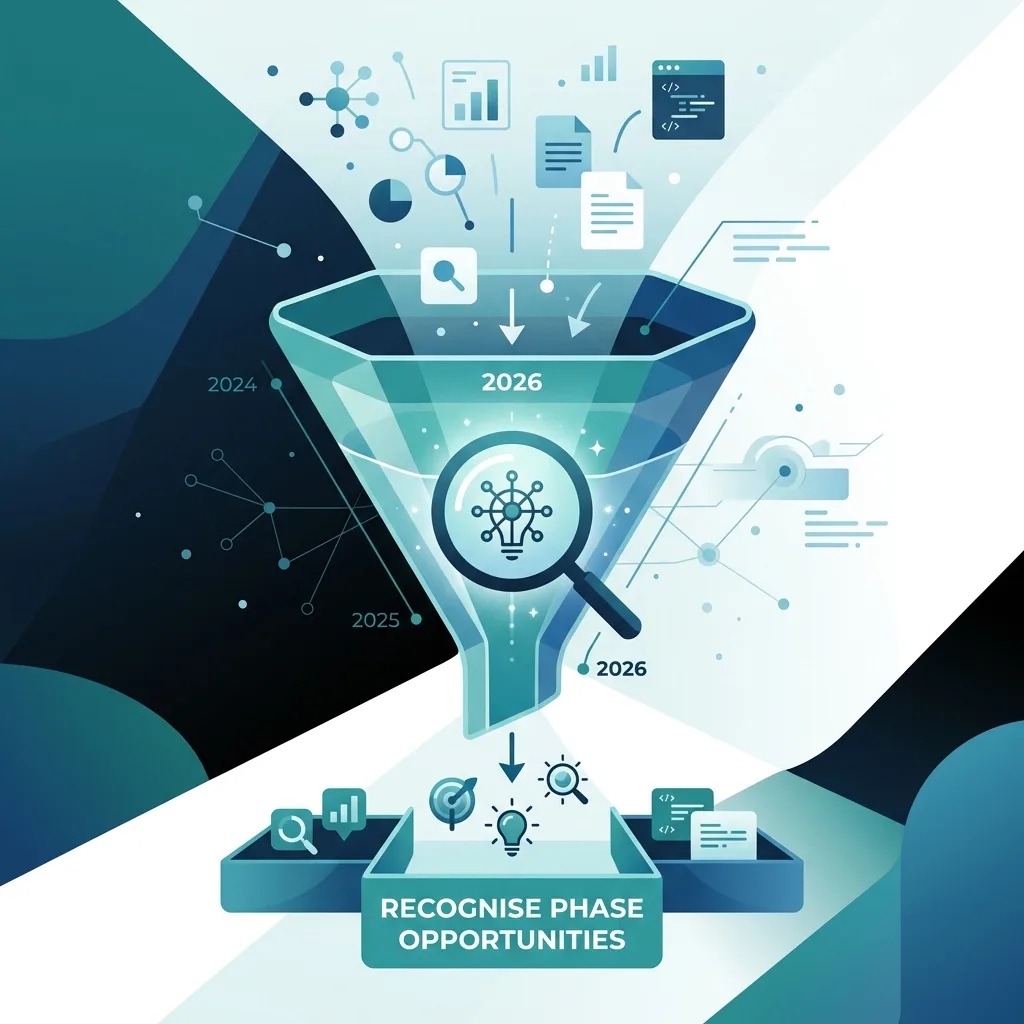
Listen, if you’re still wandering around the shop floor or scrolling through endless Excel spreadsheets looking for "something to fix," you’re living in 2010. It’s April 2026. The game has changed. In the world of Lean Six Sigma, the Recognise phase: that crucial "R" that kicks off our RDMAICS framework: isn't about gut feelings or who complains the loudest at the Friday wrap-up meeting. It’s about data. Specifically, it’s about using AI to filter out the noise and find the high-impact projects that actually move the needle.
At Lean 6 Sigma Hub, we’ve seen too many Black Belts waste months on "pet projects" that don't save a dime. The 2026 Filter is our way of making sure that never happens to you. Let’s get into how you can use agentic AI and pattern recognition to scan your enterprise data and find your next goldmine project.
Why the Recognise Phase is the Make-or-Break Moment
Before we talk tech, let’s get the "why" straight. The Recognise phase is where you identify, define, and select projects that align with the organization's strategic goals. If you pick the wrong project here, no amount of sophisticated Fault Tree Analysis in the Analyse phase is going to save your ROI.
In the old days, project selection was political. In 2026, it’s mathematical. We use AI to scan the massive "data lakes" most companies have been building for the last decade to find hidden pockets of waste (Muda), inconsistency (Mura), and overburden (Muri).

Step 1: Connecting the AI Agents to Your Data Stream
You can’t scan what you can’t see. The first step in the 2026 Filter approach is deploying AI Agents. These aren't just chatbots; they are autonomous scripts designed to live within your ERP or CRM systems.
By 2026 standards, your AI should be able to:
- Ingest Multimodal Data: Look at everything from sensor logs on the assembly line to customer sentiment in support tickets.
- Establish a Baseline: Automatically determine what "normal" looks like so it can spot the "weird."
- Flag Deviations: Identify where the process is drifting before it even hits a threshold that would trigger a manual alarm.
When you have these agents running, you stop being a "firefighter" and start being a "fire preventer." You are essentially creating a digital twin of your process that highlights opportunities in real-time.
Step 2: Running the "Noise Reduction" Protocol
Most enterprise data is garbage. It’s messy, it’s incomplete, and it’s full of outliers that don’t actually matter. If you try to analyze everything, you’ll end up with "Analysis Paralysis."
The AI Filter uses Pattern Recognition to separate the signal from the noise. It looks for recurring themes. For example, if the AI sees that every Tuesday at 2:00 PM, cycle times in the shipping department spike by 15%, that’s a pattern. If it happens once because of a freak snowstorm, the AI filters it out.
This is where you start building your list of potential projects. Instead of a vague idea like "we need to fix shipping," you get a data-backed lead: "Shipping delays on Tuesdays correlate with a 20% increase in part-time labor turnover." Now that is a Recognise phase win.

Step 3: Objectively Ranking Opportunities
Once the AI has handed you a list of 10 or 20 potential projects, how do you choose? You don't just pick the one your boss likes. You use a structured scoring system.
In our Lean Six Sigma Master Black Belt Training, we teach the importance of objective project selection. You need to weigh things like:
- Financial Impact: How much hard or soft savings will this generate?
- Strategic Alignment: Does this help us hit this year’s "North Star" goal?
- Feasibility: Do we actually have the resources to fix this in 3–6 months?
To make this easy, we recommend using our Project Selection Scoring Calculator. You plug in the AI’s findings, and the tool gives you a rank-ordered list. No bias, no politics: just the facts.
Step 4: Translating Data into a Draft Charter
The end goal of the Recognise phase is a signed-off Project Charter. AI can do the heavy lifting here too. Once you've selected a project, you can feed the relevant data back into a generative AI tool to draft the Problem Statement and Goal Statement.
But don’t just copy-paste. You need to verify the metrics. Are you looking at a Quick Win or a Long-Term Solution? The AI can suggest the scope, but as a human leader, you decide where the boundaries are.
Use our Project Charter ROI Calculator to ensure the numbers the AI is spitting out actually make sense for your budget. If the AI promises $1M in savings but requires $2M in new equipment, that’s not a project; that’s a liability.

The "Human-in-the-Loop" Reality Check
Despite all the talk about AI in 2026, the "Human-in-the-Loop" (HITL) element is still non-negotiable. AI is great at spotting patterns, but it’s terrible at understanding culture.
The AI might find a "process improvement opportunity" that involves automating a task performed by a 30-year veteran of the company who holds all the institutional knowledge. An AI would say "Replace them." A Master Black Belt knows that’s a recipe for a communication breakdown and a failed project.
Always validate the AI’s "Recognise" findings by:
- Talking to Stakeholders: Use a Stakeholder Impact Assessment Calculator to see who’s going to be pissed off if you change this process.
- Walking the Gemba: Go see the process for yourself. Does the data match the physical reality?
- Checking the Voice of the Customer (VOC): Does the AI's "efficiency" fix actually matter to the person paying the bills? Check our VOC Priority Matrix Calculator to be sure.
Technical Snapshot: The AI Stack for LSS in 2026
If you want to implement this, here is the tech stack we’re seeing the most success with this year:
| Component | 2026 Tech Choice | Purpose |
|---|---|---|
| Data Ingestion | Kafka / Snowflake | Real-time streaming of process data. |
| Discovery | Celonis / UiPath Process Mining | Visualizing the "As-Is" process via digital footprints. |
| Pattern Analysis | Agentic LLMs (Custom trained) | Finding the "Why" behind the variances. |
| Validation | Statistical Process Control | Confirming if the AI found a true anomaly or just noise. |
Taking it to the Next Level
Using AI to scan your data isn't just about being "tech-forward": it's about survival. The speed of business in 2026 doesn't allow for six-month "Discovery" phases. You need to be able to Recognise an opportunity on Monday and be in the Measure phase by Friday.
If you’re feeling overwhelmed by the technical shift, don't worry. That’s what we’re here for. Whether you need to brush up on the basics with Six Sigma Flash Cards or you’re ready to lead an enterprise-wide transformation as a Master Black Belt, we have the tools and the training to get you there.
Stop guessing. Start filtering. The data is already there: it’s time you started listening to what it’s trying to tell you.
Ready to lead the charge in the AI-driven era of process improvement? Take the first step toward your future and enrol in our Lean Six Sigma Master Black Belt Certification Course today.