In the high-stakes environment of process improvement, the most dangerous phase isn't the data analysis or the implementation of new controls, it is the very beginning. In our RDMAICS framework, the Recognise phase serves as the gatekeeper. If you get this wrong, you are essentially steering a high-speed ship into a fog bank.
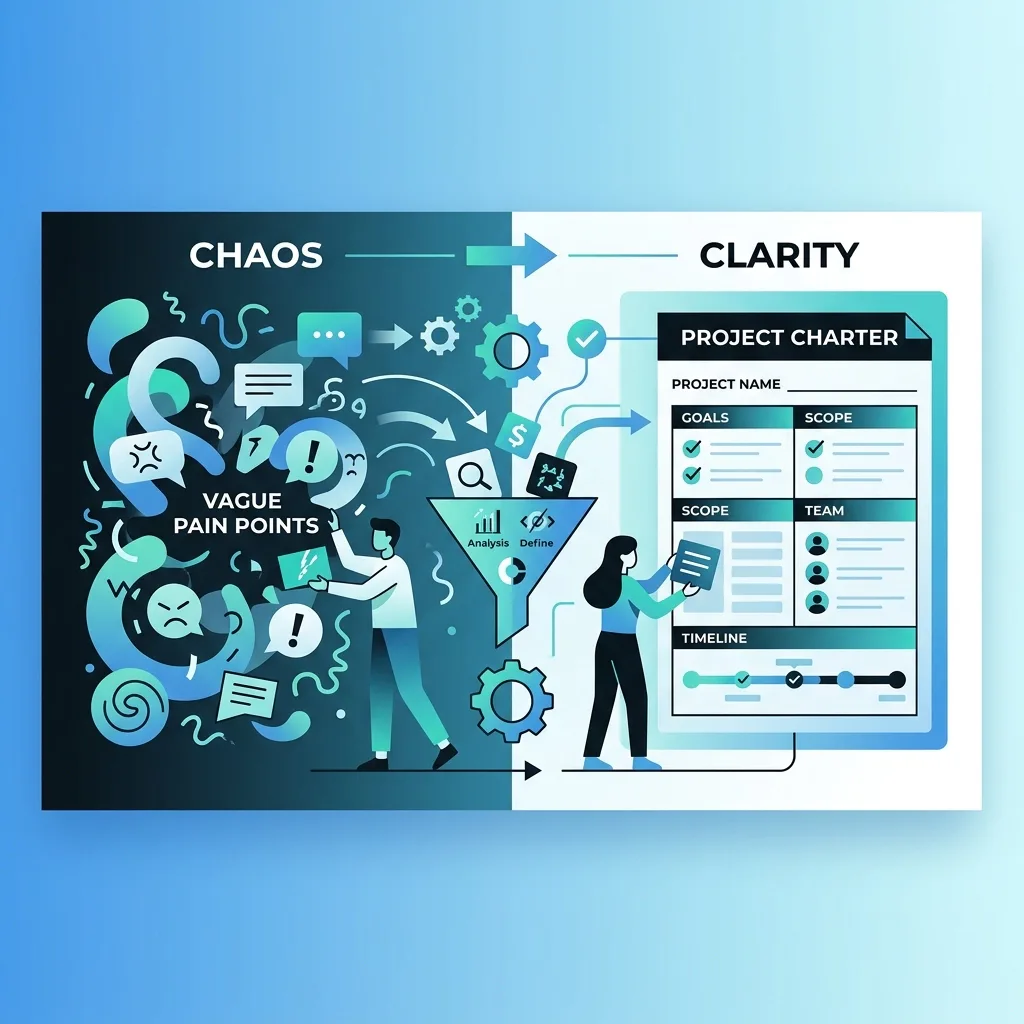
We’ve all heard the vague complaints in boardroom meetings: "Our shipping process is too slow," "The customers are unhappy with the billing," or "We have too much waste in the warehouse." These are not project descriptions; they are symptoms of a deeper malaise. To achieve real results, a Lean Six Sigma Master Black Belt must possess the surgical precision required to translate these nebulous "pain points" into a high-impact Project Charter.
The Anatomy of Chaos: Why Vague Pain Points Kill Projects
When a project begins with a vague premise, it is destined for "scope creep", the silent killer of organizational efficiency. Without a concrete charter, stakeholders will inevitably try to fold every minor grievance into the project's scope. By the time you reach the Measure phase, your team is overwhelmed, your data is diluted, and your ROI is nonexistent.
The fundamental purpose of the Recognise phase is to filter the "noise" of daily operational friction and identify the "signals" that represent true opportunities for breakthrough improvement. This requires moving beyond emotional venting and moving toward data-driven definitions.

Step 1: Quantify the "Vibe" Using the Voice of the Customer
A pain point usually starts with a "feeling." To move from chaos to clarity, you must first subject that feeling to the Voice of the Customer (VOC). Are the customers actually complaining about speed, or is it actually the lack of communication during the wait time?
Utilizing a Voice of Customer Priority Matrix Calculator allows you to rank these complaints objectively. In the realm of Lean Six Sigma, we don’t move on "feelings." We move on Critical-to-Quality (CTQ) requirements. Once you have identified what actually matters to the end user, you can begin the process of translation.
Step 2: From Symptoms to a Problem Statement
A "pain point" is a symptom; a "problem statement" is a diagnosis. To draft a concrete charter, you must articulate the gap between the current state and the desired future state with extreme clarity.
Consider this transformation:
- Vague Pain Point: "Our invoice processing takes too long and people are annoyed."
- Concrete Problem Statement: "In the last six months, the accounts payable department has averaged 14 days to process vendor invoices against a target of 5 days. This delay has resulted in $12,000 in late fees and a 15% decrease in vendor satisfaction scores."
Notice the difference? The second version is measurable, time-bound, and highlights the financial impact. To help define these requirements, many practitioners utilize a Critical to Quality (CTQ) Tree Calculator to break down broad customer needs into specific, measurable performance requirements.
Step 3: Prioritizing the Right Battles
Not every pain point deserves a Lean Six Sigma project. Some are "Just Do Its," while others are so complex they require a multi-year overhaul. In the Recognise phase, you must act as a strategic filter.
To determine if a pain point is worth the resources of a dedicated team, use a Project Selection Scoring Calculator. This tool evaluates potential projects based on criteria such as:
- Alignment with corporate strategy.
- Expected financial impact (ROI).
- Data availability.
- Complexity and resource requirements.
If a project doesn't score high enough, have the professional courage to say "no." It is better to execute three high-impact projects than ten mediocre ones that never reach the finish line.
Step 4: Mapping the Boundaries with SIPOC
Once you have a problem statement and a prioritized objective, you must define the playground. This is where the SIPOC (Suppliers, Inputs, Process, Outputs, Customers) diagram becomes indispensable.
A SIPOC diagram provides a high-level view of the process without getting bogged down in the minutiae. It helps you decide where the project starts and where it ends. For instance, does your "Invoice Process" project start when the mail is opened, or when the data is entered into the ERP?
Defining these boundaries early prevents the project from ballooning into an unmanageable beast. You can assess the potential difficulty of your process by using a SIPOC Complexity Score Calculator to ensure you aren't biting off more than your team can chew.
Step 5: Calculating the Value Proposition
To gain the "nod" from executive leadership, your Project Charter must speak the language of the C-suite: Money.
Every concrete charter needs an estimated ROI. This isn't just about cost savings; it includes cost avoidance, revenue enhancement, and productivity gains. By using a Project Charter ROI Calculator, you can present a compelling business case that justifies the allocation of Black Belt or Green Belt resources.
In the realm of professional excellence, an improvement project is an investment. If you cannot demonstrate a return on that investment, the project is merely a hobby.
Step 6: Identifying the Human Element
The technical aspects of a charter are easy compared to the human ones. Who are the stakeholders that will be impacted by this change? Who has the power to block your progress?
A critical step in the Recognise phase is conducting a Stakeholder Impact Assessment. This allows you to identify early on who needs to be consulted, who needs to be informed, and who needs to be actively managed. Ignoring the "people" side of the charter is a guaranteed way to encounter resistance during the Improve and Control phases. For more on managing these dynamics, see our guide on the impact of communication on sustaining change.
Finalizing the Charter: The Contract for Success
Once you have gathered these elements, you assemble them into the final Project Charter. This document serves as your "contract" with the organization. It should include:
- Problem Statement: The data-backed "why."
- Business Case: The financial and strategic justification.
- Goal Statement: The SMART (Specific, Measurable, Achievable, Relevant, Time-bound) objective.
- Scope: The SIPOC-defined boundaries.
- Timeline: High-level milestones for the DMAIC journey.
- Team Members: The roles and responsibilities.
By the time you finish this process, the "vague pain point" has been transformed into a surgical strike plan. You have moved from chaos: where everyone is complaining but no one is acting: to clarity, where a dedicated team has the authority and the roadmap to deliver results.
Moving Forward: Master the Recognise Phase
Translating chaos into clarity is a skill that separates the amateurs from the masters. It requires a blend of technical expertise, emotional intelligence, and a relentless focus on data.
If you find yourself constantly struggling with projects that stall or lose support, the issue likely lies in your Recognise phase. Building a solid foundation is not just a "nice-to-have"; it is the fundamental prerequisite for operational excellence.
Ready to sharpen your skills and lead high-impact transformations in your organization? The path to becoming a recognized expert starts with world-class training.
Enroll in our Lean Six Sigma Green Belt Certification today and learn how to master the Project Charter and every other tool in the DMAIC arsenal.