
In the world of Lean Six Sigma, we often obsess over the "D" in DMAIC: the Define phase. But at Lean 6 Sigma Hub, we operate with a sharper edge: the RDMAICS framework. That first 'R' stands for Recognise, and it is the most critical hurdle you will face.
You’ve done the heavy lifting. You’ve spotted the waste, identified the variation, and found a project that could save the company six figures. But now comes the hard part: walking into a boardroom and getting a room full of skeptical executives to actually care.
If you can’t sell the Recognise phase, your project dies on the vine. Getting "The Nod" isn’t about being the loudest person in the room; it’s about being the most prepared. Here is how you pitch your findings with high-attitude precision and get the green light every single time.
1. Stop Pitching Ideas: Pitch Business Outcomes
The biggest mistake Green Belts and even seasoned Black Belts make is pitching a "Lean Six Sigma project."
Execs don't care about Six Sigma. They don’t care about your p-values, your fishbone diagrams, or your obsession with 3.4 defects per million opportunities. They care about the bottom line, risk mitigation, and competitive advantage.
When you present your Recognise phase findings, translate your technical jargon into the language of the C-suite. Don’t tell them you want to reduce variation in the shipping process. Tell them you’ve found a way to stop $15,000 a week from leaking out of the warehouse due to rework.
To do this effectively, you need to be surgical with your data. Use a Project Charter ROI Calculator to turn your observations into hard currency. When you lead with "This project will return $250k in the first six months," you aren’t just a "process person" anymore: you’re a business partner.
2. Know Your Enemy (and Your Allies)
Every boardroom has a resident skeptic. Maybe it’s the Operations Manager who thinks you’re attacking their "baby," or the CFO who views any new project as a drain on resources.
Before you even book the meeting, you need to map your stakeholders. This isn't just corporate politics; it’s tactical positioning. Use a Stakeholder Impact Assessment Calculator to identify who has the most to gain: and who feels most threatened: by your proposed project.
- The Champion: The person who feels the pain most acutely. They are your primary ally.
- The Skeptic: The one who asks, "Why now?" or "Why can’t we just work harder?"
- The Blocker: The person who sees your project as a critique of their previous work.
Address the skeptic’s concerns before they even open their mouth. If you know they are worried about resource allocation, show them exactly how this project will eventually free up 20% of their team’s time through cross-training and operational excellence.
3. Lead with the "Cost of Poor Quality" (COPQ)
Skeptical stakeholders love the status quo because it feels "safe." Your job is to prove that the status quo is actually the most dangerous place to be.
During the Recognise phase, you should have gathered enough data to quantify the Cost of Poor Quality. This includes:
- Internal Failure Costs: Rework, scrap, and wasted man-hours.
- External Failure Costs: Customer returns, warranty claims, and: most importantly: brand damage.
When a stakeholder says, "We don’t have the budget for this right now," your response should be: "We are currently spending $200k a year not doing this. Can we afford that?"
If you are struggling to quantify the impact of complex processes, a SIPOC Complexity Score Calculator can help you demonstrate just how bloated and expensive the current state really is.
4. The Power of the "Quick Win"
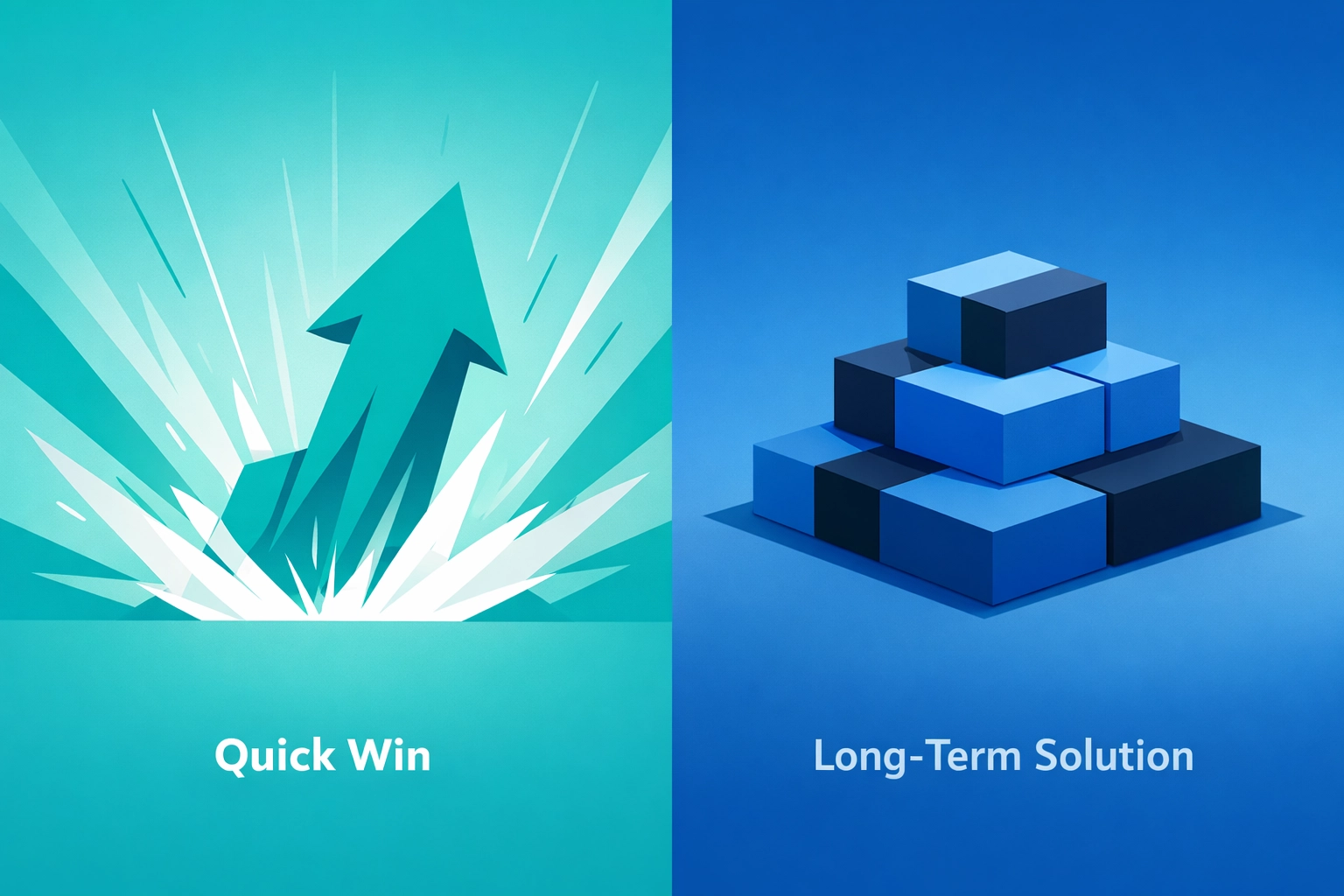
Nothing silences a skeptic faster than a win. While the goal of a full RDMAICS project might be a long-term cultural shift, you need to dangle a "Quick Win" in front of your stakeholders during the pitch.
A Quick Win is a low-effort, high-impact improvement that can be implemented almost immediately. It builds credibility. It proves that you aren't just there to "study" the problem for six months; you’re there to fix it.
Distinguish between Quick Wins vs. Long-Term Solutions during your presentation. Tell them, "Phase 1 will stop the immediate bleeding within 30 days, while the full project will redesign the system for permanent stability." This creates a sense of momentum that is hard to vote against.
5. Visualise the Friction
Humans are visual creatures. A spreadsheet with 500 rows of data won’t move an executive, but a clear Voice of Customer (VOC) Priority Matrix will.
Show them the gap between what the customer expects and what you are actually delivering. Use a CTQ (Critical to Quality) Tree to map high-level customer needs down to the specific process requirements you plan to fix.
When you can visually demonstrate that "Customer Satisfaction" is failing because of "Process Step X," the conversation shifts from if the project should happen to how fast it can start.
6. Structure the Pitch: The 15-Minute Rule
If you can’t pitch your Recognise phase findings in 15 minutes, you don’t understand the problem well enough. Executives are busy. Don’t waste time on the history of Lean Six Sigma. Get to the point.
The Winning Pitch Structure:
- The Hook (2 mins): The current business pain point and its financial impact.
- The Evidence (5 mins): The data from your Recognise phase. Keep it high-level but irrefutable.
- The Solution (3 mins): What the project will look like and the resources required.
- The ROI (2 mins): What the company gets back in terms of cash, time, or quality.
- The Q&A (3 mins): Handling the skeptics.
If the room gets heated or you encounter serious roadblocks, know your escalation procedures. Sometimes, you have to lean on your Project Sponsor to clear the path.
7. Handling the "Data" Objection
Occasionally, a stakeholder will try to derail you by questioning your data. "Is that sample size representative?" or "How do we know the measurement system is accurate?"
This is why the Recognise phase must be followed by a rock-solid Measure phase. If they challenge your data, be ready to explain your Measurement System Analysis (MSA) basics. Showing that you’ve already considered data integrity makes you look bulletproof.
If you aren't sure which project to lead with, use a Project Selection Scoring Calculator. It provides an objective, mathematical justification for why this project is the priority over others. It takes the "opinion" out of the room and replaces it with logic.
The Bottom Line
Pitching the Recognise phase is about authority. You are the expert. You have seen the waste that others have ignored, and you have the tools to fix it.
Don't go into the room asking for permission. Go into the room presenting an opportunity. When you align your findings with the strategic goals of the company and back it up with hard data, "The Nod" isn't just likely: it's inevitable.
Skeptical stakeholders aren't your enemies; they are just people who haven't seen the data the way you have yet. Show them the path, quantify the value, and lead the change.
Ready to stop guessing and start leading? Master the art of the pitch and the science of the process with our top-tier certifications.
Step up your game and lead high-impact transformations by enrolling in our Black Belt Certification today.