Let’s be real for a second: most companies are absolutely terrible at picking projects. Usually, the project that gets the green light isn’t the one that’s going to save the most money or fix the biggest customer headache. It’s the one the CEO’s favorite manager mentioned in the elevator, or the "pet project" that some VP has been nursing for three years despite it having zero ROI.
In the world of Lean Six Sigma, specifically during the Recognise phase of our RDMAICS framework, we don't do "gut feelings." We don't do "whoever screams the loudest gets the budget." We do data. And if you want to stop wasting your time on projects that fizzle out before they even hit the Measure phase, you need to master the Weighted Selection Matrix.
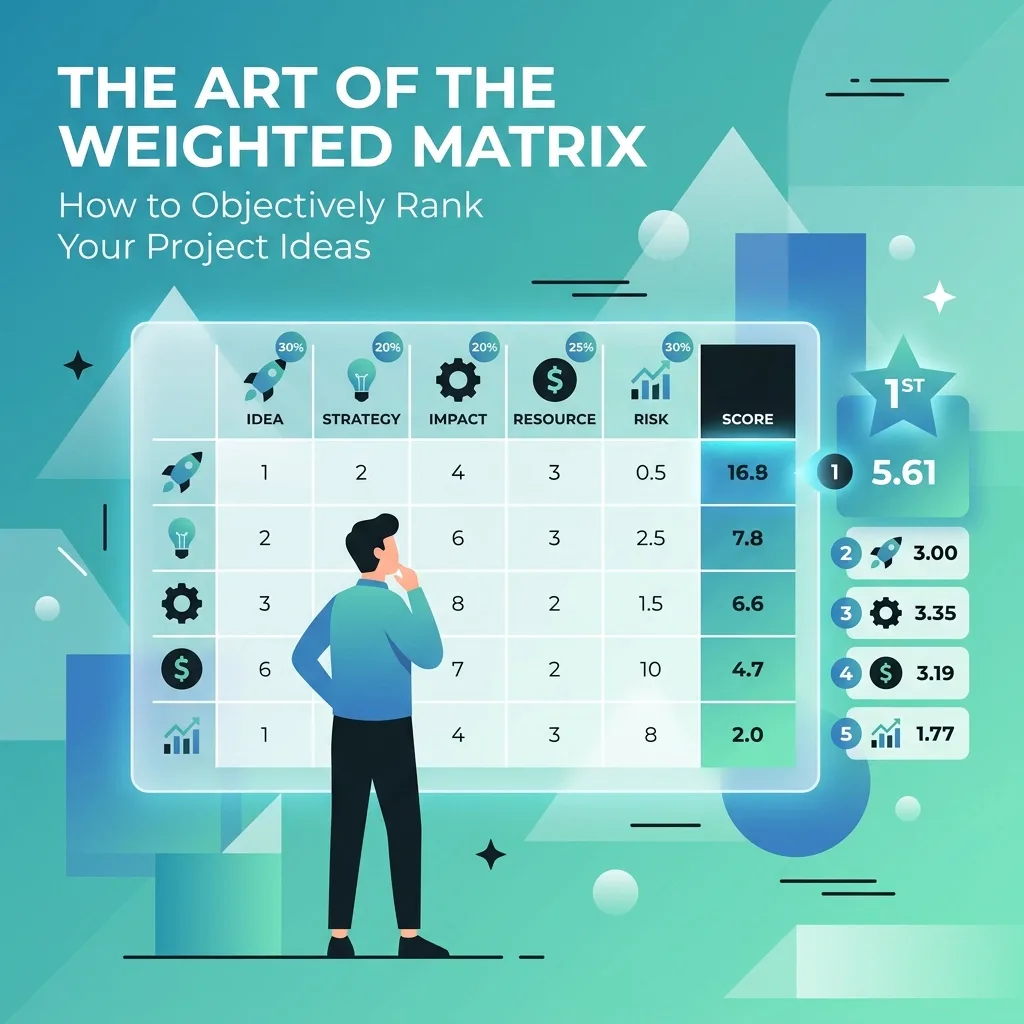
This isn't just a spreadsheet. It’s a filter for the nonsense. It’s how you objectively rank your ideas so that when you present your findings to the board, you have the math to back up every single "yes" and "no."
Why Subjectivity is the Enemy of Excellence
Before we dive into the "how-to," let’s talk about why you need this. When you’re in the Recognise phase, you’re usually looking at a mountain of problems. Shipping is late, the defect rate is climbing, employee turnover is through the roof, and the coffee machine is broken.
If you pick the wrong one, you’re not just wasting money; you’re burning through your team’s morale and your own credibility as a Lean Six Sigma professional. Using a weighted matrix forces you to quantify your priorities. It turns "I think this is important" into "This project scored a 4.8 out of 5 based on our strategic pillars."
The fundamental purpose of this tool is to remove the "Human Factor" (the biased, emotional part of our brains) and replace it with a logical, repeatable process. To fully appreciate the power of this, you have to realize that not all problems are created equal. Some are just "noise," while others are Critical to Quality (CTQ) issues that directly impact your bottom line.
Step 1: Define Your Criteria (The "What Matters" List)
You can’t rank anything if you don’t know what "good" looks like. In the Recognise phase, your first job is to huddle with your stakeholders and decide what criteria should dictate a project’s worth.
Don't just stick to the basics. Look at the big picture. Common criteria include:
- Financial Impact: How much hard or soft cash is this going to save or generate?
- Strategic Alignment: Does this actually help the company reach its 2026 goals, or is it a side quest?
- Customer Impact: Will the customer actually notice if we fix this? (Check your Voice of the Customer Priority Matrix for this).
- Ease of Implementation: Do we have the resources, or are we trying to build a rocket ship with a rubber band?
- Urgency: If we don't do this now, will the house burn down?

Step 2: Weighting the Criteria (The "Power" Play)
This is where the "Weighted" part of the Weighted Matrix comes in. Not every criterion is equally important. In a high-growth startup, "Strategic Alignment" might be a 10, while "Ease of Implementation" is a 2. In a struggling manufacturing plant, "Financial Impact" is probably the heavyweight.
You assign a weight to each criterion, usually on a scale of 1 to 10.
- High Importance (9-10): Non-negotiable strategic drivers.
- Medium Importance (4-8): Essential but not the primary focus.
- Low Importance (1-3): "Nice to have" benefits.
Pro-tip: Totaling your weights to 100% or using a simple 1-10 scale is fine, as long as everyone agrees on the weights before you start looking at the project ideas. If you adjust the weights after you see the scores, you’re just cheating to get the result you want. Don't be that person.
Step 3: Scoring the Contenders
Now, bring in your project ideas. Maybe you’ve identified five potential lean projects during your SIPOC analysis.
For each project, you give it a score (typically 1-5 or 1-10) for how well it satisfies each criterion.
- Does Project A have a high financial impact? Give it a 9.
- Is Project A impossible to implement without hiring ten new engineers? Give it a 2 for "Ease of Implementation."
This is where the magic of the Recognise phase happens. You’ll start to see that some "great ideas" are actually nightmares in disguise. You might find a Quick Win that scores decently across the board, or a massive overhaul that is technically impressive but scores a zero on strategic alignment.
Step 4: The Math (Crunching the Numbers)
Don't worry, you don't need a PhD in statistics for this: save that for the Analyse phase. The calculation is simple:
Weighted Score = (Rating x Weight)
Sum up all the weighted scores for each project to get the "Total Score."
For example:
-
Project: Reduce Shipping Errors
- Financial Impact (Weight 10) x Score 8 = 80
- Ease of Implementation (Weight 5) x Score 4 = 20
- Customer Impact (Weight 10) x Score 9 = 90
- Total Score: 190
-
Project: New Office Layout
- Financial Impact (Weight 10) x Score 2 = 20
- Ease of Implementation (Weight 5) x Score 8 = 40
- Customer Impact (Weight 10) x Score 2 = 20
- Total Score: 80
The numbers don't lie. Even if the office manager really wants that new layout, the "Shipping Errors" project is clearly the high-value target. If you want to make this even easier, we have a Project Selection Scoring Calculator that does the heavy lifting for you.
Step 5: Analyzing the Results and Picking the Winner
Once you have your rankings, it’s time to make a decision. But a word of caution: the highest score isn't always the automatic winner. It’s a guide.
If your top two projects are within 5% of each other, you might need to look at secondary factors, like team availability or risk. This is a great time to perform a Stakeholder Impact Assessment to see who’s going to support or block the project.
In the realm of professional Lean Six Sigma, the Recognise phase is about building a solid foundation. If you can show a steering committee a clean, objective matrix, you’ve already won half the battle. You’re not just a "process person"; you’re a strategic asset who understands how to prioritize resources for maximum impact.
Common Traps to Avoid
Even the best Master Black Belts can fall into these traps if they aren't careful:
- Criterion Overload: Don't have 50 criteria. Stick to 5-8 key drivers. If everything is important, nothing is.
- The "Yes Man" Scoring: Scoring projects high just because you like them. If you’re scoring everything a 9 or 10, your matrix is useless. Be ruthless.
- Ignoring the "Ease" Factor: It’s easy to get blinded by a $1M savings potential, but if the project takes 3 years and requires a total software overhaul, it might not be the best place to start.
- Skipping the Recognise Phase entirely: Going straight into "Solve mode" without verifying that the problem is worth solving.

Putting It Into Practice: A Hypothetical Case Study
Imagine a company, "Precision Parts Inc.," dealing with a 15% defect rate. They have three ideas:
- Project A: Install automated sensors on the line.
- Project B: Retrain the entire staff on 6M Root Cause Analysis.
- Project C: Switch to a cheaper raw material supplier to offset the cost of defects.
By using a Weighted Matrix, they realized that while Project C saved money on paper, its "Customer Impact" score was a 1 because the quality would drop further. Project A had the highest ROI but an "Ease of Implementation" score of 2 because the sensors were backordered for six months.
Project B: the training: scored high across the board. It was easy to do now, aligned with their goal of "Continuous Improvement Culture," and had a solid ROI. Because they used the matrix, they avoided the expensive sensor trap and the "cheap material" disaster. You can see more examples like this in our Lean Six Sigma Hypothetical Project breakdown.
Level Up Your Recognise Phase Skills
Mastering the Weighted Matrix is a hallmark of a true Green or Black Belt. It’s the difference between being a "helper" and being a leader. If you’re ready to stop guessing and start delivering results that actually move the needle, it’s time to get serious about your certification.
At Lean 6 Sigma Hub, we don't just teach you how to fill out a spreadsheet. We teach you how to think like a Master Black Belt: strategically, objectively, and decisively.
Ready to lead high-impact projects and command the salary you deserve? Explore our accredited certification programs today.
- Get Your Green Belt Certification – Perfect for those ready to lead departmental improvements.
- Step Up to Black Belt – For leaders ready to tackle enterprise-wide transformation.
- Master the Boardroom with Master Black Belt – The pinnacle of Lean Six Sigma expertise.
Don’t leave your career: or your projects: to chance. Use the data. Rank the results. Win the game. Enrol in our Lean Six Sigma training now!