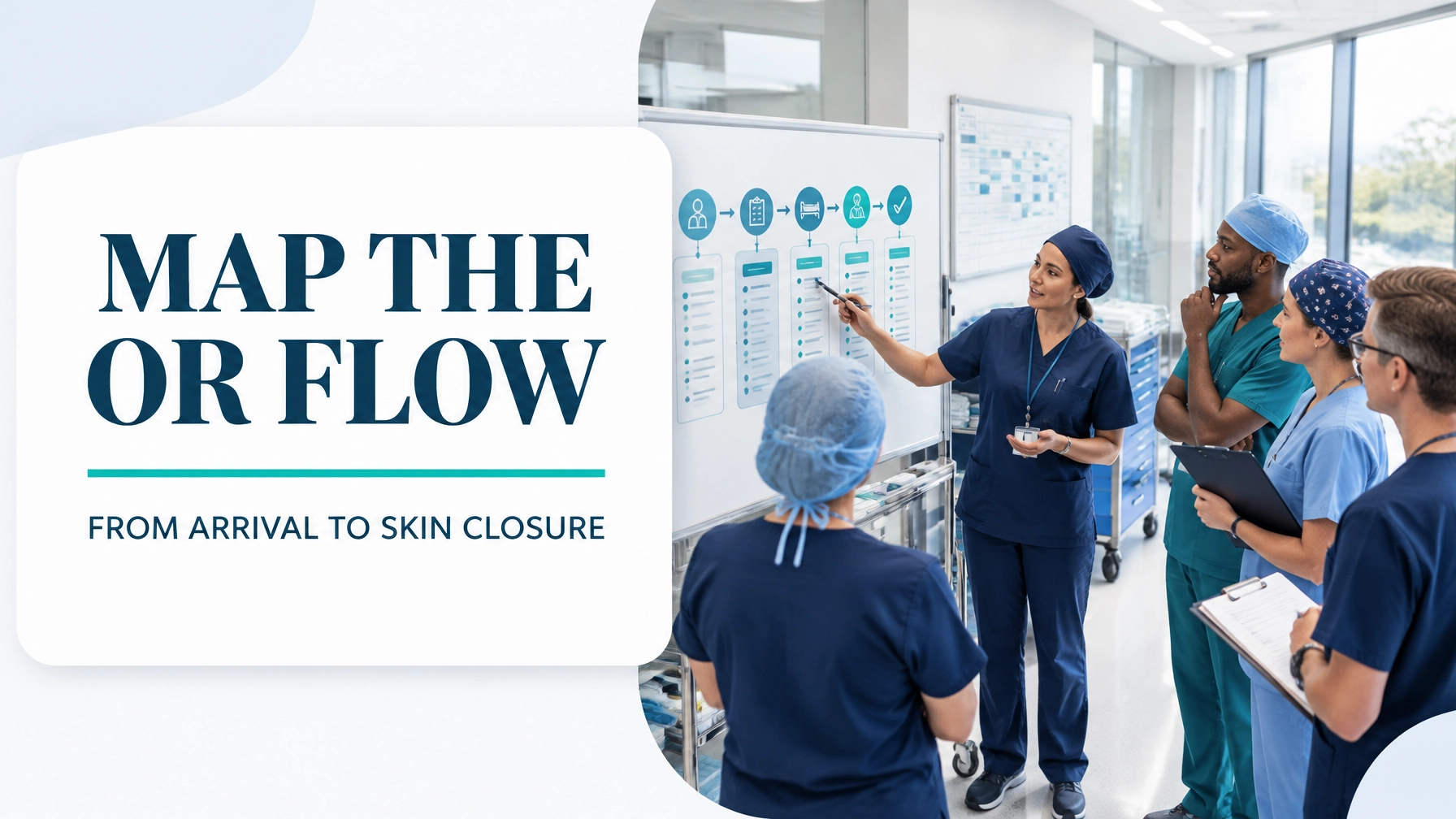
In the realm of hospital operations, surgical flow is more than a scheduling concern. It is a connected system that affects patient safety, staff workload, operating room capacity, overtime, clinician experience, and hospital revenue.
When a patient waits in pre-operative care, when an anaesthesia team is not ready, or when a room remains unavailable during turnover, the delay rarely stays isolated. It propagates through the day. A 20-minute morning delay can become a late afternoon finish, cancelled elective cases, additional overtime, and reduced access for patients.
Value Stream Mapping (VSM) makes this flow visible. It connects patient movement, clinical work, information, equipment, and waiting time in one current-state view. The objective is not to make teams work faster at the expense of safety. The objective is to remove avoidable delay while protecting clinical decision-making, infection prevention, consent, identification, surgical time-out, and discharge criteria.
This guide presents a worked healthcare micro-industry example for an elective same-day operating room pathway.
1. Select a Clear Scope Before Mapping
A useful VSM begins with a disciplined boundary. For this example, the scope is:
- Start: Patient arrival in the pre-operative bay
- End: Skin closure in the operating room
- Included: Pre-op assessment, consent verification, anaesthesia preparation, patient transport, room readiness, procedure, and turnover to the next elective case
- Excluded: Emergency add-ons, trauma cases, inpatient bed flow, post-anaesthesia care unit discharge, and overnight admissions
The process family is therefore the elective same-day surgical journey. Emergency cases remain important, but mixing them into the first map would combine fundamentally different demand patterns, priorities, and response requirements.
Before collecting data, the team should agree on operational definitions:
- First-case on-time start: incision begins within 5 minutes of the scheduled time
- Turnover time: previous patient exits the OR until the next patient enters the OR
- Case duration: incision to skin closure
- Weekly capacity opportunity: additional elective cases that could be accommodated using recovered OR time, subject to staffing, equipment, demand, and clinical governance
A VSM should be created at the gemba. Observe the actual pathway, compare timestamps, and ask staff where work waits: not merely where the policy says it should occur.
2. Current-State Map: Where the Surgical Turnover Lag Begins
Consider an eight-OR surgical suite handling 42 elective cases per week.
The baseline is:
- Average scheduled case duration: 92 minutes
- Average actual case duration: 121 minutes
- Average turnover time: 47 minutes
- Turnover benchmark: 25 minutes
- First-case on-time start rate: 58%
- Operating schedule: 8 ORs × 5 days = 40 OR-days per week
- Average elective volume: 8.4 cases per day
A simplified current-state map looks like this:
Patient arrival
   ↓
Pre-op assessment and readiness verification
   ↓ waiting for labs, consent, surgeon or anaesthesia
Anaesthesia preparation
   ↓ waiting for room release or equipment
OR entry and positioning
   ↓
Procedure: scheduled 92 min / actual 121 min
   ↓
Patient exits OR
   ↓ waiting for cleaning, instruments and room setup
Turnover: average 47 min
   ↓
Next patient enters OR
   ↓
Next case begins
The difference between scheduled and actual case time is 29 minutes per case. The difference between current and benchmark turnover is another 22 minutes. Together, the process carries approximately:
29 + 22 = 51 avoidable minutes per case
At 42 cases per week:
42 × 51 = 2,142 minutes, or 35.7 OR-hours per week
If a future-state elective case cycle requires approximately 117 minutes: 92 minutes for the procedure plus 25 minutes for turnover: the recovered time represents:
35.7 ÷ 117 = 0.305 of a case per case equivalent
Across the weekly volume, the suite has a modelled capacity opportunity of approximately 11.9 additional cases per week, rounded conservatively to 12 cases. This is not an automatic promise of 12 extra surgeries. It is recoverable capacity that must be validated against demand, staffing, surgeon availability, instruments, anaesthesia coverage, and patient safety controls.

3. The Eight DOWNTIME Wastes in OR Flow
The DOWNTIME framework helps the team classify waste without blaming individuals.
-
Defects
Missing consent, incomplete pre-op documentation, unavailable implants, or incorrect instrument trays create rework and delay. -
Overproduction
Reserving excessive blocked time “just in case” can reduce access for other patients. Creating duplicate paperwork or preparing unnecessary equipment also consumes capacity. -
Waiting
Surgeons wait for rooms, anaesthesia waits for patient readiness, patients wait in pre-op bays, and nurses wait for instruments released from decontamination. -
Non-utilised talent
OR nurses, technicians, porters, and environmental services staff often understand the delay causes best, yet may not be involved in redesign decisions. -
Transportation
Patients, equipment, specimens, and instrument sets travel between pre-op, ORs, sterile processing, PACU, and storage areas. -
Inventory
Excess sterile stock, duplicate preference cards, and instrument sets held in the wrong location increase search time and handling. -
Motion
Staff walk to retrieve equipment, locate missing supplies, print documents, or find a functioning workstation during turnover. -
Extra-processing
Repeated readiness calls, duplicate chart checks, manual transcription, and multiple handoffs add work without improving patient value.
The current-state map should identify the waste at the point of occurrence. For example, “turnover delay” is too broad. A stronger observation might state: “Instrument set unavailable for 11 of 30 observed turnovers, creating an average 8-minute wait.”
4. Future-State Design: Parallel Preparation and Standard Work
The future state should not simply set a 25-minute target. It must redesign the work that makes the target achievable.
Create parallel preparation
Instead of waiting for one step to finish before beginning the next:
- Start environmental cleaning immediately after patient exit.
- Move clean equipment and standard supplies into position while cleaning progresses.
- Prepare the next patient in pre-op while the room is being turned over.
- Confirm instruments and implants before the previous case ends.
- Assign a visible owner for each readiness condition: room, patient, equipment, instruments, and team.
A standard turnover kit can contain commonly required supplies, positioning aids, labels, documentation prompts, and approved cleaning materials. The kit should be replenished outside the critical turnover window using a simple two-bin or par-level system.
Use a visual readiness signal
An Andon-style visual signal can show:
- Green: patient, team, room, equipment, and instruments ready
- Amber: one issue is being resolved
- Red: the next case cannot safely proceed
The signal should trigger support, not pressure staff to bypass safety checks. Escalation rules should specify who responds and within what time.
Complete discharge planning before surgery
For applicable same-day procedures, begin discharge readiness before the operation:
- Confirm escort and transport arrangements during pre-op.
- Complete patient education and medication reconciliation early.
- Identify potential discharge barriers before the patient enters the OR.
- Prepare follow-up instructions and prescriptions in advance.
- Maintain all clinical discharge criteria and post-anaesthesia assessments without shortcuts.
This reduces downstream waiting and prevents a full PACU or short-stay unit from becoming the next bottleneck.
5. Current State Versus Future State
The following table uses an illustrative contribution value of $3,500 per additional elective case. Actual financial modelling should use the hospital’s approved net revenue or contribution margin.
| Measure | Current state | Future-state target | Improvement |
|---|---|---|---|
| Average turnover time | 47 min | 25 min | 22 min saved |
| First-case on-time start | 58% | 90% | +32 percentage points |
| Average cases per day | 8.4 | 10.8 | +2.4 cases/day |
| Effective elective room utilisation | 53% | 68% | +15 percentage points |
| Weekly overtime | 21 hours | 8 hours | 13 hours reduced |
| Weekly revenue opportunity | Baseline | $41,650 | 11.9 × $3,500 |
The improvement target should be validated through a pilot. A high-performing future state is not achieved by moving delay from the OR to pre-op, sterile processing, PACU, or staff overtime.
6. A 90-Day Kaizen Sequence
A practical implementation sequence is:
Days 1–15: Define and measure
- Confirm definitions for turnover and on-time starts.
- Collect timestamps for at least 30 turnovers per OR where possible.
- Stratify results by surgeon, procedure type, OR, shift, and delay reason.
- Build a Pareto chart of the largest delay categories.
- Validate the measurement system with nurses, anaesthesia, surgeons, and operations analysts.
Days 16–30: Analyse and design
- Conduct a cross-functional current-state VSM workshop.
- Time each turnover element separately.
- Identify internal work that can become external preparation.
- Create standard turnover kits and room-readiness checklists.
- Design the visual readiness board and escalation process.
Days 31–60: Pilot and improve
- Pilot in two ORs with similar elective case profiles.
- Test parallel cleaning, equipment preparation, patient transport, and instrument confirmation.
- Run daily 10-minute huddles.
- Track turnover median, 90th percentile, first-case starts, defects, and safety exceptions.
- Adjust standard work using frontline feedback.
Days 61–90: Control and scale
- Expand successful practices across the remaining six ORs.
- Establish weekly control charts for turnover time.
- Review first-case delays by coded reason.
- Audit kit completeness and readiness-board use.
- Report capacity, overtime, staff experience, and patient-flow outcomes to governance leaders.
The broader DMAIC structure supports this sequence: Define the opportunity, Measure the actual pathway, Analyse root causes, Improve the flow, and Control the gains.

7. Build the Capability to Lead the Change
Operating room VSM is a cross-functional improvement project. Nurses and OR managers need the ability to facilitate mapping, interpret process data, manage stakeholders, and test countermeasures without losing sight of clinical quality.
A CSSC-accredited Lean Six Sigma Green Belt course is well suited to nurses, OR managers, quality professionals, and project leads who will run focused improvement projects.
Perioperative directors and enterprise transformation leaders may benefit from the more advanced Lean Six Sigma Black Belt training, which covers complex analysis, cross-functional leadership, advanced SPC, project governance, and sustained organisational change.
For additional project structure, review the Lean Six Sigma project storyboard toolkit and process bottleneck analysis guide.
Start mapping your elective surgical pathway, quantify the turnover opportunity, and pursue Lean Six Sigma certification to lead safer, faster, more reliable perioperative improvement.
Kaizen. Kai-Care. Kai-Done. ( Lean Six Sigma)