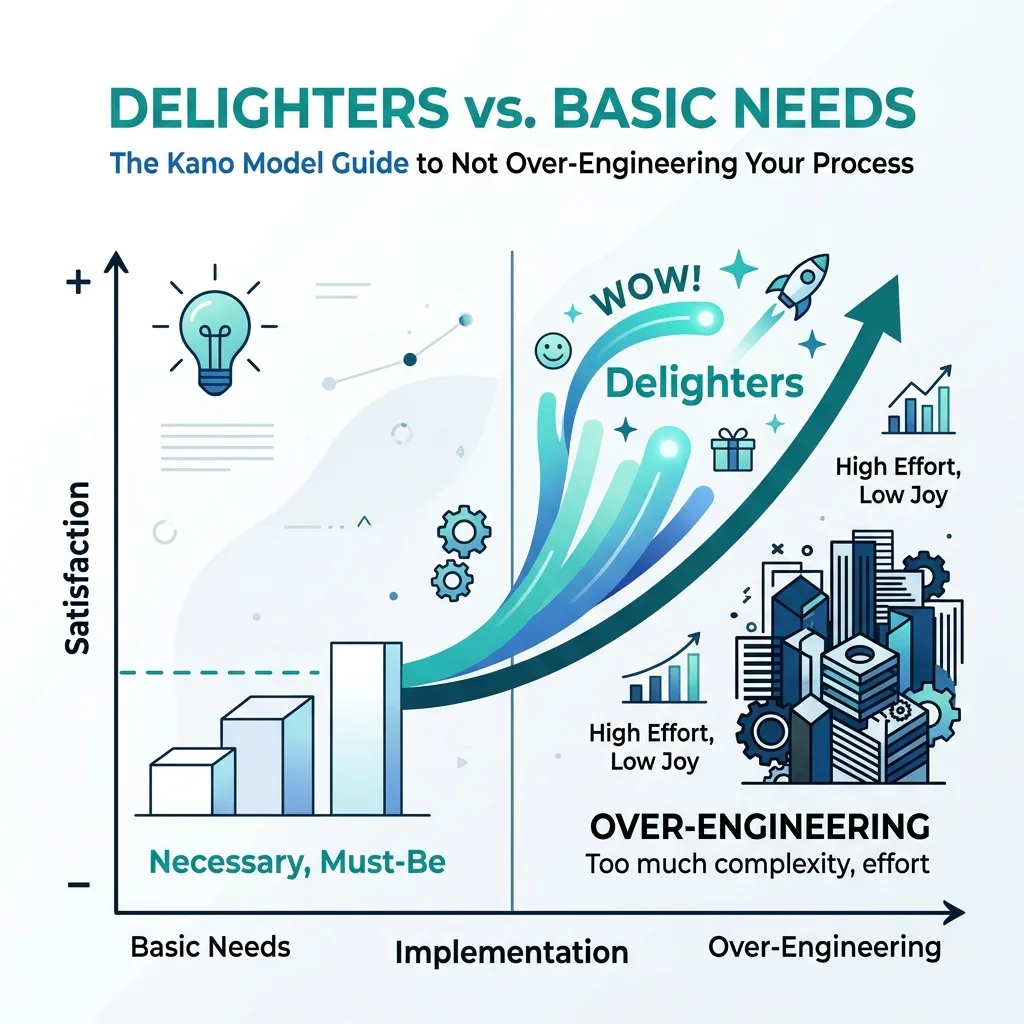
In the realm of Lean Six Sigma, the pursuit of operational excellence often leads practitioners down a treacherous path: the trap of over-engineering. In an earnest attempt to provide "value," project teams frequently layer on features, steps, and complexities that the customer never requested and, quite frankly, does not want to pay for. This phenomenon represents a fundamental misunderstanding of the Voice of the Customer (VOC). To navigate this complexity, seasoned professionals turn to the Kano Model: a robust analytical framework designed to categorize customer requirements and prevent the waste of over-processing.
To fully appreciate the Kano Model, one must first recognize that not all "quality" is created equal. Some attributes are non-negotiable foundations, while others are mere distractions if the basics are not secured. Understanding these nuances is a core component of any Lean Six Sigma concepts and glossary mastery.
The Strategic Imperative of Understanding Customer Value
The fundamental purpose of the Kano Model is to challenge the assumption that customer satisfaction is a linear equation. Many managers mistakenly believe that adding more features always results in a happier client. The reality is far more complex. Noriaki Kano’s research demonstrated that certain features are expected as a baseline, while others can exponentially increase satisfaction despite being unexpected.
When a process is over-engineered, it often means the team has prioritized "Delighters" at the expense of "Basic Needs." This is not just a tactical error; it is a strategic failure that can lead to project rejection during tollgate reviews in Lean Six Sigma.
Decoding the Kano Model: The Three Tiers of Quality
The Kano Model categorizes process outputs into three distinct categories. To achieve a state of high-performance operational efficiency, practitioners must prioritize these tiers with clinical precision.
1. Basic Needs (The Must-Be Requirements)
In the context of the Kano Model, Basic Needs (also known as Threshold or Must-Be attributes) are the absolute minimum requirements. They are the "price of entry" for any process or product. The paradox of Basic Needs is that their presence does not significantly increase customer satisfaction, but their absence causes immediate and intense dissatisfaction.
Consider a commercial airline. A "Basic Need" is that the plane lands safely at the correct destination. If the airline achieves this, the passenger is not "delighted": they simply consider the service fulfilled. However, if the plane lands in the wrong city, no amount of free champagne (a Delighter) will compensate for the failure of the Basic Need. In your internal processes, these are the Critical to Quality (CTQ) elements that must be identified early using a Critical to Quality (CTQ) Tree Calculator.
2. Satisfiers (Performance Needs)
Satisfiers represent the attributes where "more is better." There is a direct, linear relationship between the performance of these attributes and customer satisfaction. The customer is typically very vocal about these needs during the initial process mapping in the measure phase.
Examples include:
- The speed of a software interface.
- The fuel efficiency of a vehicle.
- The turnaround time for a loan approval.
Because these are competitive benchmarks, organizations often spend the majority of their time trying to optimize these metrics. While important, they must never be optimized at the cost of the Basic Needs.
3. Delighters (Excitement Needs)
Delighters are the unexpected "wows." These are features the customer didn't know they wanted until they saw them. Because they are unexpected, their absence does not cause dissatisfaction, but their presence can lead to high levels of brand loyalty and premium pricing.
However, this is where over-engineering begins. Teams often get seduced by the allure of Delighters, spending thousands of hours developing features that are essentially "gold-plating." If your process documentation is weak: refer to our guide on effective process documentation: adding Delighters is like putting a fresh coat of paint on a crumbling foundation.
The Technical Execution: Mapping the Voice of the Customer (VOC)
To avoid the pitfalls of subjective guessing, Lean Six Sigma professionals use the Kano Questionnaire. This involves asking two specific questions for every potential feature:
- Functional Question: "How do you feel if this feature is present?"
- Dysfunctional Question: "How do you feel if this feature is absent?"
By mapping the responses, we can mathematically categorize features. If a team finds that a feature is categorized as "Indifferent," yet they are spending 20% of their budget on it, they are over-engineering. To streamline this analysis, use the Voice of Customer Priority Matrix Calculator. This tool ensures that your data-driven decisions are grounded in actual customer sentiment rather than departmental ego.

The Danger Zone: Why Over-Engineering Kills ROI
To fully appreciate the cost of over-engineering, one must look at the Return on Investment (ROI). Every hour spent on a feature that the customer classifies as a "Basic Need" beyond the point of "fulfillment" is a wasted hour. Similarly, every "Delighter" added to a process that still fails to meet "Satisfier" benchmarks is a waste of capital.
For instance, if a manufacturing process has not yet stabilized its data normality: which can be checked via the Shapiro-Wilk test: it is far too early to worry about "delighting" the customer with customized packaging. You must fix the process variance first.
Over-engineering often manifests as:
- Excessive precision: Measuring to the fourth decimal place when the customer only cares about the first.
- Redundant approvals: Adding "checks on checks" that do not improve the quality of the Basic Need.
- Feature creep: Adding software buttons that only 1% of users will ever click.
Before committing to a long-term solution that might be over-engineered, consider if a "Quick Win" would suffice. Our guide on quick wins vs. long-term solutions provides a framework for this exact dilemma.
The Decay of Delight: The Time Factor
A critical, often overlooked aspect of the Kano Model is that Delighters eventually become Basic Needs. This is known as the "Decay of Delight."
In the 1990s, remote keyless entry for a car was a "Delighter." Today, if you buy a new car and have to put a physical key in the door lock, you are dissatisfied. It has transitioned from an excitement feature to a Basic Need. This means that "innovation" is not a one-time event; it is a continuous cycle of re-evaluation.
If your organization is still relying on lessons learned documentation from five years ago to define customer needs, you are likely failing to meet current Basic Needs while trying to sell yesterday's Delighters.
Implementation Protocol: A Step-by-Step Guide
To ensure your process improvement project remains focused and avoids the complexity trap, follow this protocol:
- Identify the Attributes: List every feature or process step currently in scope.
- Classify via Kano Survey: Use the functional/dysfunctional question pairing to categorize each attribute.
- Audit the "Basic Needs": Ensure these are 100% stable and fulfilled. Use a Project Charter ROI Calculator to justify the spend on these foundational elements.
- Optimize the "Satisfiers": Look for the point of diminishing returns. Use an optimization plot to find the "sweet spot" where performance meets cost-effectiveness.
- Strategically Select "Delighters": Pick one or two low-cost, high-impact Delighters that provide a competitive edge without adding process complexity.
- Eliminate "Indifferent" and "Reverse" attributes: If the data shows the customer doesn't care or finds a feature annoying, delete it immediately. This is the purest form of Lean.
Conclusion: Discipline Over Complexity
The Kano Model is not just a "nice-to-have" tool; it is a disciplinary framework for the modern professional. In an era where we are inundated with data, the ability to distinguish between what is "required" and what is "extra" is the hallmark of a true Six Sigma leader. Stop guessing what your customers want. Stop over-engineering processes that are fundamentally broken at the "Must-Be" level.
By applying the Kano Model with the technical rigor expected of a Master Black Belt, you ensure that every resource spent is an investment in genuine value, not just a contribution to organizational noise.
The path to mastery requires more than just reading; it requires rigorous, accredited training that bridges the gap between theory and high-stakes execution.
Elevate your professional standing and organizational impact by pursuing your certification today. Explore our comprehensive Lean Six Sigma Hub training programs and secure your place among the elite practitioners of process excellence.