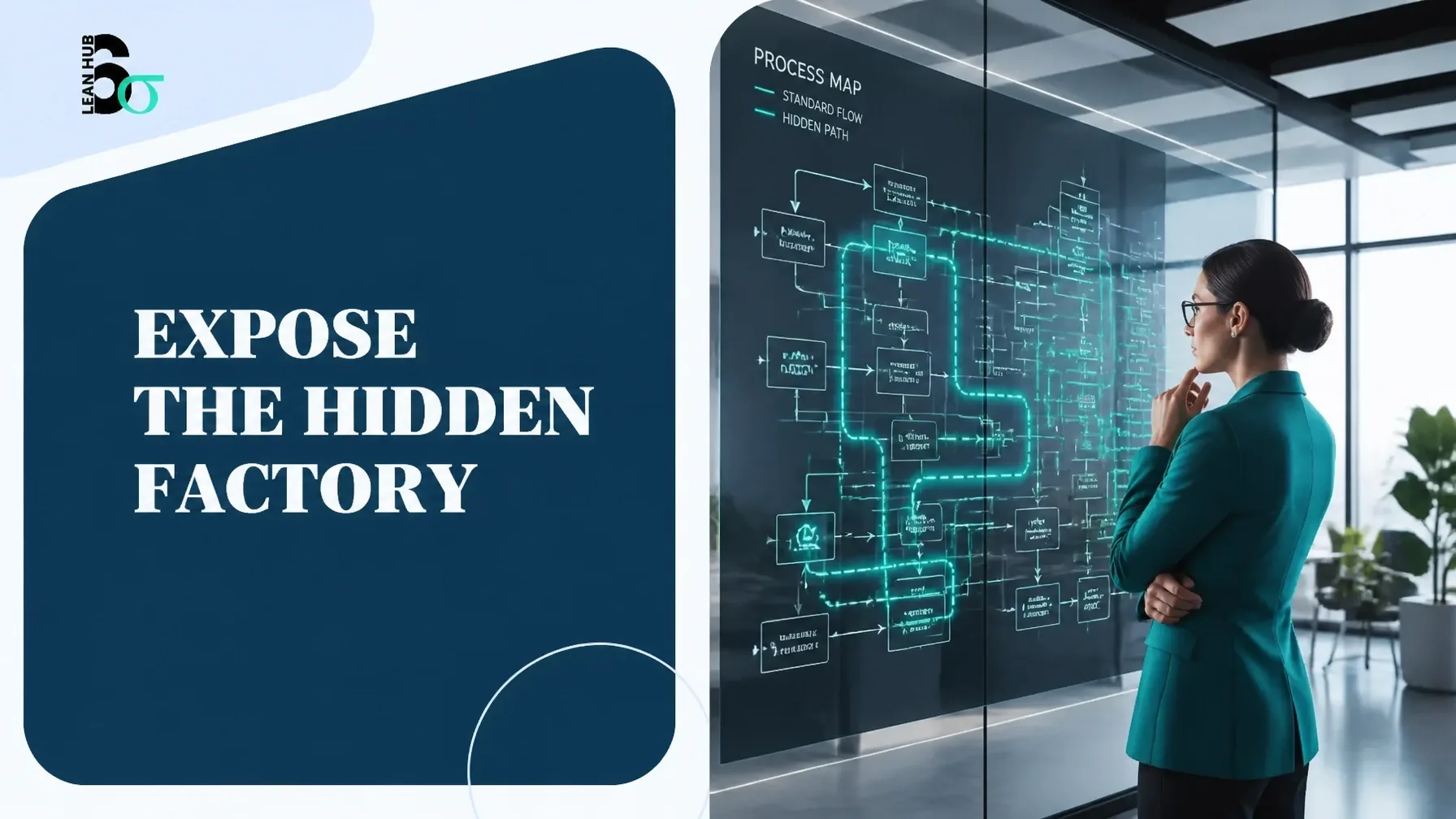
In the realm of operational excellence, what you see is rarely the whole truth. Most organizations operate under the delusion that their "standard operating procedures" are the reality of their daily work. They look at their output metrics, see a 90% success rate, and congratulate themselves on a job well done.
To fully appreciate the gravity of the situation, you must realize that those "successes" are often hiding a graveyard of wasted effort, redundant checks, and unofficial workarounds. This is the Hidden Factory: the untracked, undocumented, and unplanned work that consumes your capacity and erodes your profits. If you aren't mapping these "ghost processes," you aren't managing your business; you're just riding a wave of chaos and hoping for the best.
What is the Hidden Factory?
The fundamental purpose of any process is to transform inputs into value for the customer. However, between the input and the final deliverable, a shadow process often emerges. Originally coined by Armand Feigenbaum, the Hidden Factory represents the additional work required to correct errors, defects, or process failures.
We are talking about Waste (Muda) in its most insidious form. Whether it is a manufacturing operator reworking a part at their station because the tool is slightly off, or an office worker manually re-entering data because two software systems don't talk to each other, these are the "silent killers" of productivity. These activities constitute the eight DOWNTIME wastes: Defects, Overproduction, Waiting, Non-utilized talent, Transportation, Inventory, Motion, and Extra-processing.
The Mathematical Reality: Y = f(x)
In Lean Six Sigma, we live by the formula Y = f(x). This means that the output (Y) is a function of the various inputs and process variables (x). When you ignore the Hidden Factory, you are ignoring critical "x" variables that are dictating your results.
Most managers focus solely on the final "Y": the shipping report or the completed service. But if your process is rife with Variation, your "Y" will be unpredictable. You need to differentiate between common cause variation (the inherent noise in the system) and special cause variation (unforeseen disruptions). The Hidden Factory is often the result of people trying to "fix" special cause variation with undocumented ad-hoc solutions, which only introduces more instability into the system.

Measuring the Invisible: FPY vs. RTY
To expose the Hidden Factory, you must stop looking at simple "Yield" and start looking at Rolled Throughput Yield (RTY).
- First Pass Yield (FPY): This measures the percentage of units that complete a single step correctly the first time. It's a localized metric that often looks great while the overall system is failing.
- Rolled Throughput Yield (RTY): This is the probability that a unit will pass through the entire process without a single defect or rework requirement.
If you have a 5-step process where each step has a 95% FPY, your RTY is actually only about 77%. That means nearly a quarter of your work is passing through the Hidden Factory. This is where your Throughput (the units produced per period) is being strangled. By tracking RTY, you gain a clear Voice of the Process (VOP), which reveals whether your performance actually meets the Voice of the Customer (VOC).
The Roadmap: How to Map Your Ghost Processes
Mapping the Hidden Factory requires a high-attitude approach to truth-seeking. You cannot do this from a boardroom; you must go to the Gemba: the place where the work actually happens.
1. Create the "As-Is" Value Stream Map
Start with a high-level Value Stream Mapping (VSM) exercise. Identify all the steps from start to finish, including material and information flow. Use tools like the SIPOC Complexity Score Calculator to understand the initial boundaries of your project.
2. Identify the Rework Loops
This is the most critical step. Where does the work go when it fails? Look for the "hidden loops": the places where Work in Process (WIP) accumulates because something wasn't done right the first time. Are people using manual spreadsheets to "verify" what the system already did? That's a ghost process. Are they waiting for a "quick check" from a supervisor? That’s Waiting waste.
3. Classify the Value
For every step you find, ask: Is this Value? Value is defined by the customer's willingness to pay. If the customer wouldn't pay for the rework, it shouldn't be there. Use a Voice of Customer Priority Matrix to align your process steps with measurable CTQ (Critical to Quality) requirements.
4. Quantify the Capacity Loss
Calculate your Process Cycle Efficiency. When you factor in the time spent in the Hidden Factory, you will likely find that your value-added time ratio is embarrassingly low: often less than 5%.

Leveraging the Analyze Phase (DMAIC)
Once you have exposed the Hidden Factory, you move into the Analyze Phase (DMAIC). This is where you identify the root causes of the rework through statistical and visual tools.
You need a team that understands these principles. This isn't a job for the untrained:
- White Belts provide the basic awareness to spot waste.
- Yellow Belts support the project as trained team members who understand the essential tools.
- Green Belts manage the data-driven decision-making and lead smaller project segments.
- Black Belts are the advanced practitioners who lead these complex overhauls and mentor the team.
- Master Black Belts build the governance frameworks to ensure these hidden factories don't rebuild themselves the moment you look away.
By analyzing the data, you can determine if your Voice of the Business (VOB): your need for profitability and efficiency: is being balanced with the customer's needs. If your Throughput is limited by a specific step, you have found a Bottleneck. Systematically improving that limiting factor is the only way to lift the entire system's performance.
The People Solution: Building Capability
The Hidden Factory is ultimately a result of a lack of process discipline and capability. To kill the ghost processes, you must build a culture of Zero Defects. This philosophy, popularized by Philip Crosby, promotes doing things right the first time. It is not an impossible dream; it is a management standard.
When your team is trained in Lean Six Sigma, they stop accepting "workarounds" as a part of the job. They start seeing them as the enemies of efficiency. They learn how to use an LSS Black Belt Sample Project as a template for driving organizational change and securing leadership buy-in through a solid Business Case.

Conclusion: Expose or Be Eroded
The Hidden Factory is eating your margins. It is slowing down your deliveries, frustrating your employees, and hiding the true potential of your business. Mapping the work you didn't know you were doing is the first step toward reclaiming your capacity.
Don't let your "average" success blind you to the waste beneath the surface. Use the tools of Lean Six Sigma to shine a light on the ghost processes and eliminate them once and for all. The path to world-class efficiency starts with the courage to see the process as it really is, not as you wish it to be.
Take the first step toward mastery. Pursue your Lean Six Sigma certification with Lean 6 Sigma Hub today and start leading the change your organization desperately needs.