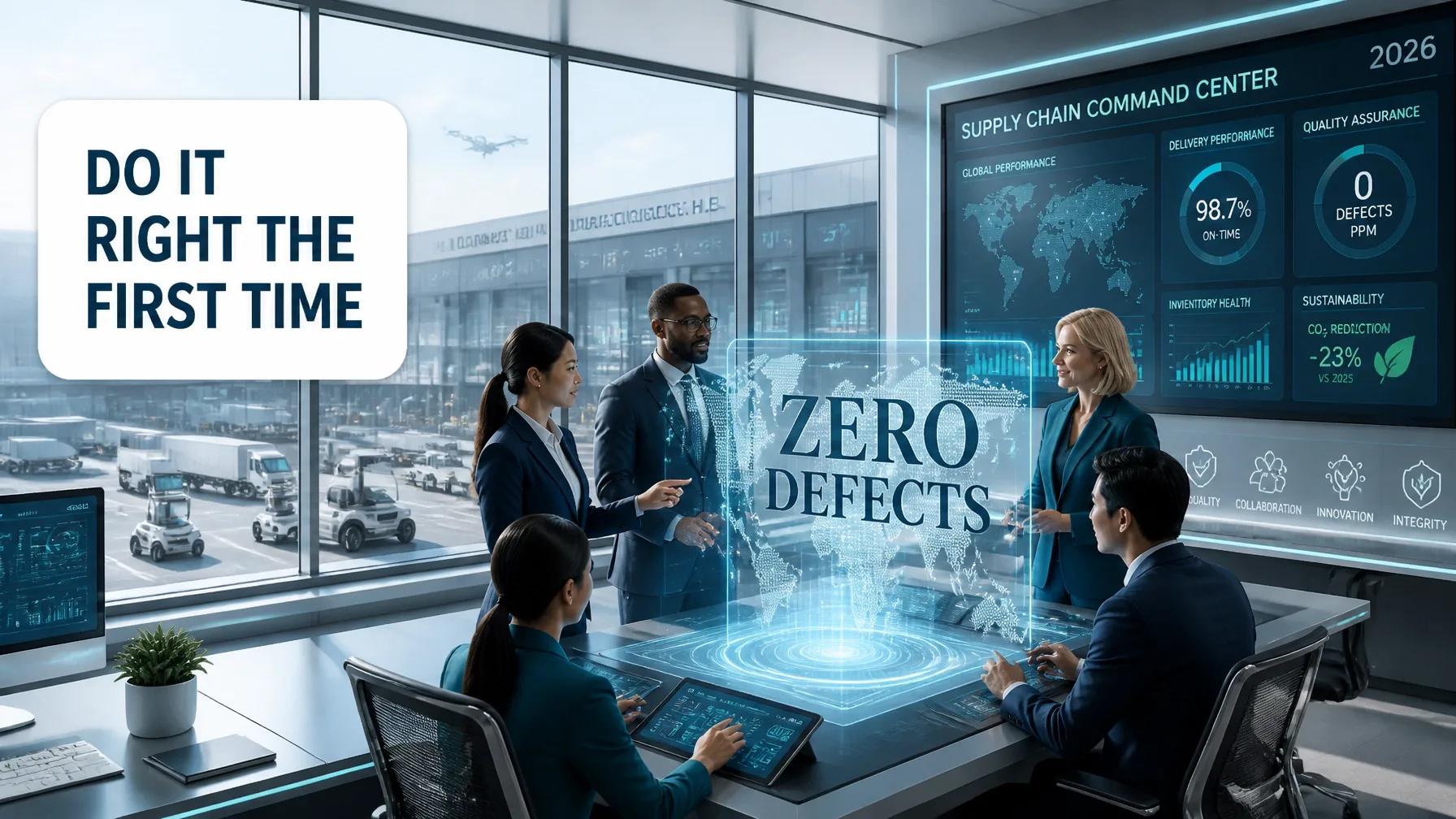
In the realm of modern operations, we have been fed a dangerous lie. We are told that "to err is human" and that a certain percentage of failure is just the "cost of doing business." We accept Return Material Authorizations (RMA), freight claims, and shipping errors as if they were natural laws of physics.
Let’s be clear: they are not.
To fully appreciate the competitive landscape of 2026, one must realize that "good enough" is a slow-acting poison. Every time a defective product leaves your warehouse, every time an incorrect SKU is loaded onto an automated carrier, and every time a data entry error delays a customs clearance, you are bleeding capital.
Philip Crosby, the legendary quality guru, famously asserted that Quality is Free. He didn't mean that quality systems don't require investment; he meant that the investment in doing things right the first time is a fraction of the cost of doing them wrong. This is the Zero Defects philosophy. It isn't a motivational slogan for a breakroom poster; it is a rigorous, data-driven management system designed to eliminate the Price of Non-Conformance (PONC).
The Four Absolutes of Quality Management
To implement a Zero Defects strategy, you must first discard the outdated notion that quality is "luxury" or "goodness." In the Crosby framework, quality has a binary definition.
1. Quality is Conformance to Requirements
The fundamental purpose of any process is to meet a specific set of requirements. In a supply chain context, this means your On-Time, In-Full (OTIF) rate isn't a goal: it’s a requirement. If the requirement is 100%, then 98.5% isn't "pretty good"; it is a failure. Quality is achieved when every person and every machine performs exactly what they have been asked to do.
2. The System of Quality is Prevention, Not Inspection
Relying on inspection to "catch" errors is like trying to lose weight by just standing on a scale. Inspection is expensive, reactive, and ultimately ineffective because the defect has already occurred. True Lean Six Sigma practitioners, such as those trained through our Green Belt and Black Belt programs, focus on Error-Proofing (Poka-Yoke) and process control to ensure defects cannot be created in the first place.
3. The Performance Standard is Zero Defects
This is where most organizations lose their nerve. They set a "standard" of 95% or 99%. By doing so, they are effectively telling their employees that it is acceptable to fail 1% or 5% of the time. Would you accept a 1% failure rate from your heart surgeon? Would you accept a 5% error rate from the pilot of your next flight? In a 2026 supply chain, where automation and AI move at blistering speeds, a 1% error rate can cascade into a multi-million dollar disaster in hours.
4. Quality is Measured in Money: The Price of Non-Conformance (PONC)
We do not measure quality in "feelings" or "vibe." We measure it in cold, hard cash. Price of Non-Conformance (PONC) includes every cent spent because things weren't done right the first time: rework, scrap, expedited shipping fees, penalties, and lost customer trust. Conversely, the Price of Conformance (POC) is the cost of doing things right (training, process audits, quality planning).

Practical Application: The 2026 Logistics Case Study
To see how this works in the real world, let’s look at a hypothetical 2026 logistics hub: NexusStream Logistics.
NexusStream was struggling with an average Order Accuracy rate of 96.4%. To many, this sounded professional. However, their Master Black Belt conducted a Cost of Quality Evaluation and uncovered the following:
- Average Daily Orders: 10,000
- Daily Defective Orders (3.6%): 360
- Cost per Return (Freight, Labor, Rework): $120
- Daily PONC: $43,200
- Annual PONC (360 days): $15,552,000
NexusStream wasn't just "missing the mark"; they were burning $15.5 million every year because they accepted a 3.6% error rate.
Implementing the 14 Steps
The leadership team at NexusStream moved to implement Crosby's 14 Steps to Quality Improvement, guided by a team of Black Belts.
- Management Commitment: The CEO issued a policy that the performance standard for all outbound shipments is Zero Defects.
- Quality Improvement Team: A cross-functional group from IT, Warehouse, and Procurement was formed.
- Quality Measurement: They deployed real-time IoT tracking to measure exactly where orders were failing (Voice of the Process).
- Cost of Quality: They socialized the $15.5M figure across the entire company.
- Quality Awareness: They shared the PONC data with every floor worker, explaining how a single mis-scan impacts the bottom line.
- Corrective Action: Using A3 Problem Solving and 5 Whys Analysis, they identified that 70% of errors came from a specific legacy labeling software.
- Zero Defects Committee: They planned a transition to a fully automated labeling system.
- Supervisor Training: All warehouse leads were enrolled in Yellow Belt training to master basic process control.
- Zero Defects Day: NexusStream held a "Z-Day" event, launching the new system and signaling a cultural shift.
- Goal Setting: Each shift set a target to reach 99.9% accuracy within 90 days.
- Error-Cause Removal: Employees were given a "Quality Stop" button to halt the line if they noticed a system glitch.
- Recognition: The top-performing shift was awarded based on their First Pass Yield (FPY).
- Quality Councils: Managers met weekly to review data and ensure no regression.
- Do it Over Again: The cycle restarted, moving the focus from shipping to inbound receiving.

The Results: Proof that Quality is Free
After 12 months of relentless adherence to the Zero Defects philosophy, NexusStream achieved a Order Accuracy rate of 99.92%.
- New Daily Defective Orders: 8
- New Daily PONC: $960
- New Annual PONC: $345,600
- Total Savings: $15,206,400
The cost to implement the new software, the training, and the automation was roughly $2.5 million. In Crosby's terms, they spent $2.5M to save $15.2M. Quality was not just free; it was incredibly profitable.

Navigating the Challenges of 2026
In 2026, the supply chain is more complex than Crosby could have ever imagined. We are dealing with global volatility, AI-driven demand forecasting, and carbon footprint requirements. However, the core of Zero Defects remains the same: Prevention.
If you are a White Belt just starting your journey, your role is to understand the language of quality. If you are a Green Belt, you are the one using data to identify these conformance gaps. If you are a Black Belt, you are the architect of the Zero Defects culture.
Do not let the "myth" of human error stop you from achieving perfection. The technology exists. The methodology exists. What is usually missing is the Management Commitment.

Secure Your Competitive Advantage
The world of 2026 has no room for mediocrity. Organizations that continue to tolerate "acceptable" error rates will be out-competed by those who view Zero Defects as their baseline.
Whether you are looking to lead massive organizational change or simply want to master the tools that make "doing it right the first time" possible, your journey starts with formal, accredited training.
Take the first step toward operational excellence. Browse our Lean Six Sigma Training and Certification courses today and join the ranks of professionals driving the zero-defect revolution.