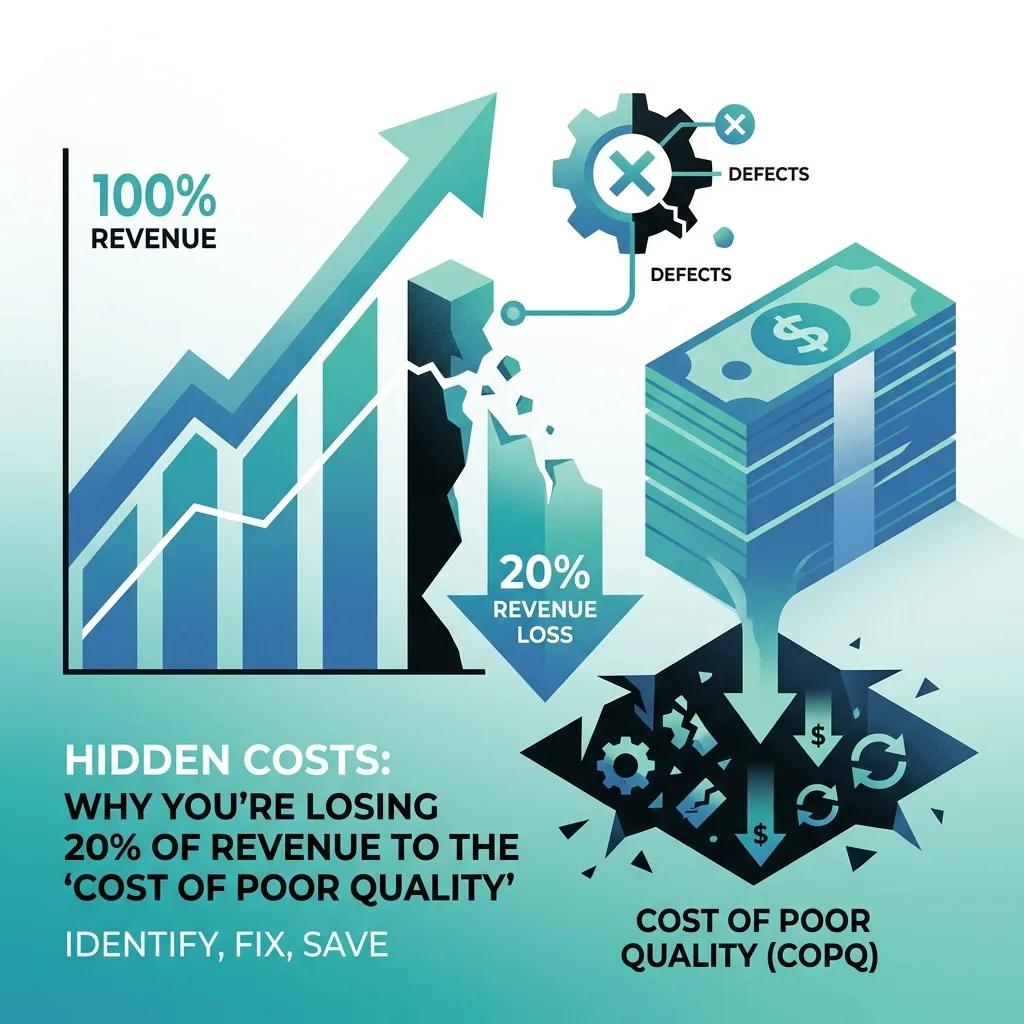
In the realm of modern manufacturing and service delivery, there exists a silent, financial hemorrhage that consumes profitability with surgical precision. While executives often obsess over top-line growth and market expansion, a devastating percentage of their realized revenue: often between 15% and 25%: is being surrendered to a phenomenon known as the Cost of Poor Quality (COPQ).
To the untrained eye, quality costs are merely the price of scrap material and the labor required for rework. However, the fundamental purpose of a sophisticated quality management system is to reveal the "Hidden Factory": the massive, subterranean network of wasted effort, lost capacity, and damaged reputation that never appears as a line item on a standard P&L statement. To ignore COPQ is to remain oblivious to the single greatest opportunity for margin expansion within your organization.
The Technical Anatomy of COPQ
To fully appreciate the magnitude of the problem, one must first master the technical definitions provided within the Lean Six Sigma Hub glossary. COPQ is not a singular metric but a composite of four distinct categories, collectively known as the PAF Model: Prevention, Appraisal, and Failure (both Internal and External).
1. Prevention Costs
These are investments made specifically to keep defects from occurring in the first place. In a high-functioning Lean Six Sigma environment, these are the only "good" quality costs. They include:
- Quality Planning: Designing processes that are inherently robust.
- New Product Review: Utilizing tools like the Critical to Quality (CTQ) Tree to align engineering with customer needs.
- Training: Ensuring the workforce is certified in Lean Six Sigma methodologies.
- Process Control: Implementing statistical process control (SPC) to monitor stability.
2. Appraisal Costs
These are the costs associated with measuring and auditing products or services to ensure they conform to specifications. While necessary in a flawed system, appraisal adds zero value to the customer.
- Inspection: Testing and checking at various stages of production.
- Quality Audits: Confirming that the quality system is functioning as intended.
- Supplier Evaluation: Assessing the quality of incoming raw materials.
3. Internal Failure Costs
These costs occur when a product fails to meet quality standards before it leaves the facility.
- Scrap: Defective parts that cannot be repaired and must be discarded.
- Rework: The labor and overhead required to "fix" a mistake that should never have happened.
- Re-testing: The appraisal cost incurred a second time because the first attempt failed.
4. External Failure Costs
This is the most dangerous category, representing defects found by the customer. The financial impact here is exponential and often includes:
- Warranty Claims: The direct cost of replacement or repair.
- Customer Returns: Logistics and administrative overhead of handling failures.
- Product Recalls: Catastrophic financial and legal exposure.
- Brand Erosion: The unquantifiable loss of future sales due to a damaged reputation.

The Iceberg Effect: Visualizing the Hidden Factory
The most significant danger of COPQ lies in its invisibility. Traditional accounting systems are designed to capture "Visible Costs": the tip of the iceberg. These include scrap, rework, and warranty claims. However, beneath the surface lies the Hidden Factory, where the true financial devastation occurs.
When a process is unstable, the organization develops "workarounds." These are undocumented, non-value-added steps that staff perform daily to compensate for poor quality. Examples include:
- Excessive Inventory: Carrying "safety stock" because the process is too unreliable to guarantee on-time delivery.
- Expediting Costs: Paying premium freight rates to ship replacements for defective parts.
- Overtime: Working weekends not because demand is high, but because the first-pass yield was so low that the quota wasn't met during normal hours.
- Engineering Firefighting: Diverting high-value engineers from innovation to solve recurring quality "fires."
To identify these hidden drains, leadership must employ Process Mapping in the Measure Phase to visualize the actual flow of work versus the "ideal" flow.
The 1-10-100 Rule: The Arithmetic of Failure
The financial impact of a defect scales dramatically depending on when it is discovered. This is often described as the 1-10-100 Rule.
- $1 (Prevention): If you spend $1 on prevention (e.g., proper training or a robust FMEA), the defect never occurs.
- $10 (Appraisal/Internal Failure): If the defect is caught during inspection within your four walls, it costs $10 to fix or scrap.
- $100 (External Failure): If the defect reaches the customer, it costs at least $100 in terms of returns, field service, and lost trust.
In many industries, the multiplier is even more severe. For a $100 million organization, a 20% COPQ means $20 million is being evaporated. By shifting just 2% of revenue toward Prevention and Appraisal, an organization can often reduce Failure costs by 10% or more, resulting in a direct $8 million injection into the bottom line. You can utilize a Project Charter ROI Calculator to model these improvements for your specific business case.
Quantifying the Damage: A Hypothetical Case Study
Consider a mid-sized medical device manufacturer with annual revenues of $50,000,000. On paper, they appear profitable, but their EBITDA margins are stagnant. A deep-dive Lean Six Sigma audit reveals the following:
- Direct Scrap: $1,200,000 (Visible)
- Rework Labor: $850,000 (Visible)
- Customer Returns/Warranty: $900,000 (Visible)
- Hidden Factory (Overtime and Expediting): $2,200,000 (Hidden)
- Lost Capacity: $3,500,000 (Hidden – revenue they could have generated if machines weren't producing scrap)
- Engineering Firefighting: $1,400,000 (Hidden)
Total COPQ: $10,050,000 (20.1% of Revenue)
By implementing a rigorous DMAIC (Define, Measure, Analyze, Improve, Control) framework, the organization can target the root causes of these failures. For instance, using the SIPOC complexity score can identify which processes are too convoluted to maintain high quality, allowing for simplification and error-proofing (Poka-Yoke).
Strategic Mitigation: From Appraisal to Prevention
The transition from a "inspect-in quality" culture to a "built-in quality" culture is the hallmark of a mature organization. To achieve this, leadership must move beyond the superficial and embrace advanced statistical tools.
Step 1: Establish Baseline Metrics
You cannot manage what you do not measure. Use the Stakeholder Impact Assessment to align the organization on which quality metrics matter most. Establish a baseline COPQ and track it monthly with the same rigor as sales figures.
Step 2: Leverage Tollgate Reviews
Quality escapes often happen because projects are rushed. Implementing Tollgate Reviews ensures that a product or process does not move to the next phase of development until all quality criteria are met. This is the ultimate prevention tool.
Step 3: Formalize Documentation
A primary source of COPQ is "tribal knowledge": operators doing things "their way" instead of the standard way. You must learn how to document process changes properly to ensure that improvements are sustained and defects do not return.
Step 4: Invest in Professional Certification
The complexity of identifying and eliminating COPQ requires a level of expertise that goes beyond basic management. A Lean Six Sigma Black Belt is trained specifically to find the millions of dollars hidden in the cracks of your operational processes. They are the architects of the 1-10-100 shift.
The Path to Operational Dominance
The Cost of Poor Quality is not an inevitable tax on doing business. It is a choice. Every dollar lost to a defect is a dollar that could have been invested in R&D, employee benefits, or shareholder dividends. Organizations that master the art of COPQ reduction do not just save money; they gain a massive competitive advantage by being faster, more reliable, and more profitable than their peers.
The financial drain of 20% of your revenue is a call to action. It is time to stop accepting the "Hidden Factory" as a cost of doing business and start treating it as the profit-recovery opportunity that it is.
Stop allowing poor quality to erode your margins and compromise your brand's future. Elevate your professional standing and your organization's profitability by pursuing the highest level of expertise. Enroll in our Lean Six Sigma Black Belt or Master Black Belt certification programs today to gain the advanced statistical tools and leadership strategies required to eliminate waste and drive sustainable excellence.