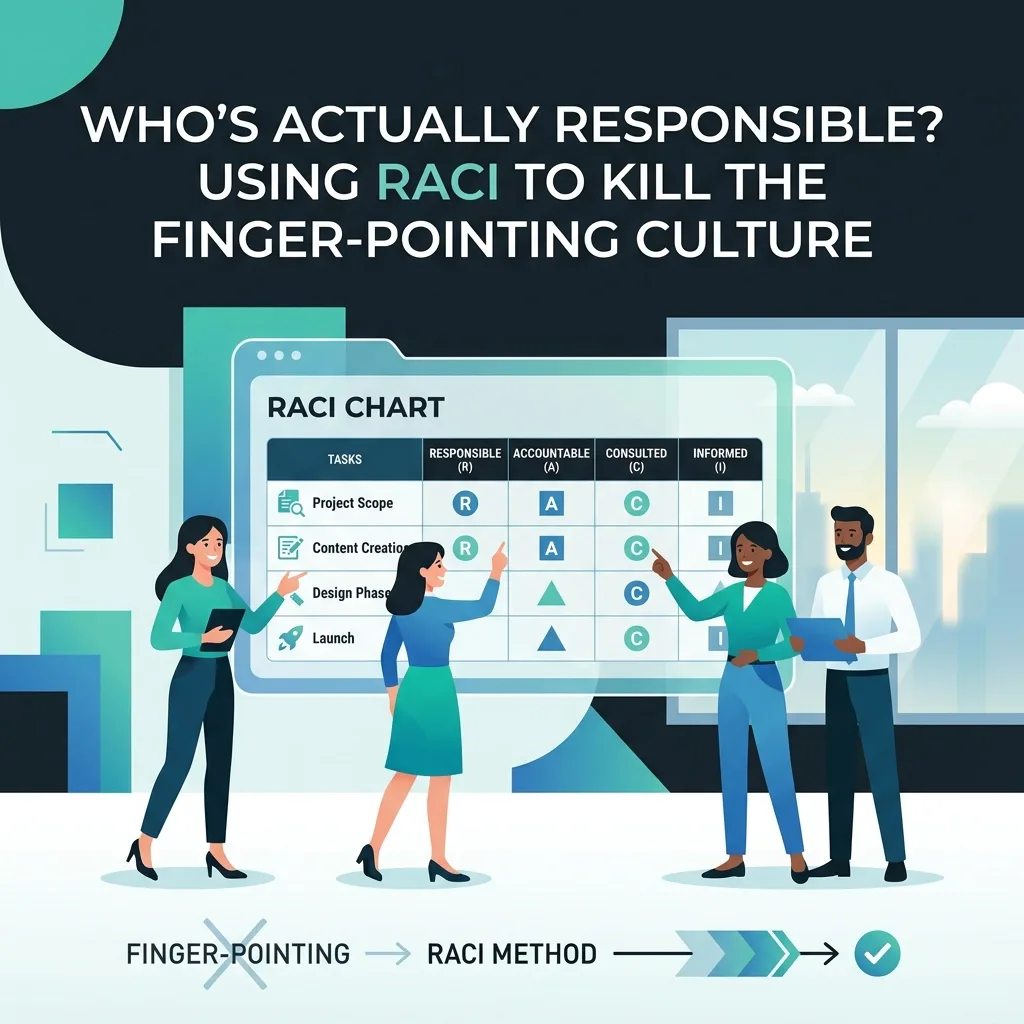
In the realm of high-stakes process improvement and organizational transformation, ambiguity is the silent killer of ROI. We have all witnessed the corporate "blame game": that toxic phenomenon where a project misses a deadline, a defect escapes to the customer, or a budget is blown, and suddenly, the room becomes a circle of pointed fingers. No one knows who was supposed to sign off, no one knows who was supposed to do the work, and everyone claims they were "never informed."
This operational paralysis is not just a cultural flaw; it is a systemic defect. To eliminate this waste, elite practitioners turn to the RACI Matrix. The fundamental purpose of the RACI framework is to establish a rigorous, indisputable map of authority and execution. If your organization suffers from a finger-pointing culture, it is because you have allowed roles to remain fluid and undefined. It is time to inject meritocratic clarity into your operations.
The Technical Anatomy of RACI
To fully appreciate the power of RACI, one must look past the acronym and understand the functional mechanics of each role. As defined in the Lean Six Sigma Concepts and Glossary, clear role definition is a cornerstone of the Define phase in DMAIC.
The RACI model categorizes every stakeholder into one of four distinct roles:
- Responsible (R): These are the "doers." They are the individuals tasked with executing the activity or creating the deliverable. While multiple people can be Responsible for a task, having too many often signals a lack of process efficiency.
- Accountable (A): This is the most critical role. The Accountable person is the "owner" of the task or deliverable. They must sign off on the work and are ultimately answerable for its success or failure. Crucial Rule: There must be exactly one person Accountable for any given task. If two people are accountable, no one is.
- Consulted (C): These are the subject matter experts (SMEs). Communication with them is two-way. They provide input, feedback, and specialized knowledge before a decision or action is finalized.
- Informed (I): These stakeholders are kept in the loop regarding progress or decisions. Communication is one-way. They do not have veto power or input rights; they are simply notified of the outcome to ensure alignment across the organization.

Why Ambiguity Breeds Failure
When a project operates without a RACI matrix, it defaults to a state of "unstructured collaboration." In this state, the "Accountable" person is often invisible until something goes wrong. Conversely, you may find "Consulted" parties attempting to act as "Accountable" parties, overstepping their bounds and creating bottlenecks.
Consider the Stakeholder Impact Assessment. Without a RACI, you cannot accurately assess the weight of each stakeholder's influence. This leads to "Scope Creep" and "Decision Fatigue." When roles are undefined, every minor process change requires a committee meeting. This is the antithesis of Lean.
By implementing RACI, you transform a project from a series of "hopeful interactions" into a disciplined execution engine. You transition from a culture of "I thought you were doing it" to one of "The RACI says I am Responsible, and you are Accountable."
Practical Application: Building the Matrix
Creating a RACI matrix is not a passive exercise; it is a tactical negotiation. It should occur early in the project, ideally during the development of the Project Charter.
Step 1: Identify the Deliverables
List every major activity, task, and milestone. Do not be vague. Instead of "Documentation," use "Creation of Standard Operating Procedures."
Step 2: Identify the Stakeholders
List the individuals or functional groups involved in the project. This ranges from the Lean Six Sigma Black Belt leading the charge to the frontline operators and the executive sponsors.
Step 3: Assign the Roles
Map the R, A, C, and I to each task. This is where the "high-attitude" leadership comes in. You must be ruthless in ensuring only one "A" per task. If a department head insists on being "Consulted" on every minor detail, challenge the necessity. Is their input critical to the quality (CTQ), or are they just creating a bottleneck?
Step 4: Validate and Socialize
The matrix is useless if it sits in a folder. It must be socialized and agreed upon. This is a key component of Tollgate Reviews. If a stakeholder cannot agree to their assigned role during the review, the project does not move forward.
Data-Heavy Case Study: The $250,000 Finger-Point
To ground these concepts in reality, let us examine a hypothetical case study from a mid-sized manufacturing firm. The project aimed to reduce defects in a high-volume assembly line: a classic LSS Black Belt Project.
The Problem: The project stalled for three weeks during the "Improve" phase. A critical process change required an update to the machine calibration settings.
- The Engineering lead thought Maintenance was "Responsible" for the update.
- Maintenance thought Engineering was "Accountable" for the sign-off.
- The Plant Manager was "Informed" but had no idea the update hadn't happened.
The Cost: This three-week delay resulted in 1,200 defective units, costing the company $216,000 in scrap and $34,000 in expedited shipping for replacement parts. Total loss: $250,000.
The RACI Solution:
Upon implementing a RACI matrix:
- Task: Machine Calibration Update.
- Responsible: Maintenance Lead (Execution).
- Accountable: Engineering Manager (Final Sign-off and Quality Verification).
- Consulted: Quality Assurance Lead.
- Informed: Plant Manager.
With these roles codified, the "I thought you were doing it" excuse evaporated. The Engineering Manager knew that if the machine wasn't calibrated, the failure sat squarely on their desk. The result? Future updates were completed in under 24 hours, and defect rates dropped by 85%.
Common Pitfalls: The "RACI Failures"
Even with a matrix in place, weak leadership can allow the finger-pointing culture to seep back in. Watch for these red flags:
- The "A" Vacancy: No one is assigned the Accountable role because the task is "too risky." This is a failure of leadership. Every task must have an owner.
- The "C" Overload: Assigning too many people to the "Consulted" role. This leads to "Analysis Paralysis." If you have 10 people to consult for a simple process change, your process is broken. Use a SIPOC Complexity Score to identify if your stakeholder map is too bloated.
- The "R" and "A" Confusion: Frequently, the person doing the work (R) thinks they are also the one who decides if it’s good enough (A). This creates a lack of oversight. The "A" should ideally be one level of authority above the "R" to ensure objective validation.

Integration with the DMAIC Framework
RACI is not a standalone tool; it is an integrated component of the Lean Six Sigma methodology. In the Measure phase, a RACI helps define who is responsible for data collection and who is accountable for data integrity. In the Control phase, it defines who owns the long-term monitoring of the process.
Without a RACI, your Lessons Learned Documentation will simply be a record of who failed, rather than a roadmap for who succeeded. Professionalism requires that we move away from blaming individuals and toward holding roles accountable.
Conclusion: Lead with Accountability
The finger-pointing culture exists only where ambiguity is tolerated. As a professional, your job is to eliminate that ambiguity with surgical precision. The RACI matrix is your primary instrument for this task. It creates a "No-Excuses" environment where performance is visible, and responsibility is absolute.
If you are tired of the corporate carousel of blame, it is time to elevate your skillset. Lean Six Sigma is not just about charts and data; it is about the disciplined management of human effort toward a common goal. Stop guessing who is in charge and start defining it.
Take the first step toward professional mastery by pursuing your Green Belt or Black Belt Certification. Equip yourself with the tools to demand accountability and drive measurable success in any organization.