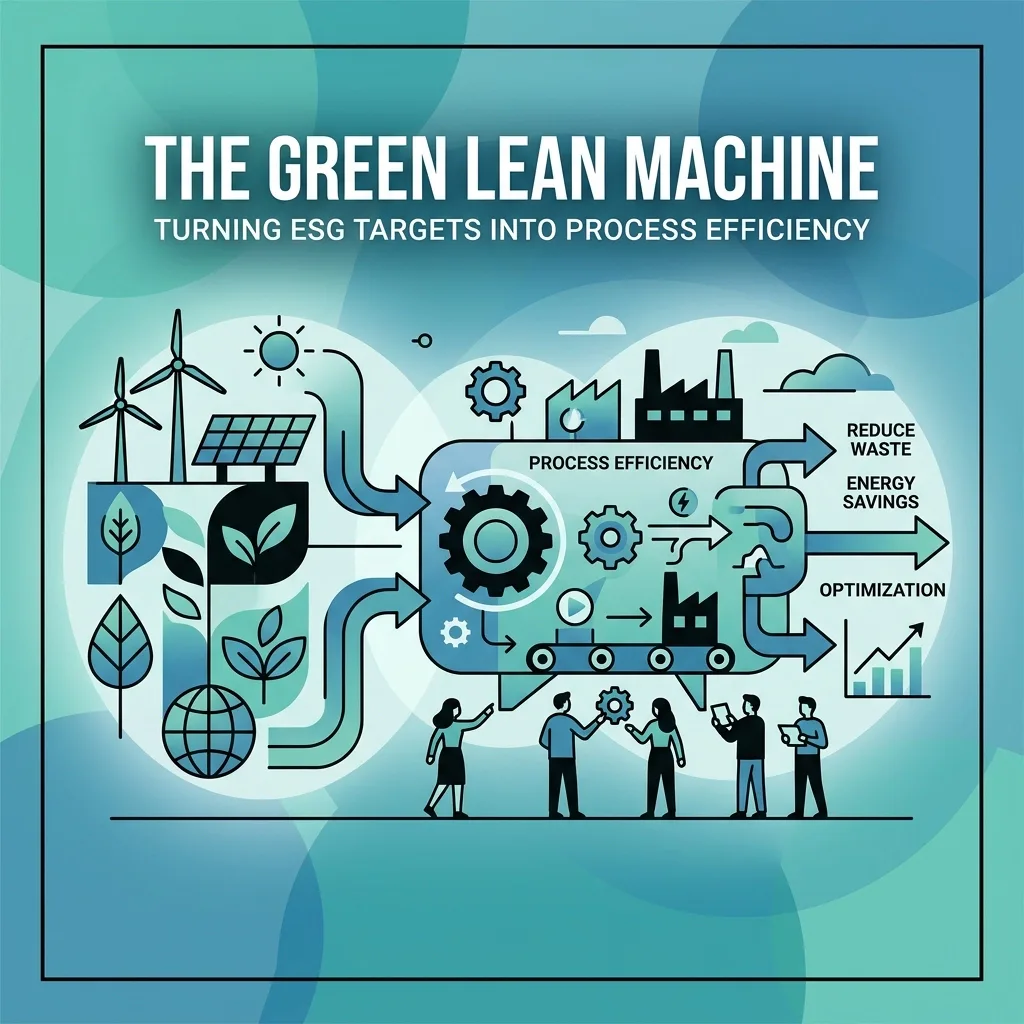
For decades, Environmental, Social, and Governance (ESG) targets were the domain of PR departments and annual reports: fluffy metrics designed to keep stakeholders happy without actually disrupting the status quo of production. But it’s 2026, and the game has changed. If you’re still treating sustainability as a "nice-to-have" or a compliance headache, you’re missing the biggest operational goldmine of the decade.
The truth is simple: Environmental waste is process waste.
Every ton of carbon emitted, every liter of water wasted, and every kilowatt of energy consumed unnecessarily is a direct hit to your bottom line. At Lean 6 Sigma Hub, we’re seeing a massive shift toward Green Lean Six Sigma (GLSS). This isn't just about "being green"; it’s about weaponizing the DMAIC framework to crush ESG targets while simultaneously driving massive ROI and process efficiency.
In the realm of operational excellence, being "green" is no longer a moral choice: it is a competitive requirement.
The ESG-DMAIC Integration: A Technical Deep Dive
To fully appreciate the power of the Green Lean Machine, one must understand how ESG metrics integrate into the traditional Six Sigma toolkit. We aren't reinventing the wheel; we’re just putting high-performance tires on it.
The fundamental purpose of GLSS is to identify "Environmental Critical to Quality" (eCTQ) characteristics. These are the sustainability metrics that matter most to your customers and your balance sheet. By applying the DMAIC (Define, Measure, Analyze, Improve, Control) methodology to these eCTQs, you can turn abstract carbon goals into concrete process improvements.
1. Define: Aligning Profit with Purpose
In the Define phase, the scope of a project must bridge the gap between corporate ESG goals and shop-floor reality. This is where you use tools like the project-selection-scoring-calculator to prioritize projects that offer the highest overlap between waste reduction and sustainability impact.
A "Green" project charter doesn't just aim for "better quality." It aims for "15% reduction in electricity per unit produced" or "zero hazardous waste by Q4."
2. Measure: The Sustainability Baseline
You can’t improve what you don’t measure. In GLSS, the Measure phase involves establishing a baseline for resource consumption. This goes beyond standard cycle times and defect rates. We are talking about:
- Carbon Footprint: Total emissions per production cycle.
- Energy Intensity: Kilowatts used per unit of output.
- Resource Yield: The percentage of raw materials that actually end up in the finished product versus the scrap bin.
3. Analyze: Identifying Ecological Root Causes
This is where the heavy lifting happens. When a process consumes too much energy or water, the cause is rarely "just the way it is." It is a process variation. To identify these drivers, experts use sophisticated statistical methods. For example, if you are comparing different shifts or machine settings to see which yields the lowest emissions, you might use the Dunnett test to compare multiple treatments against a control group of "peak efficiency."

Re-Imagining the Eight Wastes Through a Green Lens
The traditional "Eight Wastes" of Lean are the bread and butter of any practitioner. But when you view them through an environmental lens, the impact on your ROI becomes even more apparent.
- Overproduction: Creating more than the customer needs doesn't just tie up capital; it generates unnecessary carbon emissions for storage, cooling, and handling.
- Waiting: Machines idling between steps are "energy vampires." In a Green Lean environment, idle time is treated as a direct environmental violation.
- Transportation: Moving materials between facilities is pure waste. By optimizing logistics, you don't just save time: you slash your scope 1 and 2 emissions.
- Extra Processing: Are you using high-heat cycles or chemical washes that add no value to the customer? That’s not just a process flaw; it’s an environmental cost.
- Defects & Rework: Every defective part represents raw resources, energy, and labor that are now destined for a landfill. Quality is sustainability.
- Underutilization of Data: Failing to use data to optimize machine settings leads to "over-processing" with energy. Organizations that ignore their data are essentially throwing money and resources out the window.
The ROI of the Green Lean Machine
Let’s talk numbers. The skepticism surrounding ESG often stems from the belief that it costs more to be "green." The reality is the opposite. Organizations implementing GLSS projects are seeing:
- Energy Savings: $40,000 to $100,000 annually through simple process optimization.
- Waste Disposal Cost Reductions: Slashing hazardous waste by 20% can save tens of thousands in specialized disposal fees.
- Increased Productivity: Eliminating the "environmental waste" often leads to a 10-15% bump in overall equipment effectiveness (OEE).
One of our clients, a medium-sized manufacturer, integrated sustainability metrics into their lean-six-sigma-hypothetical-project and found that by reducing material scrap by 5%, they simultaneously hit their 2026 waste reduction target and added $120,000 to their bottom line in a single year.
Why CSSC Accreditation Matters
In a world where "greenwashing" is rampant, credibility is everything. You can't just claim to be an expert in process efficiency; you need the credentials to back it up.
All of our training at Lean 6 Sigma Hub is accredited by the Council for Six Sigma Certification (CSSC). This isn't just a badge on a certificate; it is a global gold standard that ensures your skills are recognized by top-tier employers worldwide. Whether you are pursuing a Green Belt or a Black Belt, having CSSC-accredited training means you possess the rigorous analytical skills required to solve the complex sustainability challenges of the modern era.

Sustaining the Gains: The Control Phase
The biggest trap in ESG initiatives is the "rebound effect": where efficiency gains are lost over time because the new process wasn't standardized. In the Green Lean Machine, the Control phase is critical.
Utilizing lessons-learned-documentation ensures that every sustainability win is captured and replicated across the organization. This isn't a one-off project; it is the foundation of what is operational excellence.
By establishing robust Control Plans that monitor energy and material usage in real-time, you turn "temporary savings" into "permanent profit."
The High-Attitude Conclusion: Lead or Be Left Behind
The era of choosing between "profit" and "planet" is over. In 2026, the most profitable companies are the most efficient ones, and the most efficient ones are the most sustainable. If your career isn't moving toward the intersection of Lean Six Sigma and ESG, you are operating on a 20th-century mindset in a 21st-century economy.
Stop guessing at your process improvements and start using the data-driven rigors of Six Sigma to crush your targets. Whether you want to start with a free-lean-six-sigma-white-belt-practice-exam or dive straight into high-level leadership with a Black Belt, the time to act is now.
The Green Lean Machine is leaving the station. You’re either on it, or you’re the waste it’s designed to eliminate.