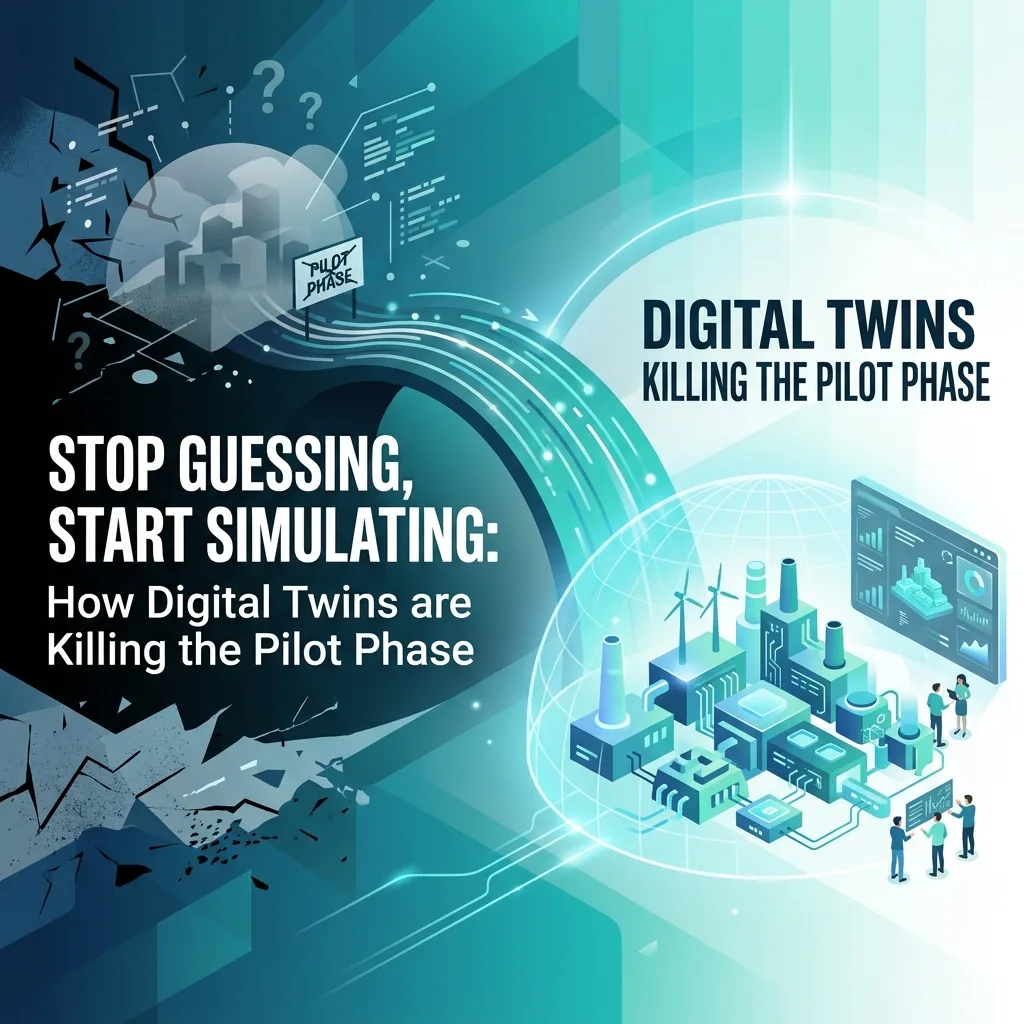
In the realm of professional process optimization, the traditional "pilot phase" has long been regarded as a necessary evil. It was the bridge between a theoretical solution and full-scale deployment: a period characterized by "trial and error," high capital expenditure, and an agonizingly slow feedback loop. However, as we navigate the industrial landscape of 2026, a fundamental shift is occurring. The fundamental purpose of the pilot phase is being subsumed by the Digital Twin.
For decades, Lean Six Sigma practitioners relied on physical pilots to validate their "Improve" phase. We built small-scale production lines, rearranged physical office layouts, or launched "beta" services to see if our DMAIC (Define, Measure, Analyze, Improve, Control) assumptions held water. But physical pilots are riddled with Muda (waste). They consume time, resources, and often fail to account for the complex variables of a global supply chain.
The era of "guessing and checking" is over. To fully appreciate the impact of this transition, we must examine how Digital Twins are not merely augmenting the pilot phase but effectively executing its execution.
The Technical Anatomy of a Digital Twin
A Digital Twin is not a mere 3D CAD drawing or a static flowchart. It is a dynamic, virtual replica of a physical asset, process, or system that is updated with real-time data. It utilizes sensors and IoT (Internet of Things) integration to mirror the exact state of its physical counterpart.
In a Lean Six Sigma context, a Digital Twin allows a Black Belt to run thousands of "What-If" scenarios in a matter of seconds. Instead of spending six months on a physical pilot that might yield a 5% efficiency gain, an engineer can simulate 10,000 iterations of a process to find the one configuration that yields a 22% improvement.

Why the Traditional Pilot Phase is a Bottleneck
To understand why the pilot is dying, one must look at the data regarding traditional development cycles. In industries like automotive manufacturing, a traditional sequential development process: from design to mechanical integration to physical testing: can take between 1.5 to 2 years. This lag is a catastrophic form of waste.
The primary failures of the physical pilot include:
- High Cost of Failure: If a physical pilot fails, the investment in materials, labor, and downtime is unrecoverable.
- Limited Scope: A pilot can usually only test one or two variables at a time.
- The "Island of Excellence" Trap: A pilot often works in a controlled environment but fails when integrated into the messy, high-variance reality of full-scale production.
By shifting these experiments to a virtual environment, organizations can utilize tools like the Project Charter ROI Calculator to predict financial outcomes with surgical precision before a single dollar is spent on physical equipment.
Virtual Commissioning: The New "Improve" Phase
The concept of "Virtual Commissioning" is perhaps the most aggressive killer of the traditional pilot. This involves testing the entire control logic of a production line against a Digital Twin before the physical machines are even bolted to the floor.
At Lean 6 Sigma Hub, we emphasize that the "Improve" phase of DMAIC should be data-driven, not intuition-based. By using Digital Twins, practitioners can identify bottlenecks, calculate the SIPOC Complexity Score, and optimize floor layouts virtually.
Consider a hypothetical project where a manufacturer intends to implement an automated sorting system. Traditionally, they would install a prototype, run it for three months, and collect data. With a Digital Twin, they can simulate the sorting system's interaction with the existing upstream and downstream processes. They can introduce "noise" into the system: simulating sensor failures or power surges: to see how the process recovers.
This level of stress testing is impossible in a physical pilot without risking expensive equipment. To truly understand the statistical validity of these simulations, advanced practitioners often utilize the Duncan Multiple Range Test to compare the means of different simulated scenarios and ensure that the "optimum" found in the virtual world is statistically significant.
Bridging the Gap: Real-World Simulations in Lean 6 Sigma Hub Courses
We don't just talk about the future at Lean 6 Sigma Hub; we train you to lead it. Our curriculum has evolved to move beyond the whiteboard. In our Lean Six Sigma Green Belt and Black Belt programs, students engage with a Lean Six Sigma hypothetical project that mirrors the complexity of modern simulation-driven environments.
By integrating Digital Twin logic into our training, we ensure that our graduates are not just "Project Managers" but "Process Architects." They learn to use a Stakeholder Impact Assessment Calculator to gauge the organizational ripple effects of a simulated change. This allows for a more holistic approach to change management, where the "Control" phase is designed simultaneously with the "Improve" phase.
Statistical Rigor in the Virtual World
One might argue that a simulation is only as good as its inputs. This is where the discipline of Six Sigma is more vital than ever. You cannot "simulate" your way out of bad data. The Measure phase remains the bedrock of success.
Before running a Digital Twin simulation, one must ensure the baseline data is accurate. This involves:
- Utilizing the Voice of Customer Priority Matrix to define the CTQs (Critical to Quality) that the simulation must prioritize.
- Conducting a Dunnett Test to compare multiple simulated "treatment" groups against a control group (the current state).
- Documenting every iteration in a Lessons Learned Documentation format to ensure the "Digital Memory" of the organization grows with every simulation.
The goal is to reach a level of "Statistical Confidence" that makes the physical pilot redundant. When your Digital Twin has accounted for 99.7% of the variance (the 6-Sigma standard), a pilot is no longer a validation step: it is merely the first day of full production.
The Financial Reality: Why CEOs Love Digital Twins
The move toward simulation isn't just about technical elegance; it's about the bottom line. Traditional pilots are capital intensive. They require "frozen" assets that aren't producing revenue. In contrast, Digital Twins allow for Parallel Development.
While the physical facility is being prepared, the software, logic, and process flow are being perfected in the cloud. This reduces "Time to Value" by up to 40%. For a Master Black Belt managing a portfolio of projects, this means the ability to scale improvements across multiple sites simultaneously rather than waiting for Site A to finish its pilot before moving to Site B.
For those looking to justify these high-tech implementations to stakeholders, our Project Selection Scoring Calculator provides a framework to prioritize Digital Twin initiatives based on their potential for massive ROI and risk mitigation.

Conclusion: Don't Get Left in the "Physical" Past
The message is clear: The companies that continue to rely solely on physical pilots will be out-paced, out-maneuvered, and out-earned by those who embrace simulation. Digital Twins provide a "sandbox" for innovation that is faster, cheaper, and infinitely more scalable.
If you are still using 20th-century methods to solve 21st-century problems, your career (and your company) is at risk of becoming a "bottleneck." It is time to upgrade your toolkit and master the art of data-driven simulation.
Stop guessing. Start simulating. Secure your future in the era of Digital Twins by enrolling in our advanced certification programs today.
Enrol in the Lean Six Sigma Black Belt Course
Master the Fundamentals with our Green Belt Certification