If you are still walking around with a clipboard, a stopwatch, and a basic Excel spreadsheet, I have some bad news for you: You aren’t a Lean Six Sigma professional anymore. You’re a museum exhibit.
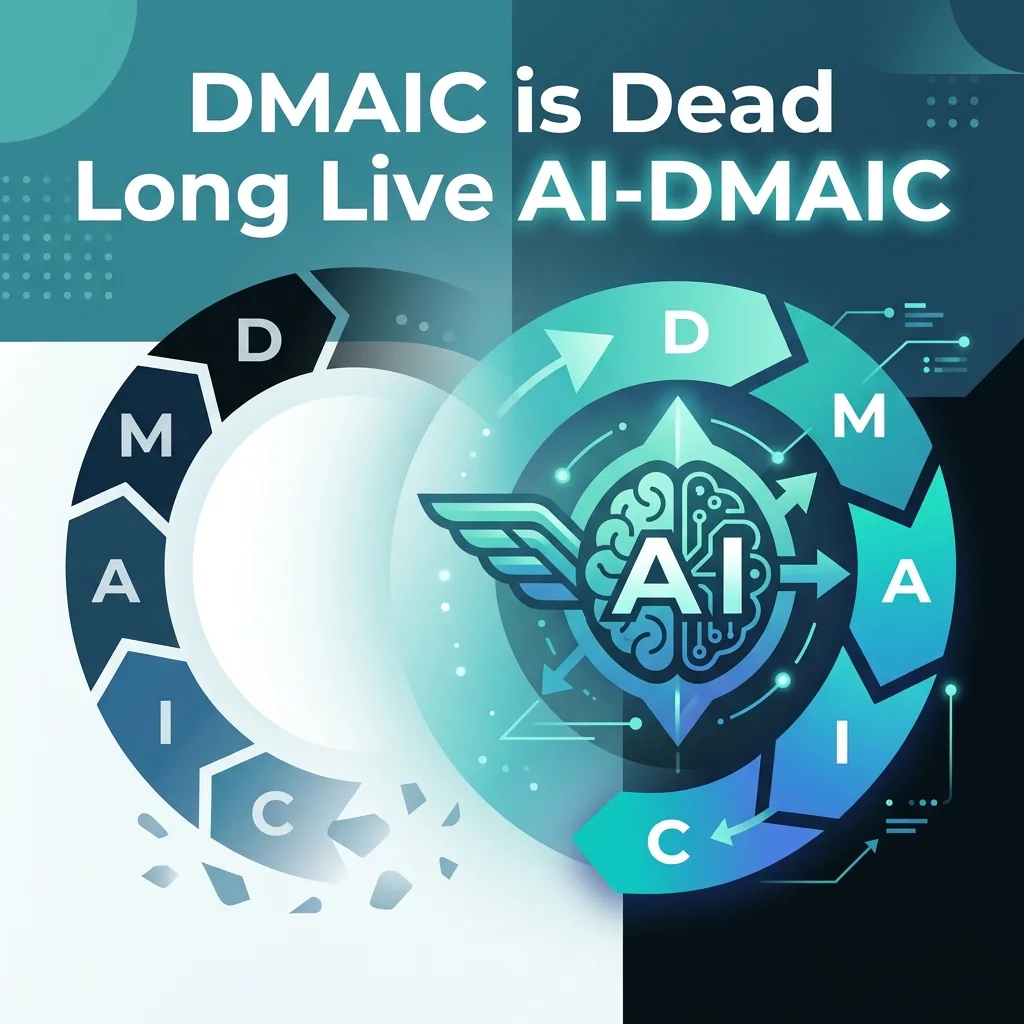
It is May 2026. The world has moved past the slow, manual, hypothesis-driven slog of traditional DMAIC. If your idea of "Analyze" is sitting in a conference room for three hours arguing about a Fishbone diagram based on "gut feel," you’ve already lost. The traditional DMAIC cycle: as we knew it for forty years: is officially dead.
But don't panic. Something much faster, meaner, and more profitable has taken its place: AI-DMAIC.
At Lean 6 Sigma Hub, we’ve seen the shift. The industry has pivoted from reactive problem-solving to predictive process orchestration. We aren't just looking for "root causes" anymore; we are training neural networks to anticipate defects before the raw materials even hit the factory floor.
Here is how AI (NLP, Machine Learning, and Predictive Analytics) has fundamentally rewired the DMAIC roadmap for the modern era.
Define: Beyond the Sticky Note
In the old days, the Define phase was a series of tedious interviews and Voice of the Customer (VOC) surveys that took weeks to compile. By the time you defined the problem, the market had already changed.
In 2026, we use Natural Language Processing (NLP) to scrape every customer touchpoint in real-time. We’re talking about thousands of support tickets, social media mentions, and live chat logs analyzed in seconds. AI doesn't just tell you that customers are unhappy; it identifies the specific linguistic patterns that correlate with churn.
Modern practitioners use tools like our Voice of Customer Priority Matrix Calculator to instantly rank these insights. The "Project Charter" is no longer a static Word document; it’s a dynamic dashboard. If you want to see what a high-level project looks like in this new era, check out our LSS Black Belt Sample Project to see the level of depth required today.
Measure: The End of Manual Data Entry
If your Green Belts are still manually counting defects, they are wasting company time. The Measure phase has been completely taken over by the Internet of Things (IoT) and computer vision.
We now have "Always-On" measurement. Sensors on the line feed data directly into Machine Learning models that establish a baseline in hours, not months. We’re looking at millions of data points, not a sample size of 30. When the scale of data gets this big, you need to understand the complexity you're dealing with. Use the SIPOC Complexity Score Calculator to figure out if your process is even measurable or if it’s a chaotic mess that needs a complete redesign.
 ](A futuristic control room where a digital twin of a manufacturing plant is displayed on holographic screens, showing real-time data flow and AI heatmaps.)
Analyze: From Hypothesis to Prediction
This is where the "Dead" part of DMAIC really hits home. Traditional Six Sigma is hypothesis-driven. You think "A" causes "B," so you run a t-test.
AI-DMAIC is data-driven. You feed the data into a Random Forest or Gradient Boosting model, and it tells you what the influencers are. It finds correlations that a human brain: even a Master Black Belt brain: could never see.
Are we still using the classics? Of course. Statistical rigor hasn't vanished; it’s just evolved. You might still need to know how to perform the Dunnett Test or the Duncan Multiple Range Test when comparing multiple groups against a control, but now these tests are triggered automatically by AI agents when they detect a shift in the process variance.
Improve: Enter the Digital Twin
In the old world, the Improve phase involved "pilots." You’d try a change on one line, pray it didn't break anything, and wait a month to see the results.
In 2026, we use Digital Twins. We build a virtual replica of the process and run 10,000 "Improvement" simulations in an afternoon. We use predictive analytics to see how a change in temperature in Step 2 will affect the tensile strength in Step 40.
This kills the risk. By the time you implement a solution in the physical world, you already know it’s going to work. You’ve already calculated the ROI using a Project Charter ROI Calculator, and the AI has verified the probability of success.
Control: Agentic AI and Autonomous Loops
The Control phase used to be the hardest part. You’d set up a Control Chart, train the staff, and walk away: only to find the process had reverted to its old, broken ways three months later.
AI-DMAIC has solved the "sustainability" problem. We now use Agentic AI: autonomous software agents that monitor the process 24/7. If a process parameter starts to drift, the AI doesn't just send an email alert; it automatically adjusts the machine settings to bring it back into control.
This isn't science fiction. This is the standard for any company currently dominating its market. They’ve moved from "Statistical Process Control" to "Autonomous Process Orchestration."
Why Your Certification Matters More Than Ever
You might think, "If AI is doing all the work, why do I need a certification?"
The answer is simple: AI is a tool, not a leader.
An AI can find a correlation, but it can’t navigate the office politics of a major digital transformation. It can’t convince a skeptical CEO to invest $2M in a new automation layer. It can’t perform a Stakeholder Impact Assessment with the nuance of a human leader.
The "New" DMAIC requires a new kind of leader. It requires a Black Belt who understands data science, or a Master Black Belt who can architect an entire AI-driven ecosystem.
The salary gap is widening. Those who understand AI-DMAIC are commanding salaries north of $200k, while those stuck in the "Old DMAIC" are seeing their roles automated away.
The Transition: How to Get There
If you're feeling behind, the best time to start was two years ago. The second best time is right now. You need to bridge the gap between traditional statistical rigor and modern computational power.
- Audit your current toolkit: Are you still using manual calculators? Move to the Free Six Sigma Calculator suite to speed up your baseline.
- Learn the New Language: You need to understand how AI integrates with Lean principles.
- Get Certified: Don't just get a "paper" certification. Get one that actually respects the 2026 tech landscape.
We offer several paths at Lean 6 Sigma Hub to get you up to speed:
- Not sure where you stand? Take our Free Lean Six Sigma Yellow Belt Practice Exam to test your foundational knowledge.
- Ready to lead? Our Green Belt Certification focuses on practical, data-driven application.
- Want to reach the top? The Black Belt Practice Exam will show you exactly what is required to lead multi-million dollar transformations in the AI age.
Stop Being a Dinosaur
The "Dead" version of DMAIC was about fixing what was broken. The "Living" AI-DMAIC is about creating processes that are incapable of breaking. It’s about speed, precision, and a level of efficiency that was literally impossible a decade ago.
The world doesn't need more people who can draw a Pareto chart by hand. It needs people who can lead AI-driven revolutions.
Stop clinging to the past. Upgrade your career, master the new toolkit, and lead the future of industry. Enroll in a Lean 6 Sigma Hub certification course today.