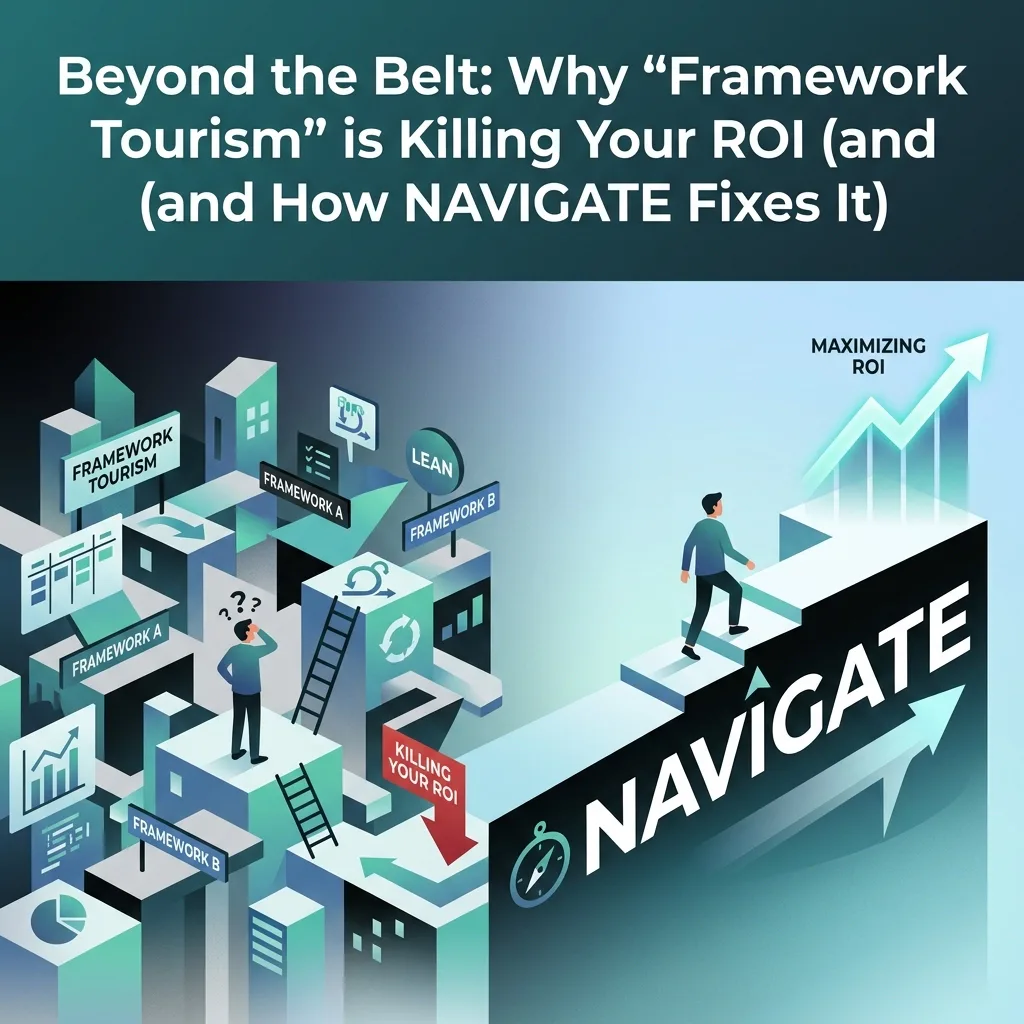
In the modern corporate landscape, leadership teams are frequently lured by the promise of the "next big thing." Whether it is the rapid-fire flexibility of Agile, the data-driven precision of Six Sigma, or the waste-reduction focus of Lean, organizations are investing millions in specialized training. However, a dangerous phenomenon has emerged that threatens to negate these investments: Framework Tourism.
Framework Tourism is the habitual practice of jumping from one methodology to another: treating professional frameworks like holiday destinations rather than permanent operational foundations. It is the pursuit of the "badge" or the "belt" without the requisite integration into the company's DNA. For many organizations, this lack of a unified execution strategy is not just a minor inefficiency; it is a significant drain on Return on Investment (ROI) and institutional morale.
To move beyond the belt and achieve sustainable transformation, leaders must adopt a governance-heavy approach. This is where the NAVIGATE framework becomes the essential "glue" for organizational excellence.
The High Cost of Methodological Disconnection
When an organization operates as a "Framework Tourist," it suffers from a lack of methodological continuity. One department might be sprinting in two-week Agile cycles, while the manufacturing floor is mired in a traditional DMAIC project that won't see results for six months. Without a bridge between these worlds, the results are predictable: friction, redundant data collection, and conflicting KPIs.
The fundamental purpose of any process improvement methodology is to drive value. Yet, according to industry benchmarks, nearly 70% of process improvement initiatives fail to meet their long-term objectives. This failure is rarely due to the tools themselves; it is due to the "Integration Gap."
Consider the financial impact. When teams are siloed by their specific "belts," they often overlook the broader strategic objectives of the firm. A Green Belt might successfully reduce defects in a specific sub-process, but if that sub-process is not a primary bottleneck for the customer, the ROI is effectively zero. You can read more about the ROI of a Green Belt to understand how these savings are often calculated: and where they go wrong when misaligned.
Identifying the Symptoms of Framework Tourism
To fully appreciate the need for a solution like NAVIGATE, leaders must first diagnose the state of their current operations. If your organization exhibits the following symptoms, you are likely stuck in a tourism cycle:
- Metric Chaos: Different departments report success using metrics that do not correlate. While one team celebrates "Velocity," the other is measuring "Sigma Levels," and neither can tell you how these metrics impact the quarterly P&L.
- The "Check-the-Box" Mentality: Employees pursue certification as a career milestone rather than a tool for organizational change. The focus is on the certificate, not the application.
- Methodological Tribalism: Agile teams refuse to talk to Six Sigma teams, viewing their philosophies as diametrically opposed. This "us vs. them" mentality prevents the LSS vs. Agile synergy required for 2026 competitive advantages.
- Zero Sustainment: Improvements are made during a "blitz" or a project cycle but vanish the moment the consultant or the Black Belt leaves the room.

How the NAVIGATE Framework Provides the Map
The NAVIGATE framework was designed specifically to end the era of Framework Tourism. It is not another "belt" to be earned; it is a meta-framework: a governance layer that orchestrates existing methodologies (Lean, Six Sigma, Agile, etc.) into a single, cohesive transformation engine.
NAVIGATE stands for:
- Need: Aligning every project with strategic business goals.
- Assess: Using data to identify actual bottlenecks and chokepoints.
- Validate: Ensuring the proposed solution actually addresses the root cause.
- Integrate: Merging the project into the existing workflow without disrupting daily operations.
- Govern: Establishing the rules of engagement and ownership.
- Accelerate: Using Lean and Agile techniques to speed up the delivery of value.
- Transfer: Handing over the improved process to the right process owners.
- Evaluate: Conducting a rigorous benefits realization tracking phase.
By utilizing NAVIGATE, leaders move from being tourists to being architects. They no longer ask, "Which tool should we use?" Instead, they ask, "How does this tool serve the NAVIGATE roadmap?"
The Role of Strategic Governance in Scaling ROI
For a transformation to yield high ROI, it must be scalable. Framework Tourism fails because it relies on individual heroics rather than institutional systems. NAVIGATE fixes this by introducing rigorous governance at the "Integrate" and "Govern" phases.
A critical component of this governance is the use of high-level analytical tools during the project selection phase. For instance, using a Project Selection Scoring Calculator allows leaders to rank potential initiatives based on their strategic alignment and expected financial impact, rather than which department shouts the loudest.
Furthermore, integrating advanced Stakeholder Analysis ensures that the human element of change management is addressed long before the technical implementation begins. This prevents the "rejection" of new processes by the workforce: a common pitfall of disconnected frameworks.
Case Study: From Disjointed Tools to NAVIGATE Orchestration
Imagine a global logistics firm that had invested heavily in Lean training for its warehouse staff and Agile for its IT department. Despite these investments, shipping delays were increasing. The IT department was releasing software updates that the warehouse staff found unusable, and the warehouse’s "lean" improvements were creating data silos that the IT systems couldn't track.
By implementing the NAVIGATE framework, the organization forced an integration phase. They realized that the "Need" was not faster software or cleaner warehouses, but a reduced "Order-to-Delivery" cycle time.
- They used a SIPOC Complexity Score Calculator to map the entire cross-functional value stream.
- They identified that the bottleneck was actually in the hand-off between IT data entry and physical picking.
- By applying NAVIGATE’s "Transfer" protocols, they ensured that process ownership was clearly defined, preventing the "regression to the mean" that usually follows a project.
The result? A 22% reduction in cycle time and an estimated ROI of $1.4 million in the first year: results that were unattainable when the teams were operating as independent tourists.

Leading the Change: The Master Black Belt Perspective
To truly stop the bleeding of ROI caused by Framework Tourism, organizations need leadership that understands the "big picture" of integration. This is the domain of the Master Black Belt (MBB).
While a Black Belt is an expert in project execution, a Master Black Belt is an expert in deployment strategy. They are the ones who design the NAVIGATE roadmap for the entire enterprise. They ensure that every Green and Black Belt project is contributing to a unified goal. They are the architects who move the organization away from the "flavor of the month" and toward a disciplined, multi-methodology system of excellence.
If your leadership team is frustrated by the lack of tangible results from your continuous improvement efforts, it is likely because you are managing tools, not a framework. You are sightseeing, not navigating.
Conclusion: Stop Sightseeing, Start Navigating
The era of disparate, disconnected process improvement is over. In a global economy where margins are shrinking and the pace of change is accelerating, you cannot afford the luxury of "Framework Tourism."
The NAVIGATE framework provides the governance and integration required to turn individual projects into a cohesive engine for growth. It demands that you look beyond the belt and focus on the systemic integration of value.
It is time to elevate your operational strategy. Secure your organization’s future by mastering the art of integrated deployment. Take the first step toward professional mastery by enrolling in our Master Black Belt Certification program today.