
In the realm of operational excellence, the pursuit of professional certification is no longer merely an elective enhancement to one’s curriculum vitae; it has become a fundamental requirement for leadership in a data-driven economy. As we navigate through 2026, the landscape of Lean Six Sigma (LSS) has evolved, integrating advanced analytics and artificial intelligence into the traditional DMAIC (Define, Measure, Analyze, Improve, Control) framework. To fully appreciate the nuances of choosing the correct certification, one must understand the distinct methodologies, accreditation bodies, and the long-term return on investment (ROI) associated with each path.
Choosing the "best" certification is a subjective endeavor that depends heavily on an individual’s career trajectory, current experience level, and the specific requirements of their organization. This guide provides a technical and objective comparison of the leading certification bodies to assist you in making an informed professional decision.
The Accreditation Landscape: ASQ vs. IASSC vs. CSSC
The global standard for Lean Six Sigma is maintained by three primary entities. While the core mathematical principles remain consistent across all three, their pedagogical approaches and certification requirements differ significantly.
1. The American Society for Quality (ASQ)
ASQ is often regarded as the traditionalist choice within the industry. Their certification process is rigorous and places a high premium on practical application. To achieve an ASQ Black Belt, for instance, candidates must not only pass a comprehensive examination but also provide evidence of two completed projects with signed affidavits, or one project and three years of relevant work experience.
- Primary Benefit: High prestige and industry recognition for project-verified expertise.
- Drawback: Longer completion timelines and higher administrative costs.
2. The International Association for Six Sigma Certification (IASSC)
The IASSC focuses exclusively on the "knowledge" aspect of Lean Six Sigma. They provide closed-book, proctored exams that test a candidate’s mastery of the Lean Six Sigma Body of Knowledge. Unlike ASQ, they do not require project evidence for certification.
- Primary Benefit: Speed of certification and a standardized, exam-based validation.
- Drawback: Lack of project verification may require candidates to prove their practical skills through other means.
3. The Council for Six Sigma Certification (CSSC)
The CSSC is a prominent accreditation body that offers a flexible approach, catering to both self-paced learners and those seeking intensive training. Organizations like Lean 6 Sigma Hub utilize CSSC accreditation to ensure that their training materials meet the highest global standards while remaining accessible. One of the primary advantages of the CSSC pathway is the permanence of the credential; unlike other bodies, CSSC certifications typically do not require expensive renewal fees.
- Primary Benefit: Cost-effectiveness, open-book examination options that reflect real-world resource usage, and no expiration of credentials.
- Drawback: Professionals must be self-disciplined in maintaining their skill sets as no re-certification is mandated.
Analyzing the Belt Hierarchy: Which Level is Appropriate?
The Lean Six Sigma methodology is structured into "Belts," mirroring the progression of expertise in martial arts. Each level carries specific responsibilities and technical expectations.
White and Yellow Belts: The Foundational Layer
The White Belt serves as an introductory overview of Lean principles. It is ideal for staff members who need to understand the basic terminology of process improvement without becoming practitioners. Our Lean Six Sigma White Belt online training can be completed in a single weekend and provides a baseline for organizational alignment.
The Yellow Belt is designed for those who will participate as project team members. At this level, the focus shifts toward understanding the SIPOC complexity and basic data collection. Professionals at this level can expect a salary range between $65,000 and $95,000 annually, depending on their industry.
Green Belt: The Core Practitioner
The Green Belt is arguably the most versatile certification in the 2026 market. Green Belts lead smaller-scale improvement projects while spending approximately 25-50% of their time on functional process improvements. They must be proficient in statistical analysis and the use of tools like the Critical to Quality (CTQ) Tree.
Black Belt and Master Black Belt: The Strategic Leaders
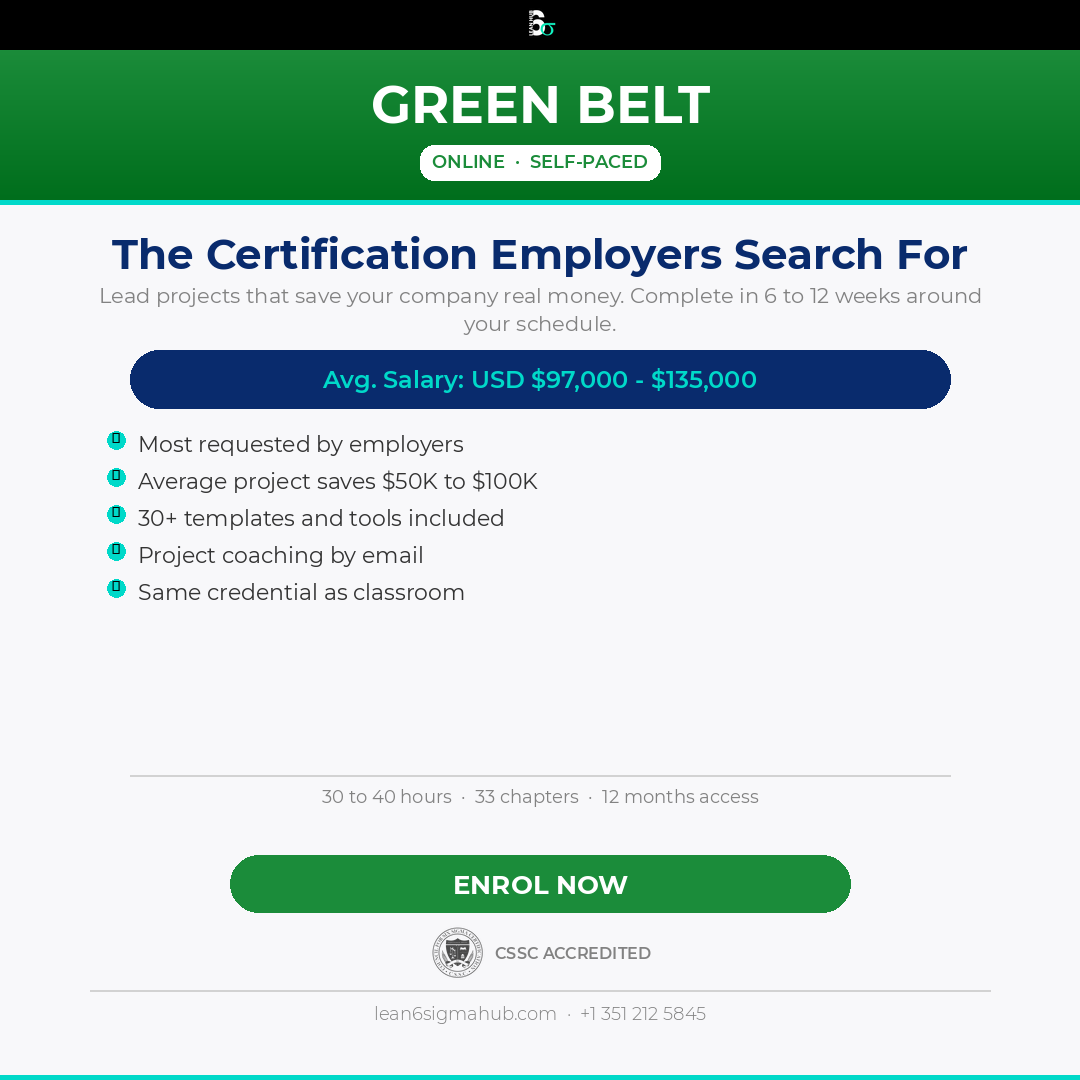
The Black Belt is a full-time change agent. These individuals possess a deep understanding of advanced statistical tools and are capable of leading complex, cross-functional projects that yield significant financial returns: often exceeding $175,000 to $250,000 in annual savings per project.
The Master Black Belt (MBB) represents the pinnacle of the profession. MBBs do not just manage projects; they manage the entire LSS deployment for an enterprise. They act as mentors to Black and Green Belts and bridge the gap between technical process improvement and executive strategy.

Caption: A technical comparison of the statistical depth and leadership requirements across the five Lean Six Sigma belt levels.
The Role of Technology and AI in 2026 Certifications
As we progress through 2026, the methodology has embraced the digital transformation. When choosing a certification provider, it is imperative to ensure their curriculum addresses the intersection of AI and human analysis. Modern practitioners must be adept at using automated dashboards and predictive modeling.
For example, understanding left-skewed histograms is no longer enough; a 2026 Black Belt must know how to feed that data into a machine-learning algorithm to predict process drift before it occurs. If a certification body is still teaching the 2010 version of the methodology without acknowledging these advancements, the credential's value is significantly diminished.
Financial Considerations and ROI
The investment in a Lean Six Sigma certification should be analyzed with the same rigor as any corporate project. To accurately determine the value, one must consider the initial training cost, exam fees, and the potential salary increase.
| Belt Level | Average Training Cost | Estimated Annual Salary (2026) | Potential Career ROI |
|---|---|---|---|
| Yellow Belt | $300 – $600 | $70,000 – $95,000 | Moderate |
| Green Belt | $1,200 – $2,500 | $97,000 – $135,000 | High |
| Black Belt | $3,500 – $5,000 | $120,000 – $168,000 | Very High |
| Master Black Belt | $8,000 – $12,000 | $200,000+ | Exceptional |
To calculate the specific impact a certification could have on your current organizational role, we recommend utilizing a project charter ROI calculator. This allows you to quantify the fiscal benefits of your newfound skills to your employer, potentially securing corporate sponsorship for your training.
Practical Decision Factors: A Step-by-Step Guide
To select the optimal certification path, follow this protocol:
- Consult Your Organization: Verify if your HR department or leadership team has a preference. Some Fortune 500 companies only recognize ASQ, while many modern tech firms prefer the agility of CSSC-accredited programs.
- Evaluate Your Experience: If you lack project experience, start with a Yellow Belt. If you are already leading teams, the Black Belt is your logical destination.
- Assess Your Timeline: Do you need a credential within 30 days to qualify for a promotion, or do you have 12 months to dedicate to a multi-phased project?
- Review the Curriculum: Ensure the provider includes practical tools such as error-proofing techniques and dashboard design.
Conclusion: The Path Forward
In the final analysis, the "best" certification is the one that aligns with your professional integrity and career objectives. Whether you prioritize the project-heavy requirements of ASQ or the modern, streamlined, and cost-effective approach of CSSC-accredited training through the Lean 6 Sigma Hub, the act of certifying is a powerful signal to the market.
The data is unequivocal: Lean Six Sigma remains the gold standard for process improvement in 2026. By mastering the DMAIC methodology, you position yourself as a vital asset in an era where efficiency and data accuracy are the primary drivers of competitive advantage.
Take the definitive step in your professional journey today by enrolling in our CSSC-accredited Lean Six Sigma certification programs.